
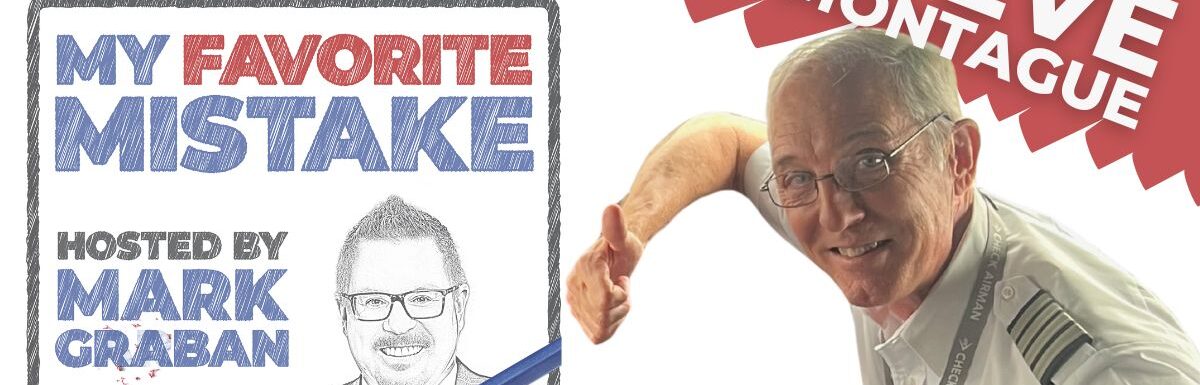
Steve Montague flew F-14s in the Navy and spent 37 years at American Airlines, the last four as a check airman. Early in his airline career, after a month of flying with a captain who shut him down every time he offered help, he watched the airplane descend toward 10,000 feet at 300 knots — 50 over the limit that applies below it — and deliberately said nothing. He calls it the least proud moment of his professional life.
Listen:
Check out all episodes on the My Favorite Mistake main page.
My guest for Episode #364 of the My Favorite Mistake podcast is Steve “Monty” Montague, a retired American Airlines captain who spent his final four years flying the 787 as a check airman. Before his 37 years at American, he flew F-14s as a Navy fighter pilot. He's a distinguished graduate of the Naval Academy, holds a master's in human factors and system safety from Lund University in Sweden, and has spent more than two decades bringing Lean and crew resource management into patient safety work at more than 100 hospitals, including Vanderbilt, Ohio State, and UCLA. He has taught speaking up in the cockpit for most of his career. His favorite mistake is the day he chose not to.
About two years into his airline career, Monty was paired with a captain who shut him down every time he offered anything. Asked whether he wanted to request a deviation around a thunderstorm 80 miles out, the captain told him that when he made a decision, he'd say so. Told that maintenance had been called for a burned-out light, which federal regulation required, the captain told him to ask permission next time. By their third three-day trip of the month, Monty was fed up. Descending into Albuquerque, he watched the airspeed sit at 300 knots below 10,000 feet, where the limit is 250. He saw it. He knew it. And he decided to let the captain be wrong.
The captain caught it himself, slowed the airplane, and chewed him out. Appropriately, Monty says. Nothing happened — at that altitude it's a speeding ticket, not a near miss. What bothered him then and still bothers him now wasn't the berating. It was that he had let his pettiness exceed his professionalism. He came away with two commitments: he would never do that again, and he would never create an environment where somebody wanted to withhold help from him.
We also get into how he briefed every crew once he moved to the left seat, why he told first officers that challenging him was an order rather than an act of courage, and what he said when one of them stopped the airplane on a taxiway because he thought Monty had misheard a clearance. We talk about the Aviation Safety Action Program and just culture, why letting people report mistakes without punishment isn't permissiveness, and the reasons people stay quiet beyond fear — futility, embarrassment, and simply not understanding what a reporting system is for. Monty also walks through the four-step assertion script he teaches in operating rooms, and why aviation moved to a first-name rule back in the 1980s.
What You'll Learn
- Why deliberate silence and fear-driven silence look identical from the outside, and why leaders should worry about both
- How a month of being shut down turned a capable professional into someone who wanted his captain to be wrong
- Why “fear or futility” is an incomplete list, and what embarrassment and role confusion add to it
- What a captain can say before every flight that turns challenging him into compliance rather than courage
- How the response to the first person who speaks up sets the price for everyone who considers it afterward
- Why allowing people to report mistakes without punishment is not permissiveness, and what it's actually for
- The four-step assertion script Monty teaches in hospitals, and why “I have a concern” is nearly impossible to argue with
- Why a flight attendant using his title instead of his first name was a signal he learned to stop everything for
Scroll down to find:
- Video version of the episode
- How to subscribe
- Quotes
- Full transcript
Find Steve on social media:
Watch the Episode:
Memorable Moments from the Conversation:
Click on an image for a larger view
!["[People] catch their own mistake maybe 65, 70% of the time. Something's going to trap that error and mitigate its impact."
steve montague](https://www.markgraban.com/wp-content/uploads/2026/08/Steve-Montague-My-Favorite-Mistake-Quotes-5.jpg)
Subscribe, Follow, Support, Rate, and Review!
Please follow, rate, and review via Apple Podcasts, Podchaser, or your favorite app—that helps others find this content, and you'll be sure to get future episodes as they are released.
Don't miss an episode! You can sign up to receive new episodes via email.
This podcast is part of the Lean Communicators network.

Other Ways to Subscribe or Follow — Apps & Email
Episode #364: Steve “Monty” Montague, Retired American Airlines Captain
Meet Captain Steve “Monty” Montague
Mark Graban: Sorry for the flight delay. Geez, oh Pete. All right. Maybe I'll leave that in. Welcome to My Favorite Mistake. I'm your host, Mark Graban. Our guest today is Captain Steve Montague, or Monty. He's a retired American Airlines 787 captain who spent his last four years there as what they call a check airman. I think we'll get into what that means a little bit in the show today. Before his 37 years at American, he flew F-14s as a Navy fighter pilot. He volunteered with what's called the Aviation Safety Action Program, which takes a just culture approach to the mistakes pilots make in line operations. Monty's also spent 17 years bringing Lean and crew resource management into patient safety work with more than 100 hospitals, including Vanderbilt, Ohio State, and UCLA, plus hospitals in Sweden, Brazil, Argentina, and Mexico. He is a distinguished graduate of the Naval Academy and holds a master's in human factors and system safety from Lund University in Sweden. And I'm happy to call you a friend. I've known you for a long time, and we've done podcasts together, but thank you for being here on My Favorite Mistake. Monty, how are you?
Steve Montague: I'm well, thanks. It's always a pleasure to be here. You will recall that you and I were in text or email contact for about a year before we got together and actually met each other at the Starbucks. We both lived about three miles from that Starbucks, and we couldn't get together. We do much better now.
Mark Graban: Yeah. And happy retirement. Is that a rocking chair that you're sitting in, or no?
Steve Montague: It is indeed. I thought it was appropriate. No more captain's chair for me. I'm in the rocking chair.
Mark Graban: Well, I'm glad we can tap into your experiences in all these realms, and I know there's a lot we're going to get into. We'll jump into the question we always start with. Monty, what's your favorite mistake?
The Mistake: Choosing Not to Speak Up
Steve Montague: Having listened to several episodes, I know I'm not alone. To call it my favorite mistake is perhaps not the right term, but it's one that I think does speak to one of a few situations in which people will not speak up. This is my least proud professional moment in my entire career.
So this was fairly early in my airline career. I had been flying airplanes for a long time. I felt very, very comfortable as a pilot. But I'd only been flying in the airline world for maybe two years, and we were just starting to bring in what we called subsequently crew resource management, one part of which was respectful assertion. So it was this inclusion aspect that you're all about.
And I was flying with this guy that, to say it nicely, he was a thoroughgoing misanthrope. He was mean. He was disrespectful. He denigrated everyone. He just put everybody down. Maintenance technicians, flight attendants, air traffic controllers, and of course me. His first officer.
A couple of anecdotes. We'd be flying and there would be a thunderstorm 80 miles out, and I would say, “Do you want to go right or left of this storm? So I can call air traffic control and get us a clearance.” And he would say, “When I make a decision, I'll tell you what I want to do.”
Another example. I'm out doing my pre-flight walk around of the aircraft. I see a bulb burned out, and he's not at the aircraft yet. I go upstairs, I call on the radio and get maintenance out there. Now mind you, that is an FAR, a federal aviation regulation. I have to do that. And so he gets to the airplane and I said, “Hey, just so you know, I called maintenance. We've got a light burned out on the left side.” And he says, “Monty, in the future, ask me if I want you to call maintenance.” So in other words, don't take any initiative, whatever. And you've written about this extensively in many of your books, so I know you know the feeling.
And again, I'm not proud of this, but we're on our third three-day trip of the month, and we're descending into Albuquerque, and everywhere in the US, almost everywhere in the US, when you are below 10,000 feet there's a speed limit of 250 knots. And so we're descending through 10,300, 10,200, and he's at 300 knots. And I see it, and I know it, and I'm going, in my head, “Okay, Captain Wonderful. You're the man. You know everything. You don't want any help.”
Mark Graban: Is that a matter of safety, or just the noise, or regulation? Sorry to interrupt. I'm curious why.
Steve Montague: So it is a regulation, and it is oriented to creating safety. Because as you are descending, the traffic gets closer. Up at altitude, the traffic is further apart. At this point it's a speeding ticket, because if you're at 9,800, it's not that different than 10,200.
And I'm just about to speak up, and he realizes it and slows down to 250. And of course, appropriately, he chewed me out. This was unprofessional of me. This was not my best day, Mark. I let my pettiness exceed my professionalism. After a full month of this, I was just fed up.
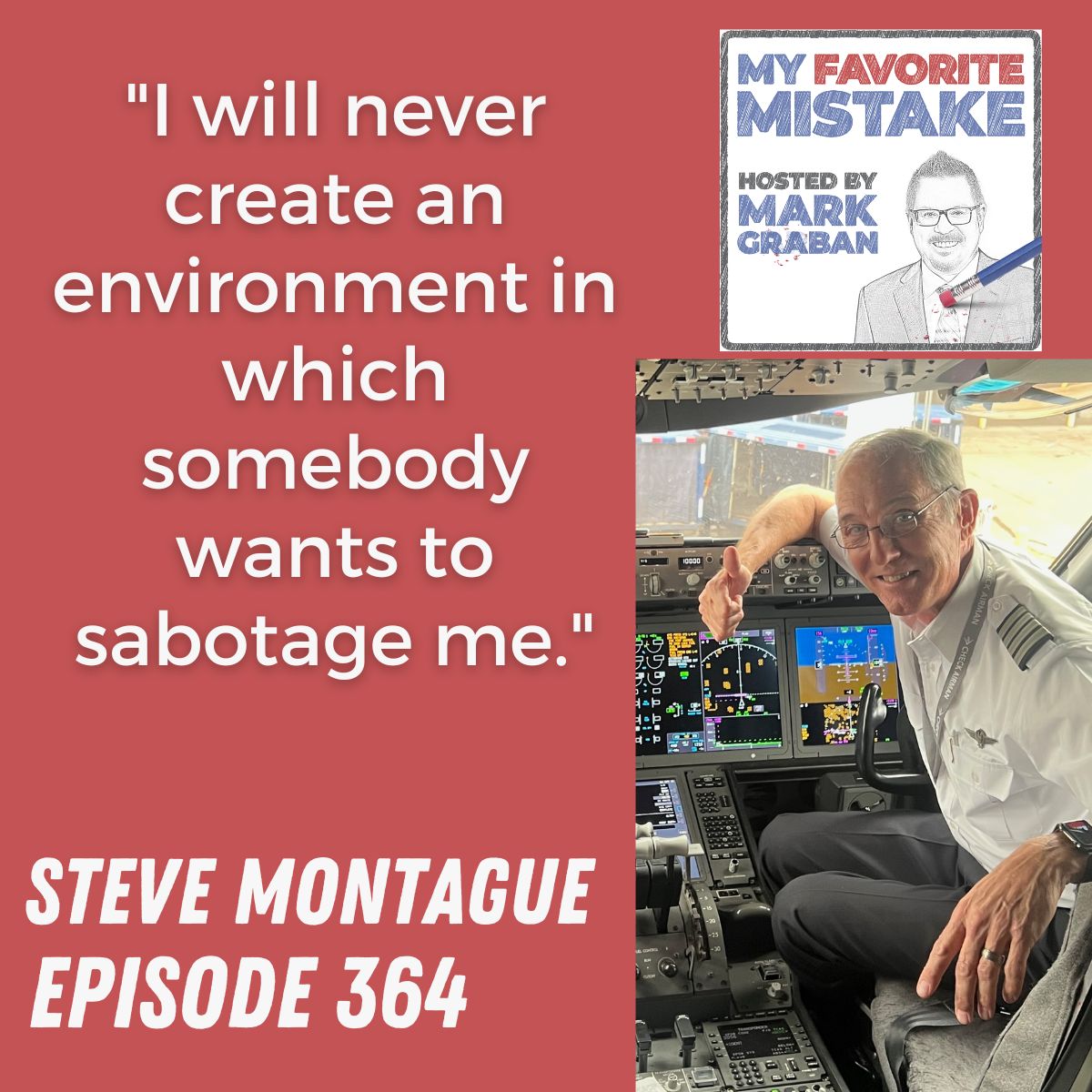
And one, I vowed I would never, ever do that again, because I felt awful. Not because he was berating me, I didn't care about him, but because I had let myself down as a professional. And then the other thing I took away from that is I will never create an environment in which somebody wants to sabotage me, somebody wants to undermine not just me, us, our work, what we're trying to achieve.
So it was not great. And it was intentionally not speaking up. And I've seen that. I've seen that when I've been doing observations both in the simulator with pilots or on the floor or the maternity suite or the operating theater, whatever. You can see intentional behaviors, but you understand it. It's human. And I think it goes to something you talk about a lot with respect to creating an atmosphere. It's the biggest blemish on my career. And it still bothers me to this day. There are lessons to be learned from it.
The Chilling Effect and Where Crew Resource Management Came From
Mark Graban: You just get a sense of the chilling effect of that sort of behavior that would lead to you censoring yourself. Let's step back and look more broadly at lessons commercial aviation has learned from fatalities that occurred because somebody knew there was a problem and didn't speak up. That's the ultimate bad outcome from that sort of cockpit environment, right?
Steve Montague: Yes. That is the data from which all of crew resource management emerged. “Hey, we've got a problem here. It's a cultural problem. It's not mechanical or anything else.” And I should say that we were not in the safety realm yet. We were very much in the tisk, naughty, you're at 9,800 and you're above the speed limit. And that happens. I guarantee it happened today. It does happen for a lot of reasons, and that goes into the ASAP world, the reporting and learning from it. Okay, why and how did that happen? And then corrective actions can take place. But still, it was just unprofessional.
The Black Line and the Blue Line
Mark Graban: What's the mindset when you think about these numbers, 10,000 feet, 250 knots? This is all pretty precisely measured. What's the balance between being reasonable versus there being a slippery slope around, well, hey, if we slack off about 10 feet or two knots, what else do we start excusing?
Steve Montague: At Lund, we talked about the black line, which is what's written, and the blue line, which is where we really operate, or it won't work. I will say that operationally, nobody in 37 years, I never saw anybody intentionally exceed that. It was always an error or somebody not speaking up. But no, that's a black line.
And I think we have a culture of the rules are the rules. And yet, you either over-prescribe or you under-prescribe when you're creating rules. You can't build a system that humans… that will actually work. Otherwise work-to-rule strikes would not work. It would not be effective.
Mark Graban: And for those who don't know, could you explain or give an example of that real quick?
Steve Montague: Of the work-to-rule strike? Yeah. So there is, and I haven't read the regulation recently, but during most of my career, there was a federal regulation that you should taxi no faster than a man can run. And so I don't know what that speed is, but let's say it's 10 miles per hour. I don't know the answer, but let's say it's 10 miles per hour.
Mark Graban: Is the regulation the fastest man, or an average typical?
Steve Montague: Exactly. What's he carrying? No, but nobody, no airliner does that. Typically, when you are on an active taxiway and you're going to the runway, you're probably going 15 to 20, which is school zone, right? But that's about where you're going to be.
And yet, if all of a sudden there's contract negotiations and we're upset, the union can say, “Hey, guys, be safe. Follow the rules.” And so now every airplane's out there taxiing at 10 miles per hour, and everything's slowed down and people get upset. It's the dynamics of how, I mean, you've worked in a union environment, so you understand how all that works. So anyway, that's an example of a rule that frankly should be eliminated.
When a Rule Is Unreasonable, People Break It
Steve Montague: And back to your original question, I think, of flybys, like in Top Gun, when they buzz the tower. When we were deployed at sea on the aircraft carrier, the ship would, for morale, say, “Okay, come on in and do a flyby.” And the rule was no lower than 500 feet. That's only 100 feet lower than what we'd come in every single day when we're coming in to land on the ship.
And so what do guys really do? “Well, I did mine at 300. I did mine at 200. Oh, he did it at 100,” whatever. And now you have a rule that is unreasonable and always disobeyed, always ignored, until either somebody ties a record and hits the water, or finally they fly low enough that the commanding officer says, “Okay, that's enough,” and now we hammer that guy for doing what everybody else did.
So, I mean, you and I, we sometimes could go down rabbit holes and such. But yes, that is a problem in having a rule that is unreasonable and won't allow the organization to complete its mission. And so people have to break the rules. So no, this one is not one of those. This one is one that is complied with. It is reasonable. It is workable. It is expected. I hope I didn't confuse any of that.
The Only Name He Ever Put on the Do-Not-Pair List
Mark Graban: No. So I want to step back, just a couple follow-up questions on your story there. After that trip, did you have an opportunity to say, “Hey, I'm not going to work with that guy again”? Or how much control did you have over your scheduling?
Steve Montague: That is a very insightful question. First officers can put, on their monthly, we call it a bid, but you're asking for your schedule, you can put in a note, “Do not pair with this individual.” And as you would expect, there are some folks who have 150 first officers who say, “I won't fly with that guy again.” And it's the only time in my career that I've put somebody on that list, and it was him.
And years later, I got rid of that name. I no longer put it in, because you had to redo it every month, and I said, “To heck with it.” And it turned out I ended up flying a trip with him. This was probably eight years later, seven years later. And I just vowed, “I am going to be the most professional, dedicated, helpful person I can be. I'm going to kill him with sunshine.” And the trip went very, very well. And he had changed. I don't know, there were some life things that had happened to him, but he had changed his demeanor too. Somehow he got religion.
Professional Standards: Letting Pilots Handle Pilots
Mark Graban: Then the other thing I was going to ask, other than putting someone on a list, I would be curious at what point does the airline look and say, “Well, some of these captains seem like outliers.” Everybody might be on somebody's list, because you just don't get along or whatever. But at what point does that draw attention? Or the question I was going to ask you is, was there a mechanism if somebody's behavior was so bad where you felt like, “This is unsafe for everybody on board”? Was there a way to report that to the airline or the union? Or was that trouble to do?
Steve Montague: Yes. You nailed all of it. We pioneered this program, but every major airline in the US has it, and I would say most of the European carriers have adopted this program. We call it professional standards. We have it for the pilots. We have it for the flight attendants. I assume we have it for the mechanics, I'm not sure.
But if somebody is getting a long list like this, yes, there are formal administrative ways of doing it, but the first approach is typically going to be to kick it over to the union professional standards folks, and for them to talk to the guy pilot to pilot and say, “Hey, dude, you're on everybody's list. Is everything okay? What's going on?”
And my friends, I never worked in that, my friends who did said a lot of the time there's something going on. A sick child, a divorce, whatever. And our VP of flight to this day, well, the current VP of flight, has said, “Look, when professional standards calls, my first question is going to be, what do you need?” Not what's the problem. What do you need? And lets the pilots handle the pilots to resolve the problem. And that may be what happened with this fellow, I don't know.
But yes, there are programs in place to pull somebody over. And of course there are still all the administrative, “Okay, we're going to have an Article 21 hearing, and this may be a career day kind of a day for you.” All that stuff is still in place. We prefer to handle it professionally.
Fear or Futility? Why People Don't File Reports
Mark Graban: Sure. And then it kind of begs the question, I don't know if you can answer it, maybe this is just rhetorical, but if somebody were to say, “Well, I want to file a report, but I'm not,” would that be more likely a fear factor or a futility factor involved? Like, it would be the right thing to do, but what's the point? Or, ugh, there might be backlash.
Steve Montague: So the answer is yes. There is fear. “I don't want to put myself on report.” And at this point, for us in our profession, that's kind of silly, because we have put into place these safety mechanisms that monitor the aircraft. Our flight operations quality assurance folks, every single flight is monitored, and they're using just the aircraft digital data to say, “Hey, you exceeded a flap speed,” or, “You were too high on this approach,” or those kinds of things.
So that's there. There is tremendous transparency, and of course that's built on trust. And that's an important part from the management side. “Okay, we want to fix it, so we're going to trust you guys, pilots, to watch this, monitor it, and have the coaching calls.” So that's kind of a silly reason for us not to report.
And in fact, we incentivize that. If you exceed 250 knots below 10,000 feet and you report it, there will be no action on your license or anything like that. No speeding ticket. It just goes away, because it is handled through the auspices of that program, and that's typically going to be a phone call, sometimes a face-to-face meeting, with a reenactment. It depends on the level of how did we get here, and how unique it is. Of course, recall the number one purpose is not getting people out of jail or anything like that. It's learning as an organization what's really happening out there.
Mark Graban: It's not permissiveness. Allowing someone to report without it being punitive is not permissiveness.
Steve Montague: No. It's learning. I sat on a board and we had to retire the pilot, because it was just, “No, you're out of bounds here.” I don't want to go down that road a lot. But it is not permissiveness. It is recognizing that the system is broken. Sometimes the part of that system that's broken is the individual pilot, and you can't, in my view, you can't separate the two. The pilot can't operate without the system and vice versa.
So let's fix what the problem is. Is it a training issue? Is it a perception issue? A physiological issue? Or attitudinal? Or is it, “Oh my gosh, this system is set up for failure”? And of course, how many folks have failed this and not reported it? So anyway, no, it is not permissiveness.
Futility. What's the point? Nobody does anything. There's a lot of stuff you can do to address that. And a lot of it is just getting the word back out to people. “Hey, this happened. Here's what we found out. Here's what we fixed.” And so people recognize that, “Oh, wait, this is how I fix the system.”
“ASAP? I Didn't Make a Mistake.”
Steve Montague: There's another one, and I'll have to think of an F word, because fear and futility is good, but my stepdaughter's a flight attendant. And there was an incident that happened on her flight with a passenger. A passenger pulled her hair or something like that, and I asked her, I said, “Did you file an ASAP report?” And she said, “ASAP? I didn't make a mistake.”
So it is a misunderstanding of what the whole point of the system is. They need to understand this happened, this happened, this happened, and the passenger pulled her hair. That's probably a remove-and-replace passenger solution, but still it's a misunderstanding of what the system is.
When it came out, as you were aware, there was the NASA system. When we started ASAP, there was the NASA system wherein you reported, and if you reported it, you were now in the system, and it was adjudicated differently. But when we came out with ASAP, when it was first rolled out, I think in '93, unfortunately, in the marketing to the pilot group it was, “Hey, you won't get a ticket. It's going to get you out of jail.” And so for some people still, they think that's the purpose of an ASAP report. “If you screw up, report it.”
I wrote ASAP reports on stuff that changed the way our charts were written, because I recognized, I'm going, “Hey, this is wrong. We're misleading our pilots.” Put in the report, boom. It's to fix the system. And anyway, so maybe also a fear of reporting a problem is, yes, fear of futility, but also that's not my responsibility. That's not my lane. Or, I didn't screw up. Why would I report it? I don't know. There's a lot of reasons why.
Embarrassment, Pride, and Seven Mistakes an Hour
Mark Graban: Yeah, but the name of that program, the acronym, Aviation Safety Action Program, the focus is on, it sounds like the boundaries would be anything safety related, not mistake related, or individual flaws. Because people do put a lot of shame on themselves when they make a mistake, even if they're not being punished externally. That pride factor might prevent somebody from wanting to report, even if they know they won't get punished. Embarrassment. I guess that's a type of fear, fear of embarrassment.
Steve Montague: Yes, without question. And so there is the embarrassment factor of not making mistakes. And I will say that's one thing culturally that is helpful for us as pilots, and I should have looked this up before we sat down to talk, but there was, I think NASA Ames did a study and reported that pilots make seven mistakes an hour.
Mark Graban: Oof. How's that possible?
Steve Montague: Well, I probably…
Mark Graban: Small mistakes, I hope, then, right?
Steve Montague: Probably doctors do, authors do, whatever, speakers do. And it's resilience. So either they catch their own mistake, which happens, I don't know, 65, 70% of the time, their colleague catches their mistake, another X percentage, or a controller does, or the technology does. And the Swiss cheese thing is kind of outdated, but it is something that's going to trap that error and mitigate its impact. And we're taught that early on, from your flight instructor's humility, “Hey, keep an eye on me,” to all of our reporting and all that stuff.
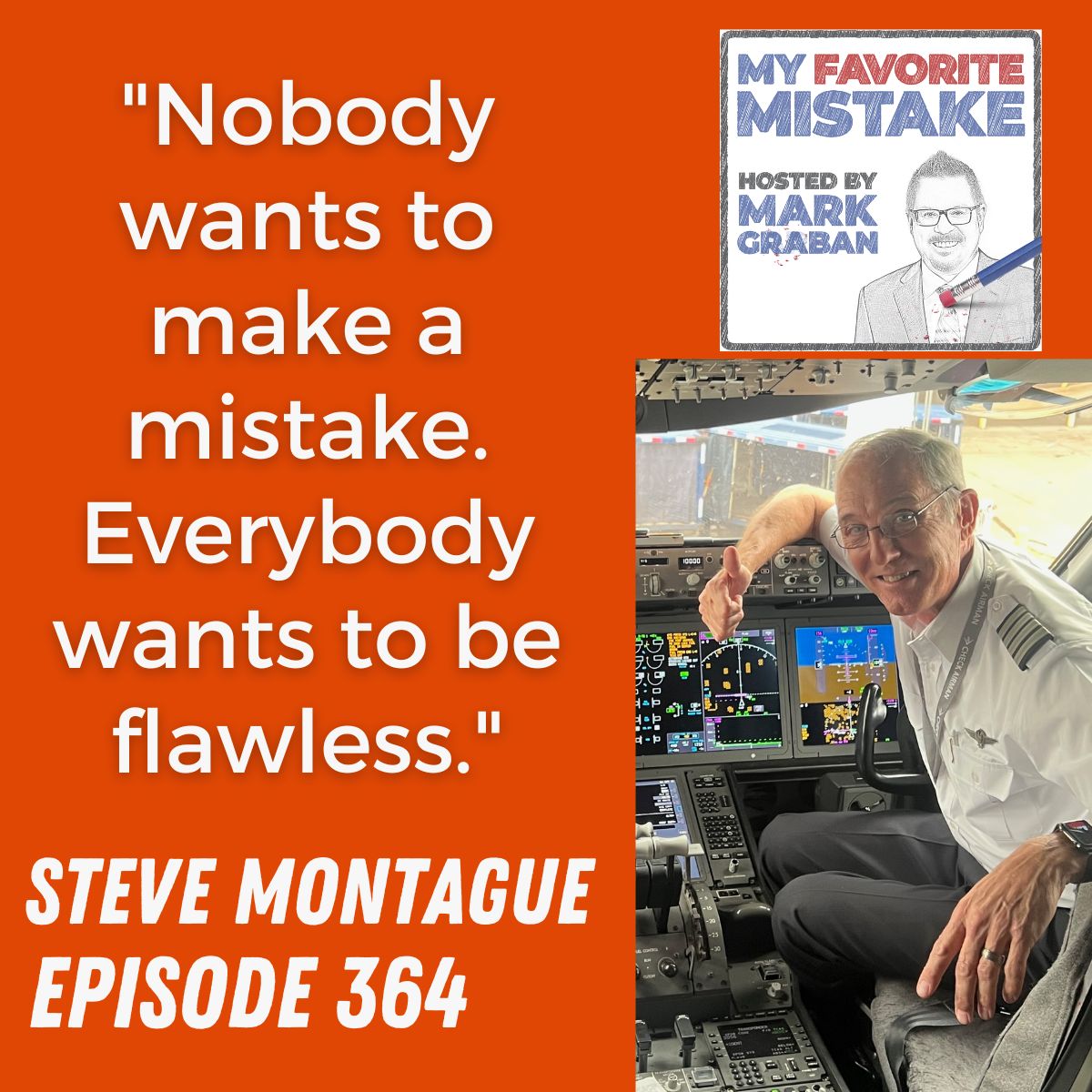
And so I'm not saying anybody boasts about when they screwed up. Nobody wants to make a mistake. Everybody wants to be flawless. I think that is certainly a… Either, “I don't want to admit I made a mistake,” or even let's say you're on a shop floor or something like that, and you think the supervisor has made a mistake, and you want to help them by calling it out, but then it turns out you're wrong, and now it's the embarrassment of, “Oh, you made a mistake in front of the crowd.” And so that is another barrier to speaking up about mistakes.
And I know that you read Amy Edmondson's work. She talks a lot about this. So anyway, lots of reasons why people may be reluctant to speak up about a mistake they've made.
Mark Graban: A previous guest on this podcast, I don't have the episode number handy, but Amy Edmondson from Harvard Business School. People can Google that or ask your AI.
Steve Montague: I would love to meet her or even talk to her.
Mark Graban: Yeah. Ask your AI friend or Google, or that's one and the same now.
What He Told Every Crew Before Every Flight
Mark Graban: So when you talk about the lessons you learned and how you, when you became a captain, wanted to create a different type of cockpit environment. Tell us, I know the answer to this, I know it's a great story, but tell the audience what you would tell the first officer before every flight.
Steve Montague: Do you mind if I go chronologically back before that?
Mark Graban: Go ahead.
Steve Montague: So I am not required to, but I make it a point, I did make it a point, figuring I'm not going to be captaining any more flights, but I would try to make eye-to-eye contact, shake hands with every member of my flight attendant crew. When they get aboard, they deploy up front and back of the airplane. And if I hadn't met them pre-flight, I would walk the back of the airplane, make eye contact. We know that if you've already spoken to somebody once and they know your eyes, they are more likely to speak up again. So that's one thing you can do to open the lines of communication.
And then, in my briefing to my flight attendants, I would say, “Listen, if at any time you see something that doesn't look safe or doesn't look right to you, I want you to bring it to my attention. Bring it to the purser's attention, who is the number one flight attendant, or bring it to my attention immediately.” So that was the larger crew.
But then, in the front of the airplane, in the cockpit, there is a culture that descended from the military. And it's just a different environment. We don't deal well with people, so that's why they put a cockpit door there. But you can be a lot more direct. And I will say, “Listen, guys, if you see anything that I'm doing or you see anything that doesn't look right or you think is a mistake, I expect you to speak up.” And so I actively task my fellow pilots. Thou shalt. And if enough of us say it to each other every day, every flight, it becomes the culture.
And we always say that the closer you sit to the instruments and the glare shield, the less you see. And the guy in the jump seat, your relief pilots on the international flights, are sitting two feet further behind you. They see everything. They miss nothing. And they're not tasked, they're not actually trying to fly the airplane, they're observing, and so they see everything and they always speak up. I always had that experience. I never had anybody fail.
Hinting and Hoping vs. Speaking Directly
Steve Montague: Now, what I will tell you, it's funny, Mark, and I'm sorry if I'm going off here.
Mark Graban: No, hey, this is why you're here. Go ahead.
Steve Montague: I did occasionally, every once in a while, have a first officer who was what I would call hinting and hoping. They would ask a question, in the scenario I gave before, “Did you want to go 300 knots below 10,000 feet?” A little passive aggressive, right? So they're sort of socially softening that, “Hey, knucklehead, you're going too fast.” And when it happened, I just started laughing. I was like, “Dude, thank you, and you don't have to do that here. Please just speak directly to me.”
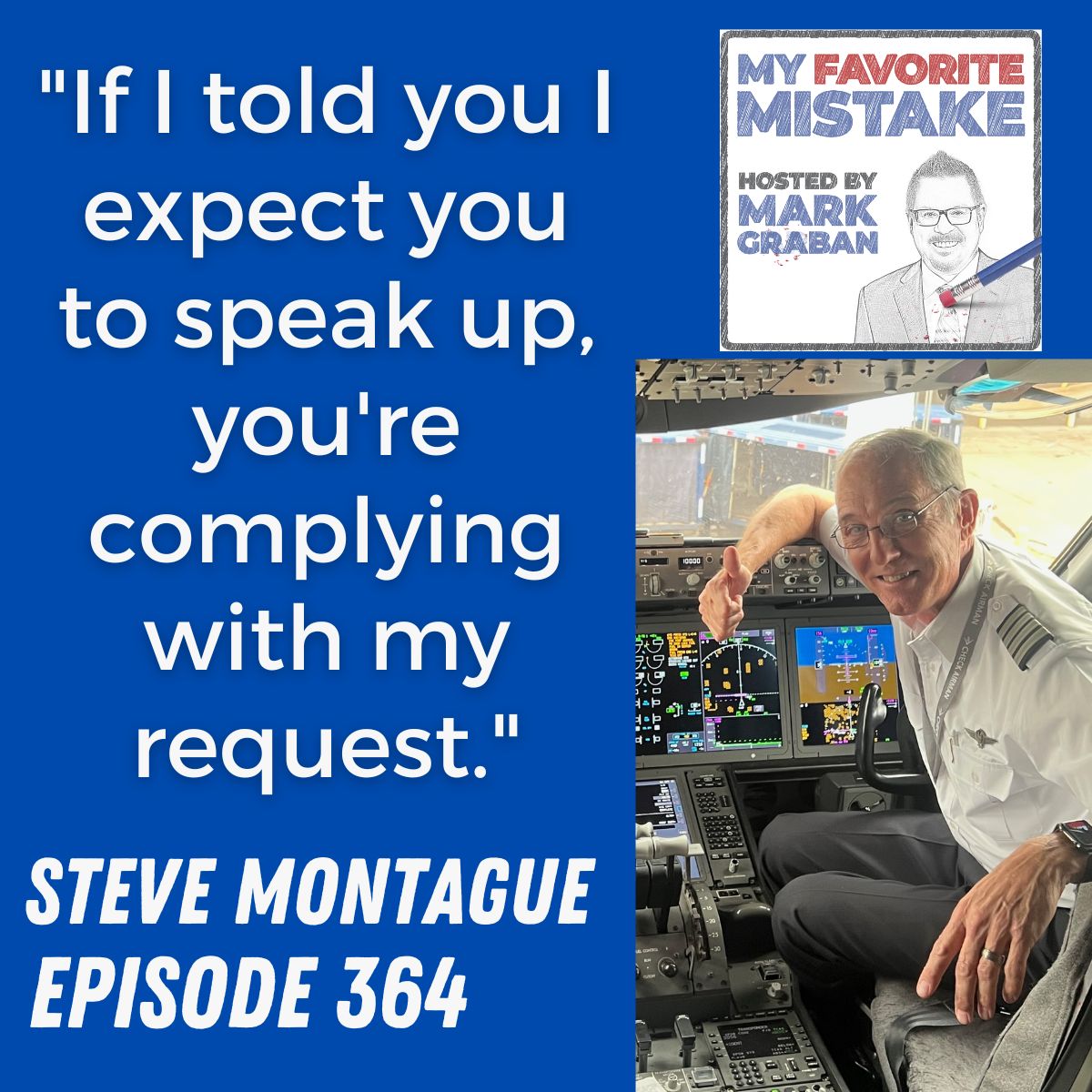
And sometimes it was retrospectively, that we would be at the gate or walking through the terminal to our next flight and I would say, “Hey, when you said this, is this what you were actually saying?” “Yeah, I just didn't want to be quite that direct.” And I'd be like, “Dude, I told you, I want you to speak up.” If anything, you were being more respectful of authority by doing exactly what I told you I wanted you to do. If I told you I expect you to speak up, you're complying with my request. My command.
Mark Graban: That's an order that you challenge. I order you to challenge me.
Steve Montague: Exactly. Exactly.
Mark Graban: And setting that expectation and the humility of saying, “I might make mistakes,” or, “I will make mistakes, I expect you to speak up,” followed by the thank you and the reinforcement is really what matters. That's when people learn, “Oh, he's not just saying what he thinks he should say, he means it.”
The First Officer Who Stopped the Airplane
Steve Montague: Another story, or are we out of time?
Mark Graban: No, this is a place for stories. Go.
Steve Montague: So when you move from the right seat to the left seat, the biggest difference is that only the captain in the left seat drives the airplane on the ground. And it's really, really challenging. It's not like you're going from Austin and driving in Austin, and now you're driving in Dallas-Fort Worth. It's not like that. It's like you're driving in Austin, and now you're driving in Bangkok. And even Chicago was notorious. They had no standardization in their naming conventions or whatever, and you had to know. You're from the Detroit area. There was a terrible accident, Metro, because they got lost when they were taxiing in a fog.
Mark Graban: No, I don't know that one.
Steve Montague: It's critical. It's one of the most difficult things when you move from the right to the left. A, managing all the people and stuff, but B, driving the airplane around the airport. In the air, everything's the same, but on the airport, everything's different.
And so we were given taxi instructions, and we're going along, and my first officer thinks we should be turning left at this taxiway, and I am intending to turn left at the next taxiway, because that's what I understood the clearance to be. And he's going, “No, no, wait, wait, wait, wait. We need to turn here. We need to turn here.” So I stop the airplane, and we call the ground controller, “Hey, just confirm we're turning at the next one, not this one.” And they said, “Yeah, that's right.”
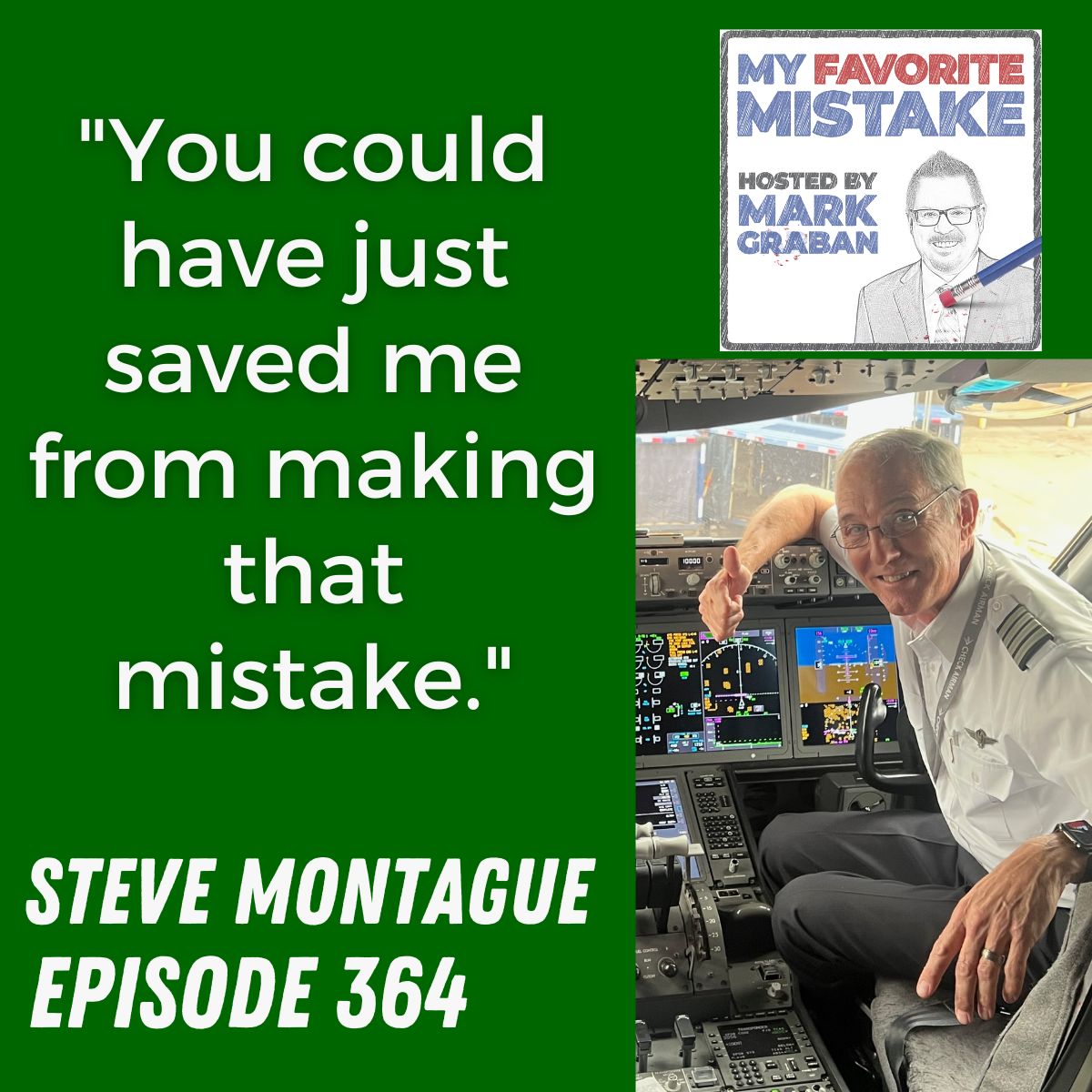
And now, of course, my first officer is just melting, going, “I'm so sorry. I'm so sorry. I'm so sorry.” I said, “No. No. You could have just saved me from making that mistake, and we're going the wrong direction.” And a lot of the taxiways are one-way streets. You can't just turn around. And so we very easily could have been nose to nose with another aircraft going, “Oh, this is not going to look good.”
And so he had the courage to say, “No, I think we're making a mistake.” So am I going to say, “Oh, you knucklehead, pay attention”? No. It's like, “Next time you see me make a mistake, say something.” So yeah, you're right. The response is everything.
Mark Graban: And it reduces the amount of courage required when speaking up is the norm and an expectation and it's rewarded. That reduces the fear factor.
Steve Montague: Yeah. I think you tell a story in one of your books about somebody clapped. Somebody said, “There's a problem with this,” and the whole room goes quiet, the boardroom goes quiet, and the CEO claps.
Mark Graban: It's a famous story about Ford and Alan Mulally, who came from Boeing.
Steve Montague: Okay, thank you. From Ford.
Mark Graban: So anyway, starting to at least acknowledge and celebrate somebody for reporting the real reality. It's not great that there's a problem, but if we don't know there's a problem, we can't work it.
Steve Montague: No problems is a problem.
Why Near Misses Make the News in Aviation
Mark Graban: So I want to ask about, unlike healthcare, near misses end up in the news. As the flying public, you hear about the runway incursion that was a near miss, or, what was the most recent one, where a firetruck was hit?
Steve Montague: Air Canada, LaGuardia. It was heartbreaking.
Mark Graban: Yeah. But you read, sometimes it's an air traffic controller. I think one of the ones I read earlier was they lost track of which plane they had given clearance to. Kind of a human mental lapse. There are different ways human error is, the system's not fully resilient against this human error.
So the question I was going to ask, you read about runway lighting, and this might sound like a dumb question, but when it comes to runways, why isn't there something more like a physical barrier that would prevent somebody from driving onto a train track? Is that just too much physical infrastructure? Is there still too much reliance on, “Hey, you need to do your job properly,” to everyone involved?
Steve Montague: No. Well, my first answer to that is the physical barrier part. I guess you could have something come out of the ground, but of course we have wings, so anything like a railroad crossing or something like that isn't going to work.
They have electronic systems. They're not everywhere yet, but they have electronic systems that don't even rely on the controller. The lights are automated. So here at Dallas Fort Worth, if I'm sitting on the runway waiting for a takeoff clearance and they have cleared aircraft or trucks or whatever downfield to cross the runway, they are sensed and I get a different light displayed, and it's all red, and crossing red is never good. The lights come on, and this is entirely without controller input. So they are using technology to improve. The physical barrier part, I think that would be probably very expensive. Yeah, I don't know. It's a good question.
Mark Graban: But technology, higher tech forms of mistake proofing. I think, what could we do? The firetruck, if I remember right, didn't have the electronic tracker.
Steve Montague: The transponder. Yeah. The ADS, I think.
Mark Graban: Yeah. Technology is just not rolled out consistently, even if there are known solutions, and that's frustrating as somebody who flies.
Steve Montague: Yes. Why not? Amen. And it's just like in healthcare, it's the costs versus the benefit. I don't know. We could go down 55 rabbit holes there.
First Names in the Operating Room
Mark Graban: So let's touch on a few things in healthcare. We could do a whole discussion just around lessons learned there, but the one thing that comes to mind when you talk about this eye contact and introductions, in an operating room, I interviewed a surgeon from Australia once who was a huge advocate not only for that, but for wearing a surgical cap with your name on it, because he said the evidence shows when you can address people by name, that goes a long way to creating a speak up culture. But he said healthcare people thought it's silly. “I'm not going to put my name on my hat.” It's just more of an emotional resistance to doing something that would be effective.
Steve Montague: I agree with the surgeon with whom you spoke.
Mark Graban: Or anesthesiologist. My mistake, but he's in the operating room.
Steve Montague: Oh, I'm sorry, anesthesiologist. But we went to the first name rule back in the '80s for that reason, because it lowers a barrier to speaking up. It's also far more efficient.
There are times in the operating theater, let's say there's the attending, which is the professor of surgery or professor of anesthesiology, and there are residents who are in training to become fully out there in the world. And I don't know, there's seven doctors in the room, and so if you say “Doctor,” that's the same as saying somebody call 911, which is the same as saying nobody call 911, right? Whereas if you say, “Seth, we need this,” it's much more efficient.
There's another piece there, though, because normally I'm going to call you Doctor, and if I'm now saying “Seth,” you're trying to burn through. Maybe you've already said something once and you didn't get my attention. So what I would, not all the time, but if I was having a conversation with somebody, if somebody says to me, “Captain,” because we're on the first name rule, so typically it would be Monty. “Hey, Monty, we don't have catering,” or, we're boarding people and I don't have all my flight attendants aboard, something like that. If they said, “Monty, this…” and I'm busy, I'm calculating fuel, whatever, and they don't burn through.
If they were to say, “Captain,” nobody calls me that. Well, not nobody, but none of my crew does. The gate agent might, the mechanic might, the fueler might, but my flight attendants are not going to use that term. So if they say, “Captain, here's the problem,” it's like, whoa, wait a minute. Something's going on here. She's signaling me. And I need to pay attention to this.
The Four-Step Assertion Script
Mark Graban: And I had the opportunity to see you and I think some other colleagues do some training for a group at a hospital about not just lecturing them that, “Hey, you should speak up.” I hear talk like that a lot that I think is unfair. “You should speak up. It's your professional obligation to speak up.” But look, if someone's going to get screamed at, I understand why they would learn to not speak up.
But what I remember being taught was so powerful is your four-step statement. “Dr. Montague, I have a concern. I've stated the concern. I recommend we do this.” That's respectful. It's direct. Calling someone by name, whether it's, “Hey, Seth,” or, “Hey, Dr. So-and-so,” it gets their attention. It's a statement of fact. I would hope if someone says, “I have a concern,” the answer is not, “No, you don't.”
Steve Montague: Exactly. And as you have experience, I can do 30 minutes on the power of that format.
Mark Graban: Oh, it's so simple, but so powerful.
Steve Montague: It is the most direct and effective, succinct way to burn through. It can also be a coaching script, by the way. If you're mentoring somebody, bringing them along, it works the same both ways.
But “Mark,” I have your attention. “I'm concerned.” Can you argue with that statement? “No, Monty, you're not concerned.” You can't argue with it, right? And it takes away any perception that I'm pointing the finger at you, you're making a mistake. So, “Mark, I'm concerned. I don't have the minimum number of flight attendants aboard, and yet I have two passengers on board. Let's stop boarding and get another flight attendant on board so that we're not any further in violation of this federal regulation.”
So state the problem, not you're screwing up. Very neutrally. Here's what the issue is. And then “we” or “let's” language for your solution, saying, “Boss, I'm still on your team. Let's do this.” And the boss, the supervisor, the attending, the captain doesn't have to accept your solution. So this is not a, “Well, I spoke up and the captain did what he wanted anyway.” Okay, that's fine, as long as you spoke up and we solve the problem. This is not mutiny training. The captain is still the captain.
Mark Graban: Right. And the other thing that stood out, here I'm going to use an example. I could say, “Monty, I'm concerned that we might be bumping up against your schedule. Should we stop the podcast?” You might say, “No, I can run a couple minutes long.” That alleviates the concern in a different way. Or you might say, “Oh, you're right. Thank you. It's been great to be…” There's different ways of alleviating the concern without saying, “Well, you were dumb for asking.”
Wrapping Up
Steve Montague: Mark, that's a great, thank you for bringing that up. Your way to solve it, I think, is a great one. We should probably wrap this up, and if there is sufficient meat there for another conversation, we can pick it up there.
Mark Graban: Let's do a follow-up episode at some point, because I think it would be its own… I won't put you on the hook for a second favorite mistake unless you have one to volunteer. But let's do another episode where we can talk more about what you've learned about mistakes in healthcare, preventing them, learning from them. Let's do that some other time.
Steve Montague: I would love to do that. It's an area that's rich with material, and as you know, you've worked a lot with hospitals. So anyway, I'd look forward to that. This is fun.
Mark Graban: Okay. This has been great. So we apologize for the late arrival. We had a bit of a late start because of a departure delay, because I had a couple false starts in kicking off the episode.
Steve Montague: It's all about the recovery.
Mark Graban: I should have left it in the recording, but it's so tempting to hit restart when it's only five seconds into the episode. Other than that, I tend not to edit out my mistakes.
Steve Montague: That's fair enough.
Mark Graban: All right. Monty, this has been fun. Again, retired Captain Steve Montague, thank you so much, and I'll look forward to, we'll do another conversation.
Steve Montague: Sounds good. Thanks, Mark.