
Fighter pilots fly missions where a moment of ego or self-protection can get people killed — so their debriefs are built to strip blame out entirely. Former Royal Australian Air Force pilot Christian “Boo” Boucousis explains the method that lets senior commanders admit error first, and why he now teaches leaders to aim for “flawless” instead of “perfect.”
Listen:
Check out all episodes on the My Favorite Mistake main page.
My guest for Episode #359 of the My Favorite Mistake podcast is Christian “Boo” Boucousis, a former Australian fighter pilot and CEO of Afterburner, a leadership firm that has spent three decades translating combat aviation discipline into frameworks for business leaders. Boo's favorite mistake is really a reframe of the whole concept — in fighter pilot culture, there is no word for “mistake,” only data to debrief, and that single distinction changes how honestly a team can talk about what went wrong.
Boo walks through the moment that shaped his thinking: his first mission as a commander ended in a visible, ten-second failure in front of three of the most senior leaders in the Air Force — and every one of them owned their own error first in the debrief that followed. That experience became the foundation for ORCA (Objective, Result, Cause, Action), the method he now teaches business leaders to replace blame with structured learning.
Boo is a former Royal Australian Air Force fighter pilot and the CEO of Afterburner, a leadership development company that has worked with more than 3,500 organizations, including two Super Bowl-winning NFL teams and companies such as Google, Microsoft, and Zurich. He is the author of The Afterburner Advantage and the upcoming Flawless Leadership, releasing this summer.
Themes and Questions:
- Why fighter pilot culture has no word for “mistake” — only outcomes to debrief
- The ORCA method (Objective, Result, Cause, Action) as a structured alternative to blame
- Why senior leaders admitting error first is what actually builds psychological safety
- The difference between “perfect” and “flawless” — and why perfectionism drives burnout
- How undiagnosed perfectionism shows up as a need for control
- Reprogramming adults who were conditioned by school to fear mistakes
- “To-do” lists versus “achieve” lists, and why the distinction changes behavior
- Speed versus velocity — why intentional slowing down beats constant urgency
- Applying military debrief discipline to sales, product launches, and construction projects
Questions
- What's your favorite mistake?
- Do you have an example of a mistake that became a learning opportunity and prevented something worse?
- Does debriefing individually before debriefing as a group translate to business settings?
- How hard was it to leave that “parallel universe” of fighter pilot culture and return to a world with more emotion and fear around mistakes?
- How do you help a leader in their 40s, 50s, or 60s change a lifetime of conditioning around mistakes?
- What's the difference between “perfect” and “flawless” in a nutshell?
Scroll down to find:
- Video version of the episode
- How to subscribe
- Quotes
- Full transcript
Find Boo on social media:
Watch the Episode:
Memorable Moments from the Conversation:
Click on an image for a larger view
Subscribe, Follow, Support, Rate, and Review!
Please follow, rate, and review via Apple Podcasts, Podchaser, or your favorite app—that helps others find this content, and you'll be sure to get future episodes as they are released.
Don't miss an episode! You can sign up to receive new episodes via email.
This podcast is part of the Lean Communicators network.

Other Ways to Subscribe or Follow — Apps & Email
My Favorite Mistake with Boo Boucousis
Introduction
Mark Graban: Hi, welcome to My Favorite Mistake. I'm your host, Mark Graban. In fighter jet aviation, mistakes can be fatal, so the systems around learning, debriefing, and continuous improvement are rigorous by necessity. My guest today is going to talk about all of that and more. He is Christian, who goes by Boo Boucousis. He's a former Australian fighter pilot and the CEO of Afterburner, a leadership company that has spent 30 years translating the discipline of fighter aviation into practical frameworks for business leaders. His latest book is called The Afterburner Advantage. Boo has worked with more than 3,500 organizations, including two NFL teams that went on to win the Super Bowl. He's also delivered keynotes for companies including Google, Microsoft, and Zurich. Boo, welcome to the podcast. How are you?
Boo Boucousis: Thanks, Mark. Thank you for having me. I'm very grateful. I'm great. It's such a wonderful opportunity to join you and have this conversation today. Mistakes are something that I think humans really struggle with, and I'd love to explore how we can help them not be so afraid.
Mark Graban: I appreciate your willingness to do that, and I'm really interested to tap into your experiences and expertise. I have to ask first, since football is such a big thing here — are you allowed to say which NFL teams?
Boo Boucousis: Yeah, the Giants. It was the Manning brothers that really bought into the process. So it was the Giants initially in '11, '12, and then the Broncos, I think '14, '15, or '13, '14 — I can't recall, it's been so long. Neither of them were my team, so you tend not to remember those ones so much.
Mark Graban: So Eli and Peyton. I'm sure that was a lot of fun working with them. As we always do here, Boo, I'm curious — of the different things you've done in your career, what's your favorite mistake?
Boo's Favorite Mistake: Why Fighter Pilots Don't Use That Word
Boo Boucousis: Great question. And I might be a little bit controversial, and it's not through avoidance — it's through the conditioning and the way you view life when you're trained as a fighter pilot. In our world, we don't even have the concept of a mistake. When we reflect, when we look to improve and learn, we run through a debrief. A debrief is a style of meeting, but ultimately it becomes a cognitive model. In that meeting, we describe what happens in two ways: good things happen, which was what we set out to achieve, and then other things happen.
I love this idea of “other.” One of my fighter pilot mentors once told me that nothing's ever as good or as bad as it seems — it just is. I think one of the challenges with being human, and it's in my next book, which is released in a few months, called Flawless Leadership, is that we are programmed with all of these biases. A lot of them are conditioned during school, where that word “mistake” holds a lot of gravitas. If you think about those formative years from kindergarten all the way up to 12th grade, you are conditioned to learn that if you make a mistake, you will not get what you want in life. You will not get 98 percent on an exam paper. You will not get into university. So we're never really trained on the success side — that success is a process of “hey, we're just not there yet.” We're used to just being punished.
So in my opinion, through the education system we've learned to be very avoidant of mistakes because the gravitas that comes with them is so high. Flip that on its head in the Air Force — the mistakes are the goal. There's no losing, just learning. We accept that as a human being, it's humanly impossible to fly the perfect mission. This is the whole idea of flawlessness, whereas flawless is getting close to perfect, but accepting it's unachievable, and using that opportunity to grow and invest in what you can. So my favorite mistakes are all of them, because without them you can't do anything new. That idea has served me well because I've applied it from the cockpit into business for the last 20 years. You just accept it — you're going to make a mistake. So what?
The Debrief That Taught Him Senior Leaders Make Mistakes Too
Mark Graban: Before we talk about translating that idea into the business world, which is arguably lower stakes than flying a plane — I want to dig a little more into those experiences as a fighter pilot. I know you're not avoiding the question, but let me ask it differently. You said there are only good things that happen and other things that happen. Do you have a favorite “other thing” that was a learning opportunity that then prevented something that would've been far worse? Or can you give an example of the learning?
Boo Boucousis: Yeah, one of the most powerful lessons I learned was in a debrief when I was doing my mission commander upgrade. When you're a mission commander, it means you can lead as many aircraft as need to be led on a package — up to 20, 30, even 100. You're trained in the formula to take many disparate airplanes and missions and pull them together to execute within a two, three, four-hour window.
On my very first mission commander upgrade ride, I was flying right at the front of the package, in a formation we call “sweep” — it's a bit like a broom. Your job is to sweep all the bad guys out of the way so everyone else can get in behind you. My formation lasted 10 seconds. We pushed over — it was an exercise in Northern Australia, with US, French, Italian, Thai, Indian, about 18 different nations in this package. The bad guys were hiding in the mountains right at the push point, and we had to run home with our tail between our legs after 10 seconds. What added to the sense of “what a loser, what a visible failure this is” was that in my formation of four airplanes, there was me, the chief of the entire Air Force, the chief of the whole fighter pilot community, and my squadron commander — three of the most revered leaders in the team. So as I'm flying home with this very visible failure, in front of people you don't want to fail in front of, I wasn't feeling great.
We landed and got into the debrief. The first thing you do is debrief yourself — every airplane has a digital recording that records everything: the radar, the HUD, every communication. As I was listening to it, I thought, “I feel like I was actually in the right spot, looking in the right place.” That takes about 15 to 20 minutes. Then you come back together as a group, and what I discovered was that every one of these three very visible, very accomplished leaders had made incredibly poor personal execution decisions. And every one of them raised their hand and admitted to their mistake, and we learned from it. So here's this young pilot — 23 years old — learning that even the senior leaders make mistakes, put their hand up, and admit to it.
What happened, and this is what doesn't happen in most of business and life — I don't really like separating “this is business, this is life, this is hobbies,” it's all just life — was that when you create an environment where even the best of the best make mistakes and admit to them, you learn how to operate in a safe environment. You learn that the value of the mistake is in the admission, the ownership, and what you do next. It's not the mistake itself. You liberate yourself from the emotional connection with mistakes.
Mark Graban: Wow. It's interesting — you said earlier the word “mistake” doesn't exist, but you used the word “failure.” Was that talked about differently? Like failure was the outcome, and then you learn from what led to it?
Boo Boucousis: No, we don't use the word failure either. The only thing we use “failure” for is if the left engine fails, or there's a systems failure — not a human failure. There's just no point. There are so many mistakes on any mission — if you were to label them all, you'd spend one to three hours going over them. In the fighter pilot world, a “failure” could be when you're doing a dogfight and you're 10 knots out — 380 instead of 390 — and that could cost you success in the mission. In a dogfight you're probably taking 30 to 40 learning points away, bundled up, often the same repetitive error, like constantly missing the speed.
If your leader just listed them off — “and then you did this, and then you did this wrong” — which is how professional sports and Super Bowl teams often operate, you're not connected to the learning. But the method we use is called ORCA, and it's very important that you use it this way.
The ORCA Method Explained
Boo Boucousis: The first O is Objective. So the objective is 380 knots. R is the Result — the result is 370. C is the Cause — what caused that? I pulled the stick back too far. When you fly an aircraft in air combat, it speaks to you — it makes different noises. You know how in an airliner, when they put the flaps down for landing, it gets noisier? In a fighter jet, imagine your airliner pointing 30 degrees nose up. That noise, compared to a fighter jet, is about 30 times louder, and you play with that. So you go, “I was in the rumble, not the waterfall. I need to stop pulling on the stick when I hear the rumble.” And that's the A — the Action. I've taken a mistake, applied it to the context of what winning looks like, and now I have the action to win next time. It's a very different way of thinking about a mistake.
Debriefing Individually Before Debriefing as a Team
Mark Graban: One thing you talked about was debriefing individually first, and then as a group. Does that translate well to business settings — a sales team or any other kind of team? It sounds very intentional to debrief in your own mind first.
Boo Boucousis: Yes, because we live a life of perception. We view life through filters, and there are around 188 cognitive biases — little programs. If we don't bring intention to anything, we run on an old program. So first you have to get yourself to a perception that mirrors reality. You might fly a mission, land, and feel like it was amazing because that's how you saw it — and then in the debrief you find out you were actually shot 20 seconds in, you just didn't hear it. You go from hero to zero pretty quickly. So you learn to park your ego and expectation, because you don't actually know what happened until you debrief.
It's the same in sales, in a product launch, in a project. I worked with a company that built a 17-floor luxury hotel in Australia, and what always surprised me was how surprised everyone was every day when things didn't go to plan — everyone was always emotional. I asked, “How can you constantly be surprised every day that things don't go to plan? That's kind of the default here.” So we started debriefing, and that way we could turn the surprises into learning and get ahead of the project. We took two months off the project timeline. I call it intentionality anchored in reflection — you can't just be intentional, and you can't just be reflective. You've got to be intentionally reflective.
Mark Graban: It's such an interesting contrast. Reflecting on things I've witnessed in my career, people get really upset — sometimes that person was me — about things that, in the grand scheme of things, aren't that important. It's almost like getting upset is a way of showing we care. But it's so interesting to hear you describe a process that sounds so even-keeled, recognizing mistakes are going to happen. That doesn't mean you and the others in the Air Force didn't care, right? Focusing on the learning seems like a better way to show you care — for yourself, for others, and for the mission.
Trusting the Data Over Emotion
Boo Boucousis: We just don't use emotion words. It's emotionless — it's just data. That's what you bring to it. The problem in life and business is data is scary. Data gets manipulated to suit our purposes. Think of it like a parallel universe. Obviously, in a fighter squadron there are a lot of egos and there's still rank — majors, lieutenant colonels, colonels, saluting, marching. There's plenty of hierarchy and politics in the Air Force. But 60 years ago we created a parallel universe and said, “When it comes to execution, when it comes to getting something done, we're going to park all of that. Whether we like each other or not is irrelevant — we're just going to trust the data.”
The same thing happens when you fly an airplane. There's this idea called “the leans” — a feeling of leaning over even though you're standing still. You don't normally experience this because your feet are anchored to the floor, so you understand what's up and what's down. But if I floated you in the air, in a cloud, within about 15 to 30 seconds you'd start to spin — you'd become very disoriented. So we trust our instruments, and in a business context, that's trusting the data. I did a mission once flying from Singapore to near Sydney — nearly an eight-hour flight — and for seven of those eight hours I could have sworn I was upside down, which in itself is probably not a good thing. With seven other airplanes and me on the wing of a tanker giving me fuel, I was sweating buckets.
What I love about being a fighter pilot is that every day it shows you how fragile humans are, and how despite our best endeavors, stuff gets in the way and stuff breaks. The best thing to do is lean into that and use it as an opportunity to get to know each other, to learn. We have constant meetings where we ask, “What's going on? What's going on?” — and turn that into the ORCA method: “This is where we're going by Friday. This is where we are. Let's throw it around — what's going on, why aren't we there yet, and what's one thing we're all going to do when we get off this call?” That's a way more powerful, more engaging meeting. We're going into meetings to do things tomorrow, not to find excuses about why we're not there yet.
Leaving the Military: Why Business Commitments Felt Different
Mark Graban: That's refreshing and wonderful to hear, because that kind of environment is so unusual in the business world. A lot of us try to create something similar to the parallel universe you described. How hard was it to leave that parallel universe behind and come back into the regular universe, where there's a lot of emotion and fear and punishment around mistakes in the workplace?
Boo Boucousis: It took a few years to adjust. I was medically discharged — kicked out because I had an autoimmune condition, so it wasn't the desired option, let's be honest. I thought being an entrepreneur was probably the business equivalent of a fighter pilot, so I'd give that a go.
The hardest part for me — even within the military, not everyone thinks like a fighter pilot, so there's plenty of emotion running around. How we think and operate is very exclusive to the fighter pilot community; it doesn't translate outside. So I had plenty of practice dealing with suboptimal performance. But what I really struggled with when I left the Air Force was how often people would say they were going to do something and it never got done. Or people would make a commitment and it would just vanish into thin air. For me, that was jarring — I was used to a world where what was said was done. I was talking to a US Navy squadron commander recently, now in business, who said, “I just miss the days where I'd walk down the corridor and say, ‘God, wouldn't it be nice if this was a blue corridor,' and I'd come to work the next day and it was a blue corridor.” The organization was that forward-leaning.
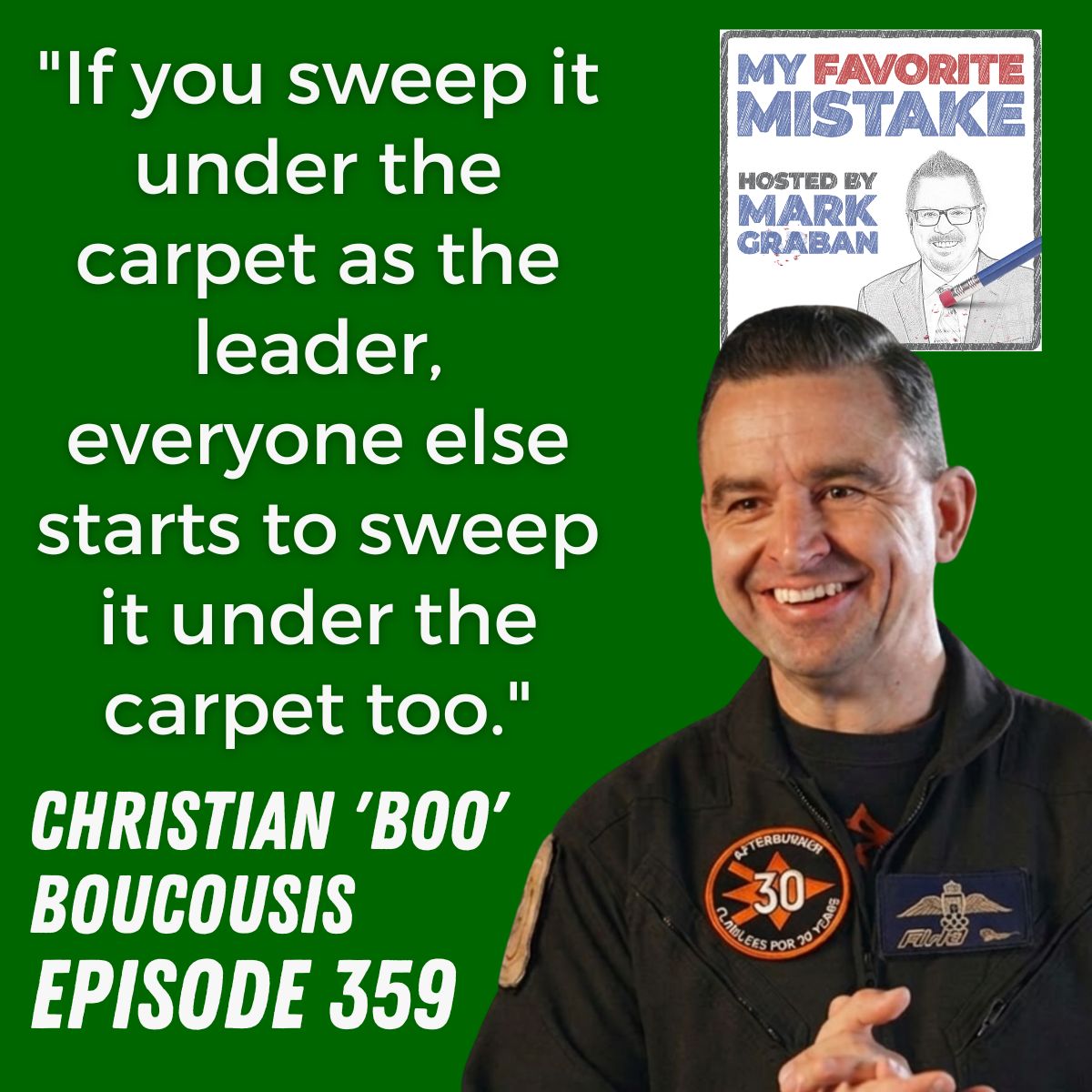
When it comes to being the best leader you can be, it's no different than going to the gym. I go to the gym every day, and there's not a single day I want to do it — I never wake up excited about it — but you always feel better on the other side. That's what debriefing is like. It's a mistake, something didn't go well — that ain't going anywhere. This is where you build credibility and trust. Everyone knows it happened, and if you sweep it under the carpet as the leader, everyone else starts sweeping things under the carpet too, and you lose the big picture of what's going on because no one's telling you — they're afraid. So when you bite the bullet and say, “Hey, it happened, let's get together and talk about what happened and fix it,” you release it.
There's this idea of mental residual, emotional residual, and attention residual — if you're doing one thing and then move into another, you carry the residual energy from the previous situation. If something went wrong, you bring that residual negative energy into the next thing. It's really important to cut it, and debriefing with the ORCA method is a great way to cut the residual and start fresh the minute the conversation is over.
Mark Graban: One of the things leaders often say they want but don't really want is honesty and candor about mistakes. Leaders say, “I want to hear the bad news fast, we've got an open door,” but then they punish people for speaking up or using that open door. You talk about reprogramming — becoming a pilot is a kind of reprogramming from earlier experiences. You probably start that training in your early 20s, right?
Reprogramming Leaders Conditioned to Fear Mistakes
Boo Boucousis: I joined when I was 19. What's unique about the military is you don't do skills training first — you do leadership training first. You go to officer training school, officer candidate school — every military service in the world has an equivalent. You spend the first three to four months learning leadership skills. Interestingly, debriefing isn't part of that formal training — that's a fighter pilot thing. But you learn the whole leadership model in military service: service-minded, service-driven leadership. It's about, hey, the first trigger under pressure is to worry about “me” — you've got to switch that into “we.” Every time you're under pressure, the strength of the solution is getting the power of the team engaged.
I've really encompassed this idea of flawlessness. If you think of a diamond, a diamond can be flawless, but it can't be perfect. When we talk about flawlessness, it means everything you can control, you're 100 percent committed to. So when a leader says, “I want you to give me the bad news, I want you to be honest with me” — that's not something you can ask people to do. It's only something you can show people how to do. Humans don't do things because we're told to — even in autocracies, people do things through mimicry and observation.
Mark Graban: A lot of people call that modeling the behaviors you want to see — modeling the candor, modeling the reaction to mistakes. Before we talk about the book, I want to dig into these words again — flawless and perfect. I imagine reprogramming is a challenge when someone has been conditioned through school and upbringing to feel a certain way about mistakes. It seems like it would be even more challenging with a leader in their 40s, 50s, or 60s, with decades of that conditioning. How do you work with a leader to change their approach to handling mistakes and leading people?
Boo Boucousis: Everything in life hinges on beliefs. What you believe you do, and what you believe, changes your biases — belief is the thing that anchors behavior and anchors the autopilot you run on. Why I bought Afterburner, and why I love this organization, is that our programs are a belief system. We present leaders with a real environment we've all lived in that operates this way, and we win 99 percent of the time, and we feel good, and we like each other, and we work hard — but we work hard on the right things. We don't worry about meetings, we don't worry about failure. So the first thing we do is present the belief system. Then we build the bridge with the ORCA model, which slowly changes your belief system, because the future is non-existent, and as a leader your job is to get there — which means you're inevitably dealing with the unknown.
You're going to call it a mistake, but really it's just the unknown becoming known. How could it be a mistake if it doesn't exist yet? You have to believe that when you get to that moment, you can iterate, you can slowly merge and try something else — rather than getting to that moment and having a knee-jerk reaction where you disappear and suddenly you're taking full control of the situation. That's why people get upset at work — it's not because of the situation, it's because they've lost an element of control.
Undiagnosed Perfectionism and the Loss of Control
Boo Boucousis: Control is the byproduct of undiagnosed perfectionism. I found a study a couple of years ago that identified that 86 percent of leaders suffer from undiagnosed perfectionism. In your mind, you have a very fixed view of what success and “good” look like. Then someone does something that's not on that mental map, and you get upset — because you've lost control. The best way to get control back is to share control — give the other person the control. What's probably happened is you had a great idea in your mind of what “good” looked like, and they had no idea. They're just mowing the lawn — they don't know how long you want it. Then you come out and say, “The lawn looks terrible,” and they say, “I did what you asked, you said mow the lawn,” and you realize, “Oh, I meant mow it at this level” — you forgot a bit of detail.
Brene Brown has a body of work on this — disappointment lives in expectations unmet. There are two sides to an expectation: the expectation itself and the reality. In most conversations, it's not one or the other, it's a bit of both. When you start to think and write ORCA, you start with the expectation, then the reality, then the curiosity of the gap, and then the action — let's bring this down and this up, and then everyone's happy. It works in relationships too — husbands, wives, children. I have a four-year-old boy who has a tantrum because he has a mental picture of what “good” looks like that he's not even emotionally or linguistically equipped to explain. You get down to his level, help him unpack it, and the whingeing and tantrums stop.
Mark Graban: So the child of a fighter pilot might need less reprogramming if they were to follow your path?
Boo Boucousis: I've got three kids — the oldest ones aren't interested in flying. It's funny, I think it can actually have the opposite effect, because when you're a child, everything is new, you're learning and growing. Once you become a fighter pilot, you're reasonably accomplished in the art of problem-solving, and I certainly find with my kids, you've got to remember the journey — I've forgotten what it was like to be a teenager, I've forgotten everything. Part of what's amazing when you watch children and then see adults is how ingrained the aversion to admitting a mistake becomes. Just wanting everything to be nice, calm, and comfortable — that's not really a fun life to live. You've got to embrace discomfort, create stretch targets, and get yourself there.
Not Yet: Applying This to Kids and Growth Mindset
Boo Boucousis: One of the things I try to instill in my kids is the idea of “not yet.” You might need certain academics — you're just not there yet. You haven't failed, you haven't stopped, you're just a snapshot in time. Debriefing and ORCA are great tools to help you understand what “not yet” looks like, and then you can do something about it, and eventually you get there. It took me 17 years to become a fighter pilot. It took me six years to become financially independent. It just takes time — but you've got to commit to the growth process to get there.
Mark Graban: That makes me think of the growth mindset and Carol Dweck's book. “Not yet” — we can get there if we learn, instead of dwelling on the mistake or the poor exam score. It's creating “not yet” instead of “not” — “I'm not a good student” becomes “you're not getting all A's, not yet.” I love that framing. I have perfectionist tendencies myself, and sometimes that serves you well and sometimes it doesn't. I understand not wanting to admit a mistake because it stings internally, even without external punishment. But I'd love to hear your thoughts on people — children or adults in the working world — who are so afraid of making a mistake that they avoid situations entirely, so they'll never have to admit to one. People get overly cautious. Entrepreneurs probably aren't of that mold. What do you see about people avoiding mistakes instead of putting themselves in situations where mistakes are inevitable, because that's how we learn and grow?
Avoiding Mistakes vs. Embracing Them: Engagement and Burnout
Boo Boucousis: In the book, I happened upon two different data sets that actually correlate. One is the level of engagement in the workplace right now, which is around 21 percent, and the other is the rate of burnout, which is in the high 50 percent range. Burnout is tracking up and engagement is tracking down. If you're burned out, you're busy. If you're busy, you're not aware. If you're not aware, you're not engaged and connected to your people, and engagement drops. We've transitioned into a world where the speed of interpreting data and making decisions is like no other time in human history. The amount of information we have to consume is overwhelming, and we're all battling for the attention span of the people around us, because busy, overwhelmed people are very distracted.
If we don't bring intentionality to that, you end up with a highly disengaged workforce, and people don't make mistakes because they don't really do anything. The easiest way to not make a mistake is to be busy doing stuff that doesn't actually have a deliverable. This is where I think Carol Dweck's book gets it wrong — and this isn't just me, this is research — you can't just reward effort. You have to have effort that delivers results. We have a whole generation of participation-award kids in the workplace now, and it doesn't work. That's not how humans are engineered in terms of survival of the fittest. I think that's why we're seeing society snap back into power dynamics, into what humans actually are, which is survival of the fittest. That doesn't mean you need to be a mean, nasty person — but it kind of is the default setting for humanity.
Mark Graban: That phrase, going back to Darwin — survival of the fittest doesn't mean the strongest, it's this word “adaptability” that leads to survival. That's something you write about — not just speed in a straight line, but adaptability, agility. Tell us about that model that's part of Flawless Leadership.
Speed vs. Velocity and Destination-Focused Thinking
Boo Boucousis: First, we frame speed as velocity, because speed just means going fast. Velocity means going fast in a very specific direction. Even the airplane we fly is centered on one thing called the velocity vector — the vector in which you're applying your velocity. If you keep it on the ground, you're going to hit the ground — that's the vector you're on. If you put it on a target, you're going to hit the target eventually. So if the problem is speed overwhelm in the battle for attention, the solution is iteration. If speed is a problem, slow down — intentionally slow down. Bring the same intentionality to focus that you bring to setting calendar dates for meetings.
Second is start at the end. In aviation we call it destination-focused. Whether you're an airliner, all about the landing destination, or a fighter pilot, all about the target, that's where we start. Next time you have a meeting, start at the time it needs to finish, and work forward, rather than start at the start time and work back. That frames everyone's mindset around finishing, not starting.
I found a fascinating study just yesterday. One of the things I've always noticed working with big companies is this propensity for people to say yes to things all the time. I was doing some research with my Claude Research agent, asking, “Are there studies that prove humans say yes more than they say no?” And there are loads. One study had strangers approach individuals and ask, “Can I look at your smartphone?” The person asking expected no — they didn't care whether someone said yes or not. But the person being asked felt rude if they didn't say yes — they were emotionally attached to saying yes, while the person asking had no emotion attached. And 96 percent of people asked, “Can I look at your smartphone?” said yes to a stranger.
Mark Graban: I think I'd be in the minority and say no, or maybe hell no.
Boo Boucousis: Right? And think about how many times in an organization that lacks direction and focus, someone has an urgent need and asks someone for something — what are they going to say? Yes, as a default. And if you say six yeses in a day, that's six more things you have to do. When I coach leaders into destination thinking, I tell them: create three “achieve” items every morning — three things you must achieve. Instead of doing to-do lists, do achieve lists. Then, no matter what happens in your day, test it against those three things. It's hard at first because there's so much going on, but after four to six weeks, the three things you set out to achieve get achieved. And guess what happens when you achieve stuff? You get less busy, because it's done. It's all common sense, really — but the brain isn't engineered for common sense. It's engineered to be busy.
Mark Graban: I love that framing of to-do lists versus achieve lists, because activity in and of itself isn't what any of us get paid for, as individuals or as a business. You have some shared perspective around lean manufacturing and lean management, Boo.
Lean Manufacturing and the Debrief Cycle
Boo Boucousis: From the position we have at Afterburner, lean is the process — a repeatable process that can be standardized. The methodology we have is the overlay to that; it's the dynamic side. Novo Nordisk is one of our clients — we helped them when they were having problems with the Ozempic production line. They were coming at it from an innovation lens rather than a refinement lens — “we need a new factory, we need to do it differently” — when really the question was, why don't we just do what we're doing even better? That's where lean lives really nicely. The plan-brief-execute-debrief cycle we run on top of that is about applying a streamlined process to different problems.
Mark Graban: What you're describing reminds me of a couple of core Toyota Production System ideas. One is not confusing activity with value. I'll paraphrase Taiichi Ohno, one of the creators of the Toyota Production System — he wrote something like, “The only place where activity equals value is at the zoo, watching animals move around.” For the rest of us in business, we don't want to do the wrong things better or the wrong things faster — that's a core lesson from lean you're reminding me of. The second one, going back to slowing down intentionally, is the Toyota-ism “go slow to go fast.” You spend more time planning for the launch of a new factory, intentionally have a slower ramp-up, so you can accelerate more quickly — because that slow ramp-up runs through cycles of problem-solving without expecting it to be perfect or flawless. A lot of companies say, “We did the plan, now let's launch and go full speed right away,” and that inevitably fails, forcing them to slow down — and then the acceleration is slower because the learning cycles are slower.
Boo Boucousis: You're always going to have natural tension when you're creating something, because it doesn't exist yet. When you look at the planning fallacy, the optimism bias, and biases around planning and goal setting — we actually get a dopamine reward for the act of planning itself, and we can fool ourselves into thinking that having planned something means it's been done. That's why it's dangerous for organizations to have separate planning departments and execution departments — they should live together. When you're dealing with the unknown, the only way it transitions into the known is through action. That's the only time something unknown becomes known. Is there a rock under the dirt when I build my house? Dig, dig — yep, there is. Now it's known, and it's a problem, so I've got to solve it.
I once heard a speaker say, “I used to worry about the future so much, but then I trusted that there's a different version of me — a kickass version of me — and that person always shows up later when it's needed, so I don't need to worry about it now.” That's like a fighter pilot too — I'm going to plan everything I know, and there's going to be a bubble of ambiguity, but I've got enough tools in my toolkit to handle whatever gets thrown at me. Whereas in an organization I worked with — 250,000 people — they kept having technology failures with no checklist, no run book, not even the basics of “here's the on-off button.” Something breaks, 100 people get on a call, it takes two days, and eventually someone just asks, “Did you turn it on and off?” You can checklist all this stuff. Everything to do with being successful and calm and relaxed is the opposite of your default program.
Mark Graban: Yeah.
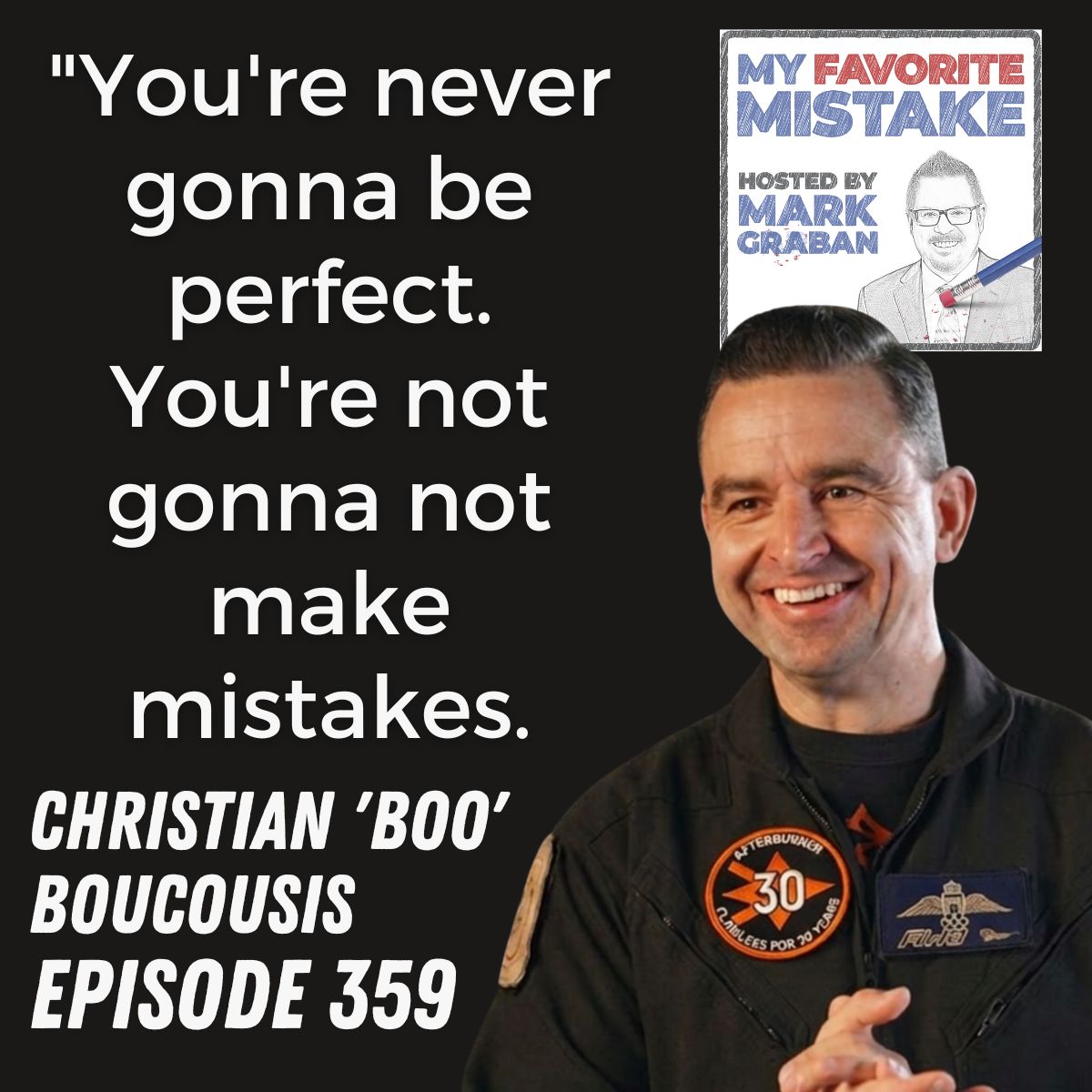
Boo Boucousis: You'll never get there unless you have intention and awareness, and start bringing the blind spots out of the shadows and into the sun where you can see them. You're never going to be perfect. You're not going to stop making mistakes. You're not going to eliminate an emotional response every day, but you don't have to be a slave to it. As we'd say in the fighter pilot world, you don't have to let the aircraft fly you. It will, if you leave it, and it'll fly you into the ground. You have the power to be in control of the airplane — exercise that power. You don't have the power to control the weather, the enemy, or the missile coming at you. But you have the power to know how to respond and adapt to it. That requires a lot of commitment to learning, to understanding the basics, to being highly methodical — to not be asking what a button does in the heat of battle because you spent six weeks learning what that button does.
The busier we are — and we're a development company — the less companies invest in training, the less they develop people. It's just “go get the job done,” and leaders end up 24/7 engaged, solving every urgent problem with a knee-jerk reaction. That's kind of where we're at right now.
Mark Graban: And you're helping people get out of that with your previous book and the new one, Flawless Leadership. Maybe a final question, because there's so much you've shared with us today. The difference between perfect and flawless, in a nutshell?
Perfect vs. Flawless: The Key Distinction
Boo Boucousis: It's interesting — the word “perfect” has its origins in Latin, in scholastic and academic groundings. The word “flawless” actually derives from “flakka,” which is Nordic for stone, a Viking word. Over time, “flakka” transitioned into “flawed” when the stone was broken. When the stone was repaired, or wasn't broken, in the 1600s we came up with the word “flawless” in the English language. Perfection is an academic ideal — it means everything has to be perfect. Flawless means a dimension is unbroken, but it can be broken — there's the potential that it's not perfect. Perfection means you must be in control of everything, including things you can't control. That's the only way you can be perfect.
Mark Graban: And that's unfair — it's unfair to think you can be perfect about things you can't control. That's one of the key points here, I think.
Boo Boucousis: Correct. But the internal narrative we tell ourselves doesn't care about that — it just tells you you're a loser, you're hopeless, you're not going to be successful. You procrastinate because the perfection narrative is running in the background. The autopilot of the brain works by filtering the whole world to make your life easy, and the easiest way it can explain success to you is failure or success. So it keeps feeding you a narrative to keep the program running so it can serve you. Your brain is actually forcing you into perfection, because otherwise it can't give you the simplest decision-making shortcuts based on your biases.
You've got to break it — say, “Enough, I don't want to hear this anymore. I don't want to be anxious. I don't want to be burned out. I don't want to be overwhelmed.” Because the perfectionist, by default, becomes highly controlling — you're trying to be perfect, so you're trying to control everything. And the byproduct of trying to control everything is overwhelm, because to control everything you have to do everything. Then what happens? You move further away from perfection, more and more goes out of control, so you grip tighter, you become more overwhelmed, and you spiral into burnout. I call it the perfection death spiral. The tool to break it is the debrief, because that's the expectation reset every day. You'll never stop the perfectionist monologue narrative — it's hard-coded — but you can reset it so it doesn't get a hold of you and drive you into the ground.
Flawless Leadership in Practice
Mark Graban: And flawless is a healthier thing to aim for, it seems.
Boo Boucousis: Yes, flawless is sustainable. The premise is that if you practice flawless leadership — mastery of your mindset, the methods you use, and the moments you show up in, call it the three M's — you'll put less effort in to achieve greater results. That doesn't mean it's going to stop you from working harder and getting more and more results with less effort — that's on you, and that's inevitably what humans do. We go, “Look at that, I achieved a massive result and barely did anything — I need more of those results.”
I'll tell you a story. When I was working with the biggest company in Australia, Woolworths — the biggest supermarket chain, one of the biggest in the world — I worked with seven leaders, and after two years they came to me and said, “This program's really good, Boo, but what do we do now? I don't have anything to do, and I think I'm probably going to get fired.” And I said, no — you've just become a flawless leader. That's your job. Your job is to not be in the weeds, to be above the action, to keep hold of the bigger picture and pull together all the parts that two years ago were tearing you apart. Now you're holding it together. That's the ultimate — lots of time to think, a lot of calm, deeply connected to your people at a human layer rather than just a work layer, driving a team of calm, impact-focused people who get more done with less effort.
Mark Graban: And that's something to be rewarded, not punished through firing or other problematic reactions.
Closing and Where to Find Boo
Mark Graban: Boo, thank you so much for sharing your experiences and expertise and insight. Our guest today has been Christian, or Boo, Boucousis. His previous book is The Afterburner Advantage, and the new book, which I'm very much looking forward to reading, is Flawless Leadership. What's the planned release date for that again?
Boo Boucousis: It'll be a summer reading book — it's with the publisher now, so it'll be out around August.
Mark Graban: Around August, okay. There will be links in the show notes to the Afterburner Advantage website and the book website. And you have an AI agent that's available now, right?
Boo Boucousis: Yes, AI Boo is out there now. Just Google my last name, or Google “AI Boo.”
Mark Graban: Fun to continue the conversation, or start your own, with AI Boo. Thank you so much — really appreciate these powerful perspectives. I wish we had more of this in the business world, but thanks to you and others trying to help create environments where we can truly learn from mistakes. Thanks, Boo.
Boo Boucousis: Thanks for having me, Mark. Have a great day.
Mark Graban: You too.