
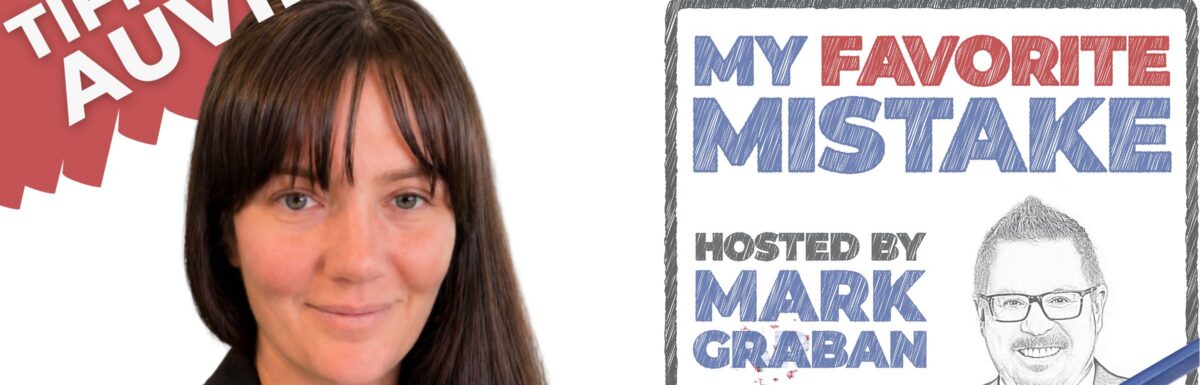
Tiffany Auvil spent more than twenty years inside the U.S. healthcare system, starting as a volunteer firefighter and eventually serving as System Director of Outpatient Clinics for a three-hospital health system. Then her husband Dave was diagnosed with cancer, and she found out how little that experience protected them.
Listen:
Check out all episodes on the My Favorite Mistake main page.
My guest for Episode #361 of the My Favorite Mistake podcast is Tiffany Auvil, a registered nurse who has spent more than twenty years inside the U.S. healthcare system, starting as a volunteer firefighter and eventually serving as System Director of Outpatient Clinics for a three-hospital health system. She is a functional medicine health coach, she is completing a Doctorate of Science in Integrative Healthcare, and she is the author of The No BS Guide for Caregivers: How to Survive the Healthcare Maze, available now.
The favorite mistake Tiffany shares is trusting the system she had worked inside for two decades. Her husband Dave was treated for renal cell carcinoma in 2016 and was cancer-free within three months. Seven years later it returned in his pancreas and liver. The night before Dave's first immunotherapy infusion, the oncology nurse called to say insurance had denied it. Tiffany had done prior authorizations for years and knew the denial did not add up, so she called the insurer, who had no denial on file at all. The failure was upstream: the hospital's prior authorization specialist had entered a diagnosis code in the field meant for the procedure code, and the portal rejected it as invalid. The oncologist was relieved someone had finally figured it out, because she had been watching authorizations get denied without ever learning why.
That was not the only failure. A Gamma Knife authorization later sat unsubmitted because nobody pressed the button, and the cancer in Dave's brain turned out to be central nervous system lymphoma, a separate primary cancer that Tiffany believes had been in his eye all along. Dave died at home in April 2025. He used to ask what people do who do not have a “Tiffy,” and the book is her answer.
Themes and Questions:
- What does it mean to trust a system you helped run, and what happens when that trust is the mistake?
- What did being on the other side of the bed teach Tiffany that twenty years of nursing never did?
- How does a prior authorization denial trace back to a diagnosis code entered in the field meant for a procedure code, and who catches that if a nurse is not in the family?
- Why did the oncologist react with relief rather than embarrassment when Tiffany identified the error?
- Why file a grievance after the problem is already solved for your own family?
- What happened when a Gamma Knife authorization sat in a portal because nobody attached the clinical notes or pressed submit?
- What would it take for an insurance portal to catch an invalid code before it becomes a denial, and what did Tiffany tell a panel of insurance executives about that?
- How does a second, unrelated primary cancer go undetected for over a year, and where do diagnostic error, cognitive bias, and human error overlap?
- Can you call it a diagnostic error when the physicians involved were excellent and the presentation was genuinely rare?
- What is Code Help, why did Tiffany find it by reading a patient handbook out of boredom, and why do most families never hear about escalation paths that already exist?
- Why do patients and families worry that speaking up will get them labeled troublemakers, and what does that fear cost?
- What does it cost to be the “pain in the butt” employee who questions things and tries to connect silos?
- What happened when Tiffany suggested that surgeons sit down with billers after significant denials?
- How do you lead so people feel safe bringing you bad news, and what does “Did they die?” accomplish that a policy cannot?
- Why is “good catch” recognition where organizational learning usually stops instead of starts?
- What exactly is the BS in “The No BS Guide for Caregivers,” and why is most caregiver advice aimed at the wrong problem?
- How should a caregiver approach a fifteen-minute physician visit when they have fifteen things to raise?
- Why start hospice months before it feels urgent, and what does Tiffany mean by “decaf hospice”?
Scroll down to find:
- Video version of the episode
- How to subscribe
- Quotes
- Full transcript
Find Tiffany on social media:
Watch the Episode:
Memorable Moments from the Conversation:
Click on an image for a larger view
Subscribe, Follow, Support, Rate, and Review!
Please follow, rate, and review via Apple Podcasts, Podchaser, or your favorite app—that helps others find this content, and you'll be sure to get future episodes as they are released.
Don't miss an episode! You can sign up to receive new episodes via email.
This podcast is part of the Lean Communicators network.

Other Ways to Subscribe or Follow — Apps & Email
Episode #361: Tiffany Auvil, Registered Nurse and Author
Meet Tiffany Auvil, Nurse, Caregiver, and Author
Mark Graban: Hi, I'm Mark Graban. Welcome to My Favorite Mistake. Our guest today is Tiffany Auvil. She has spent more than 20 years inside the U.S. healthcare system, starting as a volunteer firefighter, then an EMT, then an LPN, then a registered nurse, and eventually System Director of Outpatient Clinics for a three-hospital health system. She's also a functional medicine health coach. She's finishing a Doctorate of Science in Integrative Healthcare, and she's the author of the book “The No BS Guide for Caregivers: How to Survive the Healthcare Maze.” So Tiffany, thank you for joining us. How are you?
Tiffany Auvil: I'm well. Thank you very much for having me today.
Mark Graban: It's great to have you here. There's a lot to talk about later in the episode about your book, your recommendations and advice for others, your experiences working inside healthcare. But as we always do first here, Tiffany, looking back at things, what's your favorite mistake?
The Favorite Mistake: Trusting a System She Knew From the Inside
Tiffany Auvil: My favorite mistake would be trusting the system that I had worked in for so long when my husband was diagnosed with cancer. I learned through that process that even though we take so many safeguards inside of healthcare to make sure that our patients are cared for, people slip through the cracks, and sometimes things happen multiple times to the same person, as we experienced. That was what led me to write my book.
Mark Graban: So what came to light when you talk about flaws in the system? I'm sorry to ask, but what did your husband experience? What did you experience as a spouse and a caregiver?
A 2016 Diagnosis, and a Recurrence Seven Years Later
Tiffany Auvil: My husband was first diagnosed with renal cell cancer in 2016, and we were lucky at the time. He had a total nephrectomy, which was even done by robotic assist. He was discharged the next day, and after three months of recovery, he was cancer-free and doing great.
Then seven years later, he started having some vision problems. We kept going back to eye doctors and nobody could figure out what was going on, so his PCP and I, who work together, started talking and we were like, “Let's scan his head.” And since renal cell cancer mostly metastasizes or recurs in the abdomen or chest, we also decided to scan those areas as well, and found that his cancer had returned. This was in January of 2023, and it was in his pancreas and his liver.
Mark Graban: Oh, no.
Tiffany Auvil: He was 39 when he was first diagnosed, and so this was seven years later. He was 46.
I went straight into wife, caregiver, nurse mode, making sure he had everything he needed to get into the doctor's appointments. We decided to go to the same facility that had treated him before for his cancer. This time, instead of just seeing the urologist who removed his kidney, now we're in oncology, because now we're going to need some actual medications, which he didn't have to have the first time.
The Call the Night Before Immunotherapy
Tiffany Auvil: And then the night before his first immunotherapy, I got a phone call from the nurse that worked with the oncologist saying that our insurance had denied his immunotherapy, and that they were going to have to reschedule his appointment for the next day until they could get it figured out.
I have worked with insurances for years. I've done prior authorizations. Back in the day, before there were portals, when you were on the phone for 45 minutes to an hour and a half waiting for someone to pick up, I've done those. And I was like, “No, no, my insurance was great. I didn't require prior authorization for an MRI. I don't see why they're going to require a prior authorization, let alone deny immunotherapy.”
So I told her, “I'm going to call my insurance company and find out what's going on, and I'll call you back. Don't cancel anything.”
I called my insurance company, and they were stumped. They didn't have any denials in the system. They don't deny immunotherapy. It doesn't require a prior authorization. It should be automatic when they enter it in the portal.
Having known what I knew, I had looked up what the J code was for Keytruda, because that was the medicine he was supposed to have. I knew what his ICD-10 code, his diagnosis code, was because I can get it from the portal. So I knew what to talk to the insurance about, because they don't talk in plain language. They talk in code.
Mark Graban: And not everybody knows even what an ICD-10 code is, let alone what the code is. So you had that advantage.
Tracing the Denial Back to One Field on One Screen
Tiffany Auvil: I had that advantage. So I called the nurse back at the oncology office and I said, “Hey, I just spoke with my insurance company. I gave them this J code for Keytruda. I gave them this ICD-10 code for metastatic renal cell cancer. Even without those codes, there should be no prior authorization needed. There's no reason for him to have been denied. We will be there tomorrow at 9:30.” I was very adamant. “We are coming in tomorrow at 9:30 for his treatment.”
And she said, “Okay, I'll let my prior authorization specialist know. Thank you very much.”
I was still at work dealing with this, as those of us in the system are always dealing with things. About 10 minutes later she called me back. She was a very nice nurse, and she said, “Tiffany, I'm so sorry to bother you again.” I said, “You're fine. What's going on?”
She said, “I spoke to my prior authorization specialist, and the code that you gave the insurance company for the Keytruda was the wrong code.”
I said, “Wait a minute.” There's only one code for Keytruda. I knew this. I said, “Well, what code did she say it was supposed to be?” And she rattled off the ICD-10 code.
Mark Graban: She got the two mixed up.
Tiffany Auvil: The prior authorization specialist got the two codes mixed up. So when she was putting the ICD-10 code in the spot for the procedure or the medication, it was kicking it out saying denied, because it wasn't even a real code.
Mark Graban: That makes sense why it got kicked back.
Tiffany Auvil: I was rather upset, but happy to have figured out what the issue was. I told the nurse, “Look, don't take this the wrong way. I want you to know, and I know this is not your fault, but please call your prior authorization specialist back and let her know that if she would use the actual J code in the spot for the medication, that it would work. But the code she's trying to use is a diagnosis code, and if you need to, give her my cell phone number. I'll be happy to walk her through how to do her job.” That was the nicest way I could say it at the time.
Mark Graban: Well, it's a stressful time, and it shouldn't have happened, right?
Filing the Grievance So It Wouldn't Happen to Someone Else
Tiffany Auvil: It's a very stressful time. So I went home and I told my husband about it, and at first he's worried. He's like, “Oh my God, you said that. They're not going to treat me good anymore.” I'm like, “No, that's not how it works. Hospitals get paid on patient satisfaction surveys. They're going to always treat you good.”
But we got to the oncologist's office the next morning, and the oncologist was ecstatic that somebody figured it out. She had so many people that she had denied prior authorizations for chemo or immunotherapy, and she could never figure out why. Though they won't say it, she was wondering if this was the reason.
Mark Graban: That same mix-up was happening all the time?
Tiffany Auvil: It seemed that way. Knowing what I knew from healthcare, I went straight through the grievance process. Even though it was fixed, I went and told the patient advocate and made a grievance on it, because I didn't want it happening to someone else again. Unless things are reported, then the same mistakes can happen over and over again, because nobody realizes it's a mistake.
Mark Graban: Or people don't push back, people don't fight, people don't persevere. It makes you wonder how many people had delayed care, or, I hate to think, they didn't get it.
A Second Failure: The Authorization Nobody Submitted
Tiffany Auvil: Well, and this wasn't the only time we had trouble. A year later it appeared that my husband had metastatic brain cancer. So it looked like the renal cell cancer had spread to his brain. The treatment for that is Gamma Knife, which, when done for the appropriate thing, is very safe. You can even go to work the next day. And for anyone who doesn't know what Gamma Knife is, it's very precise radiation into the brain.
Two days before his Gamma Knife appointment, I got a phone call from the clinic again, a different clinic this time because it's radiation oncology, telling me that the insurance had not yet approved the Gamma Knife procedure. This had been just about two weeks since it was supposed to have been submitted, and I know prior authorizations from an insurance side can take up to two weeks to be obtained. So I was like, “Let me call my insurance company and push, see what I can get done. We've got a couple days here.”
I called my insurance company, and they couldn't find a claim. I said, “They're telling me that you guys aren't doing anything. Can you help me figure out what's going on?”
After about an hour and a half, two hours of the insurance representative digging through things, they actually found the claim was still sitting in the portal, not yet submitted, because it didn't have clinicals attached to it.
Mark Graban: And what does that mean, not having clinicals?
Tiffany Auvil: Like a doctor's note. The clinicals were never attached, meaning the note from the office visits. And the person who was working on it never hit the submit button.
Mark Graban: These all seem like such preventable mistakes. Not to sound judgmental about it, but it's probably fair to say these are preventable.
What a Portal Could Catch, and What Tiffany Told Insurance Executives
Tiffany Auvil: I would say preventable. Even something like just double-checking your work, or having someone double-check it.
I was fortunate enough last year or the year before to be part of the West Virginia Hospital Association Leadership Academy, and I was at a conference where they had a panel of Humana, Blue Cross Blue Shield, and a couple other insurance CEOs sitting in a room for West Virginia. This has been something I've been pushing for. I told them the story about the denial and about how the prior authorization specialist switched the codes, and I said, “You guys could help prevent this if your portal said, ‘This isn't a real code.'”
If a portal could say, “Double-check your work, this isn't a real code,” then it wouldn't have been a denial from a generic standpoint.
Mark Graban: Yeah. And boy, just one thing after another.
“What Do People Do Who Don't Have a Tiffy?”
Tiffany Auvil: And my husband, he passed away in April of 2025. But even before, pretty much since that first time, he always told me, “What do people do who don't have a Tiffy?” Because he called me Tiffy. And I even had family members say, “He lived as long as he did because he had you fighting for him.”
That was one of the things that really stood out to me. Even if you're a nurse, I was fortunate enough to know about CPT codes and ICD-10 codes because I was in a world that exposed me to them and I wanted to learn. But if you're a bedside nurse inside the hospital, you don't know what a CPT code is or a diagnosis code, because it's not part of your world.
Mark Graban: I guess one of the next things that you did was writing a book to help others navigate and go through all of this. I'm curious, was there any kind of feedback loop or follow-up from the health system? You were pointing out some things that would help your husband, that would help other patients. It was also helping the hospital. Did they thank you? Or do you not really know what they did with that input?
Tiffany Auvil: The first time, like I said, I got a lot of gratitude and thanks from the physician herself. And then of course I got a note saying, “Thank you. We are going to look into this,” the kind of thing that you get from the patient advocates.
Brain Swelling, an Emergency Craniotomy, and a Different Cancer
Tiffany Auvil: Then when it happened with the Gamma Knife procedure, my husband unfortunately woke up the day after his procedure and couldn't put his pants on and couldn't write his name. So I ended up rushing him to our local hospital. They CT'd him, and he had brain swelling that was crossing the midline. He ended up having to go back to the facility and have an emergency craniotomy the next day.
I had filed a claim prior to all that happening and talked to the patient advocate and explained, “I understand these prior authorizations take two weeks. However, this one wasn't due to that. This is because clearly my insurance company said nobody hit submit.”
A week after all of this, we got a phone call from his oncologist to go to the hospital immediately, that he was being admitted. Come to find out it wasn't renal cell that was in his brain. It was central nervous system lymphoma.
Mark Graban: Stating the obvious, an altogether different cancer.
Tiffany Auvil: Altogether different cancer. I suspect that's what was in his eye the entire time. He had intraocular lymphoma, and we never figured it out because who would have thought you had two primary cancers? But intraocular lymphoma, I learned afterward, goes into central nervous system lymphoma if untreated.
After he received the treatment for the central nervous system lymphoma, which is high-dose methotrexate, he ended up having to be admitted to the hospital eight times for a minimum of five days each time for the treatment, every other week. His vision actually got a little bit better. Because renal cell and central nervous system lymphoma have two completely different treatment paths.
He was a unicorn in so many different ways. But the day that we were going to the hospital for that, I received a letter from the patient advocate that said, “Thank you for your concern, but prior authorizations can take up to two weeks.” And I was like, “You know what? I've got bigger things to worry about today.” So I just left it.
Diagnostic Error, Cognitive Bias, and Two Primary Cancers
Mark Graban: The Gamma Knife procedure, was there just a bad outcome, or does that point to something going wrong with that, in terms of your husband not being able to function the way they expected the next day?
Tiffany Auvil: It was because it wasn't renal cell cancer. It was central nervous system lymphoma. Gamma Knife never would have been done had we known it was central nervous system lymphoma.
Mark Graban: So this traces back to that shouldn't have happened. Would we call this a diagnostic error? Or bad assumptions, of not thinking it could be something else?
Tiffany Auvil: I think it's a little bit of both, and human error. Even as the wife and the nurse with the medical background I had, I would have never thought he had a separate cancer in his eye. You very rarely hear of people who have two primary cancers that are completely unrelated. But in his case, he did.
Mark Graban: So the human error, maybe a cognitive bias kicks in even for very highly educated, intelligent people. I see you nodding there. If we assume it's very, very rare to have two primary cancers, there'd be a tendency not to even investigate that. So it's not like, what's wrong with that person, that physician? It's not so simple.
Tiffany Auvil: It's not simple. His ophthalmologist and his oncologist were both wonderful physicians. I highly recommend them to everyone, because it was the integrative approach and the team approach that we had that really, I think, kept him moving on. Even then, his original oncologist specialized in renal cell and a couple other cancers, and then we ended up having another oncologist who specialized in central nervous system lymphomas and different lymphomas, plus the ophthalmologist. So it was a whole team that worked to keep him alive as long as we had him.
Mark Graban: That's a lot to think about. Just the tragedy of a spouse dying of cancer, but then to think about the different challenges, and hearing about the bureaucratic errors, if you will. I don't want to say that's not important, but it hits differently than hearing about the diagnostic error and the treatment error that resulted from that. He had a lot going against him, unfortunately.
A Heart Attack, and Two Departments in the Same Building
Tiffany Auvil: He did, and he was very strong. He even had a heart attack right at the beginning of his treatment, before the Keytruda. He started one of the targeted therapy pills, and he had just had his second pill and called me and said, “I don't know what's wrong. I think I'm having a heart attack.”
I was really worried because of the medication. He ended up having a heart attack and going back to the facility where he was receiving his treatment, after it was diagnosed at the local facility. And it wasn't associated with his cancer medication at all. He actually had an 80% blockage in the LAD.
Mark Graban: Pretty significant blockage.
Tiffany Auvil: That had been quietly building up, and that could've taken him. But we had some issues when he was admitted for that too. I write about it in my book. He ended up being on an oncology floor because he was an oncology patient, but he was having treatment for a cardiac issue. And one thing I learned: sometimes when you get bigger and bigger in the hospital systems, people talk less and less.
He was admitted on a Friday, and then on Saturday they took him down and did a heart cath, and that's when they found the blockage. But they didn't treat it. They brought him back out and said they didn't know what they were going to do, because they needed to talk to oncology.
So 24 hours later, oncology still hadn't talked to cardiology, and I was getting a little irritated. I'm like, “What's going on? What's the plan?”
Code Help: The Escalation Nobody Mentioned
Tiffany Auvil: And I was thumbing through their patient handbook, and I came across that this certain facility has a Code Help. Different facilities have different codes, but theirs is called Code Help.
Mark Graban: A code that someone can activate.
Tiffany Auvil: Yes. And family members can activate a Code Help whenever they feel like treatment's been delayed or if things aren't going well. So it's something not just for nursing staff, but more geared toward family. And it wasn't something where people were like, “Hey, you can use Code Help,” you know? But since I actually picked up the book because I was bored and was reading it, I saw it. And we had been all day, like, “When is oncology going to talk to cardiology? You guys are in the same hospital. How hard is it to sit down and make a decision with each other?”
So I put his light on, and of course he's mortified. And the nurse comes in and I'm like, “Hey, I was just reading in here that you guys have a thing called a Code Help. Do you think if I use this that maybe cardiology and oncology will talk to each other?”
And that's all I did. Within 10 minutes, oncology and cardiology were both sitting in our room talking and making a plan for the next day.
Mark Graban: And I've talked to a lot of patients and patient advocates who describe the reaction like your husband had, of like, “They're going to think we're troublemakers.” From your experience, you have to speak up. Or, it's not that you have to, but it can be beneficial to speak up even if a lot of people are afraid to.
Being the “Pain in the Butt” Employee
Mark Graban: Let me pivot a little bit to something I wanted to ask about your experience working in healthcare, Tiffany. You describe yourself with the phrase “pain in the butt employee,” somebody who challenged things and questioned things. From what I hear you describing here, you're knowledgeable, you're being patient-centered, in this case the patient being your husband. You're doing, I think, right things for the right reasons. But was that phrase thrown at you by a manager? Like, “Tiffany, you're a pain in the butt”?
Tiffany Auvil: They never said it. Not directly, anyway. Most of my career in the same healthcare system, I had the same boss for years, and she was wonderful. She was a mentor. She helped me grow, and she always challenged me to learn new things.
When I became the population health nurse manager, this is back in 2017, population health was a newer concept. Annual wellness visits, chronic care management, those kinds of services, and that's one of the things we really focused on. So I dug into it and would learn: what are the codes, how do you bill for them, what do you need to have in the chart? Because I always felt like if I didn't understand it, then how am I going to expect somebody else to? And if they're reporting to me, I need to know what they're doing, to know that it's being done right. I had always kept that kind of thought process.
“That's Billing's Issue”
Tiffany Auvil: I would work closely with the billing department to see if things would improve. One of my last meetings, because I actually ended up leaving my job, not because of this, but just life in general and taking a different path for a while, I made a suggestion: why don't we get our general surgeons to sit down with our billers every time there's a big denial? Because a lot of times your surgeons don't understand why there's a denial. They're not even told there's a denial. And then, if it's an error the surgeons are making with documentation or something, we can correct it so we don't have these denials.
Mark Graban: Right. Break down the silos and learn from it.
Tiffany Auvil: The response I got was, “Don't you worry about that. That's billing's issue.”
And so that's when I realized, maybe not everybody likes somebody that pulls people together. But I always felt like even if I was a nurse, nursing for me wasn't the only part. I learned how to operate our EHR inside and out.
Mark Graban: Electronic health record, for those who don't know.
Tiffany Auvil: Oh, yes, sorry. The electronic health record. It was just how I'm built. I need to know the why and then the how, so that way we can look for ways to improve, because you can always improve as well.
Leading So People Feel Safe: “Did They Die?”
Mark Graban: Now, when you became a leader, a manager and a director, were there things that you did as a boss to help people feel safe challenging things, so that they didn't feel like they were a pain in the butt, that they were welcome to challenge things?
Tiffany Auvil: Yes. I always encouraged people to bring up ways to improve things. And just because something isn't broken doesn't mean that it can't be improved. A lot of people have that attitude, if it's not broken, don't fix it. But that's kind of also insanity, because there might be a lot better way of doing the non-broken thing.
Whenever I was working with my employees, I always tried to make them feel comfortable to come tell me anything. I had a nurse one time come to me. She'd been working with me for a couple of months at this point, and she came and told me something. I can't even remember what it was. And I was like, “Did they die?” And she looked at me and she goes, “What?” I said, “Did they die?” And she's like, “No.” I said, “Then it's okay.”
It's going to be all right. We can work through this. It's nothing that's going to be catastrophic. We can work through whatever this issue is.
And I learned later that her previous employer was one of the ones where if you used a pink sticky note instead of a yellow sticky note, you were getting written up.
Mark Graban: That sounds very micromanage-y.
Tiffany Auvil: Very micromanaging. And so I've never really felt like that was me. I like to help people learn to grow and be independent and think for themselves.
Why “Good Catch” Isn't the End of the Learning
Mark Graban: When you think about systemic errors in healthcare, sometimes people will report a near miss or a problem, and I've heard people use that phrase of, “Nobody died,” or, “Good catch.” And there's the pat on the back or the formal recognition. And then as an engineer, I think, “Okay, well, now what?” We can still learn from that even though, yes, it's good you caught it, it's good nobody died. But what if the next time somebody's tired, distracted? The same issue could lead to something catastrophic.
We can't replay the outcome, if you will. We've got to think about what could have happened. And I find sometimes people don't like to think about that, almost in a superstitious sort of way, of like, “Well, we don't like to talk about these things.” And I'm like, it seems like you should.
Tiffany Auvil: Having those discussions, the what-ifs and the could'ves, are a way of making sure that they don't happen. History, we always say, repeats itself. But ignoring the inevitable, because if it happened once and you don't address it, it's going to happen again.
That's just like going back to the oncologist who was so happy that I figured out what was going on. How many times had this happened before? How many other patients were denied their treatment because somebody switched an ICD-10 code with a CPT code?
The Book: What Exactly Is the BS?
Mark Graban: So let's talk about the book. Again, our guest, Tiffany Auvil. The book is “The No BS Guide for Caregivers.” It's available now. “How to Survive the Healthcare Maze” is the subtitle. And we've heard a lot about not only the clinical maze, but the administrative maze that you and your husband and a lot of us have to navigate.
With the book, we say yours is a no BS guide. It begs the question: what would you consider BS that's told to patients or caregivers? What BS were you trying to avoid?
Tiffany Auvil: I was wanting to not avoid so much as be real. When it comes to being a caregiver, you really want to help. And a lot of the caregiver support that's out there is how to help yourself. Mindset, meditation, which, trust me, I have all my own mindset and meditation things that I practice, because I need those things too.
But I wanted to give people tools that could actually help them help the person they're caring for.
When I was helping my husband and we were going through that, I gained a lot of weight. And I always said, “I don't care. I've got too much to deal with. I'm not worried about it. I'm going to take care of him.” Whether that's right or wrong. When he passed away, then I was able to start saying, “Okay, now let's focus on me.”
But what people really need is how they make things better for their loved one.
Organization, Scripts, Bills, and Appeals
Tiffany Auvil: My book goes through a little bit about organization, because I don't think you can navigate the system without being organized. But then I give them tools about how to talk to a doctor. How to call your insurance company. A little bit of information on how billing works. People get really stressed out when they get a bill from their healthcare provider and they see two separate bills, because they're getting a professional fee and a facility fee, and they don't understand why.
So it breaks down those things of really being in the system, and then how to appeal a denial. How to talk to the insurance company to see if you can help get a denial overturned. Or is it really even a denial, like what we experienced.
“Decaf Hospice” and the Part Nobody Wants to Discuss
Tiffany Auvil: And then I end it with what I think people are really sometimes afraid to talk about, which is the terminal side and the end of life side.
My husband was one of those people where hospice meant the end is near. And the thing with my husband, he was riddled with cancer, but up until a month before he passed away, he was outside working in his garage on four-wheelers. So he was a healthy, I guess you'd say, very active cancer patient. He got tired easily, but he was still just doing everyday life to the best of his ability.
In December before he passed away, we got a PET scan that showed his cancer was spreading more in his abdomen. And there was a radiology report that came back that there was a tumor invading his colon. At that point I told him, “Look, we need to start hospice, not for you, but for me. Because I'm going to need them when the time comes, and I don't want to be dealing with paperwork when the time comes.”
So having had that conversation, we started what I call decaf hospice.
Mark Graban: Decaf, like coffee?
Tiffany Auvil: Yeah, I called it decaf, like half hospice, because they don't come in every day. They don't see you every week. A nurse practitioner may call you once a month, but you're in their system, and you already have all your paperwork in.
And when we found that his central nervous system lymphoma had returned in his brain, he decided he didn't want to do treatment again. This was his decision, to say, “Okay, I'm done.” And so I called hospice immediately, and they were able to come in and start helping.
Mark Graban: And hospice or palliative care doesn't mean no care, but correct me if I'm wrong, it's more about comfort at that point. We're not trying to actively cure, get rid of the cancer, but let's keep the patient comfortable, focus on quality of life at that point.
Tiffany Auvil: Sometimes treatment of the cancer's still part of it. My husband was still being treated for his cancer and doing all the things up until he decided he didn't want to have the treatment anymore. He even was still taking his targeted cell therapy pills for the first almost five days after we learned that his central nervous system lymphoma had returned. And when he decided to stop that medication, that was his decision.
But hospice came in and provided me with support and emergency medication kits for when he became ill or in severe pain, so that I had something available to give him without having to drag him out of the house, go to a doctor's office, find a pharmacy. It was all there ready.
A Book Built to Be Used, Not Just Read
Mark Graban: And in the book, just at first glance, we talk about tools and practical things that people can use. Maybe a lot of this comes from the discipline of nursing. Checklists, scripts, worksheets, quick reference guides. It's very much an action-oriented book, not just something to read and contemplate, but actually bring with you to appointments, to the hospital, and put it to use.
Tiffany Auvil: Yes. And I even say at the beginning of the book, you don't have to read this from front to back. It's not made to be read that way if you don't want to read it. You can look at the table of contents and see appeals or denials, and look in there and say, “Okay, this is where I need to go for today.”
How to Actually Talk to a Doctor
Mark Graban: And maybe as a final question. One thing in the description of the book that stands out: there's knowledge of the ICD-10 code, the diagnostic code. There's a lot of lingo, acronyms, Latin terms. If someone says, “Oh, your husband's got to be NPO tomorrow,” people are like, “What the hell does that mean?” No food, clear liquids only, right? It's a Latin phrase.
Tiffany Auvil: NPO. That's how we learn it.
Mark Graban: So translating some of that to patients and families is important. There's the knowledge layer, but as you point out, there's more of how to speak to doctors in a way where you're more likely to be heard. What advice do you have about the how?
Tiffany Auvil: The biggest thing is when you go into a doctor's appointment, and this is something I've seen in years of primary care, people come in and they've got 15 things going on, and they want that doctor to solve all 15 of those problems in a 15-minute office visit, which is what you get with your doctor most of the time.
I want people to realize that that's not practical. So whenever you go into a doctor's office, you really need to pick the top one or two things that are bothering you at the time and make an additional appointment for the rest if needed, or utilize the portal if there's one available. You can send questions over instead of saving it all up for the doctor's visit.
Why Your Doctor Can't Know Everything About You
Tiffany Auvil: And then also realize, I live in a very small town. There's only 1,300 people in my town, and my entire county in West Virginia only has 6,900 people. We're mostly national forest. But people still talk about Doc Pete Michaels, who was the house doctor 30, 40 years ago, that knew everybody in the town. He delivered half of the town.
But doctors really aren't like that anymore. They have a patient load of a minimum, I'm sure, 2,500 to 5,000 patients. They've got all kinds of information coming to them from insurance companies, through agencies like CMS and accrediting organizations like the Joint Commission and DNV, and they're trying to keep all of that together and manage their patients at the same time. So you can't expect your doctor to know everything about you. You need to be available to talk to them and explain you again.
Mark Graban: And help them help you.
Tiffany Auvil: Yes.
Mark Graban: Because we're all human, regardless of what letters we have after our name for our degrees and certifications and fellowships and everything. Nobody working in healthcare is superhuman. People are fallible. I think one thing we see very similarly from our different backgrounds is, we've got to help people help us. And part of that is doing things that can prevent mistakes.
Tiffany Auvil: Yes. And finding the errors that may have caused the mistake, like you said, the near misses or the good catches, and not just saying congrats, but actually working to improve it so it doesn't happen again.
Closing
Mark Graban: Exactly. So thank you again, Tiffany. Tiffany Auvil is our guest today. Look in the show notes for links to the book. It's available now: “The No BS Guide for Caregivers: How to Survive the Healthcare Maze.” Congratulations. Sometimes publishing is a maze. Congratulations on getting that to the finish line. The reviews are really good.
I'm looking at Amazon and it's funny here, and it's clear this is an Amazon glitch. It doesn't capitalize BS. You've probably noticed this. “The No Bs Guide for Caregivers,” which is maybe a different meaning. It's clear on the cover: No BS Guide.
So, Tiffany, again, congrats on the book. I know it's going to help a lot of people.
Tiffany Auvil: That's my hope.
Mark Graban: So important a mission. Thank you for that, and thank you for sharing your story and your lessons learned today.
Tiffany Auvil: Thank you for having me on and allowing me the time to talk with you and your audience.
Mark Graban: Of course.