

Michael Chaleff spent a year working restaurants and bars as a magician before law school, in rooms where he knew things would go wrong, and walked in without a plan for what to do when they did. In his first week, he opened his best routine with “imagine you have a deck of cards in your hands,” and the woman at the head of the table said, “I don't have hands.”
Listen:
Check out all episodes on the My Favorite Mistake main page.
My guest for Episode #363 of the My Favorite Mistake podcast is Michael Chaleff, who has spent his career at the intersection of service, persuasion, and performance. He served as a Naval officer during the Gulf War, went on to become a DOJ trial attorney handling high-stakes federal cases, and has worked as a professional magician and mentalist for more than three decades. He now delivers keynotes and workshops on influence and storytelling through Practical Influence, and his TEDx Talk at Stanford is titled “What Magicians Know About Mistakes That You Don't.“
The favorite mistake goes back to the year between the Navy and law school, when Michael decided to turn his hobby into a job and work as a restaurant magician. The work meant walking up to strangers who had been drinking, interrupting a conversation they were happy to be having, getting past their annoyance, and earning a tip. Children screaming, food orders arriving mid-trick, servers rushing past. He knew going in that mistakes were guaranteed in that environment. What he didn't do was plan for them. In his first week, at a brunch in San Diego, he opened his best routine with “imagine you have a deck of cards in your hands,” and the woman at the head of the table looked at him and said, “I don't have hands.” He locked up completely — the first time in his adult life, he says, that he lost the ability to speak. Thirty-some years later he still remembers the shame, and has no memory at all of what happened next.
Michael pushes back on calling that a mistake, since he did nothing wrong. His working definition is broader: a mistake is anything you're left responsible for handling, whether or not you caused it. The version I'd argue for is that the mistake was walking into a room he knew would go sideways without a plan for the moment it did. Either way, the rule he took from that year is the same, and it's the line he repeats in his TEDx talk: the sin is not the mistake, the sin is what you do after the mistake.
We also get into how he'd handle that table today, why drawing attention to your own error rarely helps you and rarely helps the room, what cross-examination teaches about never asking a question you don't know the answer to, why lawyers overload juries with facts instead of building a story, and the four-act structure he teaches for micro storytelling — including the fourth act he added himself, where you tell people the takeaway in five to seven words rather than hoping they land on it.
What You'll Learn
- Why the recovery, not the error, is what an audience actually judges you on
- What “don't draw attention to your mistake” means for a performer, and where it stops being good advice for a leader
- How a mistake can be something you didn't cause but are still responsible for handling
- Why anticipating the ways a moment could go wrong is a skill you can build before you need it
- What cross-examination teaches about controlling information and never asking a question blind
- Why giving people more facts makes your case weaker, not stronger
- The four-act structure for micro storytelling, and why Michael added a fourth act about clarity
- How to end a story with a takeaway in five to seven words so people don't leave with different conclusions
Scroll down to find:
- Video version of the episode
- How to subscribe
- Quotes
- Full transcript
Find Michael on social media:
Watch the Episode:
Memorable Moments from the Conversation:
Click on an image for a larger view
Subscribe, Follow, Support, Rate, and Review!
Please follow, rate, and review via Apple Podcasts, Podchaser, or your favorite app—that helps others find this content, and you'll be sure to get future episodes as they are released.
Don't miss an episode! You can sign up to receive new episodes via email.
This podcast is part of the Lean Communicators network.

Other Ways to Subscribe or Follow — Apps & Email
Episode #363: Michael Chaleff, Magician and Federal Trial Attorney
Meet Michael Chaleff, Magician and Former Federal Trial Attorney
Mark Graban: Hi, welcome to My Favorite Mistake. I'm your host, Mark Graban. Our guest today is Michael Chaleff. He is a former naval officer, former federal prosecutor and trial attorney, and a professional magician and mentalist for more than three decades. His TEDx Talk at Stanford is called “What Magicians Know About Mistakes That You Don't,” which makes him about as perfect of a guest as we could have here on the show. So Michael, welcome. How are you?
Michael Chaleff: I'm fantastic. Thank you for having me.
Mark Graban: There are so many directions this conversation could go. I have talked to attorneys. I haven't talked to a magician, so we'll probably lean more on that. But we'll start as we always do, because I don't know what realm of your career and careers this answer will come from. What's your favorite mistake?
The Year Between the Navy and Law School
Michael Chaleff: All right. So after the Navy — I was in the Navy for four years, three months, and 18 days. I was in the Gulf War, a lot of time at sea. I had about a year to kill before I went to law school, and instead of doing something rational, I decided to take my hobby at the time and say, “I'm ready to be a professional magician.” And I decided that I was going to be a restaurant magician.
And I at the time had no idea what I was getting myself into. And just for context, it's insane. The job is to walk up to people that have been drinking, that are perfectly happy having a conversation with each other, interrupt the conversation, hopefully get over their annoyance, and get a big tip.
Mark Graban: What kind of restaurant? I don't think I've been accosted or entertained by a magician in a restaurant.
Michael Chaleff: Sure. A very diverse group. Sometimes it could be a Chili's. Sometimes it could be an El Torito. Sometimes it would be some sort of either bar or family-friendly place where they would want to have it. But always — I don't think I ever went to a place that didn't have alcohol, and certainly at night people were drinking.
It's a very diverse group, which means very different approaches, but all of which in a restaurant, which means there are children screaming, and food orders are coming in the middle of your entertainment, and food is rushing past you. It is an environment that you just know mistakes are going to happen. And if you don't figure out how to recover from it, you're going to have a very short career. And I just was completely unprepared for what was to follow.
What we're going to talk about is the first week, one of my big mistakes. But whenever I tell this story, the one that always jumps to my mind is, I literally was so nervous — when you approach a table, particularly in the beginning, it's like approaching a pretty girl in a restaurant, right? You're nervous. You get better at it, but in the beginning there's this approach anxiety.
And I remember I was so nervous in one instance, I literally stepped over a seeing eye dog and asked a blind man to pick a card. He didn't look at me. He just said, in my direction, “I'm blind.” I walked away in shame. It was a low point. But I always know when anything bad happens, I have a story.
A Card Routine, Performed Live on the Podcast
Michael Chaleff: All right, so this is the environment. It's just a train wreck of an experience, particularly early on, and I realized I needed to have a really good start. I needed to make sure that I could hit it out of the park early on in order to overcome all the things that I was afraid of.
So before I tell you the story, I've got to show you the trick that I was trying to do before everything imploded. And we're going to do it together. Now, normally I would be doing this at a table. You'd have a cocktail in your hand, and I would give you all kinds of things to learn. But I'm going to ask you to use your imagination, so that it begins with: imagine you have a deck of cards in your hands.
Mark Graban: Okay.
Michael Chaleff: Are you with me?
Mark Graban: I'm with you.
Michael Chaleff: Awesome. It's going to be in what we call new deck order, which means all the cards in their specific order. There's spades, diamonds, clubs, and hearts, and then all of those are ace through 13. If you separated those cards into reds and blacks, which color would you put on the table in front of you?
Mark Graban: This is where you want the answer? Okay. Diamond.
Michael Chaleff: Well, would you put red cards or black cards in front of you?
Mark Graban: Wait, I'm not with you now. Sorry. My mistake.
Michael Chaleff: No, no, no. If we took the deck and we put all the red cards on one side and all the black cards in another, and we were going to get rid of one half of the deck — what cards would you put on the table, the red side or the black side? Which cards do you want to eliminate, reds or blacks?
Mark Graban: Let's eliminate the black cards.
Michael Chaleff: Great. Now we're going to jump ahead to what you — you were ahead of me. You separated what you had in your hands into diamonds and hearts. Which would you get rid of and put on the table?
Mark Graban: I'm going to get rid of the hearts and put the diamonds —
Michael Chaleff: So we're left with the diamonds. Where we started, five minutes into the card trick. Now you have 13, right? Ace through king is 13 cards. You're going to keep one of those cards and put the 12 on the table. What is the one card you're going to keep in your hand as you put the other 12 cards down on the table?
Mark Graban: I'm going to keep the eight of diamonds in my hand.
Michael Chaleff: The eight of diamonds. All right. Now, over the last 30 years, I've done this effect I don't know how many thousands of times, maybe. And I know tonight when you put your head on your pillow, you're going to think, “What if I had picked something other than the eight of diamonds?” So I'm going to give you the chance, one time, if you want to erase everything that we've done, to think of another card.
Mark Graban: Okay. I'll take you up on that.
Michael Chaleff: All right. What is the card?
Mark Graban: The seven of spades.
Michael Chaleff: Seven of spades. Perfect. So here's what I want you to do. You're going to take the seven of spades and you're going to turn it facing in the opposite direction. So all of the cards in front of you are face up. You're going to take the seven of spades and insert it in the deck face down, and then shuffle the deck so that you don't know where the seven of spades is. Tell me when you're done.
Mark Graban: I'm going to sprinkle — that probably didn't sound like card shuffling. Sorry to those with headphones on. I hope that wasn't too loud. Okay. I've shuffled the deck.
Michael Chaleff: Perfect. You now have a deck of cards that has one card face down, which is the seven of spades. And that seven of spades, you have no idea where it is in the deck.
Mark Graban: Okay.
Michael Chaleff: Perfect. Now, for those of you that are listening in, I'm holding a deck of cards, and I've been holding a deck of cards this whole time. Can you verify that, Mark?
Mark Graban: Yes, you've been doing that. I think it's the same deck of cards. I've been checking.
Michael Chaleff: And what was the card that you said?
Mark Graban: Finally or first?
Michael Chaleff: The seven of what?
Mark Graban: The seven of spades.
Michael Chaleff: Seven of spades or seven of diamonds?
Mark Graban: Seven of spades was what I finally got to.
Michael Chaleff: Now, there is literally one card. Can we validate to the audience?
Mark Graban: Yeah, yeah.
Michael Chaleff: If that is the seven of spades, would you not consider yourself the person that has viewed a miracle for the day?
Mark Graban: I would be amazed. Ah, it's the seven of spades.
Michael Chaleff: Can you imagine the number of years of law school I had to endure in order to learn how to do something? All right. So I'm going to tell you, I worked forever on that effect. And I was convinced that it made me bulletproof. So hold that thought.
“I Don't Have Hands”: The First Week at El Torito
Michael Chaleff: It is now the first week that I am doing magic. It is a brunch. I don't know why, but for some reason I have the worst luck at brunches. It is at El Torito in San Diego. I walk up to a table. It's the third table of the morning. It is a table in the corner, and I remember it to this day. It was a long table. There were people on the sides, and the person I could tell was kind of running the show was this woman at the head of the table.
And after greeting the table, I said, “Imagine you have a deck of cards in your hands.” And she looked at me and said, “I don't have hands.”
Mark Graban: Oh, my. And she wasn't teasing. She wasn't joking.
Michael Chaleff: No. Honestly, Mark, it is the first time in my entire adult life that I lost the ability to speak. And I felt shame. I felt guilt. It just hit me so hard. And as we were talking about, this is at the beginning, when I was already sort of trying to get over that stage fright, vulnerable in my approach. And walked up to the table and then got that, and I was floored.
Now, whenever I tell this story, someone says, “Well, Michael, why didn't you just say, ‘Imagine you have hands'?” And honestly, in the moment, the thought came to me. But equally, as clever as that was, that was never going to be the right answer. So I am traumatized.
Mark Graban: And I'm just curious here. Sorry to interrupt you. Did she hold up — she had her arms up to her wrist? Like, nubs?
Michael Chaleff: Here's what happens. You're jumping ahead. This is exactly what happens. Her arms are up against the table. She says this to me. I lock up what feels like forever, and then she leans back and starts to move her hands up. And now I'm like, “Oh, my gosh. What am I going to be confronted with?” And she ends up placing on the table two perfectly manicured hands. She was just messing with me.
Now, this happened something like 30 to 40 years ago, and honestly, to this day I still feel the trauma. I remember the trauma of, I've done something bad. And then you're going to ask me, “Well, what happened afterwards?” And honestly, just like violently getting hit by a car, I have no recollection of what happened afterwards.
Mark Graban: See, I've made a mistake as a host. I should have just let you tell the story instead of interjecting or guessing or asking.
Michael Chaleff: You're exactly where you should be. You were exactly where you needed to be, and you could not be more gracious, Mark. So that is what happened.
The Mistake Isn't Always Yours, But the Fallout Is
Michael Chaleff: Now, I reference this in my talk. The interesting thing about that year that I did magic in the pub was, bad things happened to me over and over and over again. And obviously, even in that, that wasn't a mistake on my part. But to me, a mistake is, I'm confronted with having to deal with the fallout as a speaker.
And so my talk is about, what did I learn about all these mistakes as an entertainer and a leader, and how do you manage the situation? And to me, that has become something that I've used throughout my entire life. And to the question you didn't ask — Mike, you have this diverse resume, but the core of that resume is influence, right? How do you influence people in combat? How do you influence a judge or opposing counsel? How do you direct attention when you're performing? Or if you're an executive coach, how do you get people to get past their own anxiety?
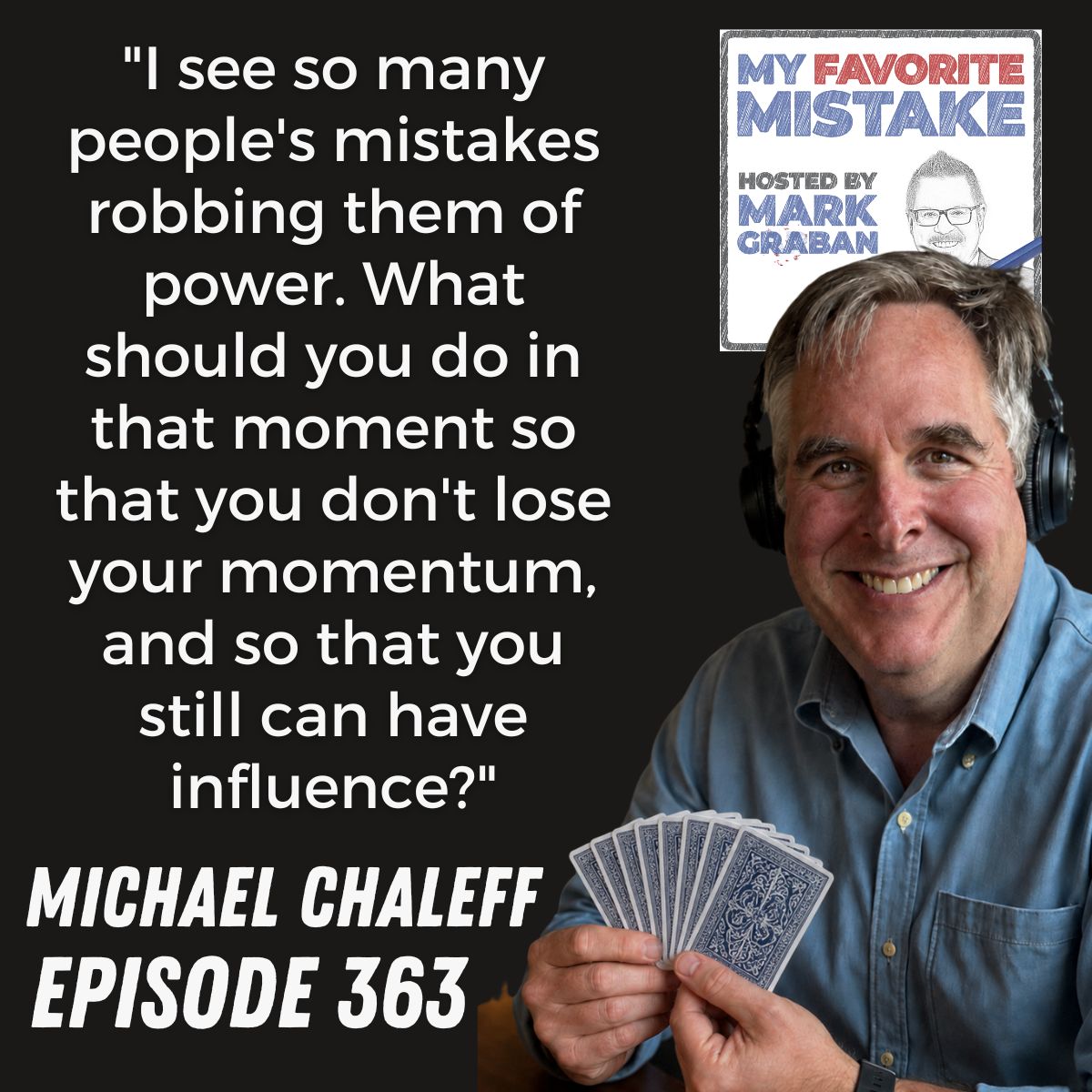
And so I think the first step for everybody — one of the many reasons why I reached out to you, because I loved the idea, and I see so many people's mistakes robbing them of power — was, what can you do or what should you do in that moment so that you don't lose your momentum, and so that you still can have influence? To me, that's what the talk was about, and understanding that. This is one of the things I do when I'm working with people, or people have come to me and said, “What do I do when I screw up?”
Mark Graban: Yeah. And I do want to dig into the connections between being a magician and, if you will, the performance in a courtroom. I do want to get into that. But let me just go back to your story for a minute. Would you frame the mistake as not having game planned what happens if somebody messes with you, or somebody legitimately does not have hands?
Michael Chaleff: Sure. So technically, I think, if someone said, “Did I make a mistake?” — I didn't make a mistake in what I did, right? There was no intention, and that was perfectly appropriate in that context. And so when I think of mistakes — because I'm normally talking to people that are performing or presenting or speaking or storytelling — I normally think of a mistake as something, even if you're not responsible for it. If somebody does or says something and the audience is uncomfortable, you're still responsible for figuring out how to make everyone comfortable, so that you land the plane, so to speak.
In that instance, if you said — which I think is a great question, and I may tell you another story that directly relates to this later in our conversation — but what would I do today? Honestly, today, I would have just said, “Oh my gosh, that's amazing.” And I would have made a joke about it and gotten really curious. Today I wouldn't have imagined stepping in something that horrible. And because it was such a sensitive topic, right, until she had done the reveal, I would have asked her, “Well, how should we proceed?” Just out of really being curious.
The Sin Is Not the Mistake
Michael Chaleff: The big secret, the big reveal — I talk about this in my TED Talk — is if you make a mistake, don't draw attention to it, right? No good comes from you saying, “Let me raise up this thing and draw everyone's attention and remind everyone how horrible it has been.” Because the number one truth in what I learned through that entire year was, the sin is not the mistake. The sin is what you do after the mistake. And how you leave people, and how they feel.
Mark Graban: Yeah. And the thing about definitions — I define a mistake, and to me a mistake and a failure are not the same. To me, a failure is an outcome.
Michael Chaleff: Right.
Mark Graban: You can have a failure caused by a mistake, or a failure has other causes. But to me, the definition of mistake I come back to is, there's the mistakes of commission — I did something that I thought was good and it turned out to be bad. Or the mistakes of omission — I didn't do something and it led to a bad outcome and I wish that I had.
So that's why I was kind of thinking through, it wasn't a mistake to approach that woman and start the trick the way you normally would. But maybe the mistake — and I'm not trying to beat you up — I think that comes back to thinking through, it was a mistake to not be prepared for the different ways people might respond, other than “okay, I'm game, I'm playing along,” right? Because you talk about being in a bar and people might be drunk, and someone might be belligerent. So do you game plan what if someone says, “Hey, get out of here,” and they're cursing? Do you just walk away? You've got to kind of game plan that, right?
Making a Plan for the Thousand Ways It Could Go Wrong
Michael Chaleff: Well, I wasn't going to go through my entire TED Talk, but the first one was, right, something happens: don't raise attention to it. Redirect the room to whatever you want them to — your idea, your passion, your interest, your entertainment. So if something bad happens, don't focus on it. Move to the next thing.
But the second thing was, if either something has happened before or something you're afraid is going to happen, then to me you make a plan. And so over the years, one of the things that I did during that entire time was, how am I going to make sure this never happens again?
And then my mind tends to be one that thinks of the thousand negative things. So it can be maddening to be around me sometimes, because I'll bring forth an idea and I'll go, “These are the eight failure points.” And honestly, as someone that works with me, it's great, because I keep people out of trouble. But as somebody that has to live in my head with the “wow, this is a mistake, this is the problem” — I see the threat matrix.
And part of that is law school. Because law school is about storytelling. And when I went to law school, they tell stories that never have happy endings, right? The contract always fails. The person always loses their leg. The divorce always happens. So you learn about problems that get before the court. So I used to be able to walk into a room and think, “Oh my gosh, that's a beautiful chandelier.” And now I think, “That damn thing is going to fall.” So law school mars you a little bit.
Mark Graban: And engineers — I'm an engineer with no legal training other than an intro to law class that I took my senior year. But I think engineering does give you this mindset to think about what could go wrong, so that you try to proactively prevent it, right? So there's a time and a place for preventing the mistake or preventing the failure or the harm or the tort, instead of just reacting to it well. But either way, let's learn. We can learn proactively, or we can learn after the fact. And you make the key point there — how do we not do it again?
Looking Back With Fresh Eyes: How Was He Showing Up?
Michael Chaleff: I'm 60. I turned 60 a month ago. Maybe two months ago now. And I know you're thinking, “God, he looks so good.” But that aside — one of the interesting things as I've gotten further and deeper into thinking about magic, and more importantly thinking about coaching — being in the Navy, being a lawyer, being a magician, a lot of that was about being clever, I think, in my own mind. And as I've gotten older and gotten more into coaching, and really realized the thing that feeds my soul is helping people find their voice, I look at those things with fresh eyes.
So one of the things I find interesting is, I've started asking myself a question that I can't know the answer to. And that is, if I could go back and watch myself, is it possible that the way that I showed up was as a cocky 20-something to that woman? That the way that I showed up caused her to react in that way?
And the few data points that I've had is, there were some times where I know I got into conflict over ego in my early 20s during that year. And so I think it's possible that I was showing up in a way — either because the way that I compensate for feeling vulnerable might have been, and I wouldn't be surprised, probably was, to show up with more bravado or false bravado — that evoked reactions from people.
Mark Graban: Or you just ran into a lady who was a smartass, right?
Michael Chaleff: Absolutely. Absolutely. And I can't know, other than to have the grace to ask myself the question. Which is, as I've gotten older, I don't feel the need to be as right as I used to be. And so I can look back and say, “Okay, what were the things that were going on?”
Never Ask a Witness a Question You Don't Know the Answer To
Mark Graban: So I'm curious about one parallel to being in court. And again, I've watched enough movies and legal dramas. The one thing that comes to mind, I'm going to frame it as a question of, is this true or is it more complicated than this? Never ask a witness a question you don't know the answer to.
Michael Chaleff: So let me confess. Not all lawyers are trial lawyers. My time doing prosecution — there were not a lot of those instances where I was having those immense cross-examinations. I was in the Alexandria courthouse, and I spent six months doing that. I was a trial attorney doing mostly investigations and doing depositions of people that didn't want to answer questions.
And now, because of how I teach, I'm often teaching lawyers how to give opening statements or how to present storytelling. What I find interesting is, lawyers when they look at a case, often when they're junior lawyers, they look at the facts. And so they give it what I call a narrative. This happened. Instead of looking at it and saying, “I want to create a story that gets the person across from me emotionally involved.” And story is the way that you create emotion and connection, and I think that's the flaw people have.
Why More Facts Make a Weaker Case
Michael Chaleff: To your point, what I'm often struggling to teach, whether it's lawyers or whether it's engineers or — I love economists — is this idea of, how do I communicate complex ideas to the person across from me? And so what becomes essential is, how do I put things together in the simplest way possible in a story that someone can understand, and then use that as a pivot point to start adding more information?
So I find when I'm talking to lawyers that I'm teaching, and I'm watching them put their cases together, they just want to throw all this information at the person across from them. And there's this false belief that if I give them enough facts, they'll figure it out. And my answer is, “No, no, no, no, no. You want to give them the least number of facts with the clearest picture that you can provide, and understand them to the largest extent that you can.”
This is also my concern about lawyers. You went to law school. You spent all of your time around people that think and talk about the law. You all often have a lot of money. You often come from high education. That doesn't necessarily prepare you to have a really important conversation with somebody that's had a completely different life experience. And if you're not listening and you're not talking and you're not aware, you may not even realize that what you're saying is not even landing.
And to me, that's life. It's funny, you have to think about law, I think about life. Like, how do I get the person across from me to hear me in a way that presents an idea that I think is important, that helps them act? Whether you're a lawyer, in court or out of court or anything, those are the things I find challenging. And I'll come back to magic: attention, focus, perception. That's the through line. Influence.
Mark Graban: So you didn't answer my question.
Michael Chaleff: All right. Ask the question again. I want to make sure I answer it.
Mark Graban: Do lawyers think that you shouldn't ask a question you don't already know the answer to?
Direct Examination Versus Cross-Examination
Michael Chaleff: Yes. It is a truism. There are some times that you can ask a question where it doesn't matter how they respond, where they're going to look bad no matter what. Like, why did you leave your children home alone with a gun in the house, right? There's no answer that they're ever going to give that is going to justify that. So there are some instances. But in the vast majority of cases, you don't want to ask questions that you don't know the answer to.
And I'm going to give you — you didn't ask for it, we're going to go one level deeper.
Mark Graban: Please.
Michael Chaleff: So if you're the person putting your witness on, you want that person to tell your story. And this goes back to, are you a good lawyer or a bad lawyer. A good lawyer knows the story that they want to put on with their witness. And so they've either worked with the witness or talked to the witness and they know what's coming in, and they ask questions — what I was saying before — limit the number of facts. You don't want a lot of facts. So I'm using this person to give information to the jury, or to the trier of fact, or whoever I want in front of me, that comes through my question.
That's radically different than what I want to do as somebody that's cross-examining. In cross-examining, I basically want them to affirm what I say. So in a cross-examination, I may have 20 questions. I think shorter cross-examinations are better. I don't ask any question that I don't know the answer to. And usually, if they've done a deposition, if they say something I don't expect, then I can say, “On this date you said something completely different.”
But I'm usually saying, “And you were looking at your iPhone when you did this, and you were going 27 miles an hour when this happened, and you actually owed money at the time that this happened” — and really just getting them to say yes or agree. And I'm really controlling the information that's coming out, in the frame that I want it to come out.
Now, if they say something in a cross-examination that I didn't expect, usually I have a way to discipline them, and that's through a challenge that you would use. “On December 27th you did a deposition, correct?” “In that deposition, that was closer in time to the time when this violent offense happened.” “Yes.” “At that time you swore that you were going to tell the truth, right?” “Yes.” “Even, as a matter of fact, after we gave you an opportunity to change what you said.” “Yes.” “Look on page seven. I've asked you the question, ‘How fast were you going during the time of the incident?' You have just said, '30 miles an hour.' What does it say in front of you?” “50 miles an hour.” “Thank you.” Then, “Were you lying then or were you lying now?” You'd get an objection, you're not supposed to say that. Anyway.
Did I answer your question? Mark, I want to get an A. At the end of this, I want you to say, “Michael, you've got an A+.”
Mark Graban: You did answer the question, and I gave you a chance to educate us. What I heard you saying was, you ask a question, you might not know exactly what words are going to come out of their mouth, but you shouldn't be surprised by a fact of the case. If it's something you don't want to come up, you shouldn't be asking about it, and you shouldn't be surprised.
Michael Chaleff: Correct. When you're doing a cross-examination, if you're good and you've done your homework, you shouldn't be surprised, because you should have laid out all the questions. You should be asking questions where you know they're going to agree.
The challenge, when you become really good at what they call moving on direct, is when the person goes off script. When we're sitting around having cocktails and talking about nightmares, it's like, out of nowhere she admitted that she killed everybody in the house. That's when you get the unexpected answer, that you've talked to the client 20 times, you thought you knew the exact story, and then you got them on the stand and they came out of left field with something that you've never heard of, and you're now left with, “I don't know how to fix this.”
Mark Graban: And you don't remember what happened after that either, like this.
Michael Chaleff: Yes. Yes.
Emotional Connection Before Chronology
Mark Graban: So I want to talk a little more about storytelling, because you're making me think a little bit of my own journey of trying to become a better storyteller as a speaker or as a writer. You talk about wanting to give all of these different details. I'm an engineer. My wife is also an engineer, but she is a better natural storyteller, and she always reminds me — in a loving, friendly way, that sounded really aggressive — you don't always need all of that detail. You tend to give too much detail.
I think that's the engineer trap, to think about the facts and the details mattering, as opposed to what decision, what conclusion do you want someone to draw from the story? What's the goal of your story?
And I'm curious if you've run across — someone I've been studying and trying to learn from is a behavioral economist. You mentioned liking economists earlier.
Michael Chaleff: Kahneman?
Mark Graban: Rory Sutherland. No, I think he's younger than Daniel Kahneman. Maybe not a generation younger. Did you know of Rory Sutherland?
Michael Chaleff: The name sounds familiar. What ends up happening is everything sort of blends together in my mind. As I become busier and busier, I'm usually trying to find something on a podcast. And so the names don't always land, but the concepts do.
Mark Graban: Well, so I'll tell you. I wasn't trying to quiz you. Again, you're not being graded. Relax. It's not law school.
Michael Chaleff: I feel like I'm being graded. My A has moved down to a B.
Mark Graban: No. But Rory Sutherland is one of the heads of the Ogilvy ad agency in the UK. And one of my great takeaways from seeing Rory Sutherland speak and reading his book is, you've got to make that emotional connection first before all else. Don't tell the story sequentially, chronologically. There's got to be some sort of emotional hook, that they've got to feel some sense of pain in the situation before they even want to listen to a solution. Which sounds obvious in hindsight, but that's something I've struggled with, and I think it's something I've tried to get better at.
The Four-Act Structure for Micro Storytelling
Michael Chaleff: So there's so much information about stories out there, and we were talking before about lawyers having trouble with stories, which when I say that, people are sort of shocked. When I think of story, I'm actually thinking of the classic narrative structure — a three-act structure. Act one ends with the hook, and we'll talk about the hook. Act two is the journey, and act three is the resolution. And then for my purposes, I add act four. My act four is clarity.
And when I teach storytelling, I'm teaching micro storytelling with a purpose. So what that means is, when I teach someone to tell a story — and actually I'm working on a book right now on this — it's purposeful. I'm telling the story to get an outcome. I'm telling the story because I either want to lead, I want to inspire, I want to sell, I want to do something.
So in the world we live in, right, with TikTok, people just have short attention spans. How do I get there quicker? And I'm going to come back to your question. The difference between a story and a narrative, which is just a bunch of facts, is: I got up this morning and I went to the market and I got pizza and I came home and we ate it. Facts.
And I'm going to forgive — I know this example came from a book that I read, and I'm going to apologize to the author in advance. I'm stealing your idea and I'm not giving you credit, and I am so sorry. But the difference is: I went to the market because my child was deathly ill and I needed milk, and it was closed.
Mark Graban: Mm-hmm.
Michael Chaleff: It creates this tension of, well, what happened? And so act one ends with this idea of a hook. And the hook is, what is the thing that causes me to feel uncomfortable or want to know more? So either it begs to be resolved, or it's like, “Michael, you do all these things. How do they all fit together?” It is that thing that drives interest or wanting resolution on the part of somebody else.
Mark Graban: So in your favorite mistake story, did act one end at the point where the woman said, “I don't have any hands”?
Michael Chaleff: Yes. It's a micro story, and it ends with, “I don't have hands.” And then everyone goes — if I stop talking at that moment, you'd go, “Michael, you can't stop there. What happened? Did she not have hands?”
Mark Graban: Right. Yeah, because I did that.
Michael Chaleff: Yeah. You were a perfect audience, and I was a perfect storyteller. In that moment, people can see the confluence of those things.
Two Questions That Find Your Hook
Michael Chaleff: So when I talk to somebody about a story, I usually ask — it depends on whether they start talking about a story or whether they say, “Michael, we want to start with a consult.” What I usually say is, “What is your audience and what is your goal?” Because that drives all the decisions.
And then I will say, “What is your story about?” And usually when I ask somebody what their story is about, they've crystallized the hook in that moment. And if it isn't that, then the next question gives you the hook, which is, “What is the action or thing that got you to that point?” Those two questions get you the hook of your story.
Mark Graban: It's the emotional center you're talking about. And so then walk us through act two and act three again. So act one is the hook.
Act One: People Need Much Less Than You Think
Michael Chaleff: Well, all right, let's finish act one as long as we're — you're going to get the summary of my book.
Mark Graban: Okay.
Michael Chaleff: But still buy the book when it comes out.
Mark Graban: Yes, please do.
Michael Chaleff: So act one is where everybody has the problem, and this is what you're talking about and your wife's talking about. Because from our point of view, and the things that are important to us, people want to add all of this information. “This is where I was in my life, and this is what was going on, and this is what was needed, and this is where I was and how I felt and what I was wearing and what I ate.” People need enough information to be oriented with who are the players and where were they in space and time. That's all that matters.
Mark Graban: Because I get annoyed if someone's telling me a story and they jump in. I'm like, “I don't even know what — why are you telling me this? Who are these people?”
Michael Chaleff: Yes. And here's the challenge. The amount of information, if I'm going to tell a legal story to lawyers, would be significantly less than I would tell somebody that was a non-lawyer. So it's not a static decision. How much act one needs to be is radically affected by your audience and your goals. But the big message I have for people is, they need much less. They need much less.
And to me, I think of stories as tools. So when I tell a story, I'm assuming that I'm going to polish it and use it for a lifetime and pull it off my shelf and continue to use it. So I'll say to somebody, “How did that land? What worked? What didn't work? What more did you want?” And then to me, it's constantly growing and adapting.
Mark Graban: Yeah. There's a feedback loop there.
Michael Chaleff: Correct. Yes. So that's act one. I want act one to be enough for people to get enough information to get the hook. And this is for a micro story. If I was turning a story into a stage play, then my act one might be longer, right? The time that I invest in each section depends on, what am I doing and why am I doing it? So I'm very mindful and practical about what I'm trying to accomplish.
Act Two and Act Three: Collapse the Journey
Michael Chaleff: Act two is the journey. So what happened, right? In my story, we jump through act two. We get right to it. I tell you my emotional state, tell you where I was, and then the resolution is, she put her hands on the table. That's act three. And then we kind of talk about a little bit what happens.
Act two can go really long, right? Everything that happened or didn't happen, you can add or subtract in that story. To me, the big trick is what I did for you. I answer two questions: what was my emotional state, or what do you need to know?
Let's say, for example — tell me your favorite. Why don't we do this? Do you have a story? Or would that be terrible? You've told all your stories so many times. Why don't we play with one of your stories? But I don't know if I'm putting you on the spot.
Mark Graban: And I don't know if we have time for that.
Michael Chaleff: Okay. Perfect. You're going to have to have me back.
Mark Graban: We'll find out. I'm sorry.
Michael Chaleff: So normally when somebody says, “I went on this long journey, and this is what I learned here, and this is what I learned here, and this is what I learned here,” I just say, “Tell me what you learned.” Like, “Over the 10 years after I had this experience, what I learned was important was, it was really about my emotional state.” Or, “You need to know that when I left that courtroom, I hated my wife,” right? Just tell me what I need to know. It collapses. And then act three is the resolution. How does it all work out?
Act Four: Say the Takeaway in Five to Seven Words
Michael Chaleff: Now, act four is this piece. When I'm doing something for a business purpose or a selling purpose, I don't want there to be ambiguity, so I just tell people what their takeaway is. So this is what I learned from that story, and I do five to seven words. “Give gifts often.” Or, “My big takeaway is, you always have to be kind to people.”
A lot of times I'm helping people do interviews. “How do I tell a story in an interview that makes sure I get hired?” Give them that five to seven words that you want the interviewer to remember about you. “I always go to my boss when I have challenges.” Whatever that is.
Mark Graban: So then in act four, is it fair to say you're trying to provide clarity without over-explaining things?
Michael Chaleff: Absolutely. Absolutely. And what I say to people is, “How many times have you gone to a movie and everyone walked out and you're like, ‘Did we watch the same movie?'” Everyone's looking at it, they came to different conclusions. No matter how well you tell a story, people have different life experiences, and so they subjectively add different parts to it. It may land in a different way. Even though you've told the story the way you wanted to, they may have a different takeaway.
When it's important, don't be accidental. Say, “This is how it's changed the way that I work or think, or what I learned.”
Mark Graban: Yeah. I mean, I think in business it would be a mistake for everyone to leave a presentation with a different takeaway. Maybe in the art of filmmaking, maybe a movie that everyone walks away from with a different perspective on is great filmmaking.
Michael Chaleff: Yeah, it might be, right? And it goes back to the question — I often say, “I'm a dumb rock. What is my goal and how do I get there?” And so when I'm talking to somebody about what they're trying to accomplish with their story, I'm getting really clear on, what do you want to happen?
And what I love is talking to different people. Like, I did storytelling for funeral directors. So we talked about having story to sell more caskets. Or in a lot of instances, how do you help people with grief? I was working with physical therapists the other day. How do you use story in the context of a physical therapy session, when you only have 30 minutes and you're trying to inspire this person to do their exercises? Just things like that.
The Book in Progress, and Why It Needs More Examples
Mark Graban: Okay. So as we wrap up, I am very curious about your book. Is the focus around in particular these micro stories, or storytelling more generally?
Michael Chaleff: No, it's completely — I really love stories. I love talking to people about stories. But my question was, do I have something to say that other people don't? And my answer is, I really think being purposeful about stories, and learning how to tell micro stories in really powerful ways, and having a roadmap about how to do it. We talked about some of the tricks about how to do that.
The thing that's getting in the way is, I have most of the book written and I know the whole structure. What I think is, no matter how cleverly I explain it, what I really need is example after example after example. So I'm now in the process of finding people and saying, “Spend 30 minutes with me. Tell me your story and let's edit it together,” and then it's going to be a section in the book, or I'm going to use it for specific purposes. And finding those people that are willing to do that with me is really what I'm spending a lot of the time working on.
Mark Graban: Yeah, because micro stories — as a podcaster, or if I'm interviewed on a podcast or on radio, or if I'm doing a training session or giving a talk, I use micro stories. You define that as, like, 30 to 90 seconds.
Michael Chaleff: Yeah.
Mark Graban: But it still goes through those four acts.
Michael Chaleff: Absolutely. Well, you don't always use the fourth. As you said before, sometimes I don't care if there's clarity if I know that I'm getting the reaction that I want. Particularly when it's a business purpose or something that's heavily commercialized, people want their tagline, because I think that's a powerful branding tool. Or if you're in a job interview and there's a thousand people, you want people to remember you and remember that thing about you.
Mark Graban: Great. So do you have a title for the book as we wrap up?
Michael Chaleff: You know, I've gone through a bunch. It's basically going to have some variation of micro storytelling and being purposeful. But my best friend and I are fighting. It's ChatGPT and Claude, and I write the book and then they tell me what they hate about it, and then I have them play against each other. And so I have like five different titles right now. I'm going to wait till I get to the end, and then I think the title may change.
Mark Graban: Sure. That's a hard thing to try to crystallize, and at some point something will hit you and you'll go, “Ah, that's it.” But the work goes on in the meantime.
Wrapping Up
Mark Graban: Again, our guest today, Michael Chaleff. I said that wrong. Chaleff.
Michael Chaleff: Chaleff, yes.
Mark Graban: I said it right the first time. That was my mistake. Michael Chaleff, our guest today. The website, we do know this, practicalinfluence.com. I'm sure you can follow his work there or on LinkedIn, and we'll all learn when you announce the title of the book, and we'll learn when it's out, and I'll look forward to reading it, because it's going to hopefully make me a better storyteller.
Michael Chaleff: And I would love to get your feedback on the TEDx talk. So if you have a chance to see that, I'd love for you to take a look at it and then let me know what you think about that. It was really fun to do, and I made mistakes in there. So maybe I'll come back and we'll talk about all the mistakes I made during my TEDx talk.
Mark Graban: Okay. But Michael, thank you so much. I didn't know if it was going to spoil the story to watch the talk in advance, so I'm going to go watch it now. You had told me the story in the initial email, but I very much tried to put it out of my mind, so for better or for worse I could react naturally to the story and the way you told it.
So, thank you for being the first magician, or at least the first person to admit being a magician, here on the show. But really enjoyed having you here, and thanks so much for being a guest, Michael.
Michael Chaleff: Thank you. It was a joy.