
What happens when a career decision that feels like a mistake turns out to be the right move—and burnout still finds you years later? Dr. Susan Landers shares hard-earned lessons from decades in neonatology, physician leadership, and ultimately confronting burnout head-on.
Listen:
Check out all episodes on the My Favorite Mistake main page.
My guest for Episode #213 of the My Favorite Mistake podcast is Susan Landers, M.D., a retired neonatologist, author, & speaker. She practiced full-time in the NICU for over thirty years and wrote a book about her experience: So Many Babies: My Life Balancing a Busy Medical Career and Motherhood. Susan is an expert in physician burnout, breastfeeding medicine, & donor human milk banking. During her career, she published over thirty peer-reviewed papers.
In this episode, Susan shares her favorite mistake story about a career decision that she thought was a mistake for years… but things turned out fine. But how did she get disillusioned with working in healthcare and how did that lead to burnout? How can we recognize burnout in ourselves (and others) and how can we help? How can we take better care of ourselves?
Questions and Topics:
- What motivated you to leave academic medicine after 14 years?
- What was your husband's role during this transition, and how did it affect him?
- How did the change from academic medicine to private practice impact you professionally and personally?
- Can you describe some challenges and ethical dilemmas you faced in the NICU?
- How did these challenges contribute to your feelings of burnout?
- When did you first recognize that you were experiencing burnout?
- What were the signs of burnout, and how did they manifest in your behavior?
- How common is it for others to recognize burnout before the person experiencing it?
- How prevalent is physician burnout, especially post-pandemic?
- How do you see hospital systems contributing to burnout, and what systemic changes are needed?
- How often do leaders mistakenly blame individuals for burnout rather than addressing systemic issues?
- What measures can hospitals take to better support their staff and prevent burnout?
- What advice would you give to loved ones of healthcare providers who might be experiencing burnout?
- Can you tell us about the burnout checklist and other resources you’ve developed for working mothers?
- What steps are necessary for someone to recover from burnout?
- Read about the signs of physician burnout
- Get a checklist for signs of burnout in working mothers
Scroll down to find:
- Video of the episode
- Quotes
- How to subscribe
- Full transcript
Find Dr. Landers on social media:
Video:
Update Episode About Her New Book:
Quotes:
Click on an image for a larger view
Subscribe, Follow, Support, Rate, and Review!
Please follow, rate, and review via Apple Podcasts, Podchaser, or your favorite app — that helps others find this content, and you'll be sure to get future episodes as they are released weekly. You can also financially support the show through Spotify.
You can now sign up to get new episodes via email, to make sure you don't miss an episode.
This podcast is part of the Lean Communicators network.

Other Ways to Subscribe or Follow — Apps & Email
Automated Transcript (Likely Contains Mistakes)
Here is the cleaned-up transcript with relevant diagram triggers inserted.
Mark Graban: Episode 213, Dr. Susan Landers, author of the book, So Many Babies.
Susan Landers, M.D.: My favorite mistake was after 14 years in academic medicine.
Mark Graban: I'm Mark Graban. This is My Favorite Mistake. In this podcast, you'll hear business leaders and other really interesting people talking about their favorite mistakes because we all make mistakes. But what matters is learning from our mistakes instead of repeating them over and over again. So this is the place for honest reflection and conversation, personal growth, and professional success. Visit our website at myfavoritemistakepodcast.com to learn more about Dr. Susan Landers, her books, some special offers, and more. Look for links on the show notes or go to markgraban.com/mistake213. As always, thank you for taking time to listen. Hope you enjoy the show.
Hi everybody. Welcome back to My Favorite Mistake. I'm Mark Graban. Our guest today is Dr. Susan Landers. She's a retired neonatologist, author, and speaker. She practiced full-time in the NICU, or neonatal ICUs, for over 30 years and wrote a book about her experience titled So Many Babies: My Life Balancing a Busy Medical Career and Motherhood. So Susan's an expert in topics including physician burnout, breastfeeding medicine, and donor human milk banking. During her career, she published over 30 peer-reviewed papers. And Susan, I'm really glad that you're here. How are you today?
Susan Landers, M.D.: Oh, thank you, Mark. I appreciate the invitation. I'm great. I'm looking forward to a good conversation.
Mark Graban: Yeah, there's a lot to talk about here today. It's funny, with NICU, if people are not familiar with that, I pointed out the neonatal ICU, for those who don't know, of course, stands for—
Susan Landers, M.D.: Intensive Care Unit.
Mark Graban: My mistake.
Susan Landers, M.D.: Neonatal Intensive Care Unit. It's just like an ICU for adults, except it's still filled with babies.
Getty Images
Mark Graban: Yeah. And the babies there… children age range, what ages are in there?
Susan Landers, M.D.: The babies are premature infants from 23 or 24 weeks gestation born early to full-term babies who were born sick. And some of these infants stay in the NICU for six months or more. The average length of stay is probably two months. Sort of depends on the weight and gestational age of the baby. But it's not a place parents think much about until they have a baby that has a problem or is born premature. So the general public sort of doesn't have it in the forefront of their mind, but for parents who have a child that's sick, it is a big deal and it's a lifesaving area of the hospital.
Mark Graban: Yes, it is. And life-changing. And the little bit I've had the opportunity to work around hospitals and work with people and observe them working in the NICU, it's such incredibly important, heroic, meaningful work, and the people who work in those settings are amazing. So thank you. And thank you to the others who are helping babies and parents and their families that way.
Susan Landers, M.D.: Well, you're welcome. The one thing that I missed the most since I retired from clinical medicine is the teamwork. You can't work in an ICU without appreciating all the other people, all the ancillary healthcare providers that make the care possible. And I miss working with the nurses and the respiratory therapists and my partners and social workers and lactation consultants. And there's this whole cadre of people that come into an ICU, whether it's for adults or children or neonates, and they make things happen. It's amazing to be a part of that kind of team.
Mark Graban: Yes. Well, thank you for acknowledging the full team effort there, Susan, and thank you for your work. So as we dive in here, I don't know if your story is from the NICU or what the setting is. So instead of guessing, I'll just ask: From your career and things you've done, Susan, what would you say is your favorite mistake?
Susan Landers, M.D.: My favorite mistake was after 14 years in academic medicine—that is working for a medical school, actually two medical schools, and practicing in the NICU, teaching residents and fellows, teaching medical students—I decided to switch gears, pivot, and go into private practice. Now, private practice neonatology is very different from academic medicine. Usually, people in private practice do not do clinical research. There is less of an effort toward teaching residents and students. There may be an effort towards teaching nurse practitioners. And my husband and I made this major shift to leave academic medicine and go into private practice when I was 45 and he was 48.
Mark Graban: And what… was he a physician also? What specialty?
Susan Landers, M.D.: He is. My husband is a pediatric nephrologist; that's children's kidney diseases. And we had good jobs in academic medicine. We were working for a smaller medical school in a southern state. He was a division chief and vice chair of the department and just had the best job ever. We were recruited there for his job. And I had just kind of an average job and I was working too many hours and my clinical research was not going well. I had started out at Baylor College of Medicine and Texas Children's Hospital in Houston. And my career got off to a good start until I started having children. And then things slowed down a bit, but I was still managing to do clinical research and write papers.
So we moved to the second medical school for my husband's job, and I became very unhappy, not only because of managing three kids and a full-time career, but also because the clinical research wasn't going very well. I was having trouble getting papers published. I didn't have a collaborator in my area, but I did start in a new area there. I started in the quality improvement area in academics and also breastfeeding medicine in the NICU. But the long and short of it is I became very unhappy and disillusioned with academic medicine. I felt like I couldn't do it. I felt like I couldn't do it all and be really good at being a teacher and a researcher and a mom and take all the call and do all the hours. And so I just decided to change and I convinced my husband to change along with me.
Mark Graban: Now at the time, correct me if I'm wrong, he did not share similar disillusionment. He was in a leadership position doing that other work.
Susan Landers, M.D.: Correct. He loved it. He had helpers, hot and cold running secretary, research coordinator, transplant coordinator, nurse. And I just struggled as much as he was on Easy Street. And it began to affect our marriage, obviously. And I felt like it enhanced my resentment of his having a good job. And it enhanced my feeling of struggling, not being able to make it because he had it so well, and I was still struggling to get myself securely footed. It had taken me eight years to get promoted. It should only take six or seven. He had been promoted more quickly than me. So for a number of reasons, I felt like I wasn't gonna make it in academic medicine.
Mark Graban: Right. But not disillusioned with medicine, with the academic side of it.
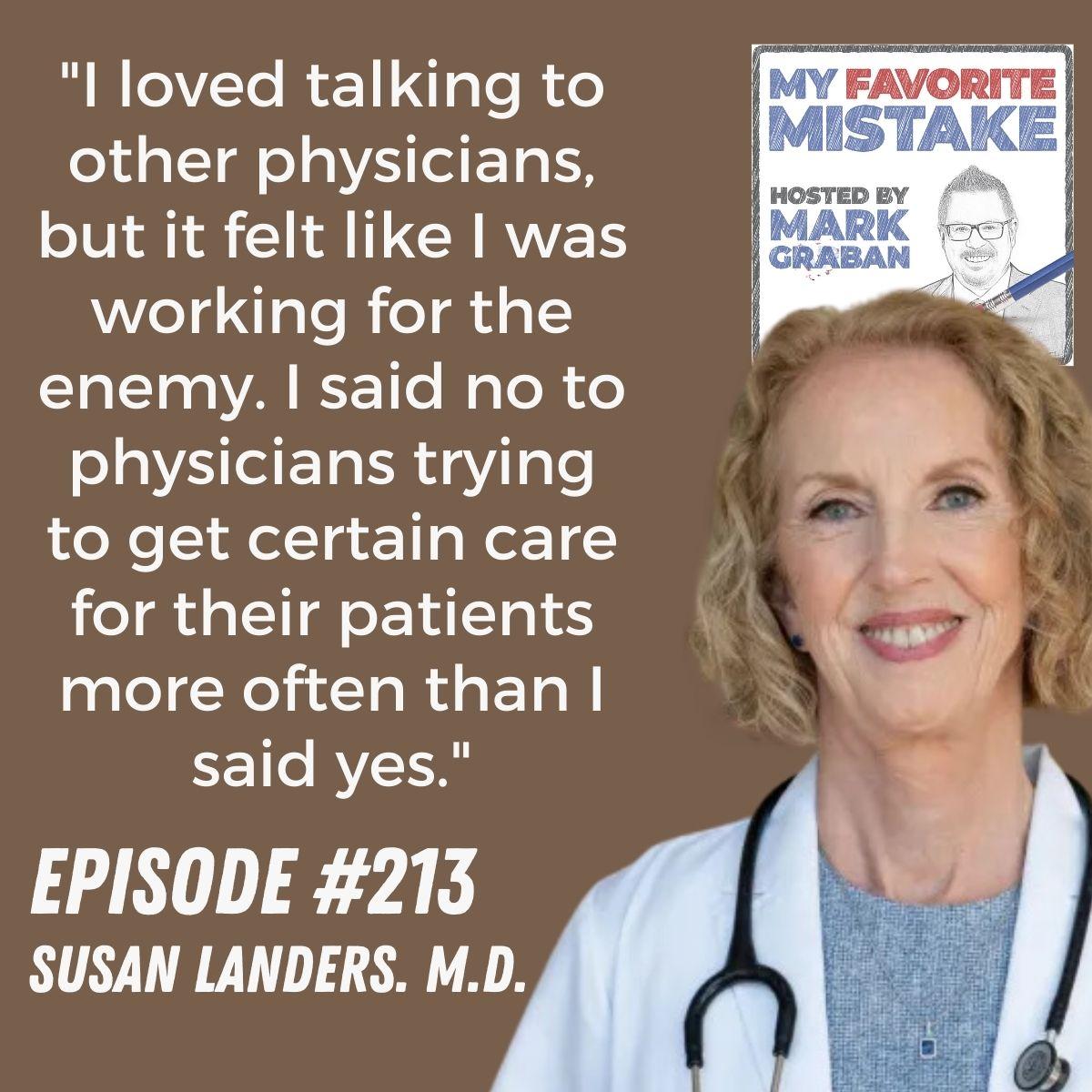
Susan Landers, M.D.: Actually, I was a little disillusioned with the whole NICU thing, and I took a job working as a medical director for a small HMO, a Health Maintenance Organization. I worked as a medical director for two years before we left academics. The medical school owned this HMO and the HMO was attempting to organize the care of all the primary care doctors at this medical school. And I enjoyed being a medical director. I learned a lot. I took a lot of physician executive courses. I traveled, I loved the meetings, I loved looking at the data, and I loved talking to other physicians on the phone. But it felt like I was working for the enemy. I said no to physicians who were trying to get certain care for their patients more often than I said yes. And I was purely following these national protocols and guidelines that insurance companies and HMOs used, but it didn't feel right. I really felt like I was working with the enemy. That's the best way to express how I felt.
Mark Graban: It must have been frustrating having to say no, not from your professional clinical education and experience, but from these guidelines.
Susan Landers, M.D.: Exactly. That was it. I was listening to the docs on the phone going, “Oh, I hear you. I understand, but my company follows these guidelines and they won't let me approve this.” And it just felt wrong. And so that was the final nail in my academic coffin. I enjoyed the experience. I loved everything I learned about being a physician executive, but I just threw in the towel on academics and research and said, “We gotta do something different.” And fortunately, my husband loved me enough and loved our family enough to make the change with me.
Mark Graban: You didn't have to… Right. So I was gonna ask, what was the motivation for you to pull him into this with you or the motivation for him to come with you? It seemed like that could have been separate, like your HMO job. Tell us more about that.
Susan Landers, M.D.: Well, he knew the HMO job was sort of a respite for me away from all the clinical hours. I was probably working 60 hours a week and taking way more night call than he was. And so he thought that the medical director job would be a recovery. And it wasn't. It allowed me time to say, “I really wanna be in clinical medicine. I loved taking care of patients and I knew I liked quality improvement by that time, and I missed it. And I didn't want to work for an insurance company.” So we had to say to each other, “Wow, we've gotta find a place where we both have good jobs.” And it did not take him too long to figure this out. I remember one of his buddies in pharmacology said, “If mama ain't happy, ain't nobody happy.” And he told my husband that, and I went, “Well, that's kinda silly.” And he said, “But it's true.” And I said, “Well, maybe it is true.” And so my husband loved me enough and we wanted to stay married and we wanted to have a family together. And so he was willing to sacrifice and look for new jobs.
Mark Graban: Now did that mean moving though? Cause I still understand… Okay. It meant moving.
Susan Landers, M.D.: It meant moving and leaving where we were. And he had always wanted to practice in Austin, Texas. When we were in Houston, we had family in Austin and had our eyes on retiring in Austin. And so when we decided to leave academics, this amazing job for him, an amazing job for me just materialized in Austin. We were both able to work with people we had trained with in Houston. He was able to start a small subspecialty practice and grow it from five to 35 physicians. I was able to join a group of nine men in a neonatology practice, three of whom I had trained with. It was like coming home. It really was wonderful. And the clinical medicine was great. It was easy. It was what I knew how to do. And it was almost effortless to just kind of rock back into the NICU and take care of patients and work with moms and talk to nurse practitioners and work with them. So it just turned out to be something that was wonderful for both of us. And that's where we stayed for the next 25 years.
Mark Graban: So the mistake… I mean, there were challenges and issues along the way. Would you say the mistake, the favorite mistake, was going into academic medicine?
Susan Landers, M.D.: Well, I told you initially my favorite mistake was leaving academic medicine. I had always wanted to be a researcher and publish papers and speak at meetings and present data. And in my mind, that was the real deal in neonatology. But turned out that I was better at being in private practice. I had an opportunity to become a medical director of the human milk bank. I began to do some real serious policy work with the American Academy of Pediatrics. And my opportunities in private practice were greater than they had been in academic medicine. So… I don't know. I think so the mistake is that I was in academic medicine for 14 years before I figured out that I needed to switch.
Mark Graban: Or yeah. So yeah, it could be framed as… I mean, it almost sounds like also you're saying you felt like it was a mistake leaving academic medicine, but it actually turned out to be a better path.
Susan Landers, M.D.: Exactly.
Mark Graban: That's the way to summarize it, right?
Susan Landers, M.D.: I think so. Yeah. You hit it. The first two years in private practice, I walked around going, “Well, this is really easy, and what is it that makes people good doctors in private practice?” And you know, I had a CV that was respectable, and I had all this experience as a physician executive, and nobody cared about that much in private practice. They really care about who's nice, how many patients you have, how well you get along with other members of the medical staff, how well you turn over patients and contribute to hospital revenue streams. And that was sort of a shock to me at first. The differences between academic medicine and private practice were unsettling until I figured out that I fit in there.
Mark Graban: Yeah. So during that adjustment phase, it felt for a while, those two years or however long, felt like a mistake and then realized, “Yeah, you know, this is better.” And that's one of the tough things of evaluating a decision: you're making a prediction that this direction will be better. You might have second thoughts, “Have I made a mistake? Do I keep with it?” That's hard to navigate and think through. But I think that path that you went through seems clear.
Susan Landers, M.D.: Right. Yeah. And I hear young women nowadays talking about making a pivot, a job pivot, and I guess they mean a job change when they're in a situation where they're not happy and they want a quick fix. Like my being a medical director for a couple of years, that was a pivot. Well, it was a total change. It was really outside of clinical medicine. And the real change became the switch to private practice. And so I guess what young women, young professionals are talking about is when they don't like where they are for whatever reason—the hours, the schedule, the patient load, the clinical practice structure—they wanna pivot to a different kind of practice. That's very reasonable, but it's really difficult to do. It's difficult and scary in retrospect. I remember thinking that I was brave to do that, that both of us, me and my husband, were brave to just take this huge move into a city we had never practiced in and give it a go. And it turned out beautifully well.
Mark Graban: Well, I'm glad to hear that. And maybe talk about some of the other challenges you faced along the way. I mean, becoming an expert in burnout seems like was not an academic study. This is something you lived through. So I was wondering if you could talk to us about what it was like to experience burnout. You know, when did this happen? Tell us about that.
Susan Landers, M.D.: I did not experience burnout until much later in my career. I was almost 60 years old and I was getting a little tired and working still probably 50 hours a week taking night call. That's a lot when you're 60. I was happy with my accomplishments and quality improvement and donor milk banking. And it was just kind of the mundane work of being in a NICU. I was tired, physically tired. We had some very difficult and challenging ethical cases.
One tiny, tiny baby whose father would not let him go when he had huge hemorrhages in his brain. And then he developed a fungal meningitis brain infection. And he was just going to be devastated. And the father just could not see his way to allow his child to die. That case bothered me a lot and a lot of my partners too. But, you know, we got through it and the baby went home. And of course, the baby turned out to be totally devastated.
There was another child who was born with an extremely unusual birth defect called Cloacal, where your rectum and urethra and vagina all empty out into this thing in the lower part of your abdomen. It's like a hole in the baby's pelvis. And it's a terrible birth defect, and it's usually inoperable. This baby had several operations, and the surgeons attempted to fix everything. She lost one kidney, the other kidney didn't work very well. She had a colostomy bag. Her parents were in and out of the military, and mom got a divorce during her one-year stay of the NICU.
Those two cases, at the same time, for different reasons, I was troubled by what we were doing in neonatology. I was troubled by all the technology. I was troubled by this “because we can fix something, we should fix it.” And so I became emotionally overwhelmed. I had never let cases get to me like those two cases did. And maybe it had to do with the parents, maybe it had to do with my personal life at the time, I'm not quite sure. But physical exhaustion on top of emotional overwhelm were the first signs. My nurse practitioners noticed that I became very cynical and I said, “What is going on with you? Why did we bother? What's the point?” “Care… gosh… doesn't matter. Something's bound to go wrong.”
Mark Graban: And right there, that sounds like a key difference between just exhaustion and fatigue and burnout.
Susan Landers, M.D.: Clearly. Yeah. We all get exhausted and tired after 24, 36 hours of call. But when it's chronic and when you throw on the emotional component, and then when you start to feel separated from your patients, it is clearly abnormal. And I felt that, but I didn't recognize that. One of my partners asked me one day, “Are you ok? You just don't seem like yourself.” And I said, “Yeah, I dunno, maybe I'm not okay.” And then finally, Mark, one day I said to a partner, “I just don't feel like I'm making any difference. What is the point? Why bother?” And he looked at me and he said, “You really are not yourself.” And that's when I knew that lack of fulfillment, that lack of agency was the final part of the triad that told me, “Oh my God, I'm totally burnt out.” I went home and said, “Philip, did you understand that I was getting burnout all this time?” He said, “Yeah, didn't you know?” I said, “Well, I guess I didn't realize it. Why didn't you say something?” He said, “I thought you knew that you were kind of fried.”
Mark Graban: I was gonna ask, how generally true is that, that somebody else would notice the cynicism and the burnout and point it out as opposed to kind of self-discovered?
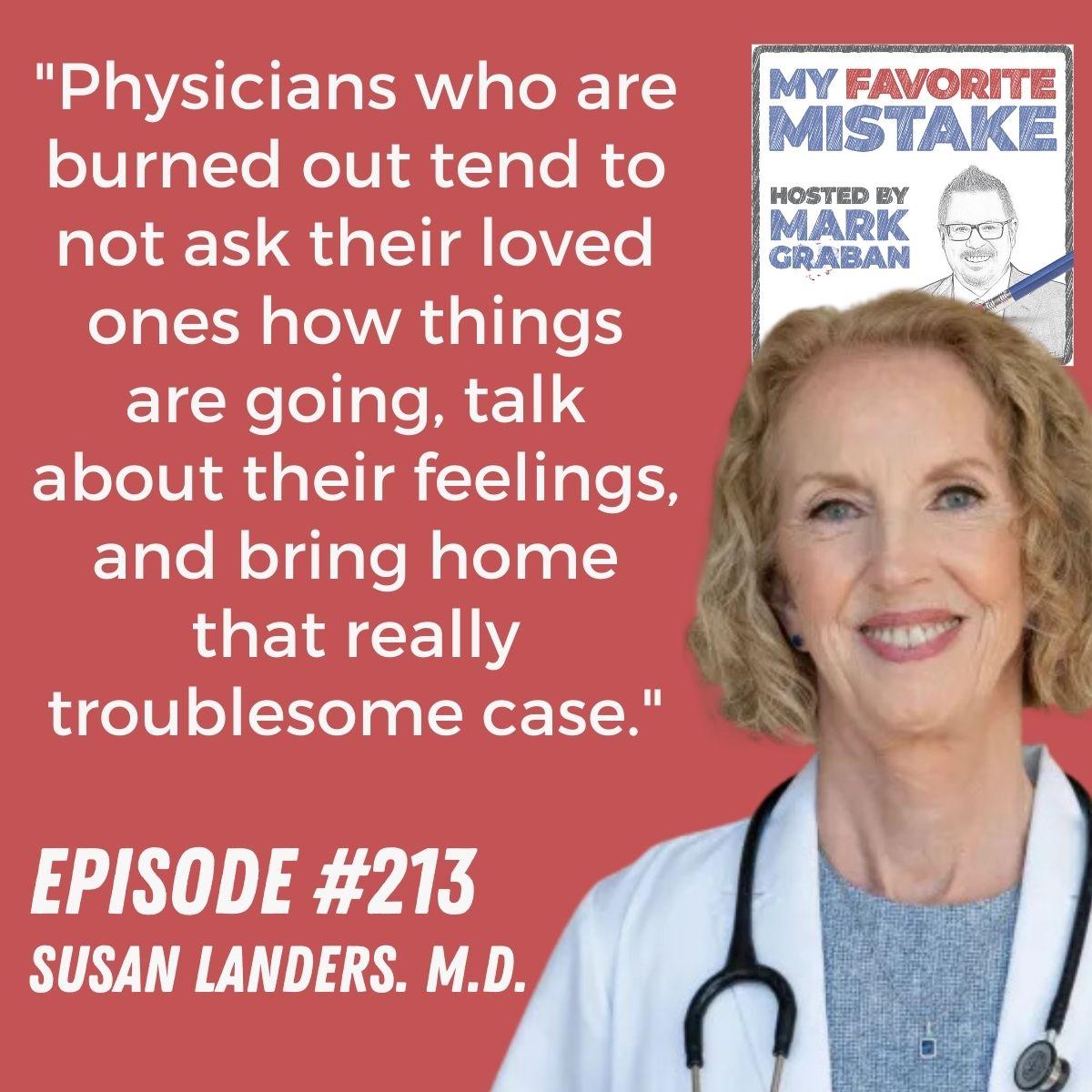
Susan Landers, M.D.: From my reading, it's most common that our loved ones notice it in us first. He knew it, and my partner knew it before I did, before I figured it out. I was just dragging around, going through the motions. And they both said, “Yeah, we knew you were burned out.” It's like, “Why didn't you tell me?” And I guess they thought I needed to discover it for myself. But physicians who are burned out tend to not ask their loved ones how things are going and talk about their feelings and bring home that really troublesome case. They tend to not admit, “Man, I'm just really overwhelmed with this case.” My husband and I shared that case, the baby with the birth defect. So he knew that I was real torn about, you know, they had the baby on dialysis. It was just a mess. And this poor baby finally went home and her mother came back into my husband's clinic and said, “When can we stop doing this dialysis?” And he said, “You can stop doing it anytime you want.” It was peritoneal dialysis. She was doing it at home. And the mother said, “She can't be transplanted.” And he said, “No, there's no room in her body to put in an artificial kidney.” And so the mom said, “I'm ready to stop dialysis.” And that happened when the baby was 14 months old after all of this time and doing all those things. So he was affected by this case too, and he wasn't talking about it, but I don't think he was burned out. We've talked about this quite a bit. He didn't do as much physical call, he didn't do as much up at night procedural work as we did in the NICU. And so he wasn't as exhausted as I was. But he did notice my being that way. And he didn't help me talk about it. I don't know why, but he didn't.
Mark Graban: So I mean, it sounds like there's a lesson there: If someone listening is the loved one of a physician, or maybe just even more broadly speaking, healthcare or elsewhere, if somebody seems not themselves, if they seem cynical and questioning “why am I doing this?” it sounds like it's worth bringing up, even if that might not be easy to do.
Susan Landers, M.D.: Totally. Yeah, totally. Sometimes you'll see your loved one just come home and pour a drink and wanna sit alone. And I probably did that many nights. Pour up a glass of wine and wanna sit, day go away. So your loved one who's a nurse or physician or respiratory therapist themselves, not from you, but from patients… question what's going on? What's troubling you? Can we talk about it? Because the only way you get better is to acknowledge the things that are overwhelming, to actually look at the issues, to actually say, “I'm working too many hours. I don't feel like I'm making a difference with my patients, or these patients are troubling me.” You've got to admit what it is that is burning you out.
In the pandemic, all those ER doctors knew it was not beds, it was not enough nurses. It was waiting on a bed in the ICU. It was death and dying right and left. They knew what was burning them out, and they were working their tails off. But it took a lot for hospital administrators to figure out and for their managers to figure out, “Hey guys, we need to sit down and talk about our feelings.” Physicians have feelings, nurses have feelings, and if they don't talk about those feelings with their peers, they stuff them. And stuffing 'em is what creates the burnout.
Mark Graban: So how prevalent is physician burnout and how much worse is that now? Three years since the start of the pandemic?
Susan Landers, M.D.: It's very prevalent. It's up to about 50% in Medscape surveys. It used to be around 30 to 35%, and people were raising red flags. Among nurses, it's 45%. Some nurses even feel susceptible to violence and verbal attacks from patients. They're admitting to not feeling supported by their hospital administrators. So physician burnout and nurse burnout are max now compared to when they've ever been. And the pandemic made all of that worse because the pandemic showed how poorly our hospital systems function when under stress; they function well in normal everyday activities. But our hospital systems do not do well when they have to ratchet up.
And so it's very prevalent right now. Anxiety among nurses is sky high, 55, 60%. The younger women are more affected by anxiety than the older ones. They feel like they don't have anybody to talk to. That's a recurring theme: “I don't have any support. Nobody cares about me. My manager just wants the schedule filled.” They're short staffed. There are not enough nurses to go around in the ICUs and the emergency department. So we're really in a bad predicament right now in America in healthcare: physicians and nurses. I read the other day, pharmacists are taking it on the chin as well. Respiratory therapists and pharmacists are feeling the strain.
Mark Graban: Right. And I think, you know, from our shared experience around quality improvement… from your view as a physician, me as an engineer, there's overlap in some of these methodologies that are used. And part of that focuses on systems thinking. And you're pointing to systemic causes of burnout. How often do you see the mistake of a leader or an organization blaming the people who are burned out for the burnout?
Susan Landers, M.D.: A lot of the time. Yeah. The hospital administrators that wondered why pediatric ICU nurses were quitting… some of them had gotten sick during the pandemic. Others were quitting because they were so short staffed. They brought in traveling nurses to staff the patients, paid the traveling nurses way more than they paid the staff who left.
Mark Graban: And they paid the agency a lot.
Susan Landers, M.D.: Yeah. They paid the agency who paid the travelers. And the regular nurses who stuck it out and worked hard and oriented the travelers, they felt like they were not being supported. My daughter had been at Dell Children's in the pediatric ICU for two years in the pandemic before that organization gave them a bonus for staying. And it was a tiny bonus. So, I mean, just something like that, just, “Wow, we really appreciate staying.” It took two years for them to say that to their staff.
Mark Graban: And then that just compounds the problems and the cycle and the spiral.
Susan Landers, M.D.: Right.
Mark Graban: Staffing is worse. People get more burned out. They leave.
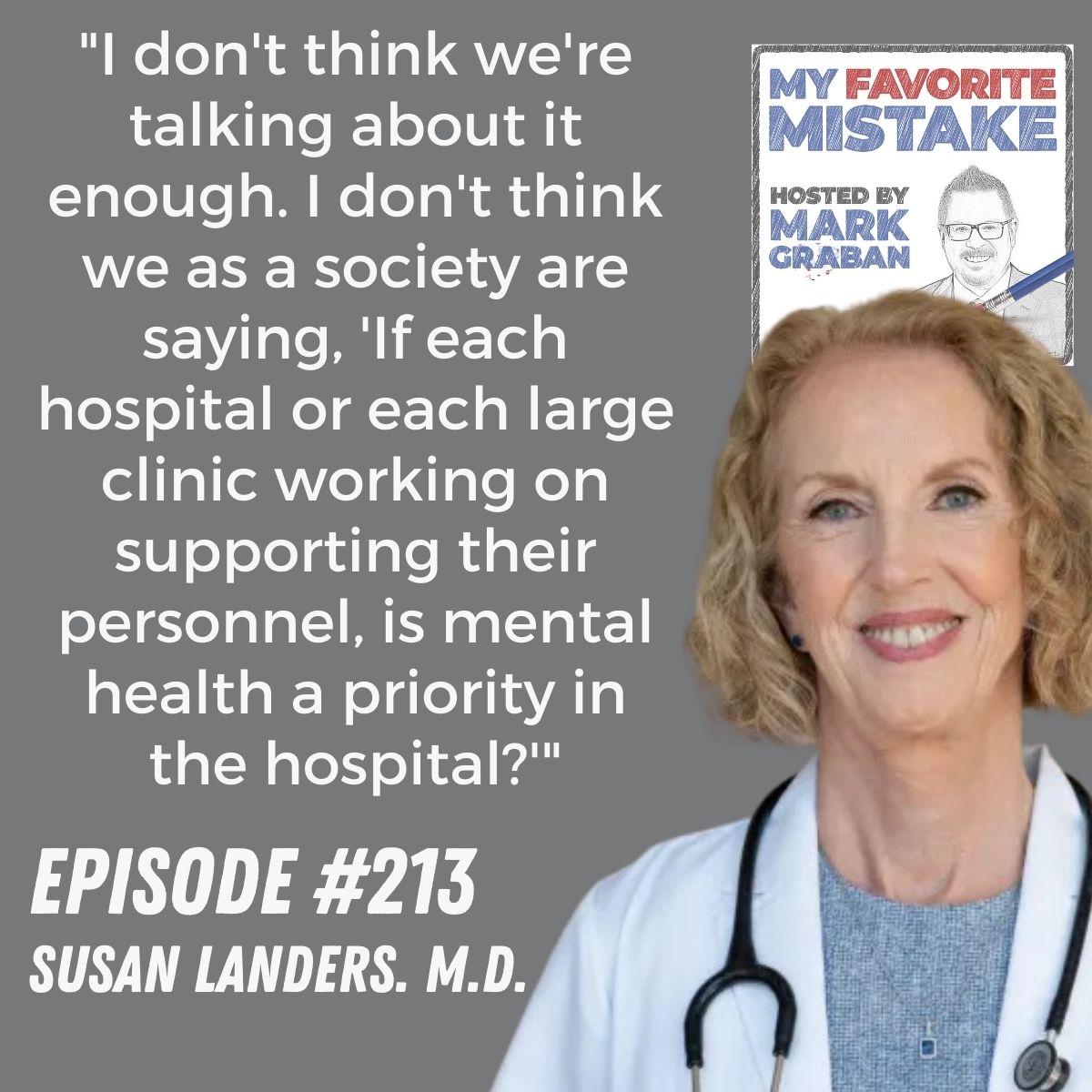
Susan Landers, M.D.: Right. And that recent survey of nurses said, gee, 40% of them are gonna change jobs in the next two years. It may be that notion of, “I just need to pivot. I just need to get to another job. Maybe go to this clinic or this hospital, maybe it'll be better.” And a lot of improvements have taken place. A lot of big clinics have made improvements. They've created wellness champions, nurses or physicians who really care about burnout and care about personnel wellbeing. But I don't think we're talking about it enough. I don't think we as a society are saying, “If each hospital or each large clinic working on supporting their personnel, is mental health a priority in the hospital? Not just infection, not just fall risk, not just unhappy patients, but providers. How happy are your providers?” So I'm not seeing that yet come to the forefront.
Mark Graban: From what I hear, I agree. We need a lot more focus. We need a lot more workplace improvement. And to me, that goes hand in hand with quality improvement. People want to do good work, and when they're overwhelmed, overburdened, not supported, they can't do that. And then I can see where the burnout cycles continue. So I think we need to help reverse, help people who are burned out and let's try to not burn out the next generation as much.
Susan Landers, M.D.: Exactly. Right. The Stanford folks have written quite a bit about physician burnout, and they advocate something as simple as a checklist for burnout every year or every six months. And the personnel all just go through 10 or 12 things and they check off yes or no. And if they get four yeses that indicate a tendency to burnout, then they all have a meeting and they sit around and talk about the issues and maybe something good comes of it. So something just as simple as “measure how your providers are feeling” could happen very easily. I mean, it's like not any big deal for hospitals to survey providers. They do it all the time about patient satisfaction.
Mark Graban: Well, I hope we have more of that, you know, at a system level, at a leadership level. Susan, I know you have something people can use at an individual level.
Susan Landers, M.D.: Oh, I do. I do. I've developed a checklist for burnout for working mothers. It's a free resource on my website. And I've developed some other resources, you know, quick solutions guide. The other thing I'll say about burnout is once you have it, it's not fixable with just a pivot and a change in your job or location. It takes some real work, some therapy, some self-care, some time on the couch, whether it's with a friend or with a therapist or a coach. It's a big deal. And it's not easy to bounce out of burnout. At least it wasn't for me. And so sorting through the issues that got you there is important. That's why it's so important for loved ones who have a healthcare provider family member: get them to talk about what's going on, get them to get some help if possible.
Mark Graban: Well, thank you for that important message, Susan. And thank you for telling us about some of your career arc and what you learned from that and for talking about this important issue of burnout. So I'll put a link to that burnout checklist in the show notes. I hope people will check that out and use it. And again, our guest has been Dr. Susan Landers. Her book is So Many Babies: My Life Balancing a Busy Medical Career and Motherhood. So you know, Susan, again, thank you. Really appreciate you being here and sharing so much with us today.
Susan Landers, M.D.: Yeah, you're very welcome. It was fun. Well, not fun, but it was important.
Mark Graban: It was important and…
Susan Landers, M.D.: Necessary.
Mark Graban: And you were engaging, so thank you for that. I appreciate it.
Susan Landers, M.D.: Thank you very much, Mark. I appreciate it.
Mark Graban: Well, thanks again. Thanks so much to Dr. Susan Landers for being our guest today. For links to her book, some special offers and more, look in the show notes or go to markgraban.com/mistake213. As always, I want to thank you for listening. I hope this podcast inspires you to reflect on your own mistakes, how you can learn from them or turn them into a positive. I've had listeners tell me they started being more open and honest about mistakes in their work, and they're trying to create a workplace culture where it's safe to speak up about problems because that leads to more improvement and better business results. If you have feedback or a story to share, you can email me myfavoritemistakepodcast@gmail.com. And again, our website is myfavoritemistakepodcast.com.
This episode explores physician burnout and medical career mistakes through the experiences of Dr. Susan Landers. Learn how burnout develops, why it is often systemic, and what recovery and prevention truly require in healthcare.