
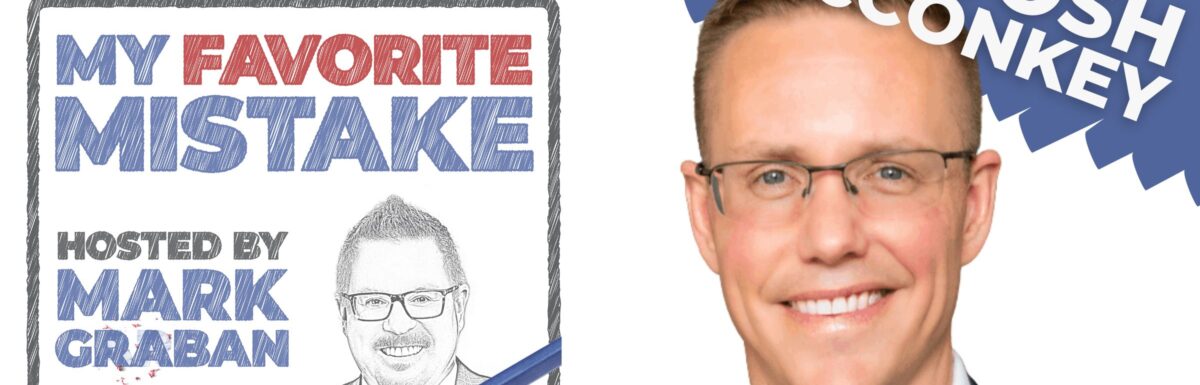
A conversation with Dr. Josh McConkey about mistakes, moral courage, and accountability in high-stakes leadership.
Listen:
Check out all episodes on the My Favorite Mistake main page.
My guest for Episode #332 of the My Favorite Mistake podcast is Dr. Josh McConkey — an emergency physician, Air Force Reserve Commander, combat-deployed medevac leader, and Pulitzer Prize–nominated author. Known as the “MacGyver Doc,” Josh has built a career solving problems in the kinds of environments where you don’t get many second chances.
Josh shares an intensely painful and costly mistake from his entrepreneurial journey: entering a business partnership without doing the proper due diligence. What followed was a cascade of Medicare violations, financial misconduct, and a $3.4 million bribe offer he refused — all culminating in a personal financial loss of nearly $5 million. Yet the deeper story is about integrity, courage under pressure, and how leaders respond when everything goes sideways.
We talk about what Josh learned from that experience, how it shaped his approach to leadership, and why he believes that integrity matters most when it’s expensive. Josh also reflects on his career in emergency medicine and the systemic failures that fueled the opioid crisis — including the perverse incentives that tied pain scores to reimbursement. His perspective as both physician and military leader brings a clarity that’s rare and deeply needed.
Josh also shares why he wrote Be the Weight Behind the Spear and his new children’s leadership book The Heart of a Leader, and how early lessons in character and kindness set the foundation for resilient young adults. We close with his decision to run for Lieutenant Governor of North Carolina in 2028 — a move driven by his belief that accountability and service belong at the center of public leadership.
Questions and Topics:
- Where did the nickname “MacGyver Doc” come from, and what does it mean to you?
- What’s your favorite mistake?
- When did you realize something was wrong in that business partnership?
- How did you respond when you discovered the misconduct and Medicare violations?
- Did you report this to the FBI and other authorities, and what happened?
- How did it feel to turn down a $3.4 million bribe?
- Were you a minority owner in the business, and how did that limit your options?
- What did you learn about due diligence and ownership from this experience?
- How did the COVID shutdowns affect your ability to pursue legal action?
- After all of this, what was it like to win the North Carolina lottery?
- How did that moment shape your work and the creation of your foundation?
- Where does the phrase “Be the Weight Behind the Spear” come from?
- How does that philosophy apply to leadership in medicine and the military?
- What systemic issues contributed to the opioid crisis from your perspective in emergency medicine?
- Did you face pressure or consequences for not prescribing opioids?
- How do you define courage in everyday leadership?
- What can leaders do to create an environment where people feel safe speaking up?
- How do you help people learn from mistakes and build resilience?
- What inspired your children’s leadership book, “The Heart of a Leader”?
- How can we teach leadership and character skills to kids at an early age?
- What led you to run for Lieutenant Governor of North Carolina?
- How are your experiences in medicine and the military informing that decision?
Scroll down to find:
- Video version of the episode
- How to subscribe
- Quotes
- Full transcript
Find Dr. McConkey on social media:
Video of the Episode:
Quotes:
Click on an image for a larger view



Subscribe, Follow, Support, Rate, and Review!
Please follow, rate, and review via Apple Podcasts, Podchaser, or your favorite app—that helps others find this content, and you'll be sure to get future episodes as they are released.
Don't miss an episode! You can sign up to receive new episodes via email.
This podcast is part of the Lean Communicators network.

Other Ways to Subscribe or Follow — Apps & Email
Automated Transcript (May Contain Mistakes)
Mark Graban: Hi, welcome to My Favorite Mistake. I'm your host, Mark Graban. Our guest today is Dr. Josh McConkey. He is known as the “MacGyver Doc.” He's got a long list of credentials and experiences. He is an emergency physician, an Air Force Reserve Commander, and a combat-deployed medevac leader who spent his career solving problems in the kinds of environments where you often don't get second chances.
He is a Pulitzer Prize-nominated author. His books are Be the Weight Behind the Spear and The Heart of a Leader. That's a children's book, and I think we'll be able to talk about both of those here today. His books draw on experiences ranging from battlefield medicine in Iraq to high-stakes emergencies here at home. His focus is on leadership, resilience, and what it takes to bring clarity and courage to a chaotic situation. So it's a real honor to have you here. Welcome to the show. How are you today?
Josh McConkey: Thank you very much. I appreciate the opportunity.
The MacGyver Doc
Mark Graban: We normally dive right into the favorite mistake question, but I have to ask you first about MacGyver Doc. What that means to you, and who first called you that?
Josh McConkey: You know, there was a publicity summit that was held last year and I was just talking with some of the consultants and they're like, “Man, what haven't you done? You've been all over the place”. The military and the healthcare background, author, traveled around the world, Africa, Europe. I'm boarded in Australasia, which is in Australia and New Zealand. And they just kind of came up with the MacGyver type of deal where I can literally probably be in almost any situation and feel pretty comfortable and figure it out. So it stuck.
Mark Graban: Hopefully, out in the field you're not having to rely on, you know, dental floss and that paper clip and trying to remember, diffuse bombs or something like that.
Josh McConkey: Right. Yeah. Diffuse a few bombs.
My Favorite Mistake: A Business Venture
Mark Graban: So I'm fascinated to jump into the main topic. I don't know what aspect of your career this answer will come from, but what's your favorite mistake?
Josh McConkey: So for me, it's my favorite and the most painful by far. But in the business ventures, so I owned a freestanding emergency department in Texas and we moved out there in 2018. The business was doing fantastic. We put so much work into that. I made an absolute egregious mistake in not doing my due diligence and went into business with some very bad individuals.
One in particular was a CEO that just, wow. Within about a year, we're doing so well. We're making great money. And then you start to peek behind the curtain and there's $90,000 being spent for an attorney for some other lawsuit at another business that involved sexual harassment allegations.
Mark Graban: Wow.
Josh McConkey: And then there was the skimming of payroll. So overcharging us about $130,000 through his management company, and then straight up Medicare violations, which are illegal. So it got crazy pretty quick.
I reported him to the FBI, the Texas Department of Insurance. And he had jumped in and offered me a $3.4 million bribe. He had a canned statement from his attorney, like, “Here's $3.4 million. You're going to say, ‘Oh, I'm going to step away from the business and spend more time with family and just coast off into the breeze,' and here's your $3.4 million”.
I know now that he's done that at several businesses. He was sued in Louisiana, Arizona, another location in Texas. And this guy owned majority shareholder ownership, which gives him all the rights. And unfortunately, he found the one dude on planet Earth that would turn down $3.4 million.
I told him to shove it up his rear end. I would not compromise my integrity. I'm a military commander. I'm a colonel in the Air Force Reserves, and he absolutely punished us.
He drove the business into the ground. His whole goal was to just bankrupt the operational company and then just restart again 'cause he owned the physical location. And I ended up losing about $5 million. We tried to file a lawsuit, but then COVID hit. So all the courts were frozen. We couldn't get a court date. It was just horrible timing for me.
At the end of the day, the FBI didn't press charges because he hadn't done anything yet. And then after he threatened the family, I moved to Australia for a year to get away from him.
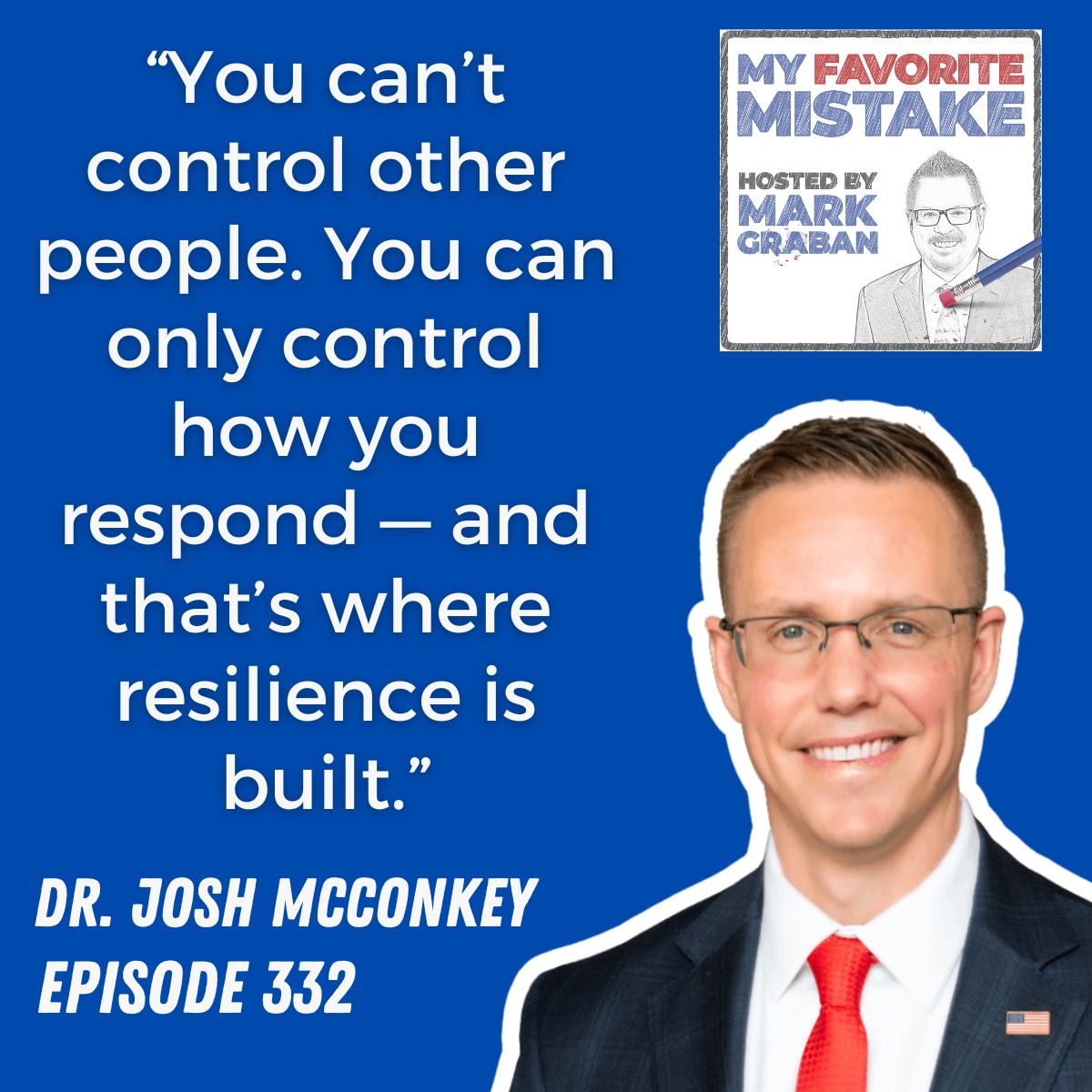
As it comes full circle, four years later, we're back in North Carolina and I won the North Carolina Educational Lottery. So the $5 million that I lost—I didn't win that much money—but everything comes full circle. You try to do the right thing. And as painful as it was in those four years of losing that much money, just getting destroyed, and just poor timing with COVID, I learned a lot of lessons that you can't control other people. You can only control how you deal with it. And I stuck to my guns and the integrity won out in the end because I won the lottery.
Mark Graban: Yeah. Karma. That would be one way of thinking about that. I'm so sorry to hear that you went through that. I mean, it sounds like this guy had a bit of a playbook.
Josh McConkey: He knew exactly what he was doing. He had done it at several other businesses. Had I done some more in-depth research on him, I would've seen the lawsuit at the previous location out in Round Rock, and that would've raised some red flags for me. He was a very smooth talker. When you really look back on things, the responses to questions were more than just kind of playing dumb. He was actually lying. He was very smooth. He's a very bright individual. He's a physician as well. He just has zero integrity, like no ethics, and he's going to be in jail eventually. Towards the end, he just stole $650,000 for the back management expenses. The judge made him put that back, but we never could get the court date. So I just had to walk away. It was painful.
Lessons on Majority Ownership
Mark Graban: And I imagine there's physician to physician a certain amount of built-in trust?
Josh McConkey: Oh, yeah. I mean, this is someone who's in charge of people's lives. I know now, actually, he's not even board-certified in emergency medicine. And he isn't board-certified in anything because there was all kinds of other issues that came out towards the end with, like, alcohol and drug abuse and stuff. But man, just a nasty individual. I made a very poor decision. That was a very bad mistake on my part, and I learned a lot from it.
Mark Graban: Have you gone into other business ventures where deeper due diligence was part of the approach, or I mean, this might scare you off to trust?
Josh McConkey: I'm pretty gun-shy there. I've been approached a couple of times and, you know, some people that I know and trust quite well, but that, that was a really bad experience.
The biggest takeaway from that lesson and that mistake is that if you don't have majority ownership, then just don't bother, because at the end of the day, those majority shareholders, they're calling the shots. They control the bank accounts. His secret weapon was that he had majority ownership. So he literally just put the clamps down on the business, refused to make distributions, refused to pay bills like our electricity bill. You can't run a CT scanner without electricity. He got really bizarre in that he was just burning it to the ground. He had like 55% ownership of it, and he just was going to burn it to the ground just to punish us. It was just an operational company. So he owned like the physical CT scan machine and had the lease on the business. So, I mean, he was just going to run it to the ground and then start over again.
The Ponzi Scheme and Aftermath
Mark Graban: You approached the FBI. Like Medicare fraud, when that occurs, where does that get, is that a separate reporting?
Josh McConkey: Yeah, so in Texas there's Texas Department of Insurance because it involves some insurance. And then the FBI was just kind of the physical threats and that there was some fraud in that he was inflating a bunch of assets to secure bank. It was a Ponzi scheme, so he just used one location, inflated the assets to fund, get the loan for the next one, or the next one, and the next one. So it crumbled around him eventually. There were two locations in Nebraska that went bankrupt. Two or three that went bankrupt in Texas. He lost the one in Louisiana. I'm not sure whatever happened in Arizona, but just a nasty guy.
Mark Graban: And that was a number of years. And were you a minority, kind of more passive investor, or were you working in the…?
Josh McConkey: So I was working it. There were just three of us that really worked the location, were the face of it, involved in the community, but I only had 10% ownership. So if you don't have majority ownership or have a collection of people that you trust that have that majority ownership in Texas, he can literally do anything he wants. Absolutely anything if you don't have the money to get it to trial. He can do anything. So I spent $250,000 in legal bills in less than a year. Just blowing through money. The whole time he's starving us out, so he's not giving us our paychecks. He's not making distributions from the business. It was diabolical. But until you can get it to trial, they can do anything they want. And then COVID hit and we couldn't get a court date, so it's just bad timing.
Mark Graban: Wow. I imagine, do you have some sort of Google Alert set up with this person's name and the word indictment?
Josh McConkey: I don't. He screwed so many people over that they all reach out and contact me every time another business goes bankrupt. So there's some other people that track him. There is a guy named Joe that I got to know real well that this individual had screwed over many, many times. And so he kind of reaches out and gives me a phone call every time we find something bad about him. So I get a chuckle, like, you know, karma comes for everybody eventually. He'll be in jail at some point, but yeah, it won't help me.
Lottery Winnings and Giving Back
Mark Graban: I wanted to ask about the lottery. This was in your bio. I was going to ask you about it. It sounds like a fascinating story of what you did with those winnings. Kind of an unusual winner's tale.
Josh McConkey: Yeah, so it put us in a very good position. I wrote a leadership book, Be The Weight Behind the Spear. It's my whole personal leadership ethos and really promoting community engagement and building up leadership skills for young people, our next generation of leaders. And that money allowed us to get that message out there.
The book did very well. It got a Pulitzer Prize nomination, Independent Press Award, and several other awards. And then we started a nonprofit organization, the Weight Behind the Spear Foundation.
That started after Hurricane Helene out in Western North Carolina, just biblical level destruction and flooding, just tore your heart out. As I sat there, just, “Oh, what can we do?” 'cause we used to vacation and spent a lot of time in Asheville and Western North Carolina. So we started the foundation, we raised some money, and we partnered with a really nice organization, Samaritan's Purse, that people may be familiar with, Edward Graham. And we're able to make some contributions and help with the rebuilding process. And there's lots to be done. There's still a lot of destruction out there.
Mark Graban: Yeah. A lot of recovery still needs to happen. That was the hurricane where like some small towns were quite literally wiped off.
Josh McConkey: Yes. Flash floods. Just insane. Thousand year record rains that had never been seen before, like literally like biblical level. You know, they're still recovering.
The Weight Behind the Spear
Mark Graban: So the book, the leadership book, Be the Weight Behind the Spear. What's the story behind that phrase? Does that come from your military experiences?
Josh McConkey: So it's always been my personal leadership ethos. I put it on the bottom of my challenge coin, my military challenge coin, gravitas hastam—Latin, gravity of the spear. Working with special operations, I've been a medical director for a combat search and rescue, the PJs, the pararescue. And these are special forces operators. They jump out of aircraft, helicopters and planes, into the most insane, dangerous environments on planet Earth to rescue men and women. Downed aviators or on mountaintops, you know, for civilian rescues.
When you see those types of just heroic individuals, what sets them apart? Like what makes them so special? I found out that it's the weight behind their spear because they're the tip of the spear. I cannot do those things. I do not jump out of helicopters. I do not take down Bin Laden. I save lives, I don't take lives. But these guys do amazing things and it's the weight behind their spear. It's teachers, coaches, volunteers, and families. That's who's given them the amazing confidence to do what they do. And you just realize that that's something everybody can be a part of. You know, in your community, be the weight behind someone or something, or an organization that really matters. So that's being the weight behind the spear.
Mark Graban: I've done work as a consultant and a coach in civilian medicine. I've met people who retired from military medicine and have ended up in civilian medicine. And the one common theme, you often hear the phrase, “the tip of the spear.” If there's a problem, a mistake, an error, harm to a patient, unfortunately, you hear this phrase, “well, the person at the tip of the spear gets blamed or punished” when sometimes that's not really maybe the real root cause of the problem.
I'd be curious to hear your thoughts around medical settings of any type, how the weight behind the spear—leadership, structure, systems, communication—how does that prevent mistakes?
Josh McConkey: Well, as an emergency physician, I've worked in civilian medicine for 20 years. I have probably countless stories there that you can chat about, but it's always the system issues. It's organizational issues and then leadership coming from the top.
The Opioid Crisis: No Narcs For You
Josh McConkey: You look at CEOs. There's one chapter of my book that I titled, if you were a Seinfeld fan, you remember the Soup Nazi. So this is instead of the, “no soup for you,” it was “no narcs for you”. And it really talked about the whole opioid crisis in this country and how that started with some government intervention there where they had set up, “Pain is the fifth vital sign”.
Pain is completely subjective. It's different for every individual. You take objective vital signs: blood pressure, temperature, heart rate. Those are hard, fast, real numbers. And changes in those numbers have increased rates of morbidity and mortality. Period. It's fact. Now, pain is just super subjective. So what they did in the early 2000s is they made pain the fifth vital sign. And they tied it to CMS reimbursement. Then physicians started getting it tied to their bonus structures with all these satisfaction score systems.
Just to take a wild guess, when you take chronic pain and drug seekers and they come to the emergency department for pain, what do you think is going to happen if you don't give them narcotics?
Mark Graban: Well, and they're asked that subjective.
Josh McConkey: Right? They're asked that and flat out like, “Oh, my pain is 10 out of 10 and I want some opiates”. Well, it may, it's probably not safe to do that. So you don't. Well, then you get a zero out of 10 and the whole scoring system was tied to bonus structures.
Mark Graban: Well, then patient experience. Oh, yeah, patient experience.
Josh McConkey: So it was all tied to their, their marketing, for their satisfaction scores. And we know now that that was really kind of what started the opioid crisis and was killing millions of Americans. Tied with, you know, like Purdue Pharma. They just lied about the addictive tendencies of these medications. So it was just a perfect storm of errors there that were definitely foreseeable.
In residency, like 2003, 2004-ish, I got the nickname the “Napper Nazi”. “Napper” is like a non-steroidal medication like ibuprofen. I wasn't comfortable with this big jump in opioids. I knew the drug companies were lying because you could clearly tell, like, just the seeking behavior and how bad people craved these medications. It was clearly addictive. Now they lied and said that it wasn't.
So I just, I didn't prescribe them. And the pharmacies in the area, I had some friends that actually worked, like, “Dude, they call you the Napper Nazi, man”. “Yeah, 'cause you never give opiates.” And, you know, I was very proud of that because as you know, rolled forward 20 years later, I was completely right. We've killed millions of people. And as an emergency doctor, I've been in those rooms and had to call those codes and talk with families and sit down and cried with those families. It's very hard. But there's a lot of mistakes there that could definitely have been avoided.
Mark Graban: In a situation like that where you have systemic structures and incentives, at some point, I'm sure, I mean, the idea that we don't want people to be in pain is well-intended. But, you know, for people listening, I'm sure you know this term, high-reliability organizations. I think one of the principles is, I'm paraphrasing it, but like, avoiding overly simple solutions to complex problems. And it sounds like this overly simple idea of like, “people shouldn't be in pain” led to death. I mean, and at scale.
Josh McConkey: And you really simplify that. They just ignored human behavior in reality. So I came up with this kind of my little phrase, “Don't feed the bears”. Don't feed the bears. If you don't feed the bears, they don't come around looking for trash in the garbage and like the opiates. You could tell when there were physicians that were just giving out the opiates, they would all show up. They had secret websites and they would tell, like, they could see the license plate on the car. They know the physician there, and they're like, “Oh, Candy Man's here”. And they all show up out of the woodwork. And then when I'm on duty, they just magically don't show up. I mean, it was crazy. But if you don't feed the bears, just like when you go to the national parks, don't feed the bears.
Integrity Over Incentives
Mark Graban: I think it would be unfair. Some people would say like, “Oh, these are greedy doctors”. What you're describing, I mean, that would be an overly simplistic explanation.
Josh McConkey: There was a component to that for sure. But you were punished if your scores were not good. So like I know people that lost jobs. It wasn't just your bonus, like if you weren't getting satisfaction scores. So you literally, you're bribing people with drugs that are dangerous drugs and life-threatening to keep your job and provide food for your family. So that was really bad. That was probably like maybe 2007, eight through maybe 2011, 12, kind of that timeframe.
Then we started to turn that corner again and we're like, “Wow, this is really bad. This is really out of hand”. And state legislators started getting involved. When I was in Florida briefly, they called them the pill mills. And they would have Oxycontin Express flights. They would fly from all over the United States to Fort Lauderdale, and these drug seekers would hit like 30 paid clinics at the same time. There were so many overdose deaths.
My shifts that I was working, my colleague, I'm like, “What is happening here?” He's like, “Oh man. Yeah, it's really bad”. They hit all these pain clinics because there were like a crazy amount of opioid overdoses and overdose deaths in Florida. The state legislator got involved and just put the clamp down on it completely. Because the hospitals weren't policing themselves, they were just feeding the addiction and crazy overdoses. I can't even tell you how many hundreds or even a thousand people I watched die with overdose death. It was crazy.
Mark Graban: It seems like there's this pattern of problem-solving mistakes, if you will. If people said, “The problem is pain, we don't want people to be in pain”. When they set up all these structures, then you ended up with overdoses. And that seems like maybe the pendulum swing too far in the other direction where people who are legitimately in pain find it difficult.
Josh McConkey: I think you see some people that are, that, you know, we'll talk about that. At the end of the day, if you've got terminal cancer, if you broke your forearm, if you really legitimately need it, I mean, it's there for you. You just have to jump through a few hoops. But life is not a pain-free state, outside of those types of medical conditions. When you sprain your ankle, it hurts. You've torn some ligaments. That's your body telling you don't walk on your ankle. So the answer is not a narcotic pain medication that could potentially kill you. It's use the crutches and don't walk on your ankle and keep it elevated and ice it.
I was a professor at Duke University and I would just teach residents all the time. “Listen, narcotics are the only medication that we give that guaranteed increase your risk of death and disability for a non-life-threatening condition”. Pain is not life-threatening. There's different variations, and certainly if you have cancer and just had surgery, but pain will not kill you. But these drugs will definitely increase your risk of death. So there has to be a balance there. And for a good chunk of those early 2000s, there was not.
Courage and Integrity in Leadership
Mark Graban: When you think about courage and write about courage, what does that look like in everyday leadership? Was it courageous to push back against the norm in terms of prescribing opioids? Would you label that courage?
Josh McConkey: You know, if you use that kind of in a similar realm of accountability and integrity. For me, just doing the right thing, having that courage to do the right thing, looking out for other people. I'm going to lose some money. It's going to piss off a lot of executives. I got yelled at a lot.
Early in my career, the first year, I had one of my bosses, the regional director, sit down with me as a young first-year attending. And ask me to write more narcotic prescriptions. Point blank, say, “Josh, I need you to write more narcotic prescriptions”.
Mark Graban: It was more of a command, it sounds like then.
Josh McConkey: Oh, yeah. And I was like, “Whoa.” I didn't expect this coming. And then he sat down and he gave me this little speech and he said, you know, like, “Josh, they're only hurting themselves, man”. I was so irate. I was so angry.
Because a week later, a woman came in, hopped up on all these narcotics that he had prescribed him personally. She was overdosed and dying. She was 30 years old. I intubated her. I'm going to send her up to the ICU. We saved her life. And then her daughter, and so the patient's mother, which is the grandmother to this little 8-year-old girl, comes up to me and she says, “My mom, is she going to be okay?”. And she's pulling on my white coat.
It was all I could do to not strangle this other doctor. Because he flat out asked me, point blank, “Write more narcotics. They're only hurting themselves”. And then he almost kills this woman. And there's her 8-year-old daughter with me right now crying. I was so pissed off.
I read about that in the book as well and I saw that a couple of different times. Man, you've got to do the right thing. You have to take care of people. People are trusting you with your lives. So I don't know if as much courage as it is integrity and I just won't compromise my integrity.
Mark Graban: I don't have a dictionary definition of courage in front of me, but one working definition would be: doing the right thing, even in the face of negative consequences. We talk about people feeling safe to speak up in different environments. In a workplace if people are bullied by their boss for disagreeing or punished for speaking up, people will learn to protect themselves or their paycheck by not speaking up.
I think it's a better approach to try to reduce the need, reduce the fear. Reduce the need for courage where people aren't being punished, people want to do the right thing. But we can't put people in situations where there's such strong incentives to do the wrong thing or punishment for doing the right thing.
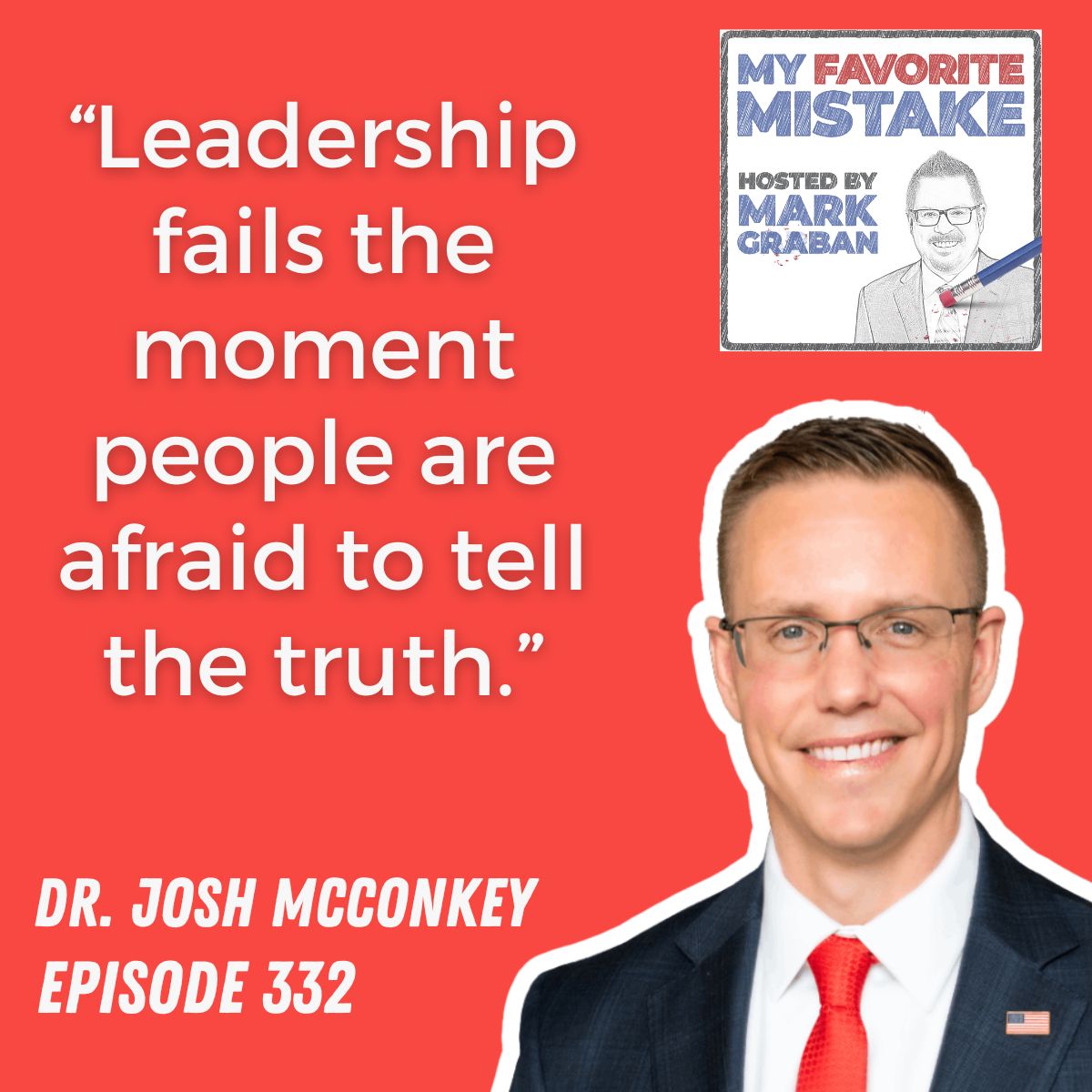
Josh McConkey: That's a great definition and that's failure of leadership. If you don't create a climate where people feel comfortable telling the truth and doing the right thing, you're probably, if you look at your mission statement of whatever organization you're in, you're probably not doing that right thing. That's failure of executive leadership.
I've made a very big point and have been very successful in just making that essential tenet to my leadership, and that Be The Weight Behind The Spear ethos. It's done well on the civilian side, nonprofit organization, and the military.
Resilience and Learning From Mistakes
Mark Graban: What are some of your lessons about helping people be more resilient when they're in a tough situation or they've made a mistake? What can we do to be more resilient in those situations?
Josh McConkey: You have to let people make their own mistakes. I think the perfect example is what we see now. There's like some management positions and then just parents that do the lawnmower parenting. So they don't let their kid make any decisions. They don't let their children make any mistakes. They're always there micromanaging. Everybody hates that boss that micromanages. You're not learning. You're always watching over your shoulder. You're constantly questioning everything you do.
That's leadership for me. You have to surround yourself with good people. And you have to be able to recognize that talent. And then you let them do their job. I don't micromanage. I tell them the objective, “Here's my intent, get it done”.
If they're not getting it done or if I have to get in there to micromanage, that's on me. I made a bad decision. So I either need to mentor that person more. They got to go and we find somebody else that can do the job. That's all leadership, and let them make mistakes. That's how they learn. Do it safely.
In my vital work as an emergency doctor, mistakes kill people. When I supervise residents, I'll let them talk about some things and make some decisions, but if it's going to be something dangerous, you step right in. “Here's our learning moment. You're going to kill this dude. Don't do that”. Learn from a near miss or a good near miss.
Your nursing staff and your ancillary staff are really important as well. I empower everybody to speak up, talk, ask questions. Don't have a big ego. Because when you let those egos come in and you take everything personal, “Oh, they're questioning me,” that's dangerous because you're creating an environment where people can't speak up and talk about dangerous situations. Those things right there, it has been very, it's helped me in my career.
The Heart of a Leader Children's Book
Mark Graban: What about, you know, helping young people? I'd love to talk a little bit more about the children's book. Are there specific lessons around resilience and other themes that are important to you?
Josh McConkey: Incredibly important. As a military commander, I found that it's very difficult to teach those resiliency skills and build some of those basic leadership skills when they're 20 years old. There's a lot of yelling. There's a lot of pushups. It's much more difficult. So we have to do it younger.
The Be the Weight series, it's a series of children's books on leadership. The first is The Heart of a Leader. It just was released officially yesterday, so it's on Amazon and on the publisher's website as well. But it's going to be part of an eight-book series. And each book is going to talk about some issues of leadership.
You ask yourself, how do we teach a five-year-old leadership? Well, we did it. I have a world-class Disney illustrator, Joe Veek. Amazing individual. So skilled, and for a children's book, that's everything.
It's just building up those leadership skills. Being a leader, it's not about being the strongest and the fastest. You just have to care and have a heart. Be there for people and stand up for people around you. It's such a good message. I'm really excited. It's been submitted for quite a few awards. There's nothing like it out there, and it's going to be part of a whole children's series, so we're really excited.
Mark Graban: What are the target ages, the age range that the book would be best for?
Josh McConkey: Basically like five to nine years old, is that target range. As early as three years old, I just sit down with them and read those stories. I was a big fan of Mercer Meyer when I was a kid growing up. He did the Little Critter books. There was always a little spider. And then some had a little mouse. It was a little recurring character that was always on each page hiding, doing something.
Ours is a little squirrel. Like, “Where's the squirrel? What's he doing?”. But they're still hearing all those lessons of leadership. So you start as early as like three years old, three, four years old. They're getting all those lessons. They're hearing what you say, but they're there for the books and the illustrations. And then as they get older, they can certainly read that and understand that more for themselves. But you have to start early. You can't do this when they're 20. You can do it at 20. It's just really, really hard.
Mark Graban: The book focusing on courage, character, kindness. I'd be curious how that's portrayed in the book, 'cause I think sometimes people make a mistake of thinking, well, kindness means being a pushover or being weak.
Josh McConkey: Being strong. When that bully gets up in your face and say, “You guys are losers,” you say, “Hey, have respect for yourself, for your teammates”. You stand up, you still shake their hand, you know you're a professional. Even if you lose, and then also when you win.
Being kind, you know, just having like one of the new kids in the school and kind of isolated and they don't know anybody, being that leader. Sit down with them, they're tying their shoe. “Hey, how you doing? Like, welcome to school. Do you want to play soccer with us today?”. And just reaching out and being inclusive and letting people know that they matter. That's being a leader. You recognize that. That's kindness. You're not a pushover.
Matthew McConaughey, I just watched a clip with him. That was fantastic. He talked about being a nice guy and a good man. The nice guy, you know, just kind of gets along with everybody. Kind of goes along with the flow. The difference between a nice guy and a good man is the good man isn't always a nice guy. So when you push them past their, like those breaking points or you start infringing on other people, or you start to threaten them or their family, a nice guy is not going to get it done. The good man stands up and he's not always a nice guy at that point. Because he has integrity. He stands up for what he believes in. That's the difference in that.
Mark Graban: The book focusing on courage, character, kindness. I think people would say a 20-year-old's brain is not completely, fully formed. There are probably enough habits, both good and bad, that have developed at that point.
Josh McConkey: Yeah.
Stepping Up for Public Office
Mark Graban: I hope people will check out the books, The Heart of a Leader, the new children's book, the first in the series, and then the previous book, Be The Weight Behind the Spear. As a final question, Dr. Josh McConkey, of all the titles that you've had in the military, in the medical world, I know it says on your website, you've thrown your hat in the ring for another potential title, Lieutenant Governor. Service is important to you. I'd just love to hear your story about deciding to run for office.
Josh McConkey: For me, just seeing the lack of accountability of our elected leaders in this country. And when you take away that accountability, and when people are making decisions, it descends into chaos on Lord of the Flies. So there just has to be that level of accountability.
For me, just personally, when you shut down schools, you shut down churches. There was a lot of decisions made over the past several years that have had a very negative outcome on an entire generation of Americans. And that's what I see every day in the emergency department and as a military commander.
Stepping up, I had no inclination to do this when writing the book. But the further along we've got here, several years down the road, we need more leaders, and especially in healthcare and military leadership, we need more people with accountability and integrity in public office. Just from my experience, I haven't seen a lot of that. So we're going to get out there and make a difference. And, you know, there's only one way to find out.
Mark Graban: And that's going to be 2028?
Josh McConkey: 2028 for Lieutenant Governor here in North Carolina.
Mark Graban: All right, well, we will be paying attention to that. I hope that's a good experience for you and the state. I wish you well. I hope that doesn't turn out to be a mistake.
Josh McConkey: We'll find out. And that's the great thing is, is I don't need this. I have a career. I've got a wonderful family, emergency department, the military and the reserves. I think it's needed. And if I end up not being successful, I just go back to do what I'm doing. I don't need to be a politician. I just feel that calling and I think we need better leadership, so I'm going to try.
Mark Graban: Well, you have many, many things that you're doing, and this could be one more thing for you. Again, Dr. Josh McConkey, it's been a real pleasure, a real honor to have you here on the show. Thanks again.
Josh McConkey: Thank you very much. I appreciate it.