
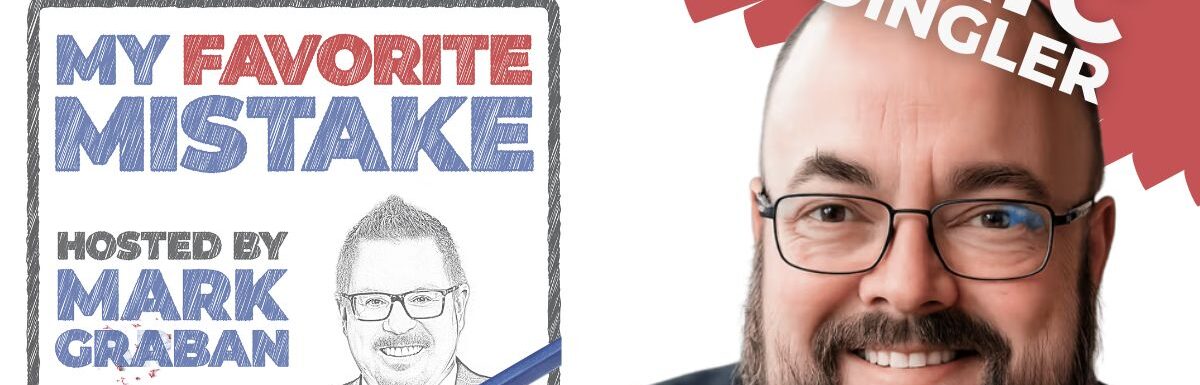
Eric Dingler was running two businesses remotely while his family traveled full time, and every week he and his wife sat down to review the numbers. When they paused that meeting for what was meant to be six weeks, it stopped for a year. A short draw on a line of credit became debt he couldn't repay, and he kept it to himself until he could also bring her a fix.
Listen:
Check out all episodes on the My Favorite Mistake main page.
My guest for Episode #368 of the My Favorite Mistake podcast is Eric Dingler, a business coach, owner of the digital marketing agency In Transit Studios, and author of Hire to Grow: Make Your Next Hire Pay for Themself in 30 Days. Before building teams in business, he spent 15 years running a summer camp, hiring and leading a new seasonal staff every year. For three years, he ran two businesses remotely while his family traveled full time, living in 55 Airbnbs across 20 countries.
Eric's mistake started with a routine he dropped. He and his wife, whom he calls the company's “chief organizational officer,” met every week to go over the business and its numbers, and they had paid off all their debt. When they moved to Costa Rica so she could attend a Spanish immersion school, they paused the meeting for what was supposed to be six weeks. They stayed a year. After losing a client, Eric drew on a line of credit and repaid it three days later. The next month, it took a week and a half. The month after that, the money didn't go back. Embarrassed, he told himself he would tell his wife once he could also show her the way out. Meanwhile, without her as a filter, he launched offer after offer, which confused clients and pulled down his email open rates. By the time he sat down with her in Liverpool, he had run through the line of credit and two credit cards.
Eric is candid about why he kept quiet. He traces regrets, including hiding mistakes, to three needs: significance, acceptance, and security. He also admits his wife had never given him any reason to expect a bad reaction. She was hurt, and it took time to heal. The business recovered once he went back to making decisions based on where they were headed instead of what he was running from.
We also get into the difference between training and developing a team, why owners should ask whether they're a business the right people want to work for before they hire, hiring before you feel ready, his 10/10/80 approach to the hours a first hire frees up, his commitment that no one on his team will lose their job to AI, and why an honest time audit is the first step for an owner who suspects they're the bottleneck.
What You'll Learn
- Why dropping a routine accountability meeting can remove the check that catches both bad ideas and bad numbers
- How a line-of-credit draw repaid in three days turned into a year of debt
- Why people hide mistakes from someone who has never given them a reason to fear the reaction
- Eric's significance, acceptance, and security explanation for what sits behind most regrets
- How panic shifts decisions from moving toward a goal to running away from a problem
- The difference between training a team and developing one, and why it matters if you ever want to step away
- How the 10/10/80 split helps a first hire pay for themself
- Why Eric has committed that no one on his team will lose their job to AI
Scroll down to find:
- Video version of the episode
- How to subscribe
- Quotes
- Full transcript
Find Eric on social media:
Watch the Episode:
Memorable Moments from the Conversation:
Click on an image for a larger view
Subscribe, Follow, Support, Rate, and Review!
Please follow, rate, and review via Apple Podcasts, Podchaser, or your favorite app—that helps others find this content, and you'll be sure to get future episodes as they are released.
Don't miss an episode! You can sign up to receive new episodes via email.
This podcast is part of the Lean Communicators network.

Other Ways to Subscribe or Follow — Apps & Email
Episode #368: Eric Dingler, Author of Hire to Grow
Mark Graban: Hi, welcome to My Favorite Mistake. I'm your host, Mark Graban. Our guest today is Eric Dingler. He's the author of the book Hire to Grow. Eric has spent nearly 30 years leading teams across churches, nonprofits, agencies, and businesses, and his core message, which we'll talk about later in the episode, is that most founders don't scale by working harder. They scale by building people who can lead without them, which is something he proved by running two businesses remotely for three years while traveling full time with his family. So Eric, welcome to the show. How are you?
Eric Dingler: I'm doing great. Excited to be here, and ready to open up and share about my mistakes and just be very vulnerable and transparent. I'm ready for it.
Mark Graban: All right. Well, thank you. I'm looking forward to hearing your story and talking more about your work and your book. I've got to ask you up front, though, just in terms of getting to know you: would you say you were a digital nomad for those three years? Is that a term you embrace?
Eric Dingler: 100%. Yep, we were a full-time digital nomad family. We lived in 55 Airbnbs in 20 countries, traveling with carry-on luggage only. So we lived out of 55 liters per person of storage space, and we've had a ball. We've had an absolutely amazing time.
Mark Graban: Wow, 20 countries. Is it fair to ask? Well, I'm going to ask anyway. Did you have a favorite country?
Eric Dingler: I had a couple at the top. I would say Argentina was amazing, and Turkey. I really liked both of those.
Mark Graban: All right. Two countries I haven't been to, so maybe we'll get there.
Eric Dingler: Worth checking out.
Mark Graban: Cool. So maybe I'll come back after the favorite mistake story and ask you if there were any mistakes that you made as a digital nomad. Maybe that is your story. So let me just go ahead and ask you, Eric, from your work and from your career, what's your favorite mistake?
The Favorite Mistake: Pausing the Weekly Business Meeting
Eric Dingler: Well, my favorite mistake has probably been the biggest. I almost bankrupted us a couple of years ago. We had been moving along. Things were going well. My wife and I had been meeting every week about the business and looking at numbers. We had completely gotten out of debt at every level, and man, it was just like we were on fire. It couldn't have been going better.
At that point, we were in Peru, and we were headed to Costa Rica. We were only going to be in Costa Rica for six weeks. My wife was going to take Spanish at an immersion school for missionaries, even though we're not missionaries. That's what the school was for. So we went there, and since it was only going to be six weeks and she was going to be busy taking classes, we said, “Well, we'll pause our weekly meeting.” Well, that six-week pause turned into a 12-month pause, because we stayed in Costa Rica for a year while she continued to take Spanish. We'd gotten plugged into a community there and had a great time.
Then about the second month in, we lost a client. But I had just sold a client, so there was a moment of cash flow where I had to pull in just a little bit from a line of credit, but three days later I was able to put it back. No big deal. The next month, it took me maybe a week and a half to put that money back in the line of credit. And then the third month, it didn't go back in. And then it just snowballed. And then I was embarrassed. It just went awful. It just went terrible, and I kept digging deeper.
I am a pastor, and I kept telling God, as sometimes we do, “I'll tell my wife as soon as you do this, God, and I can show her that we're getting out of this.” I had to be able to show her, “Yeah, I messed up and got us here, but I'm also the hero that has planned this thing.”
In the last four months of that 12-month period, I've never launched so many things. I was launching new programs and services and offers, because I was panicking. Now I was running away from something instead of running towards something. And I finally had no choice. We relocated from Costa Rica to Liverpool, England, and I had no choice but to sit down and tell my wife and show her the numbers and show her how bad it was. By then, I had completely blown through the line of credit and two credit cards, and we were way upside down in life.
Luckily, I married up, and my wife extended me an immense amount of grace. She was very hurt. She was very hurt. But we got through that, and we've almost climbed out of that financial debt again. And the business, things just started clicking after that again, when I got back to foundations, when I got back to making decisions based upon moving forward, not out of fear, when I'm moving towards a vision versus away from something. So anyway, that's the big mistake.
Panic Launches vs. Shooting Bullets Before Cannonballs
Mark Graban: Well, I appreciate you sharing that with us, and there are layers to that story. For one, I'm curious if you can tell us a little bit more about, as you described it, the panicked launch of tons of new services. Do you feel like, in hindsight, that was an intentional strategy of, sometimes you just have to throw a lot of things out there and see what resonates and then focus more on that? Or was it a mistake to launch too many things at once, where maybe none of them could really take off because there were so many things going on?
Eric Dingler: Probably all of that. I think the big thing was, I've never had an idea that I instantly thought was a bad idea. Sometimes I'll look at an idea that I've written down and come back to it a couple of weeks later and go, “What was I… That was awful.” But I didn't have my filter, my wife, who we call the COO, chief organizational officer. I'm allergic to detail. She loves detail. We're complete opposites.
Mark Graban: Well, that works together well.
Eric Dingler: Yeah. And so she was always really good. To this day, I'll get back from a walk or something, and I'll be like, “Oh my gosh, I just had this idea.” And she'll go, “Yeah, that is a good idea for somebody else.” Or, “How does that get us to this quarter's goal?” “Oh. Oh, yeah, yeah, yeah, you're right. That doesn't. We'll just put it in the parking lot.” So I didn't have that check and balance to help me filter through, so I was just throwing everything, and I was creating confusion for our clients and our email list. Our email open rates dropped off, click-through rate, because I was just confusing everybody.
Mark Graban: It's interesting what you said about never having had an idea you thought was a bad idea, or at least at first. That's what tends to happen, right? Especially if you're an entrepreneur. I think you think about what's possible. And I think it's interesting what you said, that maybe one lesson learned is sometimes let an idea sit for a little bit of time and then come back to it, where your reflection might make you question it. Or, to be fair, sometimes all you can do is go test the idea and learn through experience whether it really was a good idea or not, or if it was an okay idea that you can iterate on and make better. We can't expect a 100% hit rate, right?
Eric Dingler: Exactly. One of my favorite leadership axioms is to shoot a bullet before a cannonball. We do that all the time. We're constantly testing ideas and things like that. But in that moment, I abandoned best practices. I abandoned so much core leadership. Really, I abandoned a lot of our core values, which is a lesson there. There's a reason we have a vision, a mission, and core values. And when you don't live to those, man, it can start to go haywire.
Mark Graban: Having some way of evaluating… It maybe comes back to the question of, is this a good idea, and is it a good idea for me?
Eric Dingler: Yeah. My wife said, “That's a good idea for somebody.”
Mark Graban: I love that expression. I've never heard it said exactly that way, shoot a bullet before a cannonball, but that does resonate with me, because I've been fortunate in my career to have mentors who taught me the idea of what you might call a small test of change. It's better to fail early. I don't like to say fail early, fail often. We shouldn't be repeating the same failure. But if we can test an idea and fail quickly and cheaply without a lot of harm… I'm mixing the metaphors there, but we can preserve our cannonballs and not waste…
Eric Dingler: Not waste those. Not waste the valuable things that are going to make a real difference. So we shoot that little bullet first just to see if our targeting is in alignment, and we continue to shoot bullets until we get the targeting dialed in. Then we hit it with cannonballs.
Mark Graban: I like that.
Significance, Acceptance, Security: Why We Keep Hiding Mistakes
Mark Graban: Final thing to dig into around your story. As we talked about before the show, this is generally a show about business and leadership. It's not a relationship show, but it sounds like your wife's reaction was better than you expected it to be. I can understand the feeling you described of embarrassment and not wanting to talk about it until you could talk about the way out of the problem. But I'd be curious to hear a little bit more about your reflections around what held you back, and maybe why you thought her reaction would be worse than it really was, when she showed you that grace.
Eric Dingler: Yeah. Pride is it. There are three things that are behind every regret anybody has. I know you've done this podcast for a while, and you've written a book, a compilation book of some of the mistakes. I bet, without ever seeing it yet, that if we went and looked at each mistake in the book, behind the mistake would be one of three things. The person made the decision because they thought the decision would make them significant, or they thought the decision would make them feel accepted. The third is they thought that the decision would make them secure. We are chasing significance, acceptance, and security all day long. And anything that violates those three things within us, we hide from. We don't want anything to do with that.
So to sit and tell my wife, “Here I am, and the moment I'm not sitting with you and having this accountability…” I was 50 years old at the time. “I'm not mature enough to make wise financial decisions.” How is she going to see me? I may lose some of that acceptance, that security, and how she sees me. Is she going to lose respect for me? I'm no longer going to be as significant. I'm no longer going to be the hero. So it's because I thought it was going to hurt my significance, acceptance, and security because of how she might react. And she had never given me evidence that she would react otherwise.
Mark Graban: Sure.
Eric Dingler: But we build these things up in our minds. So that's it for me. And like I said, she did feel a lot of those things. She did feel very hurt, and rightfully so. It took some time to heal and get through that.
Mark Graban: So it sounds like it was more about you than it was about her, when it comes to…
Eric Dingler: Oh, yeah. The why and the feelings. We all do that. Next time somebody takes a group picture and shows you, who do you look for in the group picture first? Yourself.
Mark Graban: That's how that works.
Eric Dingler: Exactly. That's our human nature. We immediately go to that. And when it comes to regrets, it comes back to the SAS: significance, acceptance, and security. My kids, all day long, are making decisions that they think are going to make them significant, accepted, or secure in their peer groups. We do it in business. When I'm talking to other business owners, it's interesting. If somebody hasn't settled their significance, acceptance, and security in a healthy way and don't have their identity wrapped up in being a business owner, that's when you start to get the exaggerations of how people's businesses are really doing, and things like that, because they want to protect their identity and the significance, acceptance, and security.
The Core Ideas of Hire to Grow
Mark Graban: Eric, thank you for sharing all of that. Not just a business story, but a personal story. I appreciate your willingness to share that and talk through that and your reflections. Let's talk about your work and your book. I think you're helping people avoid mistakes by trying to teach them or coach them, or think about the impact of the book. I guess, again, the title is Hire to Grow. What would you say is the core idea from the book that you find yourself repeating the most often? What core idea do you really want to land with founders and business owners?
Eric Dingler: Two things. One is there's a difference between training and development. And the second one is, too many times we focus on trying to hire the right person before we ensure we're the right place. What we have to wrestle with as business owners is, are we the business that the people we want working for us want to work for? Do we have the culture for that level, that caliber of person? Am I the leader that the type of people I want to lead want to follow?
When we work on becoming better leaders and creating better company cultures, even if you're a solo operator who's never hired yet, you have to wrestle with those things first. Become the right person, you'll attract the right team. The right culture attracts the right people, repels the wrong ones. Too many times people jump into hiring looking for the right person before they've done enough preparing of themselves and the culture. So that's one thing we talk about a lot in the book.
And then the last one is, most business owners can't take 10 days off from their business. I help them get to the point where they can take 30 days off. We've done big, long, extended trips. We were in the Amazon jungle for 10 days a few years ago. Nobody could have gotten ahold of us if they wanted to. And I never worried about my company, because I had developed my team, not trained my team. I had developed my team so they can operate without me there every single day.
Training vs. Developing Your Team
Mark Graban: So does development go deeper than training? Tell us more about how you see that distinction.
Eric Dingler: Yeah. Development is helping your team make themselves better, helping them become more comfortable resolving conflict, helping them understand how they communicate and how others communicate, and embracing that, helping them understand the difference between having a growth mindset and a fixed mindset. All these leadership things that so many people love to learn, but they don't think it's important to… not train, but to develop their team with that.
And then not only that, the big part of development is coming back to your core values all the time. The company vision says, “We're going to the top of the mountain or the bottom of the sea.” The vision just paints a picture of where we're headed. The mission is the vehicle we're using to get there. Now, that may change. You may start out in an RV and then switch to a hot air balloon. So the mission, the method you're working to get to the vision, may change from time to time, but the vision doesn't change. And your core values say, “This is how we behave inside our vehicle. This is how we behave. I make decisions on these filters.”
And then I'm constantly talking to my team about these. What gets celebrated gets chased. So when I celebrate with my team, which I do often, I'm celebrating with my team on a core value that they've lived out. One of our core values is “obsess about our clients' goals.” So anytime I see a team member do something, I'm like, “Hey, way to live out obsessing about their goal and not making it about you. I really appreciate that.”
What gets rewarded gets repeated. What we celebrate, we chase. And so that's developing your team. That's how you're able to get to the point where I can walk away for 30 days, and our systems keep us in the middle of the road, and my team has now been developed to make the decisions the way I would make them, so they don't have to come to me to make all decisions.
Hiring Before You Feel Ready
Mark Graban: One other thing I wanted to ask, Eric. You draw a distinction, and I thought these were good phrases, between waiting until you're ready to hire and hiring to get ready. That might sound risky, to feel not ready. How do you make that case? How do you talk about the difference between those two things?
Eric Dingler: My thing is, you don't want to wait too long, right? We want to get people hired. But when you're hiring early, you need to tell people as you're interviewing them, “Hey, listen, I just want to be transparent. The airplane has taken off, but we didn't finish building it. None of the seats are fastened down. We don't even have the air masks ready. The inside of the plane is a mess, but I can't land it. So if you're okay being a part of chaos and helping us bring organization to that while we're still moving the plane forward, you're going to enjoy working here. If you're looking to join a company that has everything together, and the leader is like, ‘Look, I'm all mister…' you're not going to like this. Because I'm learning, I'm growing. I'm going to say something this month, and three months from now I'm going to change it. Are you ready to be a part of something like that?”
So hire right away. I'm a big fan of getting your first person hired, getting some administrative… Ten hours of administration off of your desk is life-giving, as long as… And this is what I talk about in ROD2, inside the Hire to Grow book. The biggest mistake I see people make is they hire somebody and then they continue to do stupid work. They don't do work that generates revenue.
Mark Graban: They should be delegating.
Eric Dingler: Yeah. They continue to do non-revenue-generating work. So when I coach somebody to make that first hire and get a VA in to take 10 hours off your plate, before we even hire, before we even put out the job description, before we do the first interview, we come up with 10/10/80.
Take 10% of that time, and that's now you time. Congratulations, you're a business owner. It's an hour, but it's your hour. What are you going to do with it? Go for a walk, join the gym, take your spouse out for lunch, binge-watch something on Netflix. I don't care. But it's an hour of you time.
Then you're going to take an hour of that and commit that hour to developing yourself as a leader, because your leadership capacity is the capacity of your business. Your business will never go past it.
Then the 80%, the eight hours, you're going to do revenue-generating activity. And when you do that, imagine doing eight hours this week and next week and the week after of actual revenue-generating activity. What worked to bring in your last 20 clients? We're going to do more of that, less of everything else. That's how that new hire is going to pay for themselves within 30 days, because it's giving you the capacity to go out and bring in the new revenue, which you're the best person to do right now. That's going to multiply. That 10 hours is going to turn into 20. It's quickly going to turn into 40. It's going to turn into a second employee. That's how I map it out for people, and that works for people who are online service-based business owners.
Using AI Without Replacing People
Mark Graban: In this day and age, gosh, it seems like we're always talking about AI. What are your thoughts on business owners now who are reaching for AI to do things instead of hiring somebody? Where does that work? Where does that go wrong?
Eric Dingler: Well, I understand the economics of it. I do. But I also understand that AI doesn't have a kid that needs braces. AI doesn't have to pay a mortgage payment, doesn't have rent. It doesn't have a kid they're trying to put through college, isn't wanting to get married, and has no hopes and dreams. Every single day in the world… Mark, this morning, thousands, hundreds of thousands of people around the world woke up and prayed to their God that they would get a job. And as entrepreneurs, we have the ability to be the answer to other people's prayers. That's pretty darn cool.
So embrace AI. I want my team using AI, but not because now I can go, “Junior developer on my team, now you can output eight hours of work in four hours, so now I'm going to double your workload.” We're actually working towards the goal of becoming a four-hour-a-day company. Over the next couple of years, we want to get to the point where nobody on my team works more than four hours a day, but everybody gets paid for a solid eight hours and is outputting 16 hours of work, because they're leveraging AI, and we're able to continue to hire people and things like that. My wife and I have committed to our team that nobody will lose their job to AI.
Because big corporations are making these decisions on money, there's an amazing talent pool coming into play. There's a lot of opportunity for small business owners to reject that trend. I see people on LinkedIn all the time: “I'm running my marketing agency, me and my 12 agentic employees.” And I'm just like, wow, what a sad… It's kind of repulsive to me. I'm just very blunt with it. Use AI. AI is an amazing, powerful tool. But people, be people first. Be people first.
Mark Graban: Yeah. And in my career, we're about the same age and about the same decades of experience, I've seen, even before AI, in manufacturing and even sometimes in healthcare, concerns about jobs being replaced by robots or automation. Some companies have made that same commitment. Think of some of the big automakers, like where I started my career, General Motors in Detroit. They pretty much said out loud they'd be happy firing all their employees if they could replace them with robots, because they saw people as being a pain in the butt.
Where I think Toyota set a different example, where they do make a similar commitment. It's not just the Japanese idea of lifetime employment, but I think a more practical commitment of, you don't want people to be afraid of losing their job because of improvements or innovations that they can be a part of. So Toyota makes that commitment. They don't lay people off. They use technology to support what people are doing. And I think that applies to AI.
I'll give a quick shout-out to my friends and the team at KaiNexus, a company of about 40 employees. Our CEO, Greg Jacobson, has made that same commitment you're talking about, Eric. We want to use technology to better serve our customers, to make our work easier and less repetitive, and no one's going to lose their job as a result. Do we possibly scale better and not hire as many people? I think that's different than a company that actively gets rid of people in a way that affects their paycheck and their lives. I think one reason to be in business… I'll get off my soapbox in a second, I swear. One reason to be in business is to help others provide a living for themselves and their families. That's a very human thing to do.
Paying Fairly and Building Culture on a Global Remote Team
Eric Dingler: Yeah, I agree. And I leverage technology by being able to do this. My team is internationally dispersed, because I can provide a very high level of living for somebody in some countries at $2,000 a month. And that's the equivalent of making $12,000 a month in the United States. So they're living very good.
Now, you have to be careful, and I talk about this in Hire to Grow. I have a chapter in there on the ethics of some of this stuff. Sometimes our desire to help can actually hurt people. If you went and hired someone in a country and said, “Well, I'll pay them $8,000 a month because that's what I'd pay in the United States,” and that's the equivalent of $60,000 a month, and then two years later you fire them, they've accustomed their lifestyle to something they can no longer sustain. They're going to lose their house, they're going to lose cars, they're going to lose relationships. You'll devastate someone. So pay well, but don't set somebody up for failure.
Have some secret savings accounts that you can shock people with when they retire and bless their socks off. Or rally your team. My team is pumped right now about the idea that in two, three years… They're only going to have to work four hours? Are you kidding me? They're like, “Yeah, let's figure this out.”
Mark Graban: And I think there's a balance to be found. When you use the phrase being hungry, hopefully we don't mean that literally. There's a balance of being financially secure so that you can focus on self-actualization and things higher up in the whole hierarchy of needs, but not… How to put it? You'll articulate this better than me. How do you find that balance of where we're still striving, we're still hungry in a way where we take initiative instead of just being happy with coasting?
Eric Dingler: Yeah, absolutely. And part of that is constantly painting that picture of a vision. This is where we're headed. And when you have that picture at the beginning, when you're interviewing somebody, again, it attracts the right people and repels the wrong ones. But you just have to be honest with people. We're very transparent in interviews, and we tell people, “Right now, there are going to be things I'm going to ask you to do, and you're going to go, ‘Where's the process? Where's the SOP? Where's the manual?' Well, when you're done creating it, you'll be able to show me. We don't have that right now.” So you have to tell people that.
We have a virtual break room. We have a WhatsApp group. It's the only thing we use WhatsApp for, because I don't want work done in it. Believe it or not, even though my team is in the Philippines, Bulgaria, India, Mexico, Ukraine, El Salvador, the US… I have some sales reps in the US. My team is all around the world, but every single one of them lives within about five miles of a Starbucks.
Mark Graban: Right. It's crazy.
Eric Dingler: So we put in regional… I won't go into how. You have to go in and change the region on the app to do it. But every so often I'll go in and pre-fill Starbucks gift cards for the regions that my team lives in, and then load the QR codes for their region, and they can go to Starbucks and scan it and get a free coffee. Because if we had a corporate office building, we'd have an employee break room, and it would probably have free coffee, right?
Mark Graban: It would probably cost a lot more than those gift cards.
Eric Dingler: Exactly. Exactly. So we do the virtual break room. And one of my favorite things that happens in there is our team shares pictures from their vacations. A couple of weeks ago, one of our team was on vacation, him and his wife and their three-year-old son. He was not married when he started working here. He did not have a son. We've gotten to celebrate all those milestones. And here's his son having his very first airplane ride. I'm sitting there watching all that, and I show my wife, and she's feeling the same thing. Yes, he works really hard. He earns his money. But we created the environment, we created the business, that allowed that to happen, and his son is going to have these memories of these family vacations.
And he's never going to associate it with me, and that's fine. I don't need it to. But I get to know, when he's older and he's talking to his spouse, and he's telling stories to his kids about this one time we went on this trip, it was our company that provided the financial means for that to all happen. That's really cool. That's multigenerational impact. And that's pretty cool as a business.
Mark Graban: Again, all these different reasons to have a business, to create opportunities, to provide jobs and opportunities for people. Yes, I think that's a big part of it. AI, at least right now, I think can't take initiative. It can be set up to do things in a routine, automated way. Occasionally in my use of AI it will make a suggestion, but it's within the context of what we're talking about. Claude doesn't open a browser and say, “Hey Mark, here's something we should talk about. Here's an idea.” AI's hungry for electricity and water.
Eric Dingler: Exactly. Exactly. But it doesn't have offspring that need things. So use it, but be people first. Be people first.
A Digital Nomad Mistake: Hesitating on Healthcare Abroad
Mark Graban: Again, our guest today is Eric Dingler. The book is Hire to Grow. There'll be links to the book and Eric's website and more in the show notes. I do want to wrap up and close the circle a little bit on your time as a digital nomad. Was there a key mistake or a favorite mistake, maybe early on? It sounds like you didn't make the mistake of bringing too much stuff. Did having just the carry-on bag ever feel like a mistake, or were there other mistakes that you learned from that would help someone else be a better digital nomad?
Eric Dingler: Oh man. Let me think. As far as digital nomading and mistakes, I would say we were more afraid than we needed to be to embrace medical services outside of the States. So we put off some routine dental work and things like that because we were nervous, until we had a situation where we had no choice with one of our kids, and then we discovered, “Hey, wait, this is totally okay.”
Mark Graban: The quality of the healthcare services, or figuring out how to pay for it, or…
Eric Dingler: In Peru, I think a cleaning was like $8. It was like $18 for… Our daughter one day in El Salvador woke up, and she came out of her room and she goes, “I don't feel right,” and the whole side of her face was swollen. We took her to the emergency room, and it turned out she had mumps. We were like, “Wow, she is vaccinated.” And the doctor was like, “Yeah, but that's not for the mumps we have here.” And we're like, “Oh, okay.”
We didn't wait long in the emergency room. We waited a few minutes and went back. The doctor came in, looked, and said, “I think it's the mumps, but I want to get an ultrasound.” And we said, “Okay.” So my wife and I thought, “All right. We'll wait now. They'll come and get us.” And we even told our daughter, “We're just going to wait for a little bit. Somebody will come and get us. We'll go somewhere, then we'll come back, and then we'll have to wait for the doctor to see it. So we're going to be here for a little bit.” Next thing we know, the doctor's rolling in the ultrasound machine, does the ultrasound, reads the results right there, confirms it, writes a prescription. We're in and out of the emergency room in 45 minutes with a prescription. It cost us $90.
Mark Graban: Wow.
Eric Dingler: So we just self-funded all of our healthcare. One mistake: we were paying too much at the beginning for healthcare. We maintained a catastrophic insurance plan to get us life-flighted back to the States. But for routine day-to-day, we just cash-floated everywhere we were. And even in England, if you're in England as a tourist, their National Health Service covers you. I even went to the chiropractor in England. I had really messed my back, and I went three days a week for six weeks, and it was like $320 for all of it. So I think we were just a little hesitant about it. Shouldn't have been.
The First Step for Founders Who Are the Bottleneck
Mark Graban: Okay. Good things to learn, and thank you for sharing. That'll help somebody else who is heading off on that adventure, and they can have that knowledge from the get-go. It's one reason I think it's good to talk about mistakes. Somebody might learn directly from that situation. So to wrap up, one final question related to the book and to your work. If there's a founder listening right now who suspects they're the bottleneck but they haven't done anything yet, what's the smallest first step? What's the bullet they should shoot that you would recommend?
Eric Dingler: The bullet they should shoot. I would say the first thing they should do is a realistic time audit. Realistic. Capture how much time you're spending on things like email. And not just email in itself, but here was an aha moment for me. I was spending about four hours a day in email. I hired my executive assistant. My executive assistant took over my email, and she could do my email in about an hour a day or less. Because I wasn't really in email for four hours. With every email, I would go to reply, and then I'd be like, “You know what? If I had a spreadsheet, it would be…” And so I would go create a spreadsheet. I'd go create a Google Doc. And then three tabs later, I'd forget that I was checking email, because I got distracted by this idea, and then this idea, and then this idea.
Every day I'm telling my wife, “Oh, I've got to get somebody to help me. I spend four hours every day in email.” No. I spent three hours a day on rabbit trails. So you've got to sit down and really evaluate your time and go, “Okay, wow. What am I doing that somebody else could do?”
Now, a lot of people who are listening kind of cringe a little bit at this idea of giving something away, because they immediately go, “Nobody can do it as good as I can. Nobody can do it as fast as I can.” No duh. You've been doing this for a long time. But that doesn't mean somebody can't be developed to do it like you do. And a year from now, you'll be much, much better off.
But the main thing I have found that people struggle with at this stage of giving things away… I used to run a summer camp for 15 years, and my first three years I was an awful leader. Awful leader. And I was afraid. I didn't want to give anything away, because honestly, being the person everybody came to made me feel really good. I was valuable. I was important. I was needed. I was the big cheese.
Mark Graban: And it's job security, beyond the way it feels.
Eric Dingler: Yes. Yes. And that ego, it stroked my ego a little bit. So I had to get past that. So for somebody who's starting right now, do a time audit and really admit to yourself the truth about what other people could do. Just start with that. And then if you see that you're ready to hire, pick up Hire to Grow. It's going to walk you through exactly: do this, then do this, and here's how you get ready. There's a whole chapter on six myths that hold people back. It's the last chapter in the book. So they could walk right through that.
Mark Graban: Well, go check out the book, Hire to Grow. Eric Dingler is the author and has been our guest today. So thank you, Eric. This has been fun. I appreciate hearing a little bit about your adventures. Thank you for sharing your favorite mistake story and for being a great guest.
Eric Dingler: Thanks. Thanks for having me.