

In Episode 339 of My Favorite Mistake, I talk with Genevieve Skory, executive coach and former Chief Field Development Officer, about a powerful leadership mistake: confusing performance with alignment.
Listen:
Check out all episodes on the My Favorite Mistake main page.
My guest for Episode #339 of the My Favorite Mistake podcast is Genevieve Skory, an international business success strategist and executive coach with more than two decades of experience in entrepreneurial growth and corporate leadership. She previously served as Chief Field Development Officer for a half-billion-dollar company, leading sales and growth strategies for tens of thousands of independent business owners. Today, she works with high-performing leaders and entrepreneurs who want to grow without burning out.
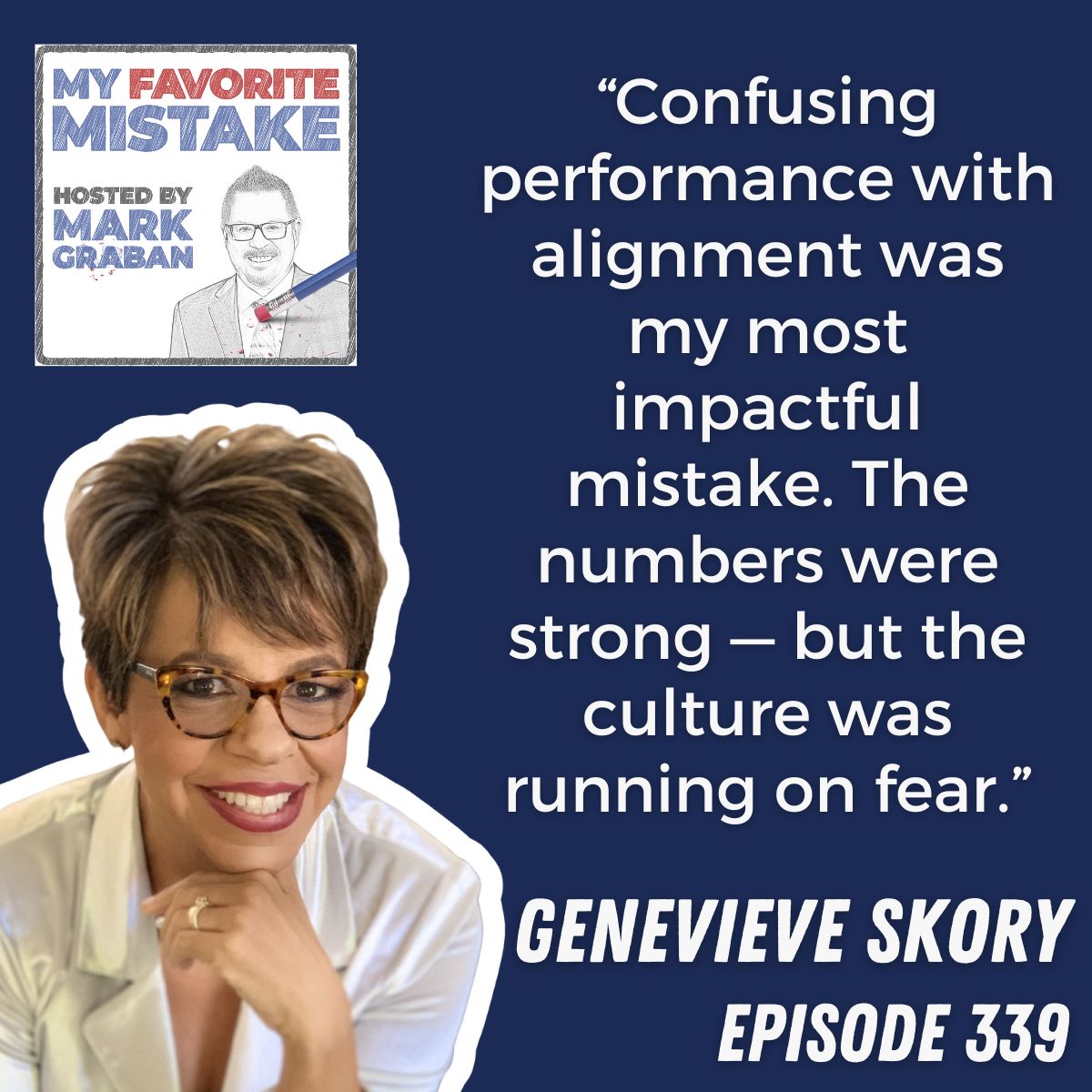
Genevieve shares what she now considers one of her most impactful mistakes: confusing performance with alignment. In her corporate career, winning meant hitting the number — at all costs. Pressure was normalized. Constant pivots felt strategic. Intensity was rewarded. And because the results kept coming, it was easy to believe the system was working.
But over time, she began to see the deeper cost. High performance masked exhaustion. Leaders operated from fear and urgency. Teams responded in predictable ways — fighting, freezing, fawning, or quietly disengaging. In that environment, people didn’t always tell the truth. Agreement wasn’t always alignment.
We talk about the neuroscience behind fight-or-flight leadership, why emotional intelligence often declines as leaders rise, and how founders and executives can unintentionally create cultures that look successful on paper but feel unsustainable day to day.
Genevieve also shares what changed for her — stepping back, learning to pause instead of push, and redefining what winning really looks like. Her work today focuses on helping ambitious leaders build cultures where performance and alignment reinforce each other instead of compete.
If you’ve ever been rewarded for getting results the wrong way — or if you’ve sensed that something feels off despite strong performance — this episode will likely resonate.
Themes and Questions:
- The difference between performance and alignment — and how strong results can mask deeper dysfunction
- What happens when leaders define winning solely by revenue or hitting the number
- How pressure-driven leadership pushes teams into fight, flight, freeze, or fawn responses
- Why teams don’t always tell leaders the truth — and what kind of environment encourages honesty
- The hidden cost of intensity and constant pivoting on trust, clarity, and sustainability
- Why emotional intelligence often declines as leaders rise in organizations
- How high-performing teams can quietly burn out while still delivering results
- What it looks like to create alignment without sacrificing performance
- How coaching helps leaders see patterns they’re too close to recognize
- Redefining “winning” to include clarity, sustainability, and psychological safety
Scroll down to find:
- Video version of the episode
- How to subscribe
- Quotes
- Full transcript
Find Genevieve on social media:
Watch the Episode:
Memorable Moments from the Conversation:
Click on an image for a larger view



Subscribe, Follow, Support, Rate, and Review!
Please follow, rate, and review via Apple Podcasts, Podchaser, or your favorite app—that helps others find this content, and you'll be sure to get future episodes as they are released.
Don't miss an episode! You can sign up to receive new episodes via email.
This podcast is part of the Lean Communicators network.

Other Ways to Subscribe or Follow — Apps & Email
Interview with Genevieve Skory: Performance vs. Alignment
Mark Graban: Hi, welcome to My Favorite Mistake. I'm your host, Mark Graban. Our guest today is Genevieve Skory, an international business success strategist with more than two decades of experience in entrepreneurial growth and corporate leadership. Genevieve previously served as Chief Field Development Officer for a half-billion-dollar company, developing sales and growth strategies for tens of thousands of independent business owners. She's a former executive turned entrepreneur, a mom of four successful YouTubers, and Genevieve now coaches women to strengthen their mindset, clarify their message, and build sustainable businesses without burnout. So, Genevieve, welcome to the show. How are you?
Genevieve Skory: I'm great. I'm great. Thanks for having me.
The Evolution of a Family Business
Mark Graban: I'm curious, the four YouTubers—do they do things together or are they all doing their own thing?
Genevieve Skory: No, they do it all together and they have for over a decade. We homeschooled our kids, and coming out of that homeschooling, when they were done with high school, my son said, “You know what, I don't think I want to go to college”. Of course, that horrified me. When you're an entrepreneur and your kids are watching, they don't think about getting jobs. He said people aren't going to watch TV the way they do now, which I totally misunderstood, but he was right.
Mark Graban: Yeah.
Genevieve Skory: The four of them started a YouTube channel and they ran it like a business at a very young age. They work together and they have all this time.
Mark Graban: Good for them. It sounds like not a mistake at all.
Genevieve Skory: It was. I am eating crow. It was bad advice I gave to my children that turned out to be really good advice for them.
Mark Graban: Well, it goes to show for any of us, we don't have a crystal ball. Sometimes we make a prediction and it turns out, sometimes not. When it doesn't turn out, we call that a mistake, but there's no shame in it.
Genevieve Skory: No. And the one thing that I appreciate the most about it—and I'll credit my husband more than myself—was that they had the fortitude and the insight to try. They were willing to make the mistakes, learn from them, and persevere. That's actually a really good trait to have.
Mark Graban: For sure, that's entrepreneurship. So, Genevieve, with the different aspects of your career, I'm curious to know where your story is going to come from. What's your favorite mistake?
Redefining Success: Performance vs. Alignment
Genevieve Skory: I think I would sum it up as saying my favorite, most impactful mistake was confusing performance for alignment. I got to a place where I traded pressure for leadership and speed for impact, and while I was in the middle of it, you couldn't have told me otherwise.
Mark Graban: Tell us more about that. Was that from the perspective of being a leader, from being led, or both?
Genevieve Skory: That's a great question. I think it's a combination of things. When you are rewarded for what I would say now are somewhat toxic behaviors, you just continue to do it. I mean toxic from the standpoint of it really wasn't healthy for me, it wasn't great for the culture, and it wasn't great from a lifestyle standpoint. But I performed, so I just kept making it work, which I thought was fun. I thought that must be how you play the game—you just keep pushing and pursuing, and then everybody says, “Yay, you made it work”. Part of it was what I was conditioned to do, and some of it was also my internal misunderstanding of what winning actually looked like. I had to take a step back and decide what I wanted my career to look like and who I wanted to be.
Mark Graban: Could you set a little bit of context? Was this earlier in corporate settings? Could you give an example of one of those behaviors?
Genevieve Skory: For me, the first thing was defining winning solely based on revenue. At all costs, whatever it took, you hit the numbers. My arena was sales, sales enablement, and training. I thought it was a game. I was the girl who could get it done at all costs. What that looked like was pressure—we thought we thrived in pressure. It was a plan based on constant pivoting, which is never really good, but it was like, “Well, that's not working, we should try something else”. It was also based on favoring performance over anything else. One of my favorite sayings was, “But did you die? You didn't die”.
Mark Graban: So it must have made you stronger.
Genevieve Skory: Exactly. Some of that I think I learned growing up in a military home. I learned that your sins tend to be forgiven if you get the thing done. I clocked all of those wins as “the name of the game” instead of thinking about how everybody wins on a day-to-day basis.
The Danger of Aimless Pivoting
Mark Graban: I wanted to dig into that a little bit more. There's something to be said for evolving and iterating, but it sounds like you're pointing to something more extreme—flailing around as opposed to being intentional?
Genevieve Skory: Yeah, and the missing element is clarity. People who tend to pivot too early and too regularly do so because of a lack of clarity about the goals, the process, and the milestones. It's definitely okay to pivot on purpose, but not just because “this feels scary”.
Mark Graban: When did all of this start catching up to you? What did you start to notice?
Genevieve Skory: I was ignoring the signals that were happening internally. I'm a high performer, and we are driven and like the chase, but I had learned to ignore the internal signals. You wake up feeling really tired, and even though you enjoy the work, you can't shake the sense that it is exhausting. In that scenario, I thought that just meant we needed to push harder and power through it.
Leadership, Fight or Flight, and Burnout
Mark Graban: While there's some short-term reward, is there long-term pain? Was it burnout?
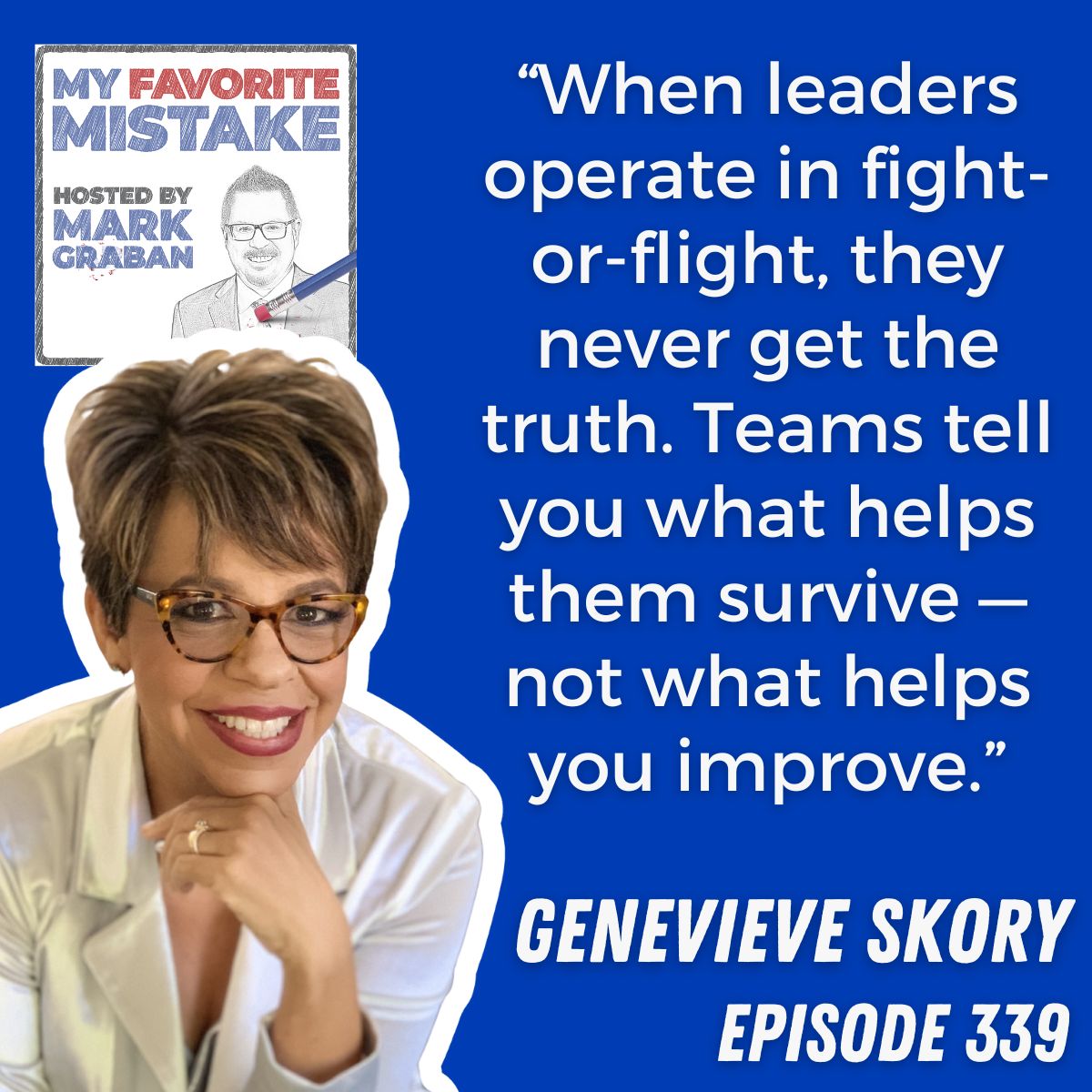
Genevieve Skory: We say burnout, but there are varying degrees and causes of burnout. For me, pressure has to do with fear, and fear puts you soundly in your fight or flight state of being. No good decision-making happens in fight or flight. And then there's this terrible rippling effect because the leader sets the tone. When you're in fight or flight mode, you never get the truth. Your team will never tell you the truth because they're just trying to survive. It creates a crazy cycle.
Mark Graban: I totally agree about leaders setting the tone. People hold back the truth because of the environment. Then it all falls apart and leaders blame the people instead of thinking about the environment they created.
Genevieve Skory: Exactly. You don't realize that until you back way away from it. When I stepped back, I thought, “Oh my gosh, that was crazy,” and I'd like to apologize to a hundred different people. There's a justification part of you that says, “Yeah, but we all made some money,” but that can't be the only measurement of success.
Recovering from the Corporate Grind
Mark Graban: What were the key adjustments you made? How much was changing your environment versus changing your approach?
Genevieve Skory: It was both. I changed the environment and became an entrepreneur. I needed a period of time to decompress and look for patterns, because this had been building over years. I tell people I'm still recovering because a lot of that is hardwired. It means stopping, calming down, and asking, “Am I making this decision out of clarity, or out of pressure or fear?”.
Mark Graban: When you're busy, you tend not to take time to reflect on whether you're spending time on the right things. That’s where a coach helps, right?
Genevieve Skory: Yes. There's a big difference between a boss acting as a mentor and an outside coach. A boss always has a particular agenda or obligation. When people hire coaches, it's often productivity-based—learning how to do more. I've come to a place where I think depth and understanding matter a lot more than just jumping to the next step.
Emotional Intelligence in High-Stakes Leadership
Genevieve Skory: The wisest people are very self-aware. I am the living, breathing example of the idea that the higher you get in the corporate world, the less emotional intelligence you have. That's proven—executives often have less emotional intelligence. When that's your frame of reference with other emotionally unintelligent people, the comparison is skewed because you're all doing crazy things. Coaching helps because it connects you to your personal goals and holds you accountable.
Mark Graban: Is it that you lose EQ as you rise, or is it a selection bias in who gets promoted?
Genevieve Skory: I think it's a combination. You lose it, and you are rewarded for everything else except that. High-powered executives are people who get things done and grow businesses, but they often leave people in their wake. If you stay in a role long enough and have some wisdom, you can't ignore the data points—like crazy turnover at high levels. You can't grow when key leadership roles are constantly changing.
Creating Safe Spaces and Genuine Alignment
Mark Graban: Does coaching others help you continue to heal?
Genevieve Skory: Yes, I have learned to show up as I am and not over-perform. I used to think I always had to be perfect. That happens because the environment isn't safe. When you create space for yourself, you create space for others. When I feel myself getting anxious, I now have a mechanism to get back down from a “ten” to a “four”.
Mark Graban: I've been in environments where things aren't working, but leaders just say, “Y'all need to try harder and focus”. It feels like doubling down on things that aren't working.
Genevieve Skory: High-performing teams can be quietly and slowly burning out, and you don't realize it until it's way too late. People are “quietly quitting” emotionally. If you're going to leverage other human beings to meet aggressive goals, you have to pay an equal amount of attention to the culture.
Engaging the “Executive Center”
Mark Graban: How do you start that conversation with a founder who says, “Genevieve, I don't have time for a science lesson”?
Genevieve Skory: You don't say, “You've got to go slow to go fast.” No executive wants to hear that. But what you can say is, “What if there are things we don't know that are impacting our effectiveness?”. Every executive wants to win. I tell them they will actually make more progress if we can commit to a couple of things and have some language to help them get more of what they want.
Sometimes the person who broke the situation can't be the one to fix it immediately because their identity is tied to “looking strong”. You have to be able to recognize a “fight or flight” conversation versus an “executive center” response. The thing that tricked me the most was “fawning”—when people say, “Excellent idea, we're going to implement,” and then nothing happens. They aren't going to fight with you because you're an executive, so they fawn and then do their own thing. Or they “freeze,” which the boss mistakes for agreement.
Mark Graban: A good coach asks tough questions. How can people find you?
Genevieve Skory: Anyone who heard this story and felt a glimmer of “that sounds like me”. Usually, these are highly successful people who have reached a point of exhaustion but aren't finished creating impact. My website is https://gskory.com/, and my podcast is called “Fix This, Grow Fast.”
Mark Graban: Genevieve, it's been a pleasure. Thank you for being here.
Genevieve Skory: It has been a great conversation. Thanks for hosting me.