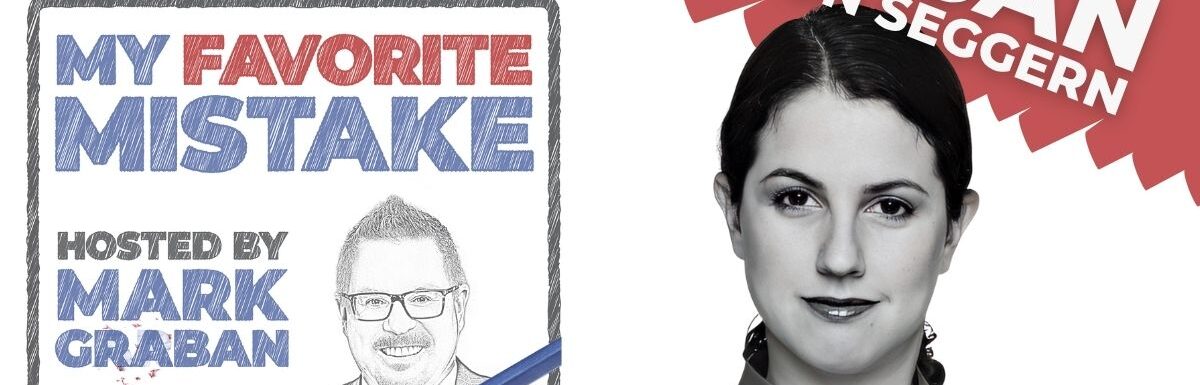
Susan von Seggern joined a friend's Los Angeles PR agency in the late 1990s as the business development half of the partnership and left the money to her partner. Business was good, so when she decided to open a New York office — lease, three hires, payroll — she never looked at the numbers. Then came the dot-com crash and the 9/11 recession. What it took to unwind that decision came out of her own pocket.
Listen:
Check out all episodes on the My Favorite Mistake main page.
My guest for Episode #365 of the My Favorite Mistake podcast is Susan von Seggern, a Los Angeles PR consultant with more than two decades in the field. She started as a major label publicist working with artists including Wu-Tang Clan, Public Enemy, Elton John, Portishead, and Ice Cube, later ran a boutique agency, did political and issue advocacy work, and now consults on earned media for clients in entertainment, technology, sustainability, and real estate.
In the late 1990s, Susan joined a friend's LA agency, Green Galactic, as a partner. Her friend had been running the business and handled operations and the finances. Susan took business development, and told her partner, “You keep handling the money.” Money was plentiful in the dot-com boom, so the split held up without much scrutiny. Then Susan decided the agency should open a New York office — a lease, three hires, salaries, insurance, payroll taxes — and she made that call without looking at the numbers. Her partner pushed back. Susan says she didn't listen.
The dot-com crash came, then the 9/11 recession, and PR budgets disappeared. A forensic accountant looked at the books and told them what they had to bring in each month to keep going. They weren't close. Susan took a home equity loan against the condo she had bought in her twenties to cover final paychecks, handed the New York lease to a company already subleasing part of the space, and closed the office. People were let go in both cities. One of the New York employees never spoke to her again. Her business partner is still one of her closest friends, which Susan attributes to both of them working hard to do right by people on the way down.
We also get into what earned media is and why Susan still builds her practice around it; her framework of press releases, sustained outreach, lead services like Qwoted, and events; why lead time is the thing clients underestimate most, especially with books; how she handles the client who expects to be famous in three weeks; pay-to-play placement in podcasts and media; and her three years doing PR for one of the world's largest online gambling companies while the legal ground was shifting under it.
What You'll Learn
- Why handing off a function is different from handing off awareness of it, and how a clean division of labor between partners turned into a blind spot
- How a decision to open a second office got made without anyone opening the books first
- What it means when your partner pushes back and you keep going anyway, and why Susan counts that as part of her own mistake rather than her partner's
- Why the dot-com crash and the 9/11 recession exposed the problem rather than caused it
- How bringing in a forensic accountant gave two partners a number to decide against instead of a feeling to argue about
- What it took to wind down an office and still be friends with your business partner 25 years later
- Why earned media still carries more weight than paid placement, and how the PESO model fits around it
- How lead time works in PR, why books need the longest runway, and what to tell a client who wants to go viral next week
Scroll down to find:
- Video version of the episode
- How to subscribe
- Quotes
- Full transcript
Find Susan on social media:
Watch the Episode:
Memorable Moments from the Conversation:
Click on an image for a larger view
Subscribe, Follow, Support, Rate, and Review!
Please follow, rate, and review via Apple Podcasts, Podchaser, or your favorite app—that helps others find this content, and you'll be sure to get future episodes as they are released.
Don't miss an episode! You can sign up to receive new episodes via email.
This podcast is part of the Lean Communicators network.

Other Ways to Subscribe or Follow — Apps & Email
Episode #365: Susan von Seggern, Los Angeles PR Consultant
Meet Susan von Seggern, PR Consultant
Mark Graban: Hi, welcome to My Favorite Mistake. I'm your host, Mark Graban. Our guest today is Susan von Seggern. She is a Los Angeles-based PR consultant with more than two decades in the field. She started as a major label publicist working with artists including… now, this is a range: Wu-Tang Clan, Public Enemy, Elton John, Portishead, and Ice Cube.
From there she went on to run her own boutique agency. She did political and issue advocacy work with the ACLU and with campaigns and others, and she's taken on global corporate clients. Today she consults on earned media for clients in arts and entertainment, sustainability events, and cause-related work, securing coverage everywhere from legacy news outlets to podcasts, like here.
So Susan, thank you for being here on the podcast. How are you?
Susan von Seggern: I'm great. Thank you so much for having me. I really appreciate you having me on.
Mark Graban: Yeah. There's a connection with some previous guests on the show, our mutual friend Jim Benson. You lined me up with Lynn Kelly. I might be forgetting somebody else, but I've worked with you on that getting people booked on podcasts side.
Susan von Seggern: Mark Reich from Lean Enterprise.
Mark Graban: And Mark Reich. So some of this was on the Lean Blog Interviews podcast, and I've known Jim forever. But yeah, it was great to get connected with you, Susan, and there's a lot we can talk about here today.
But as always, I know the question you're ready for: what's your favorite mistake?
Susan's Favorite Mistake: Growing an Agency Without Watching the Money
Susan von Seggern: Oh, gosh. I've made many mistakes. But my favorite mistake is when I had my agency, which was called Green Galactic, and we started that in the late '90s. We started kind of in music and entertainment, but because it was the late '90s, it was when the technology scene was really blowing up, and so of course we started getting a lot of technology clients and more higher paying clients and more clients.
Mark Graban: Would you say this was dot-com companies? Dot-com era?
Susan von Seggern: Yeah, so it was technology companies, dot-com companies. So when we had this agency, we started, it was just me and my roommate at the time. She had an office. I joined her in her agency. We immediately ramped up the agency to four or five people, and then we just kept growing and growing.
Eventually we had nine people in Los Angeles, and then I think it was around 1999 or 2000, we decided to open a New York office.
So the mistake… well, there's like compounded mistakes. But the main mistake was that I, who — I'm a pretty good with money person. I bought a condo when I was in my 20s. I'm a good with money person.
Mark Graban: You're responsible with money.
Susan von Seggern: I'm responsible with money, right? I kind of am good with managing money. But because I was joining her business that had already been running, and I was more in the role of the business development person, and she was the more operations person, I was like, “You keep handling the money.”
So she did, and because there was so much money around and we were doing great, we were able to grow and keep going without worrying about the money side too much. And it all seemed to just be going along fine. And then I was like, “Okay, we're gonna open a New York office.” And she was like, “Okay.”
But she never said like, “Oh my God, we can't afford to do that. Don't do that.” So I was just totally not looking at the numbers at all. And we opened a New York office, which included leasing an office space, hiring people. And at that time when you hired people — I mean, still now, but when you hire full-time people, you have to pay salaries, you have to pay insurance, you have taxes. It's a big thing to bite off, right?
Mark Graban: Yeah.
The Dot-Com Crash, 9/11, and Closing the New York Office
Susan von Seggern: And so we did. We hired three amazing people in New York who also, they weren't super expensive, but they also weren't cheap, because also New York you pay more. So we did open that New York office, and this was, I think around maybe '99.
And so we had it '99, 2000, then there was the dot-com crash, which was terrible, and we lost tons of business. And then it made it really hard to keep running that New York office. And then 9/11 happened. And that just totally destroyed everything — the 9/11 recession was so terrible.
And then it was just like, “Oh wow, we have to close the New York office.” So we actually were able to — I got a home equity line of credit, or a home equity loan, on my condo. And so we were able to pay off the rent, or we actually were able to give the lease to somebody who had already been taking part of our space. So we were able to give the lease to them. And then we were able to pay the final checks of the New York people and the LA people that we had to let go.
A lot of people at that time were going through the dot-com crash and the 9/11 recession. So it wasn't like we were weirdo losers whose business was going south. A lot of people were dealing with that at the time.
Mark Graban: Yeah.
Susan von Seggern: So we managed to get through it, and actually my business partner and I are still great friends. I threw her bridal shower, she threw my baby shower. And my bridal shower. We're still really good friends, which also a lot of people who were partners at that time I don't think are still friends.
But the big, big, big mistake was me not watching the numbers and not watching the money, and acting like it was just happening over here and it didn't matter. I was just living in this fantasy land of like, money doesn't matter, money doesn't count, whatever. Which is crazy for me because I bought a condo when I was in my 20s. I'm good with money. But I was like, “No, no, I'm not doing the money. She's doing the money. I'm doing the business development.” So that will never happen again.
Pay Attention to the Money: What Changed Afterward
Mark Graban: So that's the key.
Susan von Seggern: So after that I started consulting, and I worked for the Democrats for two years leading up to the 2004 election cycle. And then after that I was recruited to a full-time job working for one of the world's largest online gambling companies, which I did for three years, and I had my boss on the cover of Forbes and whatever. But after that, then I started really, really consulting, which I've now been doing for a really long time.
And now I really pay attention to the money. I am incorporated, so I have the money in the business and I'm watching. And then my husband and I — I handle the money for my husband and I.
He actually recently started, or I guess it was about two years ago, started another company and he was like, “You have to be the CFO. Because you're better with money than me.” Which is right. So I am the CFO of that company, although he's doing more of the day-to-day money stuff.
But in the first couple years when we were getting it set up — the legal structure, getting some early financing and whatever — I was much more involved in that. And I still do keep an eye on it, because the lesson I really learned back in Green Galactic was don't take your eye off the money. Pay attention to the money. Even if you're not interested, even if you don't care, even if you think it's fine, even if you just don't wanna deal with it, doesn't matter. You run a business. Businesses run on money. Pay attention to the money.
Mark Graban: So you're good with money if you're paying attention to it, and you've learned to pay attention to it.
Susan von Seggern: Yes, exactly. Exactly.
“It Was My Fault”: Owning the Decision and Keeping the Friendship
Mark Graban: Well, I'm glad that didn't turn out worse. People say, be careful going into business with a friend because that's a good way to ruin a friendship, when business issues come up. So I'm glad it wasn't that bad. Was it stressful at times?
Susan von Seggern: It was stressful, but it was my fault. The reason the business failed, I mean, aside from the dot-com crash and the 9/11 recession, it was my fault. It was my fault for not paying attention to the money, for thinking we could open a New York office.
You know, it's funny, since then I've done some work as a consultant in the consulting program for Spark PR, which is one of the top tech PR companies, and so through that I've had more exposure to the internal workings of a classic PR agency, which I really hadn't had before. I had worked at a small entertainment agency, and then I worked at labels, and then I had my own agency, so I literally did not know what I was doing running a PR agency. And it's amazing it lasted as long as it did and was as successful as it was.
But I just didn't really understand the whole hourly… we were just retainer-based. I'm still retainer-based, which I prefer as an independent person. I think being retainer-based is the way to go. But when you have an agency, you do have to, aside from just paying the bills and the money and the in and the out, which was pretty much what Lynn was doing, I also didn't know about billable hours and how that worked against the retainer fees, and all those things that you should know before you start a PR agency. I did not know, and a lot of those were kind of money-related too.
And now that I've had that Spark experience and other PR experiences, I'm like, “Oh, that's what I should have done.” “Oops.”
Mark Graban: You say it was your fault, but you say it was your friend's business and she didn't say, “No, don't do the office.” Did she ever express any regret for not pushing back on that, and letting you and the company run like that?
Susan von Seggern: I think she pushed back, but I didn't necessarily listen.
Mark Graban: Okay.
Susan von Seggern: It was very stressful. Having that office and having those expenses was so, so, so, so, so stressful, and we were just barely getting by. It's amazing that we managed to sneak out of it as smoothly as we did. Because I had this condo, I could get a home equity loan on the condo and then pay the bills and make everything work.
Mark Graban: Do you think one of the keys, I guess, for resolving that and keeping the friendship… it sounds like you managed a relatively smooth landing for the company, and doing right by people, and being able to offload the lease. Do you think that probably made a difference?
What a Forensic Accountant Told Them
Susan von Seggern: Yeah. Well, one thing we did when things started to… because after 9/11 and then the 9/11 recession, people were just not hiring PR. They weren't hiring us, or it was just really, really, really hard. So we actually went to a forensic accountant and had her look at the books, and she was like, “If you can't make X a month, you have to shut this down.”
And I can't remember if we had already shut down New York at that time or if we were in the process of shutting down New York, but we were like, “Okay, yeah, this is not working anymore. This is not financially sustainable if we keep doing this.” We have to be conscious about it.
So I started doing morning journaling and yoga and meditation in 1999. Or journaling and yoga in 1999 and meditation in 2000. And so I was getting into a space where I was being more mindful and more conscious — I was still drinking, but I was getting into that space. And so I think that really helped, because I was trying to be, instead of being so reactive and so stupid like I had been previously, I was really trying to deal with what was actually happening instead of what I wanted to have happen.
And I think that kind of helped us. We met the forensic accountant, she was like, “This is what you need to do.” We were like, “Okay, let's do this.” So then we took those steps.
And also I think Lynn and I were very conscious of wanting to maintain the relationship, and wanting to try to do right by the New York people and the LA people. One of the New York people hated me afterwards and never spoke to me again, and I do feel bad about that, but I also feel like we were really trying to do the right thing. It was a hard time. It was a hard time for everyone.
But yeah, I think it was trying to be really conscious of trying to do the right thing that allowed at least Lynn and I to still be friends, and I'm still friendly with the other people too, other than that one.
Doing PR for an Online Gambling Company
Mark Graban: Before we talk about what you're doing now in public relations and things, I do wanna ask, you mentioned the online gambling company. Here we are in 2026, so how many states? A vast majority of US states —
Susan von Seggern: Oh yeah, 43 or something crazy.
Mark Graban: — have legal gambling. You go someplace, or the phone apps that are advertised constantly. This was a different era. Was this like online poker, online sports betting?
Susan von Seggern: Yeah, sports betting. So the company I worked for was called Bodog, and they were one of the world's largest online gambling companies at the time.
Mark Graban: I remember hearing of that. I didn't do that, but I've heard of it. I remember that name.
Susan von Seggern: Yeah. I had my boss on the cover of the Forbes billionaires issue, and after that it was just off to the races. And then we were on ABC News — no, CBS Evening News, and Nightline, and CNN a bunch of times, and CNBC a bunch of times. He was one of People's Bachelors. So I got him tons of coverage.
So I started working there in 2005, and online gambling, whatever, nobody really cared. And then in 2006 it got a little more contentious, and then he was no longer able to come into the United States.
Mark Graban: Because the company was based in the Caribbean?
Susan von Seggern: Their marketing office was in Vancouver, a city that I love and is amazing, and I was so lucky that I got to go there so many times. Vancouver's fantastic.
Mark Graban: It is.
Susan von Seggern: And then their gambling operation was in Costa Rica, and I also got to go to Costa Rica a bunch of times, and Costa Rica is also fantastic.
Crisis PR, Federal Raids, and Losing an American Job
Susan von Seggern: So when I started there, online gambling, people weren't really paying attention. Although right when I first started, we did like a little pullout mini mag with Esquire. And the federales raided the Esquire offices. This is like the first month that I worked there.
And so that was kinda crazy, and we were working with this PR agency, and the PR agency was like, “Oh, don't worry, it'll blow over.” And I was just like, “Hmm, this is not how we do crisis PR, is it now?” So I had to jump in and do a little crisis PR right at the beginning.
Throughout the time I worked there, we had a bunch of other crises. We lost the URL, there were other legal challenges, there was a hack. All kinds of stuff. So I got a really great course in crisis PR working for them.
But yeah, so then in 2008, the federales really cracked down on online gambling.
Mark Graban: Yeah.
Susan von Seggern: Which is so crazy now, because isn't it just so prevalent and accepted now? But at that time it was not. And so they were so nice, but they were like, “We love you. You're our only American employee. You have to go.” And I had been at that job for three years.
Mark Graban: That didn't put you at any risk of getting arrested, did it, personally?
Susan von Seggern: I don't think so. When I would talk to their legal team and my legal friends, everyone would say to me, “You do PR. You are protected by the First Amendment. You can say whatever you want because you have freedom of speech.” So I never thought anything was gonna happen to me.
Mark Graban: Okay. Well, good. But it seemed like there would be a real balance at that time of wanting to promote the business and grow the business versus, eh, let's not draw too much attention to ourselves, for the way Congress or law enforcement agencies might take interest.
Susan von Seggern: Yeah. I mean, gambling businesses are all about getting people in the door. They're all about, the more people you can get, the more money you can get. You know what I mean? So they were happy to take the risk of getting a lot of media coverage. And then seeing what happened. Because there were no other employees in America. He was never gonna come into America after they made it clear that he should not.
And it was just a fun, exciting, sexy thing. I think the illegality of it made it more fun and exciting and sexy. And I kind of do PR for some weird and crazy things. I did the UFO conference, Contact in the Desert, for seven years. So weird and crazy and sort of sexy and edgy, that's kinda my brand. So I wasn't worried about that.
Other people have said to me, “You do such weird things. Isn't that bad for you as a publicist?” I'm like, “No, for me as a publicist it's great. For other people as publicists, it might not be great, but for me, it's great.”
Music PR in the 1990s
Mark Graban: So let's talk about some of the work that you've done and the work you're doing now. All these rappers and bands and artists that I mentioned — to be a publicist for, pick one for example, what did that involve? Is that helping promote a new album, a tour, media interviews?
Susan von Seggern: Yeah. So early in my career, I was only a music publicist, and I worked at mostly record labels, and that was albums coming out, bands touring, singles coming out.
Sometimes there might be some news story that an artist would be involved in that you might wanna exploit. I think I had Angelique Kidjo maybe at the '96 Olympics, and then there was that drama around the '96 Olympics, like there was a shooting or something. I can't even remember.
Mark Graban: Well, the bombing.
Susan von Seggern: The Centennial Olympic Park bombing. Yeah, so I think I got her quoted in maybe the Wall Street Journal or something for being around that.
So that's what I did in the '90s. I was strictly music PR, and then I had my agency, and then I expanded from music to also tech and events. Since I had been doing music tours, going to events was very easy. And then I had that corporate job.
So after that, once I started consulting, I really consider myself a PR generalist, so I do whatever PR people need. And right now I'm working on the Attack of the Killer Tomatoes fifth film that is coming out right now.
Mark Graban: Oh. Who knew there were five of them?
Susan von Seggern: I know. There was the one in '78, and then there was three, like '89, '90, '91, and then there was a cartoon, and now there's a fifth movie. And it's great.
So I do some film PR. I'm very film heavy right now, which is funny because I've lived in LA for all these years and I have not necessarily done a ton of film PR. I've done some docs and I've done some festivals, but this is the first time I've really had a full movie. And I have a short that is actually a 9/11 remembrance short.
And I have some politics right now, which I also really love, since I haven't really worked in politics since that 2004 election cycle. But there's a lot to be done in politics right now. So right now I'm working with the Independent Voter Project, who are trying to empower independent voters and get more independent candidates. We don't have to have a two-party system. Possibly having a two-party system isn't the best idea. So it's been really exciting and fun working with them.
And then I'm also working with a lawyer in the Bay Area, and he is an author. He has a book called We Are The Power, which is about how people power can really change the outcomes of elections and how to organize that. So that's been really fun.
But I do music. I do books. I do films. I do television shows. I do tech and real estate and corporate. In LA, I think PR people in New York specialize more deeply, but people in LA tend to be a little bit more flexible. I mean, there are people who just do film and just do actors and just do music, but there's also a lot of people like me who kinda do whatever's coming down the pike.
Rap Beefs, Real and Manufactured
Mark Graban: Now, you were involved in rap and hip hop, and there's a long history of beefs and conflicts. More current day, Kendrick Lamar and Drake, and back in the day, East Coast, West Coast. How much of that — and some of that unfortunately turned deadly, so I'm guessing there was some real conflict there. It wasn't just manufactured for attention.
Susan von Seggern: I just sort of stayed away from that stuff. When I was first working in PR, I worked at a PR agency in New York that was very hip-hop heavy and very alternative rock heavy, which at that time both of those things were very edgy and cool.
And that was around the time that Puff had that basketball tournament that people died at because they got crushed. And when that happened, I was like, “Okay, he's off the list.” In my head I was like, “I will never work with him. I will never be around that.” And I never was. In my whole career I never really had any Kanye interaction, because after that happened I was like, “Nope.”
Mark Graban: He's not Kanye. Puff interaction.
Susan von Seggern: Puff interaction, yeah.
Mark Graban: Kanye's a D, yeah.
Susan von Seggern: So I was like, “Nope.” But it's interesting — one time during the College Music Journal Convention, which was every fall in New York, it's now called Mondo New York City I think. But anyway, one time at that we were at a big party and Tricky was there, and I had a Spin journalist who was hanging out with Tricky, or trying to hang out with Tricky, and he was like, “Tricky won't hang out with me. I keep having to chase him around.” I was like, “They don't call him Tricky for nothing, dude.”
So we're at this party, and it's very chic New York, whatever, so John F. Kennedy Jr. was there. And Tricky was there.
Mark Graban: Wow.
Susan von Seggern: And Goldie, who was another British electronic music artist, more of a drum and bass artist, and the two of them were known for being tough and also being crazy, and also being tricky. So they got into a “fight.” I don't think it was real.
Mark Graban: There's finger quotes for those who are just listening.
Susan von Seggern: Yeah, “fight.” I don't think there was really a fight. I think they were like, “John F. Kennedy's here, let's get in a fight. Let's get in all the papers.” They could've told their publicist. They did not. So anyway, they got in a fight. It was all over Page Six the next day. And people were like, “Was it real?” And I was like, “Probably.” Do you think it was real? I'm not 100% sure it was real.
But yeah, so sometimes it's real, and sometimes — I mean, obviously in the case of Tupac and Biggie Smalls, way too real, right? But sometimes maybe just for getting a little press, we'll see. It can kind of go either way.
Why Earned Media Still Matters
Mark Graban: So when it comes to press, moving away from business — on your website, you quote the legendary Richard Branson, talking about a good PR story beats a front page ad. I know the term, but a lot of the audience might not know what's meant by earned media. So I was gonna ask, why is earned media so valuable? Is that still true in this day?
Susan von Seggern: Absolutely. Absolutely, yeah. So earned media is an article or a photo spread or something that says that the editors of this publication decided that your story was worth telling in their publication.
Mark Graban: You've earned the coverage.
Susan von Seggern: You've earned the coverage, right. As opposed to when you buy an ad, or these days there's also a lot of pay-for-placement media that people can get. When you buy an ad, you get the placement, but anybody reading the paper or seeing that ad knows it's an ad.
Mark Graban: Yeah.
Susan von Seggern: Versus if they're reading the story, they know it's a story. They know that the LA Times or the New York Times or Vogue or whoever said, “Oh, this is worth a story.” And so that I think means a little bit more to people, although honestly these days, I don't know that people know the difference as much or understand the difference.
So I definitely like the PESO model, which is the paid, earned, shared, owned. I personally focus on the earned media. I am a media relations specialist. I get people written about in newspapers, and magazines, and blogs, and web news sites, and podcasts, and TV interviews, and radio interviews, and such. That is what I specialize in.
But you still wanna have — that can't be all you're doing. You still wanna do some paid, which is advertising, and you still wanna do some shared, which is you sharing other things on your socials, and owned, you still need to have your blog and your site and your stuff.
And these days, honestly, with AI, you really wanna have all those things kind of working effectively together, because if you don't, then the AIs get confused, and they either don't recognize you or don't recommend you or recommend you incorrectly. So you definitely wanna make sure… I think it's Gini Dietrich who started the PESO model, and I really do like her, and she has a great Substack and blog. And it's really important to have all those things, but I personally focus on earned.
Susan's PR Framework: Press Releases, Outreach, Lead Services, Events
Mark Graban: And that's everything from press releases as one way of trying to get articles written, pitching guests. I've never thought to do this — I've been podcasting for 20 years — but there are some podcasts that make a guest pay to be a guest.
Susan von Seggern: Yeah. There's pay-for-placement all over the media now, and podcasts certainly. I just pitched one that I saw in a lead service the other day, and it was from an NPR station in the Northeast, I'll just say. And then they came back and they were like, “Oh, we do have a $250 whatever fee.” And I was like, “Mm, sorry. No.”
So to go back to your different types of PR and different ways to do PR, I have kind of a framework about how I like to do PR, and my framework definitely — press releases are definitely part of my framework. Everyone says the press release is dead. It is not dead. It's a great way to get everybody aligned on what the message is. You need it if you're gonna be pitching exclusives. Once you get that exclusive, then you wanna send that out, and then sop up whatever coverage.
And also, you just want people to see, like people in your vertical especially, you want them to see, “Oh, they're busy. They're doing stuff. They're making stuff happen. They're growing. They're active.” Even if they're not covering right from the press release or picking the press release up, doesn't matter. You're building your story, and press releasing is part of that.
And then sustained media outreach, which is just pitching, and that can be pitching regular outlets, could be podcast pitching. For my book clients especially, and political clients, I'm doing a lot of podcast pitching. And I'm getting lots of people on lots of podcasts, which I love. Because I love being successful. I have a little placement addiction. So getting people on podcasts is really great.
And another really important part of my framework is lead service monitoring and pitching. So most people have heard of HARO, which is Help a Reporter Out.
Mark Graban: Yeah, it's been around for a long time.
Susan von Seggern: But the current one that I use the most and I feel is really the best one these days is called Qwoted, which is Q-W-O-T-E-D. And they have like 300 leads a day, and it's a web platform. You do get emails from them, but it's a web platform, and you can configure what emails it's gonna send you, and what topics, and what you see. And it has some really nice features, and I've gotten a lot of coverage out of that. And huge coverage, like GQ and Parents Magazine, and Huffington Post, and Good Housekeeping. So lead service is really important.
And then events. When a publicist in Los Angeles says events, people think, “Oh, she means some crazy red carpet, cocktail, celebrities, blah, blah, blah.” I can mean that, but I don't only mean that. Events, activation, really can be anything. It can be getting your client speaking at conferences, which I did actually for both Lynn and Mark. Doing small cocktail or luncheon introductory events. If you have a music client that's promoting their concert. So the events part, it can be many different things, depending on what the client needs. It doesn't have to just be a crazy red carpet event.
Paparazzi, Personality PR, and My Cat From Hell
Mark Graban: When I think of LA, you also think of paparazzi, and there might be some stars who just get really tired of paparazzi always being around. But then there might be some stars that want to be photographed by paparazzi, and you probably figure out where to go.
I'm just gonna tell a quick story. I don't know if it's a great story, but when my wife and I lived in LA, we had dinner at Nobu in Malibu, which is said to be a place… we didn't see any celebrities that night, but we came out and we were waiting for the car, the valet parking, and I think my wife kind of trailed behind. And there was a paparazzi photographer like across the parking lot, and I could even hear the shutter, kind of aim the camera at me. I'm like, “I'm a nobody.” I don't know who they thought —
Susan von Seggern: He might have thought you were somebody and was gonna try to figure it out later.
Mark Graban: I guess with digital cameras, you don't have to worry about burning film. But yeah, I'm sure they looked later and were like, “Ah, dang it, he was a nobody.”
Susan von Seggern: Yeah, probably. So I do almost no actor PR, and I only do some personality PR. My big personality PR claim to fame was I had a guy who was a cat behaviorist, and we sold the show to Animal Planet and it ran for two seasons. It was called My Cat From Hell. But he wasn't getting chased by paparazzi. He was like the Cesar Millan of cats, basically.
But if you're ever looking at People or Us or one of those magazines and you see a mid-tier actress with her children at a park, and it's a bunch of pictures, she told her friend, the paparazzi, that she was gonna be at the park with her kid, and that they should get those pictures. That definitely is something that happens. Absolutely.
Mark Graban: And then maybe complain about it, but they were in on it.
Susan von Seggern: Yeah.
The Biggest Client Misconception: Lead Time
Mark Graban: When you have, let's say, a first-time client, is there kind of a mistaken belief, an idea that they have about PR that turns out to be wrong? Or that they learn, or you educate them, that this is not what PR is?
Susan von Seggern: The main misconception people have is that if you hire a publicist, they will make you famous immediately. And that is not accurate. Everything takes time.
And the thing that people really don't realize, even people who know, even people who should know better — and I get kind of annoyed, especially with music artists who are older, and it's like, “What do you mean you don't know about lead time? You are not new.” So I'm kind of a lunatic about lead time, because publications — people think you tell them, they write about it, like the next day. And it's like, no, no, that is not right.
Right now, I have this Attack of the Killer Tomatoes coming out on video on demand. We're doing an exclusive with someone, so I can't say exactly when, but coming up. And so I'm already talking to people about doing coverage around when that's coming out, and that's in like a month.
You gotta get out in front of things, because people plan. Even television plans, even bloggers plan, podcasters plan. I was just talking to a potential new client yesterday, and her album — we kinda figured out that the best time to put out her album is in February. So we're gonna start doing her PR in November.
Because you need… and books are the worst. You need the longest lead time for books, right? Because say you're sending it to a publication, you're sending it to an editor. The editor has to get the book, has to look at it. They have to decide they want the book, then they have to get the book, then they have to look at the book, then they have to go, “Oh, who should I assign this to?” Then they assign it to someone. Then that someone that they assign it to has to read it. Then that person has to either interview you or review it or whatever, and then it has to be in the publication, so that it gets posted or put in the print edition in a timely manner. So that stuff all takes time.
I mean, it's quicker with music or film or TV, because you can listen to the record in the car, it only takes maybe an hour or two to watch a film, or a half hour or an hour to watch a TV show. So those are a little easier, but books especially really need to take the lead time.
But also it's just respectful of journalists, who are working on something right now that's for right now. If you go to them right now, they're not gonna be able to cover it right now, because they're already covering something right now. So you need to get out in front of things so that when they're ready, they know about it when it's supposed to be covered, and then they can cover it in a timely way.
“Make Me Go Viral” and Firing a Client
Mark Graban: In the internet, social media, TikTok era, I imagine — I don't know if anyone states it so directly — it's like, “I want you to make me go viral. Make a video and it'll go viral tomorrow.”
Susan von Seggern: No, people say that all the time. If only I had that magic fairy dust. Lynn and I, she's still one of my best friends, and we do complain about PR all the time to each other. And the expectation of magic fairy dust, it's unfortunate.
Mark Graban: And then you have to level with people. Sometimes you have to, in the name of educating the client, it might not be what they wanna hear.
Susan von Seggern: Right. Everybody wants to hear that their thing is the most important, best, greatest thing, and that you can get them covered and make them famous in a month. Absolutely.
Mark Graban: Not even a month. Like, right now.
Susan von Seggern: No, I had a client earlier this year that was really up my butt three weeks in about that I was not making them famous fast enough, and what was wrong with me. I don't fire clients very often, but that was one situation where I was like, “Nah.”
A Favorite Artist to Work With
Mark Graban: Wow. So, maybe to wrap up here, of all the different artists that you've worked with, is there one that was just your favorite person to work with? See, I'm not asking for dirt. I'm asking for somebody that maybe was surprisingly nice and kind and pretty cool.
Susan von Seggern: Well, I worked with Jai Uttal for about seven years. He's a new age sort of kirtan spiritual artist, and also an amazing kind of jazz and world music artist out of the Bay Area. And he's like a saint. Literally like a saint. And so of course, working with him was so gratifying in so many ways, to learn about his journey and the music.
And actually, he has a new video series on his YouTube channel where he is talking about his journey through Indian spirituality and music. And he's really, truly an amazing, incredible person. I think he is just in his late 70s now too, so it's great that they're doing that video series.
Mark Graban: I'll have to look him up.
Susan von Seggern: Yeah. Really amazing.
Mark Graban: Nice. Well, our guest today again, Susan Van Sagern. I'll put a link to —
Susan von Seggern: Vaughn.
Mark Graban: What was that?
Susan von Seggern: Did you say Van or Vaughn?
Mark Graban: Did I make a mistake? Vaughn. Susan Vaughn Sagern. Did I? Oh, dang it. It's okay. I'm not gonna edit that out. Susan Vaughn Sagern. The correct spelling and everything, look for a link in the show notes to find Susan's website and for more about her.
But thank you for sharing your story. I'm sorry that, like you said, a lot of companies got caught up in those rough times. I got laid off from the first software startup I worked for a couple months after — five months after 9/11, as that recession was kicking in. That was a rough time for a lot of businesses, but I appreciate you sharing your story, and more importantly, the lesson learned. And I think there was some good advice there for others. So really appreciate having you here.
Susan von Seggern: Oh, well, thank you so much for having me on. I really appreciate you having me on, and I hope what I said was helpful for people. Thanks.
Mark Graban: Yeah. Thank you.