
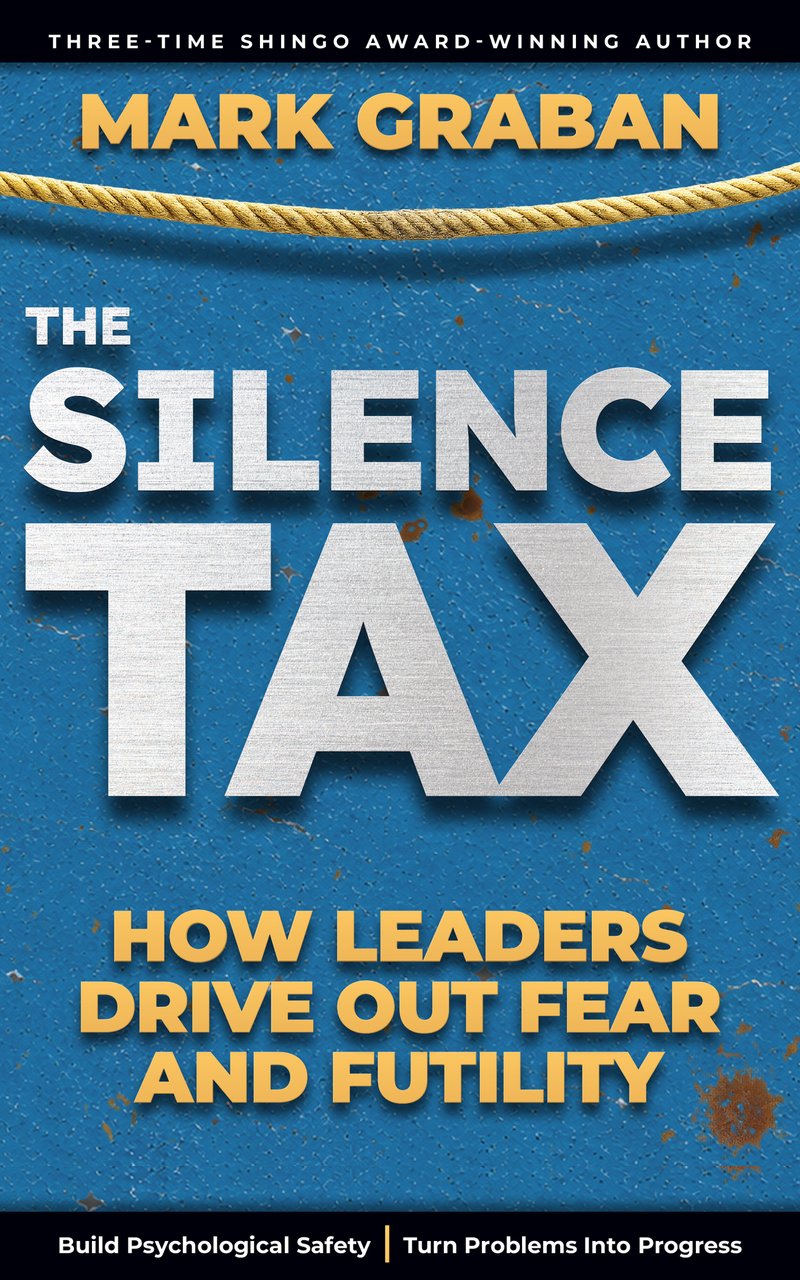
The Silence Tax · A new book by Mark Graban
Most leaders think people stay quiet out of fear. Most people say it’s futility.
You have the tools. Are you hearing the truth?
Your people see problems your improvement tools never reach. Fear keeps some quiet. Experience tells others that speaking up won’t change anything. In Mark’s keynotes and workshops, about 7 in 10 of 1,052 participants named futility, alone or alongside fear.
The Silence Tax: How Leaders Drive Out Fear and Futility explores what leaders can do to make speaking up both safe and worthwhile.
Coming February 2027.
Hand it to your team. It tells them you’re serious about hearing what they see.
10 or more copies: 20% to 35% off, signed. Orders of 50 to 99 copies include a 30-minute virtual Q&A with Mark. Reserve now; invoiced when it ships.
From the author of three Shingo Publication Award–winning books.
Sound familiar?
The real discussion happens after the meeting.
People nod through the plan, then share their doubts in the hallway.
Status stays green until the deadline slips.
The warning signs were there. They never reached someone who could help.
The ideas stop coming.
People raised concerns before, heard nothing back, and stopped expecting a response.
That’s the silence tax: what an organization pays for everything its people saw, doubted, or knew and decided not to say.
The distinction that changes your response
Making it safe to speak up doesn’t make it worth speaking up.
Fear
“If I say something, something bad will happen to me.”
Futility
“If I say something, nothing will happen.”
Fear and futility can coexist. Removing the threat of punishment matters. People also need evidence that raising a concern leads to help, action, or an honest explanation.
“His challenge to ‘close one loop’ prompted me to close two. Both were long overdue and a bit painful. The outcome was clarity.”
Lisa Thomas, President & CEO, Peak Performance Inc., on Mark’s keynote
Four behaviors to practice
Give people a reason to speak up again.
Model
Go first. Admit uncertainty, ask for help, and make your own learning visible.
Encourage
Ask for concerns and disagreements specifically. Make room for the answers.
Enable
Provide the time, methods, and authority people need to act on what they raise.
Reward
Respond with appreciation and follow-through, including when the answer is no.
These behaviors reinforce one another. You can begin with one behavior in a team you lead or support, learn from the response, and keep practicing.
Try the book
Read the Introduction and Chapter 1.
See how fear and futility keep problems hidden—and why better tools alone won’t change that. Enter your email for immediate access to the 42-page PDF and a private download link in your inbox.
No cart, payment, or account needed. Book updates are optional. Privacy policy.
Who it’s for
For leaders who want to hear about problems while they’re still small.
Written for leaders at any level, especially Lean and continuous improvement leaders, operations and quality executives, and healthcare leaders whose organizations have invested in methods but still struggle to surface problems.
It’s also for people leading from the middle, working with the authority they have and asking for support where they need it.
Practical help for everyday leadership
- Recognize when fear, futility, or both are keeping people quiet.
- Respond to concerns so people are more likely to raise the next one.
- Connect speaking up with the ability to improve.
- Interpret evidence of progress without mistaking silence for success.
No previous book or Lean background is required. Readers who know Lean will see where the ideas connect to daily problem solving.
Inside the book
From understanding silence to changing the response.
Three parts: what isn’t being said, what leaders do differently, and how you’ll know it’s working and where to begin.
Explore the chapters
Part One: What Isn’t Being Said
- Chapter 1: Your Tools Are Fine
- Chapter 2: What Psychological Safety Is and Isn’t
- Chapter 3: Fear Is Rarely Alone
- Part One Diagnostic: Where Does Your Organization Stand?
Part Two: What Leaders Do Differently
- Chapter 4: Model the Behavior First
- Chapter 5: Encourage Others to Speak
- Chapter 6: Enable People to Improve
- Chapter 7: Reward by Responding
Part Three: How You’ll Know, and Where to Begin
- Chapter 8: Measure Without Fooling Yourself
- Chapter 9: Start This Week
- Epilogue: What Outlasts You
- Appendix: Choosing One Behavior
The first three chapters examine why tools depend on candor, what makes speaking up feel risky, and why removing fear can still leave people quiet. Chapters 4–7 focus on four connected leadership behaviors: model, encourage, enable, and reward. Chapters 8–9 explain how to interpret the evidence and test a change this week. The epilogue examines what helps these practices survive a change in leadership; the appendix helps you choose one behavior to practice. Throughout, “Silence Tax Strategies” offer specific actions for meetings, daily work, follow-up, and providing time and help. The notes identify the sources behind the examples.
Stories and research behind the ideas
Meet a worker who called Alcoa’s CEO at 11 p.m. about a broken conveyor, a nurse at Virginia Mason who raised a safety concern and reported an abusive response, and a Toyota hire who needed about two weeks of consistent responses to believe leaders wanted to hear about problems.
The book draws on research from Amy Edmondson, Timothy Clark, and Ethan Burris, alongside conversations with leaders and practitioners in manufacturing, healthcare, and other settings.
In 55 keynotes and workshops, 1,052 participants answered what kept them from speaking up. About seven in ten named futility, alone or alongside fear. These were workshop audiences, not a representative sample; the pattern helps explain why addressing fear alone can leave people quiet.
How is this different from The Mistakes That Make Us?
The Mistakes That Make Us explores cultures of learning and innovation. The Silence Tax focuses on the everyday leadership behaviors that help people raise concerns, disagreements, and ideas—and get help acting on them. Each book stands on its own.
Start reading
See what your organization may be missing.
Start with the free sample. If you lead a team, reserve copies for them now: 10 or more copies are 20% to 35% off, and you won’t be invoiced until the book ships in February 2027. Orders of 50 to 99 copies include a 30-minute virtual Q&A with Mark.
Can’t wait for February? The early edition (the Introduction and Chapters 1-8; the rest is in editing) is on Leanpub →
Reader resources: a free checklist, worksheet, and the notes →
About Mark Graban
Mark Graban is the author of three Shingo Publication Award recipients: Lean Hospitals, Healthcare Kaizen, and The Mistakes That Make Us. He hosts the Lean Blog Interviews and My Favorite Mistake podcasts. He started his career as an industrial engineer at a General Motors engine plant in Livonia, Michigan, which is where Chapter 1 begins.
Read Mark’s bio →Keynotes and workshops
Bring The Silence Tax to your organization.
Mark speaks with leadership teams and conference audiences about why people stay quiet, and what leaders can do so speaking up feels safe enough and worthwhile.
Examples are drawn from healthcare, manufacturing, technology, and other industries, and shaped around your audience.