
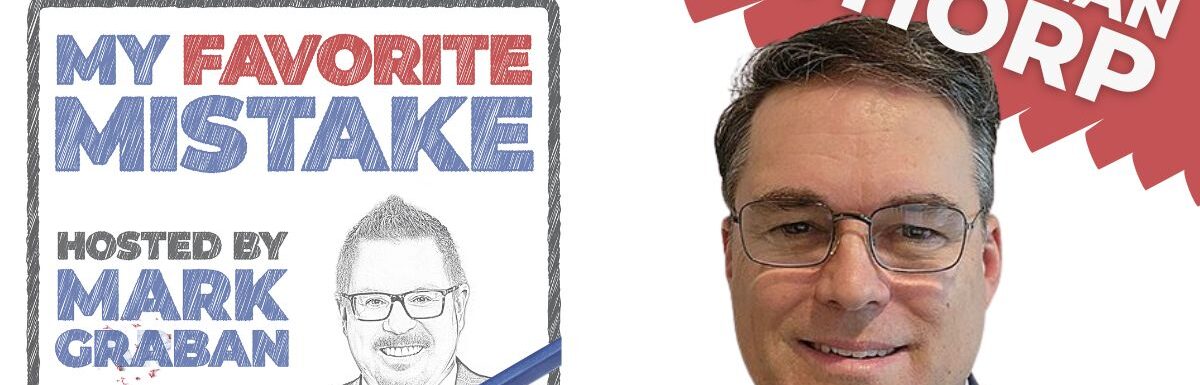
Jonathan Thorp spent 24 years as a naval aviator, then led organizational development at JPMorgan Chase before becoming CEO of Quantum Connections. His favorite mistake was assuming that creating something valuable is where the work stops, because promoting it felt like vanity. Good work kept landing as a non-event — including an incentive plan he redesigned for a client services group that people mistook for a lucky run of customer calls.
Listen:
Check out all episodes on the My Favorite Mistake main page.
My guest for Episode #366 of the My Favorite Mistake podcast is Dr. Jonathan Thorp, CEO of Quantum Connections in Dallas. He is a Naval Academy graduate in ocean engineering who spent 24 years as a naval aviator flying H-60 Seahawks, and he has taught leadership and decision making at the Naval War College since 2010. Before Quantum Connections, he was vice president of organizational development at JPMorgan Chase. He holds a DBA in organizational leadership, and he is a certified professional business coach and a CFP.
Jonathan's favorite mistake was assuming that creating value is where the work stops. He spent years building systems, methods, and models that made work more functional, and then treated the job as finished. Promotion struck him as vanity, the opposite of humility, so he avoided it. What he missed is that value is not self-evident to everyone else.
The cost showed up quietly rather than dramatically. He describes redesigning the incentive plan for a client services group after finding that the existing levers were connected to the wrong things. Results improved, and the change landed as a non-issue. People credited a good stretch of customer calls until someone explained what had actually been redesigned and why the numbers moved. His reframe now is that promotion is the servant of mission, not an act of vanity, and that translating value is part of the work rather than an add-on to it.
We also get into the Quantum Connections 2026 American Dialogue Report, a March survey of 1,000 U.S. adults that found 85% had avoided at least one conversation in the previous 30 days because it might turn into an argument. Jonathan talks about the gap between what Americans believe about everyone else's open-mindedness and what they admit about their own, what the data shows about Gen Z and about heavy AI users, what naval aviation debriefs teach about candor, and why he thinks leaders are measuring second- and third-order effects like engagement and retention while ignoring the relationship quality upstream of them.
What You'll Learn
- Why value is not self-evident, and what it takes to translate work so other people can see it
- How a well-designed incentive change can land as a non-event when nobody explains what was redesigned
- Why treating promotion as the servant of mission is different from treating it as self-flattery
- What aviation debriefs teach about candor, and why Jonathan says nobody wins with secret keeping
- Why 85% of Americans avoided at least one difficult conversation in the past month, and what that means inside a workplace
- The gap between believing other people are closed-minded and admitting it about yourself
- Why engagement, retention, and morale are downstream measures, and what sits upstream of them
- Why declaring psychological safety without evidence backfires, and what evidence actually looks like
Scroll down to find:
- Video version of the episode
- How to subscribe
- Quotes
- Full transcript
Find Jonathan on social media:
Watch the Episode:
Memorable Moments from the Conversation:
Click on an image for a larger view
Subscribe, Follow, Support, Rate, and Review!
Please follow, rate, and review via Apple Podcasts, Podchaser, or your favorite app—that helps others find this content, and you'll be sure to get future episodes as they are released.
Don't miss an episode! You can sign up to receive new episodes via email.
This podcast is part of the Lean Communicators network.

Other Ways to Subscribe or Follow — Apps & Email
Episode #366: Dr. Jonathan Thorp, CEO of Quantum Connections
Mark Graban: Hi, welcome to My Favorite Mistake. I'm your host, Mark Graban. Our guest today, joining us, is Dr. Jonathan Thorp. He's chief executive officer of Quantum Connections in Dallas. Jonathan is a Naval Academy graduate in ocean engineering who spent 24 years as a naval aviator, and then served as a flight instructor and a check pilot. After the Navy, he went into financial services, and then into learning and organizational development, where he was a VP of organizational development at JPMorgan Chase. He's also taught leadership and decision-making at the Naval War College since 2010. Jonathan holds a DBA in organizational leadership and a master's from the Naval War College. He's a certified professional business coach and a CFP. So, hey, Jonathan, welcome to the podcast. How are you?
Jonathan Thorp: Great. Thanks, Mark. Thanks for the invitation. Good to be here.
Mark Graban: There's so much we can get into here today. There's a really interesting report your company put out about dialogue and workplace conversations. But before we get into that and other things from your background, this is the question I always ask, and for all of the different things you've done in your career, I'm really curious where your story's gonna come from. What's your favorite mistake?
A Soap Dispenser, and Then a Real Answer
Jonathan Thorp: Yeah, pretty scattered past, I guess, if you read along. The first thing that popped into my head when you asked me this question, favorite mistake, I was out in town recently and I was in the washroom washing up my hands, and went to go to the hand soap. The pump dispenser, pressed down on it, and I think a little bit of dried soap had formed up in the nozzle of the pump. And of course, the soap shoots all over my dress shirt. And I'm thinking, “I know that's gonna happen.” It happens often enough to me that I should be on the lookout for it. But it's funny, even though we know these things, human beings are creatures of habit, and they still fall victim to these habits that we do. I thought that was a mistake I've made, but in all seriousness, probably not a really good answer to your question.
Mark Graban: Well, to interrupt real quickly, that seems like a bad sign if the soap dispenser's maybe not being used enough that it's dried up. That's other people's mistakes, not washing their hands.
Jonathan Thorp: Yeah. Could signal a couple of issues there, I guess, maybe in the restaurant.
The Favorite Mistake: Thinking Creating Value Was Where the Work Stopped
Jonathan Thorp: But I think if I were to think a little bit more about this and think about my favorite mistake, I'd probably tell you this. I've spent a lifetime learning how to try to create value, to create systems, methods, models that were valuable in the eyes of other people, that helped work become more functional and more effective. I think the mistake I made, and probably made it all too often, was I thought that's where the work stopped. Create value, and then you can sit and freeze and appreciate the fruit of that work.
And what I failed to appreciate is that value is not self-evident to everyone else. You can't just stop and expect people to find it. What you have to learn how to do beyond that is you have to learn how to promote and translate the value of what you've created. And again, the mistake that I kept making was I thought promotion was the face of vanity and the opposite of humility. And I started to avoid it, when in fact, promotion is really the servant of mission. And if you're serious about it, you can actually harness promotion done in the right way, and actually perpetuate and share the value of the things that you've just created. I kept making that mistake for some reason, and finally recognized I gotta stop doing that.
Mark Graban: I think engineer to engineer, that's not uncommon. I've felt very much that same way. I've talked to other engineers here on the show, right? We're kinda taught the value of finding an answer to something, and that that should carry its weight. But I guess within an organization, or when you're trying to sell, the real world is more complicated than solving a problem in a class, right?
Jonathan Thorp: I think so, and I think the real world, as you put it, involves a greater variety of people. I'd like to think certainly other engineers like us perhaps can spot the value when they see it, but there are lots of other people and lots of different learning styles that might need some kind of additional description to recognize value.
Why a Redesigned Incentive Plan Landed as a Non-Issue
Mark Graban: Was there a particular moment where this became clear to you? Was it a sneaking suspicion, or was there an aha moment that helped you reframe the idea of promoting?
Jonathan Thorp: I would probably say it's happened often enough where it'd be tough to put my finger on one. But for an example, I remember redesigning a business model for a client services group, and we were gonna find a way to re-incent or redesign the incentive plan so that people would be motivated to achieve the right kinds of results. We discovered that the levers were connected to the wrong things.
And we put this thing in place, and I thought it would be such a welcome addition to the environment, and I think it was almost a non-issue. I think people didn't know what we were doing, and only after we learned how to let people know, “This is what we've tweaked and adjusted, and this is now what we're seeing,” and they thought, “Oh, that wasn't just dumb luck. You didn't just hit a good spell of phone calls and customer response. It was something you intentionally designed.” And we had to let them know what we were doing to make that happen.
Selling as a Process: Nobody Actually Wants the Drill Bit
Mark Graban: Does it help to think of promotion or selling as a process as opposed to an activity, to try to put some structure around it?
Jonathan Thorp: I think as anyone that has a sales background will tell you, it is absolutely a process. And it predates preparation and needs analysis and market understanding, to understand what is it the market actually wants from you. The age-old expression is the people that are out selling drill bits think the market wants drill bits, and then someone wisely connected and said, “They don't want drill bits. They want the hole the drill bit creates.” But anymore these days, it's one step beyond that. It's what the fastener that fits in that hole will do for them, the screw, the hook. That's what they're buying from you, not the drill bit.
Mark Graban: Why the hole?
Jonathan Thorp: Why the hole. And I think that's part of the selling process, or even the promotion process, is you have to go backwards and understand, what is it I'm really trying to accomplish, and what's the audience need?
Mark Graban: One thing that helped me a while back, I don't know if you're familiar with the author Daniel Pink and one of his books, To Sell Is Human.
Jonathan Thorp: I know him, and I know the book, and it's a wonderful resource.
Mark Graban: The one thing that really sticks with me, he's great. I love his books. Drive, about motivation, is wonderful as well. But the thing that I think back to in the book To Sell Is Human is, you look at the language we use, like, “I don't wanna be salesy.” Well, why do we make that sound negative? It sounds like we're pushing something, or we're being slimy. And this is my engineer brain. I think if I remember right, Dan kind of reframed it: think of selling as being helpful. You're helping somebody solve a problem. You're helping somebody accomplish something. That feels good.
Jonathan Thorp: It's got to feel good. I love that association you just made. If you don't sell, you're potentially robbing somebody of access to a solution that could actually benefit them. And there is certainly a nobility if done correctly. Grant Cardone is another great resource. And he's got a book called… your example was To Sell Is Human, and this is a book called Sell or Be Sold. And his effective premise is, you're either selling or you're being sold to. Better take control of the scenario.
Quantum Connections and the Problem With Work We Only Tolerate
Mark Graban: So let's talk a little bit, in the introduction I didn't really share anything about what Quantum Connections does. Maybe tell us a little bit about the firm, and are there ways that you've applied what you've learned here from your favorite mistake to Quantum Connections, before we get into the report?
Jonathan Thorp: Yeah, I'm happy to go there. Quantum Connections is an organization built to help other workplace organizations turn work into a place that people enjoy being. And if you think about it, this kind of stems from some of the Ray Oldenburg work back in the '80s about third place. That's a concept many of your audience probably know about. Starbucks kind of champion themself as the new third place, not work, not home, but a third place. I think today, anymore, work has become a place that we tolerate, and we go there, and we actually need third places in our life to recover from work. And I think what we endeavor to do is help make work places where people can enjoy spending their time. So instead, these third places can become places of enrichment and not places of forced recovery.
And the way we do that is we spend some time with our clients getting to know what does the workplace look like today, and then understand some of the relational health that is at the heart of many of the downstream things that they're trying to fix and address. It's great work. We love it. And I hope the work continues long in the future, because we do really good stuff.
Mark Graban: You'd probably cringe the way I do when you hear people say things like, “Ugh, they call it work for a reason.” We spend too much time at work to be completely miserable, but, like, I guess as they say, it can't be all fun and games. Where's the right balance, and how is that good for an organization, not just good for the people that don't have to just grin and bear it as much?
Jonathan Thorp: Way too much time in our waking lives spent at work to not find some kind of enjoyment or fulfillment. That doesn't mean it becomes a party. You do have work to accomplish. You can certainly begin to learn how to enjoy the relationships that you deal with on a daily basis more. And I think that's what we center our work around, is that you likely have to be there, or perhaps you're in a remote environment, but can we find ways to enjoy those relationships so that they become more beneficial, more rewarding, and not such sources of pain and misery?
The American Dialogue Report: Curiosity on the Decline
Mark Graban: So let's talk about the American Dialogue Report. You surveyed 1,000 adults back in March. At a real high level, what were you asking people, and what did you expect to find? Maybe that's dangerous. Maybe that's a mistake to have expectations, if that biases the research. But tell us about sort of the purpose of the survey.
Jonathan Thorp: We wanted to understand curiosity greater. And there's some thought that curiosity's a very healthy dynamic in relational science, that people with a greater sense of curiosity remain engaged longer. They actually behave more interested in other people, which actually makes them more interesting. But we were concerned that there were signals out in the environment that said curiosity is on the decline.
And so we took the time to measure and ask a few questions around how curious people were in the attitudes and the perspectives of other people. And I think what we found was, perhaps to no surprise, is that curiosity is on the decline, and that people are avoiding tough conversations, and they're avoiding conversations in general because there's risk there. And rather than take the risk of getting engaged with somebody in managing a variety of opinions and perspectives, they retreat, and they isolate, and they turn to a chatbot instead, where they know they can find some kind of echo of their own beliefs, instead of taking a risk and talking to someone else.
Mark Graban: I programmed the AI I work with to not be as sycophantic as it maybe is originally programmed to be. That was my random interjection, or tip, to ask it, “Hey, challenge me. Push back on something. That's okay.”
Jonathan Thorp: That's a great one, and I hope the audience understands that's the best question you can ask when you're getting answers and feedback and support from AIs: “What am I missing?” Or, “What would somebody poke holes in if I were to present this argument publicly?” I think those are great questions.
Mark Graban: Great questions for a leader to ask other humans in the workplace when I run across that too, right?
Jonathan Thorp: Ideally. Ideally, AI is only a setup for real conversations with real people. No problem using it as a practice engine, but I love the idea of taking your ideas to real people.
Why 85% of Americans Avoided a Difficult Conversation
Mark Graban: So do you get a sense of why? Does the survey tell you, or do you have theories on why curiosity is on the decline?
Jonathan Thorp: There are a couple of reasons that pop up immediately. The statistic says that 85% of Americans in the last 30 days have avoided at least one conversation that appeared a little prickly or sensitive. That means most of us. And when you ask them why, two-thirds of them will tell you it's because they were afraid that they would disrupt the peace.
So the perception is that I'm gonna go ahead and create some discomfort by actually challenging you, or actually standing up for my opinion, or introducing a second opinion, instead of just going along with whatever you happen to lead with. And I think that was the most telling thing, is that it doesn't necessarily come from a place of lack of interest in other people. It's really a priority of consideration for other people, that they don't wanna insult or infringe. Which, maybe for better or worse, that's the reason. But it doesn't help us remain curious, which is a problem.
Be Curious, Not Judgmental: Einstein, Ted Lasso, and Listening for Understanding
Mark Graban: I haven't watched the first episode of season four, but Ted Lasso, new season is out, and famously, I think going back to season one, Ted Lasso quoting the expression, “Be curious, not judgmental.” I see the value in this idea of not being so quick to jump to a conclusion, not so quick to judge. If someone has a different stance, to try to ask, “Well, tell me why you think that way.” What are your thoughts around that quote, or are those such polar opposites, curiosity and being judgmental?
Jonathan Thorp: I love it, and I think the other person that's often quoted alongside Ted Lasso is Albert Einstein. Albert Einstein said, “I have no great abilities. I am only passionately curious.”
Mark Graban: Well, he did have great ability.
Jonathan Thorp: Well, we could all argue, boy, for someone like that to distill his strengths down to curiosity begs us to ask the question, what role does curiosity play for us? I think it has to remain central. I think it forces you to suspend your own opinions just long enough to make sure that I'm listening and that I'm understanding, and not just having another person reflect and tell me what they believe, but actually actively participate and say, “Here's what I just heard,” and then reflect that back to the person and say, “Did I get that right?” And invite them to correct, change, amend, endorse, whatever, but make sure that it's not just them transmitting into the air what they believe. It's did it resonate all the way and hang out in my brain long enough where I now have it. And I think that's a very important element of curiosity, that's not just maintaining eye contact and listening to somebody, but really actively listening to somebody for understanding sake.
Mark Graban: That makes me think of a different workplace habit, of listening to understand as opposed to listening for the next place you can jump in.
Jonathan Thorp: You all too often know when people are doing that, because as soon as there's a pause, they pick right back up with their agenda.
Futility: The Other F Word Keeping People Quiet
Mark Graban: In the survey, and you've kind of touched on this, the reasons people hold back, this lines up with other research that is out there. It's not always a fear factor, if you will, but your survey showed some interesting results of, I think, a bigger reason why people might not wanna get into a disagreement. It's a different F word.
Jonathan Thorp: You'll have to help me. I'm not sure which one you're referring to.
Mark Graban: Futility. I asked that a little bit too cute. My mistake.
Jonathan Thorp: That was very clever, and I'm sorry. I'm probably not sharp enough to have picked up on your lead.
Mark Graban: No, no, no. I'm sorry.
Jonathan Thorp: Thanks for walking me into that. Yeah, futility's a huge part of this. Because one of the questions we asked was, how convinced are you that Americans believe what they believe and are reluctant to go ahead and entertain new ideas? And the results say that over 90% of Americans believe we all think we're not gonna go ahead and open our minds to new ideas.
Interestingly, when they asked the question, “How much do you reflect that?” only 20% of the people shared that, “Yes, I am stuck in my own ways, and I watch only one news channel. And I believe what I believe.” Right? So we all believe that the country is inflicted with this sense of, oh, it's gonna be futile to entertain other people. But we can't recognize it in ourselves.
And I think that futility that you just mentioned draws into this relational expectancy quotient that we have, right? How much faith do I have that the relationship will entertain new ideas and my ideas? And I think that's what's on the decline, is this expectancy of a quality conversation, and that's one of the things that the survey pointed out for us.
When Disagreement Becomes an Identity Threat
Mark Graban: When it comes to a disagreement, think again of curiosity versus being judgmental. In polarized times, even things around diseases or medicine have very polarized views. I can understand, there's times where I've had some of those conversations with people where I've tried to be curious, and it's generally somebody I know really well as opposed to, let's say, a social media stranger. When there's a relationship, I think I'd be more willing, more apt to be curious.
So I think back to a conversation from like early 2021 of, “Help me understand why you don't want to get the COVID vaccine.” That was a conversation I wasn't afraid to lean into with a friend, and it was a good discussion. She wasn't being judgmental toward me for getting vaccinated. I wasn't being judgmental toward her, and we had a good discussion. And I think part of my goal, and I don't know if this was the part that was getting into judgmental, was that even though I was being curious, I did have an agenda. I was trying to change her mind. And I think I did. She went and got a vaccine. It didn't change her life perspective on this. We've talked again recently, but I don't know. I'm just kinda reflecting a little bit about these different motivations that we have to lean into a disagreement. I think I had good intentions. It didn't make her angry. We didn't get into a fight. It didn't damage our friendship. But there's risk, right?
Jonathan Thorp: A lot of risk. And I like the story because it demonstrates the value of respect and mutual respect that you had for each other. I think one of the things that makes today's dynamic a little different is that our perspectives, our opinions, and our values are much more a part of our identity today than they ever have been.
The party you vote, the platform you support, it becomes central to who we are, so that when we entertain new ideas, it's no longer just a dialogue or discourse on the issue itself. It's really my identity versus your identity. And if I surrender part of your idea, then am I surrendering part of who I believe I am, who the values that I support dictate I am? And I think that's what's becoming a little tougher for more people to separate, is let's dialogue the ideas. Let's discuss the issues and separate who we are as people from that. Harder to do today.
Relational Health Is Upstream of Engagement and Retention
Mark Graban: So within a workplace, what advice would you have for leaders to try to build conditions where we can actually have respectful disagreements, respectful dialogue that move things forward for the business?
Jonathan Thorp: I think the answer is you have to begin to pay more attention to relational health. And it sounds simple, it sounds trite, and a lot of people, when we introduce this upfront, people shrug their shoulders and say, “Well, no kidding. I understand I need to take care of my people, my teams, my employees. You're not telling me anything I don't know.”
The problem is we value what we measure, and the things we're measuring right now are second or third order effects. And by that I mean second order, these are things like engagement, collaboration, retention, morale. These are products of the relationships at work. And some third order metrics downstream of those are things like market value, profitability, growth, innovation, things like that we can actually measure. And when leaders take a look at those second or third order effects, that's what they put their hands on and say, “I want different results.” And they dictate that we address these effects.
They fail to go upstream enough. And to answer your question, what I would encourage leaders to do is to begin to invest in relational health. And that's a relational OS, if you will, that involves relational expectancy, relational capability, and relational performance. And that the relationships between employees, and between supervisor and teammate, and between executives and management, they all matter, and they're all being underserved right now because people are barking for results and failing to recognize that the root cause of all of those things, or a great deal of those things, is how well people are interacting together on the floor and in conference rooms.
Measuring How Seen and Heard Employees Feel
Mark Graban: What's the best way for a leader to gauge, or accurately gauge, the condition of things? I'm thinking back to that gap you identified in the study where we maybe overestimate our own openness to new ideas and underestimate others. We have these kind of gaps between perception and reality sometimes. How do leaders avoid the trap of overestimating, let's say, the health of the organization's culture that way?
Jonathan Thorp: Great question. There's a name for the effect, Dunning-Kruger, that actually says we mask our greatest liabilities. And I think that's what executives are doing. We have lots of metrics that measure second and third order. We talked about 'em: eNPS, Perceptyx, Glint, Q12, employee opinion surveys. They're all valuable. They give us good information, but not necessarily early enough in the process.
We have a metric called the Quantum Pulse, which actually measures relational health and actually gauges how seen and heard employees feel by their direct supervisor. The question sounds simple, but what's valuable about this one question is employees will answer it truthfully. In many other assessments, there are optics involved, and they won't be honest with you because they're worried about the perception that they're looking for work elsewhere, or that they're not happy.
And by asking the question, how seen and heard do you feel by your direct supervisor, you're actually giving them an opportunity to say, “My one most functional relationship between me and my boss is healthy,” or it isn't. And when you can assess that in aggregate, you get a real sense of the culture and the climate in the workspace. I think that's what leaders need to begin paying attention to, because once you address those relationships upfront, you'll watch second and third order effects cascade and improve because of that.
Dialogue Is a Skill That Atrophies Without Use
Mark Graban: I wanted to ask about dialogue. You talk about dialogue as a skill that atrophies without use. Tell us what you mean by that.
Jonathan Thorp: I think a lot is made about being able to communicate with other people, and sometimes communication reduces down to one person talking at somebody, waiting for silence, and having the other person talk at the other person. It's almost like competing monologues.
But the practice of dialogue is really different. It's a rich exchange of two people, each taking turns, each investing in sharing something and mirroring it back, and really building an understanding between each other. And that's one of four really essential skills that we promote in installing the skills that people need to boost the levels of workplace safety that set up this relational health. Dialogue gets kind of minimized because people think it's just talking, and it's so much more than talking at a person.
Executives and leaders are sometimes conflicted because they think, “In my role, I've got to distribute information. I've got to deliver policy. I've got to make announcements and speak at town halls.” And there is certainly going to be a time and a place for monologue. That's part of the role of an executive. But we can't just continue to operate that way exclusively. We have to promote the opportunities to dialogue in two-way fashion. I think that's what doesn't get enough attention.
Naval Aviation Debriefs: Nobody Wins With Secret Keeping
Mark Graban: I wanna pivot a little bit to drawing on some of your lessons as a naval aviator. First off, what did you fly?
Jonathan Thorp: I flew a little bit of everything, but most of my time was in rotary wing, in H-60s.
Mark Graban: H-60s. What kind of helicopter is that? I don't know this world that well.
Jonathan Thorp: That's all right. The Navy has what they call a Seahawk. It's akin to the Army's Black Hawk helicopter, multi-mission, with gray paint, if you will.
Mark Graban: Gray paint. I was thinking about your background in ocean engineering. I guess you were flying above the ocean instead of being in the ocean. That education still served you well, I'm sure.
Jonathan Thorp: Yeah, it's something about it. The marine environment is so challenging because it's tough on equipment, it's tough on people, and it really demands, I think, the finest in collaboration, communication, and teamwork to be successful in. So I've always found that an appropriate place to operate.
Mark Graban: Even as a civilian, you read about models and leadership lessons from the military, and aviation debriefs get held up as a gold standard for candor and reflection. Tell us about how that works and what lessons we could try to learn from that.
Jonathan Thorp: I think the biggest lesson that has stuck with me all these years is nobody wins with secret keeping. If you keep secrets, you're denying the next crew, the next air crew or the next team of maintainers, the chance to do what's right for the health of the aircraft and for the health of everybody in the environment, including the people on the ground.
So I think there's a very stark honesty that pervades in aviation. When we put our pride on the shelf and we say, “If we bone up an approach, we need to let people know why it happened.” If it was pilot error, so be it. If it was some other thing, we need to learn about that and be honest with ourselves and share that information, or else someone else might get hurt.
Pilot Error, So Be It: Being Honest About Human Factors
Mark Graban: Those stakes seem so high. I wanna dig into the idea of errors or mistakes. You were pretty matter of fact there a second ago. I just typed this as you said it: “Pilot error, so be it.” I'd be curious to learn why you said it that way. Was it because the focus was on learning from the mistake and realizing we all make mistakes?
Jonathan Thorp: I think so. I think in some conversations I've had, there was a real reluctance to recognize pilot error, and I think because somebody knew the individual, he or she was a great human being, and so we're reluctant to go ahead and say that that accident was pilot induced. But I think the reality is that we're all human.
And that we are apt to make mistakes, and when we do, let's understand it. Is it human factors? Did something lead up in my routine that made me a higher risk air crew that day? Did I not get enough rest? Did I over-caffeinate? Did I do something? And so I think accepting that pilot error happens is part of the fact that until we're all flown by drones and computers, we have to respect the fact that there are things that human beings can do better than any alternative. So that's my take on pilot errors. We have to be honest about it, even if we are talking about some of the people that we love, and sadly, if post-accident, some of the people that don't walk away.
Why Training Without Practice Never Takes Root
Mark Graban: Talking about trying to do an after-action review or a root cause analysis of a fatal accident, that's the highest of stakes kind of moments. But tell us about the opportunities to learn from near misses, or learning from training and simulation. That's a way to try to avoid real life, real fatal accidents, right?
Jonathan Thorp: I think so. It kind of speaks to practice. And in the corporate space, there's a lot of training out there that is really, I think, really good stuff. But I think it stops short of adding value, because all it does is splash new ideas in front of people, and then the training organization leaves and departs, and they leave implementation up to the host organization. And I think you have to demand practice, actual experiential practice within the organization in your time there before you leave.
Because if you don't practice, you're not gonna get the near misses. You're not gonna get the people that flub it up and say the wrong thing, and everyone jokes and giggles and laughs and says, “Oh, that's a horrible thing to say,” or, “That's a really awkward thing to feel.” You have to experience that, because if all you do is theoretically agree, “Oh, the training and these ideas make sense to me,” you'll never implement, because you'll never cross over that threshold and make mistakes.
And so I love the near misses, obviously the recoverable mistakes. Because they get people's eyes to open and say, “Okay, that hurt. That was bad, but it wasn't fatal. And when we've talked about it, I actually like the result. I like where I am now post-practice better than where I was when I started.” And that's traditionally what you see.
Mark Graban: And like you said, these are core themes throughout the history of this podcast, recognizing we all make mistakes. It's better to learn from them, better to give people an environment where we can learn from small mistakes in advance of a big mistake. So I love the way you talk about this connection of not just, if you will, the book learning, but the practice. I think back even when I was in grad school, and different models about the connections between learn, do, learn, do. It's just this cycle. The learning, I agree with you, doesn't take root without the do. And I think when there are big gaps between “I learn something” and “now I get a chance to put it into practice two years later,” what are the odds that I can do it as effectively as if I had practice and reps, right?
You Can't Declare Psychological Safety
Jonathan Thorp: Psychological safety is such an important ingredient in the environment. And if people truly feel that they can take risks and step on their tail and make a mistake and recover from that and not be made an example, I think is one of the best measures you can read when you're trying to assess what's the organizational climate like. If you start asking the question, “What does safety feel like in this space?” you'll get to the heart of it much faster.
Mark Graban: How would you expect people to answer that question in an environment of high psychological safety?
Jonathan Thorp: In an environment of high safety, they feel like I have the luxury, I have the privilege of trying what I know needs to be attempted. I can speak up. I can actually offer a differing point of view. I can challenge. If somebody actually makes an announcement, I can say, “That's not what I believe,” or, “It's inconsistent with what we've experienced on the floor. Can you help me explain that?” It's a conflict-rich environment that's still filled with respect. That people don't take and interpret disrespect from being challenged. I think that's a high psychological safety environment.
Mark Graban: And it's not just, instead of learn-do, it's say and do. Do we feel safe to speak up, to challenge things? Do we feel safe to try something? And instead of feeling pressured to pretend like every little thing we tried was a success, can we be candid and say, “Okay, we were trying to improve something. Here's what we did. We had a hypothesis. It didn't quite pan out. Here's what we now realize. Here's what we didn't know. Here's what we're gonna do differently.” Some environments embrace that, some leaders embrace that, and some leaders will rap your knuckles for having been wrong.
Jonathan Thorp: That's such an important aspect of this, Mark, and that is, you can declare what you want, and a lot of leaders might hear this conversation, and they might go back to their spaces and say, “We have psychological safety. I want you all to believe that we do.” Good luck. But if the actual evidence doesn't support that, then the value evaporates. And people don't believe that, and so you almost have to make sure that you demonstrate experientially what have we done to prove that people can recover from mistakes, and what have we done to celebrate mistake-making? If you don't have the evidence to back that up, then you're wasting your time declaring safety.
Mark Graban: I found that could be counterproductive. You can't declare it. And I kinda cringe sometimes when people say, “This is a safe space.” I'm like, it's not about the space, it's about the people, and how are we interacting with each other?
Jonathan Thorp: Yeah. Or the most common one, right? “I have an open-door policy.” We all love to say that. Do we really have that?
Mark Graban: The door's open for you to come in and get chastised, or the door's open for me to shoot down your ideas. The people are gonna stop using that door.
Jonathan Thorp: Yeah. Won't take long.
Over-Caffeination and Other Aviation Risks
Mark Graban: All right, I'm gonna be curious about one other, I zoom in on the details sometimes. But back when you were talking about aviation, I guess we could all understand how fatigue could be bad. The word over-caffeinated jumped out at me. What risks would that create for a pilot? I'm sure there's a real thing there.
Jonathan Thorp: Oh, sure. I think any kind of supplements render the body perhaps out of norm or alignment. And so it could be caffeine, it could be a host of things, nutritional supplements, things like that. They can act as diuretics and actually dehydrate you, which can also promote fatigue and throw your balances off. Sleep is a huge one. Are we well-rested enough? And shoot, I haven't been in a cockpit in 10 years, so I'm sure today we're much smarter about maintaining the health of aircrews and making sure they're in the best possible position to do good things.
What the Survey Says About Gen Z and Dialogue Skills
Mark Graban: So as a final topic, and again, we're joined by Dr. Jonathan Thorp, we always talk about the differences in generations, real or perceived. Your survey brought out some differences with Gen Z that I think are worth looking into. I'll ask this as a Gen X-er. Gen Z shows up as being most curious, but also most likely to give up on a conversation. What can we learn from that? What can we do with our Gen Z colleagues?
Jonathan Thorp: Isn't that funny? I love the optimism that they have approaching the situation. It's not fair to say “they,” because there are examples of all of these behaviors in all of the generations. But you're right. Gen Z appeared most willing to try, to take on the conversation. What was funny is they were also the first people to detach and disconnect from the attempts at conversation, because they didn't have, in large part, the skills to engage in a two-way exchange.
And you could argue that it has a lot to do with what media exposure has done to our attention spans lately, and this generation, the majority of their lives have been exposed to the absolute shortest attention spans on record. And so we shouldn't be surprised that there is a hope and a willingness for younger people to try to learn and listen, but that they need help. They need the tools, and they need the patience to learn how to engage with people and what actual real dialogue involves. The risk that involves. Hearing something that you don't believe, and how do I process that in a respectful way? I think that's what Gen Z is telling me when I read the results of the survey.
Mark Graban: So I wonder, is there an opportunity for leaders to not only try to engage in ways that don't shut people down, but to give some additional coaching beyond that? Or can we get past that by being more open in a way that might not shut them down?
Jonathan Thorp: I hope so. And I hope all leaders in all generations will apply this to all of the people on their teams in all generations. There is a thirst for coaching. And it shows up clearly in Gen Z, but there are those examples in every generation where they lack the skills to stay engaged long enough, to remain curious, and to learn from other people.
And so perhaps don't single Gen Z out, but offer these skills to your entire workforce and say, “I'm no longer gonna assume that we all know how to process these exchanges. And for those of you that are interested, or recognize that you'd like to add some skills, we have skills we can offer you. We can add listening for understanding skills, and we can add some of these other tools and techniques that we offer in the workspace for training.”
Closing Thoughts
Mark Graban: Jonathan, thank you so much for coming on here and sharing your stories and reflections. I'll point people in the show notes to the American Dialogue Report. There's a link on the web with a lot more detail than we were able to talk about here today. Links to Jonathan's LinkedIn profile and the Quantum Connections website. Is there anything else you'd like to share before we go?
Jonathan Thorp: We're hopeful that we can actually reverse the trend in the workplace, because the same skills that you adopt in the workplace, you take home, and you share in your personal life, too. And I think if we can better learn to collaborate, communicate, and connect, then I think the world wins, because people are a lot better at solving some of these problems that keep on plaguing us.
Mark Graban: That's well said, and thank you for the work you're doing to help others, to help other leaders. So, Jonathan, thanks again for joining us today.
Jonathan Thorp: Mark, thank you for having me on today. Thanks.