Business humorist Lisa David Olson shares how humor saved her life, delayed her book for years, and once led to a prank so risky it fractured her tailbone—revealing the fine line between connection, courage, and costly mistakes.
Listen:
Check out all episodes on the My Favorite Mistake main page.
My guest for Episode #54 is Lisa David Olson a business humorist and the author of the new book Laughs On Wry: An Improviser's Memoir. She's an appropriate guest for today, given that it's the first day of National Humor Month.
Later this month (April 12th), my guest will be Art Bell — creator of the Comedy Central channel (which is celebrating its 30th anniversary today). I wish I had an entire month of funny guests… but there's two for you.
Lisa is a speaker, author, podcaster (“Stranger Connections“), and creative partner, who loves coffee and pranks! (the exclamation point is hers).
In today's episode, Lisa shares her “favorite mistake” of not writing her book earlier because she thought nobody would read it. I think my favorite mistake from the conversation was Lisa talking about a prank at her workplace, a police station, that I'm afraid could get her killed if she repeats it. We talk about those mistakes and topics including:
- Why are you afraid of scaring the introverts?
- Humor as her escape from a traumatic childhood
- Helping businesses (and individuals) reignite their ideas… and their projects — how?
- Humor as a connector
- The risk of making mistakes when trying to use humor at work?
- What are you doing for fun?
- Humor as a gift vs something that can be developed?
Scroll down to find:
- Video player
- Quotes
- How to subscribe
- Full transcript
You can listen to or watch the episode below. A transcript also follows lower on this page. Please subscribe, rate, and review via Apple Podcasts or Podchaser! You can now sign up to get new episodes via email, to make sure you don't miss an episode. This podcast is part of the Lean Communicators network.
Watch:
Quotes:
!["A mistake I made was not writing [my book] because I thought no one would read it. And I thought I don't have a bunch of letters after my name. Why should I write a book?"](https://www.markgraban.com/wp-content/uploads/2021/04/Lisa-David-Olson-My-Favorite-Mistake-2.jpg)
Subscribe, Follow, Support, Rate, and Review!
Please subscribe, rate, and review the podcast — that helps others find this content and you'll be sure to get future episodes as they are released weekly. You can also become a financial supporter of the show through Anchor.fm.

Other Ways to Subscribe — Apps & Email
Automated Transcript (Likely Contain Mistakes)
Mark Graban (0s):
Episode 54, Lisa David Olsen, business humorist, author of the book, Laughs on Wry, an Improviser's Memoir.
Lisa David Olson (11s):
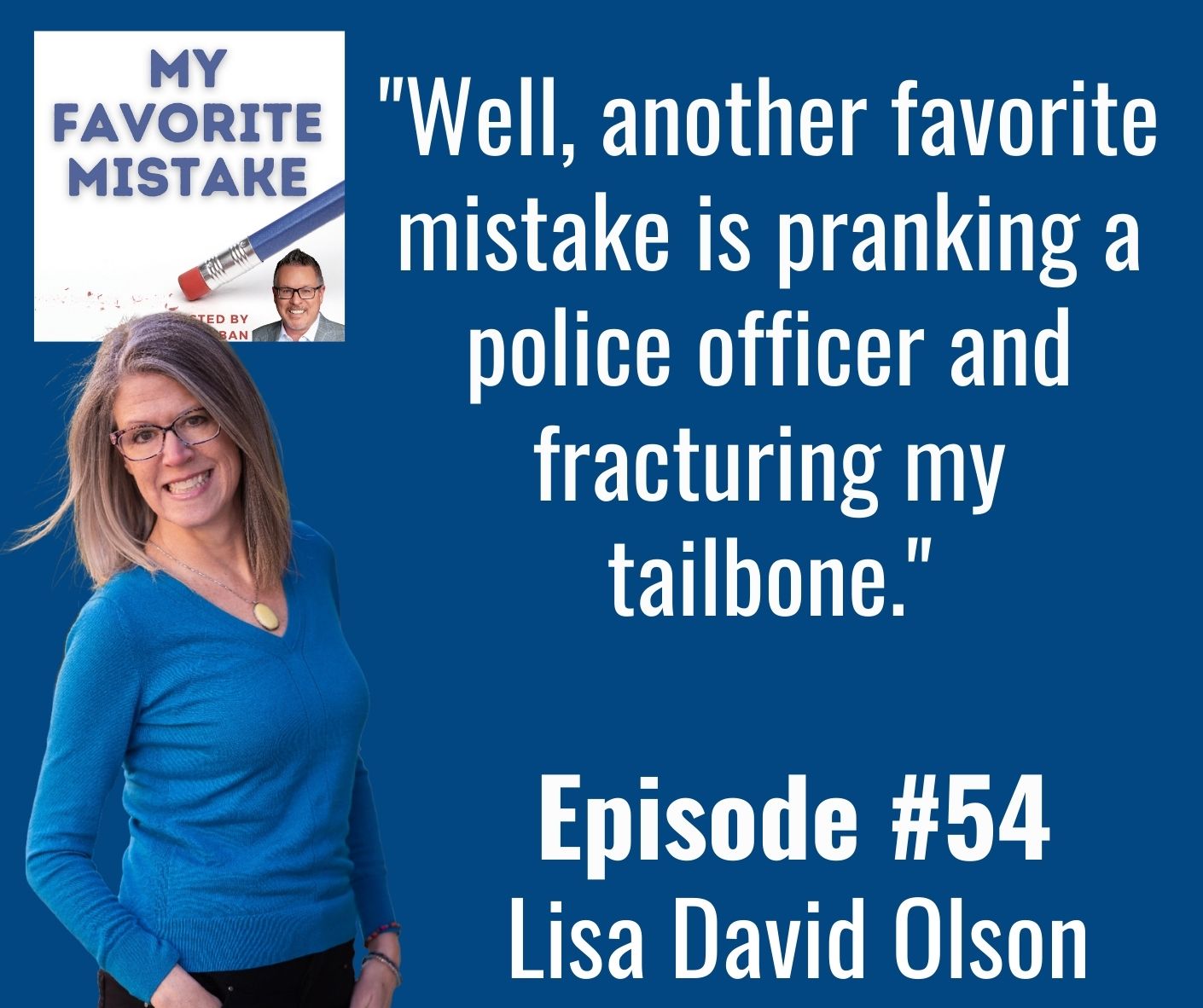
Another favorite mistake is pranking a police officer and fracturing my tailbone.
Mark Graban (17s):
Oh no, I'm Mark Graban. This is My Favorite Mistake. In this podcast, you'll hear business leaders and other really interesting people talking about their favorite mistakes because we all make mistakes, but what matters is learning from our mistakes instead of repeating them over and over again. So this is the place for honest reflection and conversation, personal growth and professional success. Visit our website at myfavoritemistakepodcast.com for show notes links, go to MarkGraban.com/mistake54, please subscribe, rate, and review, and now on with the show.
Mark Graban (1m 2s):
Hi everybody. Welcome to my favorite mistake. I'm Mark Graban. We're joined today by Lisa David Olson. She is a business humorist, and I think it would be really interesting to explore what that is and what she does. So before I introduce Lisa a little bit more, first off, Lisa, thanks for being here. How are you?
Lisa David Olson (1m 21s):
Thank you so much for inviting me. I was very excited to be invited to a show that has the word mistakes so prominently in the title.
Mark Graban (1m 29s):
And I hope well we're only a couple… we're not even a minute in and I hope you won't think it's a mistake to have agreed to do it.
Lisa David Olson (1m 36s):
Of course not. Thank you for having me.
Mark Graban (1m 38s):
Yeah. So again, Lisa, David Olsen is among other things, a speaker and author, a podcaster on, on her bio. It says she's a creative partner that she loves coffee and pranks. And I found this interesting. She says I won't scare the introverts. So as an introvert, I'm an introvert. Why are you afraid of scaring people like me?
Lisa David Olson (2m 1s):
I'm not afraid of scaring you. I want you to know that if you invite me to your company event and you want me to speak, I'm not going to say, all right now, Mark, let's take off your jacket and just come on up here. And we're going to have you talk in front of the 300 participants. That sounds great. I promise to not do that. The room for ideas and you can safely from your seat, yell ideas,
Mark Graban (2m 26s):
But I guess calling that out, you did you have a bad experience with an introvert?
Lisa David Olson (2m 31s):
I just know what it feels like as extroverted as I am. I know the feeling of the days that I'm not in the mood and I don't want to be the attention as much as that's been most of my life. What I crave, I have my downtime. You know, I just like our cell phones. We have to reset, recharge, turn them off, power them. Now I've found that in my 55 years, you got to find that time too. So if you told me at a certain time, come on out here and make something funny, I'm going to cry.
Mark Graban (3m 4s):
Well, we don't want to do that here today. Yeah. So it might tell you a little bit more about Lisa's work. She has a book coming out soon. It's called Laughs on Wry, w R Y for the people couldn't hear the pun, Laughs on Wry: An Improviser's Memoir. She has a really fun podcast called Stranger Connections. And I'll ask Lisa a little bit more about that later. And she also has a humor group on Facebook called Counter Clockwise. So I hope people would go check that out. Like not, not right now while they're listening, but after, after the episode and do it later, yes. Make a note. So you know, Lisa, there's a lot we can talk about here today and I'm glad you were kind of drawn in by the idea of talking about mistakes.
Mark Graban (3m 50s):
What would you say is your favorite mistake?
Lisa David Olson (3m 53s):
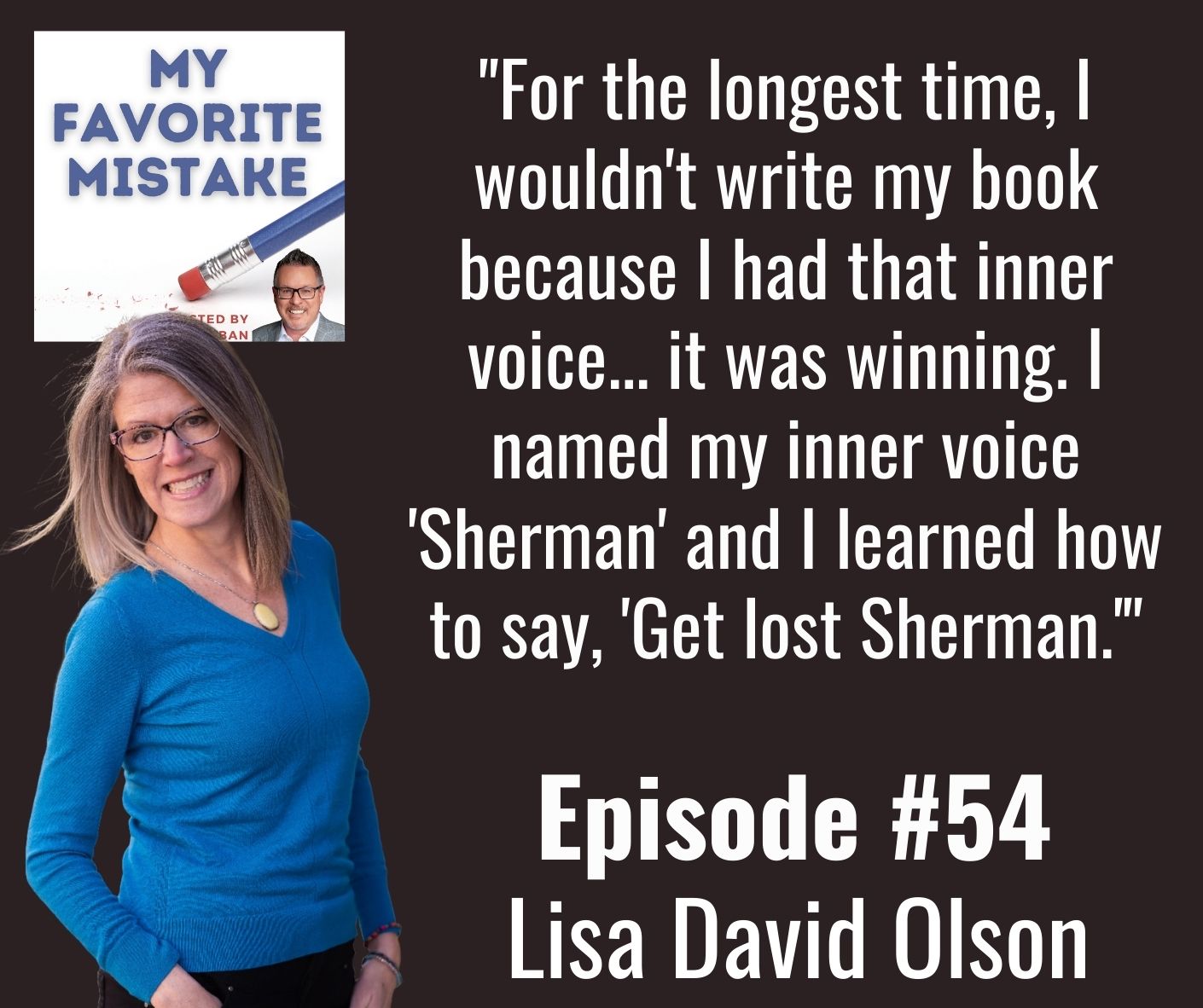
Well, it was hard to narrow it down to one. So if we ponder in dabble into any other zones, I'm, I'm free to share, but what stands out is the book, it, a mistake I made was not writing it because I thought no one would read it. And I thought I don't have a bunch of letters after my name. Why should I write a book? But yet for years I craved to create a book because it is somewhat of a legacy. It's a challenge. I, I love challenges and I believe in daring yourself daily yet I wasn't living that. So that was a huge mistake is that I waited and we all need permission to play. We all need permission to be brave, but do we, can we give ourselves permission to be brave and just dare ourselves?
Lisa David Olson (4m 41s):
I do now. But for the longest time, I wouldn't write my book because I, I had that inner voice was winning. I named my inner voice Sherman and I learned how to say, get lost Sherman. I didn't write my book. Once I started and had interest and people were interested and I had the right editor that was encouraging and we did weekly check-ins then it started to happen and Sherman got the heck out of my office. Yeah.
Mark Graban (5m 8s):
Yeah. Oh, it's funny. You talked about that, that inner voice. I have a book coach who I've used and she talks to her authors about silencing that inner voice. It sounds better the way coming out of her mouth as a woman. So I'm not going to say it quite the same way, but she says, don't listen to “your inner B” — now I've made you think the word, but I don't know, like it's, it's different her saying it. I think then it's helpful though. I
Lisa David Olson (5m 34s):
It's not ignoring it. I would challenge that I would state, you have to face it and you have to overcome it. You know, a lot of times I say, when you are walking around in life with your issues or your problems, as we all do, I just had my therapy call this morning. I I'm all for it. You walk around with rocks in your imaginary backpack and how many rocks can you unload in a day or a week? And Sherman, one of them name that inner voice, give it a face. Mine looks like a really, really bad troll and is as nutty as that sounds, it works because if you can give it that personality and I did learn that in therapy years ago, and you give it a personality, then you can yell at it or, or know that that doubt inside is really Sherman.
Lisa David Olson (6m 21s):
And it, you know, get out of here. I'm going to show you Sherman. I'm going to write that dang book.
Mark Graban (6m 28s):
Well, and maybe I misspoke or I, this is my recollection of Cathy. How the way she puts it, maybe I'll get her as a guest. And we can hear her say it in her own words. But you know, the, the message was clear. Let you know, don't talk yourself out of writing. It don't be too self-critical. How, how long was this idea in your head? Like how long did you delay writing it?
Lisa David Olson (6m 57s):
My book is about my traumatic childhood and how humor saved my life and how humor is my escape. And then owning a comedy troupe later in life. I realized that humor is my family applause as a hug and laughter is acceptance. And so why would anybody want to hear that? And you know, why, why would anybody want to read my words? But then just finding the right people and having the encouragement to get it out was amazing. And once I found the right team, it only took about eight months. And so it is about the ups and downs in my life. But the doubt part took a whole lot longer than the publishing part.
Lisa David Olson (7m 41s):
And what a waste of time, you know, everybody's got a story and if you sit there and say, well, why would anybody want to read my story? That's the ugly, inner voice that, that your friend talked about and, and that I'm referencing. And we all know it. We all have it. Whether it says you, you don't deserve that car or you can't do a marathon or half marathon. Why would you do that? That's your inner voice. That really should be the one that if you can flip it to state, I'm going to, instead of, I can't, I'm going to, at least if I try, what if I walk three blocks? That's more than sitting on my couch.
Mark Graban (8m 15s):
Yes, baby steps is a very helpful strategy for change. I've I've seen that in the workplace. I know counselors who work with clients. You don't tell somebody, Hey, you should start exercising 45 minutes a day every day, go, go home. Start now. Like that scares people off. They freak out. They don't, they don't start. So did you find baby steps in a way? Like, because writing a book is daunting, but writing a page might seem more manageable. Did you use an approach like that when you actually said, okay, I'm going to start writing
Lisa David Olson (8m 50s):
The, the big aha for me was when I wrote the words that, because coming from a traumatic home and an alcoholic mother and issues with siblings who all handled it in their own way, what if somebody reads it and it hurts her feelings? What if somebody remembers it differently? That stuck me for a long time, but I'll tell you what, these are my memories. And if you have a version that you want to tell, please go write your book. So I put that in pretty words, inviting anyone in my, in my genetic pool, that if they challenge it, help yourself write your own book. And they haven't
Mark Graban (9m 29s):
Have they, when, when is the book is it's not quite available yet, or when, when is it available?
Lisa David Olson (9m 35s):
Actually is available. And it's on Amazon and it's Laughs on Wry, W R Y an improviser's memoir. And it's a life of choices instead of excuses.
Mark Graban (9m 47s):
And I'm not going to make excuses for my mistake of not double check. I double check some other things with Lisa before we started recording. And I told her, I made a mistake in a, in, in a podcast. I, I read a subtitle of an author's book that was out of date. And my mistake this time was not double-checking the release date. So I apologize for that. The book is available now, now, now, now,
Lisa David Olson (10m 9s):
And I even get an audio version. So that was, that was a really big challenge. That was more than I've done voice work. And, and like I say, I've been acting for so long. How odd to record your own book in your own audio and not have it accepted?
Mark Graban (10m 29s):
They said, no, you have to hire another voice.
Lisa David Olson (10m 32s):
No, my voice was okay, even though it's very Minnesota, but it was the fact of, it was actually audio points and pauses at the beginning of the end and the tone and the volume and my husband is amazing. And thank goodness, he's an audio video engineer and made it work, but that took a whole lot longer than inpatient me inpatient, not inpatient in patient me was willing to handle. Yeah.
Mark Graban (10m 58s):
Well, good. Those technical details got
Lisa David Olson (11m 0s):
Yes
Mark Graban (11m 2s):
With that. Was it? I mean, w w was it less scary to do that? Voicing that I, I have a friend who read her book, his audio book, and I know it's really, it can be grueling and time consuming, but did you feel more confidence in doing that once you had the words?
Lisa David Olson (11m 19s):
Yes. The joy in voicing my own book was that you might read, my chapters are called snippets. They're so small. You might read about a prank. I pulled at work cause I am a prank enthusiast. And you might read about that in the next little spot. It could be about some abusive thing that happened when I was a kid. And then all of a sudden you're going to read about me, pranking my doctor during my female exam. So it is a rollercoaster because that's what my life is. And that was another way that I could write because of the trauma in the, I don't have clear, concise chronological memories. Like some people can say, Oh my fourth grade teacher, Mrs.
Lisa David Olson (12m 1s):
So-and-so, I don't have that. And once I forgave myself in trying to write an order and trying to be so exact, that's when I could write and again, give yourself permission. So my stuff is not in order. And I write about that if this is going to go back and forth, because I have a hummingbird brain and it's a great bathroom book, you are not involved in this big, long story. It's like, Oh, that was quick. And then I include a little lesson at the end of every snippet. And it's not me teaching you. It's me saying, and this is what I took from that.
Mark Graban (12m 34s):
Yeah. This is off topic a little bit, but you make me wonder, has there been a decline in the bathroom book genre because of our phones?
Lisa David Olson (12m 45s):
I would assume I'm not in the publishing industry, but I'm going to assume, but people just know what that means. I guess I could say waiting room book or, yeah, you're right. With the, with the phone thing. That's what I love about my young adult son. When I, I said, he said, sorry, I didn't answer your texts. I was in the bathroom. And I was like, ah, you're lying because you're 25. I know you take your phone with you.
Mark Graban (13m 12s):
And that may or may not be a mistake for people to do that. It's definitely a mistake to lie to your mom.
Lisa David Olson (13m 17s):
Yeah. We should call him right now.
Mark Graban (13m 21s):
This is not, this is not the Springer show really. Well, Hey, guess what? He's he's behind this wall. Yeah.
Lisa David Olson (13m 26s):
Yes. She's not really your mother…
Mark Graban (13m 31s):
Now in the book. Do you, do you, Trent, do you also talk about, you know, some of the things that you do now of helping people in the workplace, so using humor in a business setting, do you, do you touch on that in the book or, I mean,
Lisa David Olson (13m 44s):
Well, that's just a separate story. I am a business humorist and I have a journal that I self published and I had it printed locally and that's called what ifs and why nots and it's, it's got space to write in it. And it's a lot of improv tips that I learned from my two decades of running a comedy troupe. And it's not, it's not just saying here's what you do on stage. It's not that at all. It's, here's what I learned on stage. And here's how you can apply it like active listening or icebreakers and warmups for your team and how to connect your team, simple little exercises, or maybe Marcus stuck on writing. And what should he do?
Lisa David Olson (14m 25s):
I would say one idea is take your laptop from your desk. And obviously you're at home, I'm thinking, and you would go into a different room. Why don't you go where the sun is coming in nicer and play a different style of music, maybe play coffeehouse radio. And it sounds like you're at a coffee house or put on country if that's not what you listened to and find that flow of ideas that just from changing physically and sounds you don't touch on your tea on your senses and change those things and see what can happen. Yeah.
Mark Graban (14m 59s):
So as you work with businesses and you know, people are trying to be more creative, you know, you see magazine covers, I don't know how they determine this, you know, the 50 most creative people in business or the most creative companies. What are some of the things that you do, you know, to help spark creativity or help get things moving where maybe things have just become a stagnant in a business.
Lisa David Olson (15m 28s):
You look at the pandemic going on a year now and saying when we thought it was going to be two weeks and how that felt, no, I want you to dig down and feel how that felt. Dang. I won't be able to go to my favorite restaurant or what if stores close or, you know, what are we going to do? And all these, these things, these real worries. And now look at us how we adapted and how we are changing, how we are actually doing different styles of things and some businesses grew. So we're all doing improv in, in some way. We're, we're improving when we drive, we're improving in conversation. So improv doesn't mean on a stage with a spotlight.
Lisa David Olson (16m 8s):
So that's what I would talk about is when I get to go to companies, especially in person, I love it because I can be more gently interactive, but I've learned how to adapt to that on zoom as well. And I, I give presentations and it's a lot about getting the room to get into this think tank and do creative ideas and thought play and permission to play. And I have exercises that we will do in just thinking big and then making it workable. And it's very fun. It's very connective people participate to the level that they're comfortable. Yeah.
Mark Graban (16m 42s):
Have, have you seen it be helpful to do some sort of like formal improv type training as individuals or as a team, if, if, if they find interest in that or is that, is that a little too much too far?
Lisa David Olson (16m 58s):
It just depends on the team. And it's certainly the best way to do that is like if I was coming to your event and we could set up an improv workshop and that way, those who are interested in the actual art of improv, they would choose to be there or watch. And then we could just dig right into the actual improv, the act of listening and having your partner's back and then how that would work for your business as well. Or even at home active listening to your child, you know, are you listening to hear them or are you listening to fix it networks for partners too. So,
Mark Graban (17m 35s):
And in the context of comedy, or maybe in the context of doing an interview, I'm trying to be a good, active listener. And I'm thinking of, I'm going to say my, I think it's funny, you call it hummingbird brain. I get distracted. And I'm picturing and remembering an episode of the office where Michael Scott was going to an improv class and how bad he was at it, which considering how good Steve Carell the person is at improv. Do you remember that episode?
Lisa David Olson (18m 7s):
Yeah. Talk about acting, right. That must have hurt him physically to be so bad.
Mark Graban (18m 15s):
Right. Because I mean, he was not, you know, when you think of your point of listening and playing off of the other person, he wasn't doing that. He was just doing things he thought was funny and, and not taking those cues. I mean, how, how are some of those habits from improv helpful to somebody let's say in a meeting or in a sales conversation?
Lisa David Olson (18m 36s):
Oh. Especially with sales is to listen, to hear what that person's interested in. I mean, there's tricks about that. And the best sales people already know this, that they actually are going to mirror what you say. And there's mirroring that, you know, we're, I'm going to sit more like you are, or if you stood up, I'm going to stand up. There's physical mirroring, but there's also verbal and brain mirroring where you brought up that you liked the office. Okay. Now I know that. So now down the line, I'm going to make a reference to that or use one of the famous, Oh, well, it's not as bad of a day as spilling chili. When you're walking in for Kevin references, I'm listening actively. So I can come back and know, okay.
Lisa David Olson (19m 18s):
He brought that up. He definitely enjoys it. So that's active listening. If I'm just listening for my pitch, that's not going to work. And I just recently posted on LinkedIn about using humor as a connector, which is my big, huge overall message, but also, you know, taking two unlike ideas and bringing them together. But then also making sure that we build a relationship. So if I'm trying to sell you windows, maybe I'm going to send you a window meme in a couple of days just to stay connected with you and not making a sale. And maybe I'm going to say, wow, when you told me about your, your new bicycle, I can't believe I saw like three bikes after that, just because we talked about it, soft touches to stay in touch, but show you that I heard you and that I'm using your interests for a sales connection, but it's a soft lead.
Mark Graban (20m 9s):
Yeah. So when you think of using humor as a connector, like again, I'm thinking back to the office where I think Michael Scott tried to do that. Well, you know, building connections with his employees or times you would see him go and, and sell, but you know, whether you're Michael Scott or less extreme version, I mean, there are risks, I guess, of, of trying to use humor in the workplace. What are your thoughts on the risk of making mistakes when someone's trying to connect with others or to be funny, for whatever reason,
Lisa David Olson (20m 42s):
It happens a lot because the humor that falls a little bit flat can happen a lot because of people's nerves. And they think it's funny, or they just laugh because they're nervous. The best thing you can do is to make someone feel comfortable and don't use inappropriate jokes. There's certainly that group at work that maybe that is your thing or that it, it wouldn't be for the public for sure, but that doesn't happen on a first time introduction. So you're going to be safe with your humor and you're going to be clean with your humor. And when I do talks, it's always corporate clean. I don't go on the edge at all. If your brain wants to take it there, that's up to you. But you, if you keep it clean, that's the way to stay connected and feel safer.
Lisa David Olson (21m 26s):
So you're kind of, you have to build up your safety zone and make people feel comfortable. That's the most important thing. So finding something you connect on like the office, like we said, or maybe there's something on the wall that is of humor, and you can reference that. Or, or if somebody says something about kids, Oh, kids are so funny and the gentle nudges toward humor. But like when I'm at the store right now, I've, I've found a joy in, instead of, you know, the, the clerk might say, Oh, did you find everything? Or how are you today? And you say fine. And they, and I say, how are you fine? Well, that's all a lie. We're not fine, but we're certainly not going to get into, Oh, my knee hurts or whatever, but on a different question, one could ask, and this works at the office, but I've been doing it at the grocery store.
Lisa David Olson (22m 17s):
What are you doing for fun lately? So how would you answer that, Mark?
Mark Graban (22m 23s):
How would I answer that? Doing this podcast has been fun. That's a relatively new project of mine, finding, finding new movies, trying to find, you know, it's funny. I, the, the, when you're in the mood to watch something that makes you laugh versus other types of, I don't my, my, my wife and I, when we, we try to decide what to watch. Like she loves murder podcasts. She actually listens, she listens to this podcast, which is, I think the only non crime junkie murdery podcasts that she listens to. And she likes watching movies and shows like that. So sometimes she surprises me when I said, okay, well, you know, you want, you want to choose a show tonight and she'll say, let's watch something funny like that, that it's a pleasant surprise.
Mark Graban (23m 8s):
But then if the movie turns out to not be funny, that was a, that was a disappointment recently. That was not the question you asked.
Lisa David Olson (23m 16s):
And then that was on you because you chose it. So now it's your fault.
Mark Graban (23m 20s):
Eh, well, yeah, it was a mutual decision of like, you know, let's just move on from that, moving. We'll try something else. That's the beauty of streaming, as opposed to going to a physical theater where you, I guess you feel kind of invested in like, well, I paid for that. I'll suffer through it, but now we, we basically, Yeah. And that was, I don't think that was the case here. And I won't name names.
Lisa David Olson (23m 43s):
Oh, there's so many good things for humor out. And so in asking that, then, then I learned more about you then than just what I've just met. Now I know about your, your opinion on movies. I know that your wife is awesome because she likes crime podcasts. Like I do. And the different things that we just connected and that might've taken 35 seconds or something like that. And what I've learned at the store is one girl is on a dance team and she even showed me a picture. And I asked this other guy one day, what are you doing for fun? And it's got big dreadlocks and tie dye shirt, just a big guy. And he says, Oh, we've been fostering little kittens. And he just melted.
Lisa David Olson (24m 23s):
And he just became this sweet little gentle. You would never know that. And by simply asking someone, what are you doing for fun? That opens actual conversation. And I could have grown from that. I immediately thought, Oh, I should tell you about this show. That's funny. And that's how you connect and really get beyond the nerves. And then you can kind of find out someone's humor. Once you tell me what movies you watch.
Mark Graban (24m 46s):
That's that's, that's a great question. So there's, there's a pro tip for everybody listening. There's a great conversation starter. What are you doing for fun? Now? I want to think back to something you said earlier, Lisa, I was going to ask you as a followup because it sounds like I've learned about you. Pranks are fun. Is there a favorite recent prank of yours? That's maybe like new, it's not in the book. Like what, what's your most recent most favorite prank.
Lisa David Olson (25m 11s):
Geez. Well, another favorite mistake is pranking a police officer and fracturing my tailbone. Yeah. So I worked with police during the day. So I'll go backwards.
Mark Graban (25m 27s):
Yeah. There's, there's, there's a important middle part of the story there. What happened?
Lisa David Olson (25m 30s):
Yeah. But that, wasn't a fun way to start it. What your other say? I, my at my table and broken by a cop, that sounds dumb. That's a story I'm listening to. But one of the officers I have I'm dispatch and records at the police department. And, and one of the officers was around the corner and I took the ream of paper. I had an empty ream of paper in my hand, just the outer wrapper. And I heard him coming. So I just went up cause it was a big guy. And I went up and I went like that. And when I could tell he was coming around the corner and he raised a fist, just, just out of reflex stopped because he's good. And I got trapped between his ginormous red ofak arm and the wall. And I got dragged as he kept walking, he wouldn't move his arm.
Lisa David Olson (26m 12s):
And we worked together for years. So that's nothing new. He didn't strike me. He didn't touch me. But because I existed, I touched him and I was dragged on the wall and fell directly on my butt and fractured my fault. And I had to do it again.
Mark Graban (26m 29s):
You would surprise the police officer. That seems like a mistake to learn from.
Lisa David Olson (26m 33s):
Yeah, I do it. I do it. But I love putting those snap and pops. You ever have those they're in a little paper twisted up and you throw them on the ground and they pop sometimes they're okay. If you tape those into an open door hinge, like six is a great number. You tape the little tail onto the metal door hinge, like when it's open. So when your coworker goes into the bathroom and he shut the door, it's a delightful sound.
Mark Graban (27m 3s):
Let's see. I'm more like, I'm worried for you. This seems these are, these seem like dangerous pranks Lisa
Lisa David Olson (27m 9s):
I'm risky. That's what my husband said. What are you thinking? Pranking officers. And I go, what a way to go? That's my story. That's a good story. It's all about the good story. Our sons all moved off. I even hide around the corner to prank the dog. And I'm like, Ooh, you should've seen your face. You know, she just goes off and lays down. Not impress. Yeah.
Mark Graban (27m 36s):
Wow. We'll see. On a, w w you, you could write another snippet book of world's most dangerous.
Lisa David Olson (27m 46s):
That's your dog,
Mark Graban (27m 48s):
Different podcast beyond Stranger Connections, which is Lisa's podcasts. One other question I wanted to ask about humor and then learn a little more about the podcast and the Facebook group. What are your thoughts on humor as being like just a gift where people say, Oh, well, so-and-so, they have a sense of humor versus developing a sense of humor.
Lisa David Olson (28m 13s):
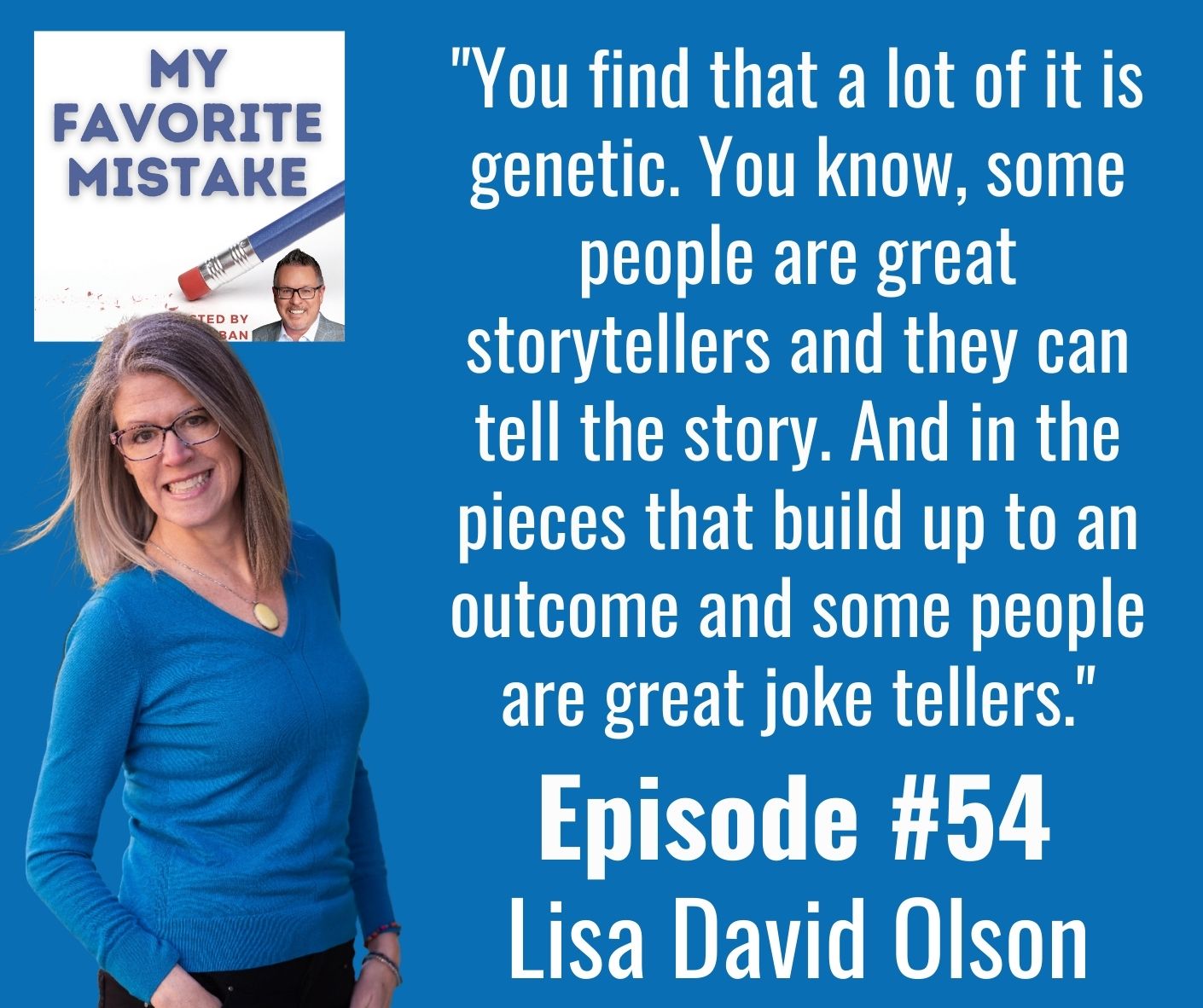
You find that a lot of it is genetic. You know, some people are great storytellers and they can tell the story. And in the pieces that build up to an outcome and some people are great joke tellers. They can do the same with that storytelling, pace myself. All I can remember are punchlines, which is another fun game. Punchlines only I made that up. I'm sure it exists, but I made it up. And so it, you will find that it's genetic. I mean, do you agree with your family, that your humor is the same? Like if you're dry or you're outwardly funny, you think about it.
Mark Graban (28m 51s):
I, I S I see variation amongst my I'm gonna think of my dad's brothers and sisters. There's varying degrees of that. I'm trying to think of, I think my, my uncle and my one aunt, I haven't seen them in the same place in together in a long time, but there's a similar, there's a similarity. So is it nature or nurture of having grown up in the same household?
Lisa David Olson (29m 20s):
That would be a science question, because when you look at being the new person at someone's family gathering, pretend you're the new partner showing up for Thanksgiving and all the inside jokes that are flying in, everybody picks on Bob for a while, and then they shifted over to Sharon for awhile, or, or it's just about, you know, the cooking. And it's so funny how the family dynamics, the ethnicity, maybe of their cooking. Maybe it's a big Italian family and they have this certain jokes. I really feel like a lot of it is genetic. And can it be learned? I think you asked, I think to a point, and there's just so many different types of humor. There's really smart humor.
Lisa David Olson (30m 0s):
There's dirty humor. There's physical humor. So there's just so many variances that this is how we find friends, I think is when we match up things like that. Not just hobbies, but what makes us laugh.
Mark Graban (30m 12s):
Yeah. Yeah. That's a good point. That's a good point. So um Lisa David Olson. Again, her book, her memoir is Laughs on Wry: An Improviser's Memoir. That's available now. And tell us a little bit more about Stranger Connections. I've heard a couple of episodes and it's, it's a interesting mix of guests that you have. What was the inspiration behind the show? Tell us about it.
Lisa David Olson (30m 35s):
Thank you. I love weirdos. And I asked for weirdos and when I say weirdo, that's a compliment and it's respectful. I want quirky stories, strange careers I interviewed. My first episode was a monk who was a monk for nine years, I believe, and then quit. So you can believe I was asking what made you start? What made you quit? And every single guest will share a dare or a prank that they have done or had done to them. And I let them know that ahead of time. I certainly don't want to spring it on them and have them sit because I want it to be a good one. And what that has turned into by a beautiful mistake is that like interviewing someone about she's a storm chaser and she's, she's running toward tornadoes.
Lisa David Olson (31m 24s):
And when I interviewed her, it was just this recent winter storm in Texas. So she didn't know she was going to lose power. It was a very, to me, very exciting episode. And then you ask about pranks and it has nothing to do with storms, nothing to do with the impending, you know, actual storm that's happening while we're interviewing. So that's what flips it. And you really get to see this other side of the person. And I just adore that. So send me your weirdos. I'm still looking for the nurse who walks on hot coals. I lost her number. I interviewed a guy who takes a 40 pound troll everywhere. He goes, he's skydived with him, sky doped, sky driven,
Mark Graban (32m 4s):
Any of those, or none of them,
Lisa David Olson (32m 8s):
Or, or nothing. Yes. Or jumped out of an airplane with this wooden figure. Yes, I'll say it. But yeah, it was cruise the episodes because there is no one theme at all, except that everyone's unique. We all have a story
Mark Graban (32m 22s):
And you start off strangers and you get to know each other through that.
Lisa David Olson (32m 28s):
I have made so many cool friends. Yes. And it's not my goal. It just happens because when you can act like we are, you find out, you know, all the connections and send each other people that might be of. And it just is a beautiful thing to meet new people and find what makes us unique yet connected.
Mark Graban (32m 48s):
Well, I'm glad that I've gotten to meet you Lisa through the podcast, and I've been doing different podcasts for 15 years and people ask, why do you do it? And I'm like, it's great for networking professionally other podcasts. And with this podcast series, I've met a lot of really interesting people who I wouldn't have met or been able to interview on some of those past podcasts. So I'm glad we could do that today. I'm glad that you could be a guest and share your story. Tell us about your book and your podcasts. Lisa.
Lisa David Olson (33m 17s):
Thanks for the opportunity. I appreciate it, Mark.
Mark Graban (33m 21s):
Thanks again to Lisa for being a guest, you can go to MarkGraban.com/mistake54. As always, thanks for listening. Please. Subscribe, rate, and review if you haven't already done. So if you liked the podcast, I actually, the best thing that you can do is share it with somebody else. Whether you want to post on LinkedIn or Twitter on Facebook, if you like this series, or if you like this episode, share it with a friend that would really help. And I hope this podcast inspires you to reflect on your own mistakes and how you can learn from them or turn them into a positive I've had listeners tell me they've started being more open and honest about mistakes and their work.
Mark Graban (34m 2s):
And they're trying to create a workplace culture where it's safe to speak up about problems, cause that leads to more improvement and better business results. If you have feedback or a story to share, you can email me my favorite mistake podcast@gmail.com. And again, our website is my favorite mistake, podcast.com.
This episode explores workplace humor mistakes, risky pranks, and the creative fear that keeps people from taking action. Lisa David Olson shares lessons on humor, courage, and connection at work.