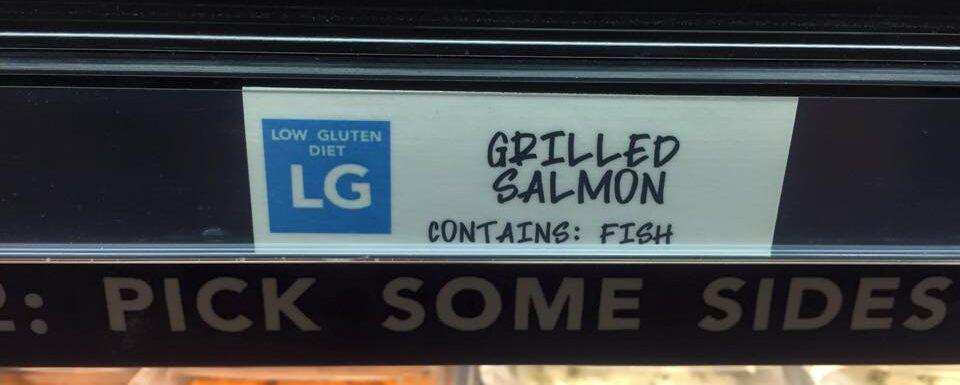
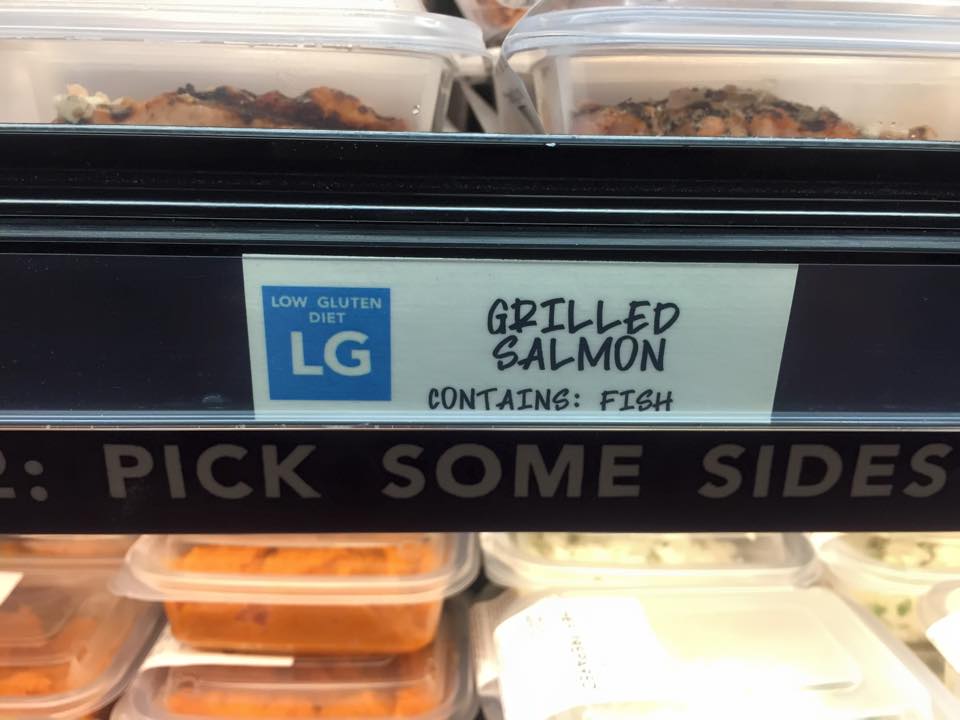
I saw this sign at a grocery-store prepared-food counter:
GRILLED SALMON
CONTAINS: FISH
I’d certainly hope so.
My first reaction was to laugh. Somebody with a seafood allergy presumably already knows that salmon is a fish. If the grilled salmon contained peanuts, milk, or wheat, that might be useful information. But warning us that salmon contains fish seems a little like labeling a carton of eggs:
Contains: Eggs
The nearby “Low Gluten Diet” symbol adds another layer. Salmon itself doesn’t contain gluten, although a marinade, seasoning, sauce, or preparation method might introduce wheat or create a cross-contact concern.
So, yes, the sign looks ridiculous.
But perhaps it isn’t.
The Warning May Not Be Written for This Particular Food
The label probably wasn’t created because somebody concluded that shoppers needed help classifying salmon.
It may instead be the result of a standardized process:
- Identify the menu item.
- Identify any major allergens.
- Display them in the same place and format for every item.
Fish is one of the nine major food allergens recognized under federal law. FDA requirements also treat the specific species of fish as relevant allergen information. Those rules apply to many packaged foods offered by retail and food-service establishments, although I can’t tell from this sign alone which exact requirement or store policy led to the wording.
The person preparing the sign may not have had the discretion to say:
“This one is obvious. Let’s skip it.”
And that might be a good thing.
Redundancy Isn’t Always Waste
In Lean thinking, we often criticize unnecessary work, extra processing, and information that adds no value.
But safety sometimes benefits from deliberate redundancy.
A pilot may already know whether the landing gear is down. The checklist still requires confirmation.
A nurse may know which medication is in the syringe. The label still matters.
A person with a fish allergy may immediately recognize salmon as fish. The standardized allergen declaration still confirms that the system has assessed and communicated the risk.
Consistency can be more valuable than cleverness.
Imagine that the store’s policy were to list allergens only when management considered them non-obvious. Now somebody has to decide:
- Is it obvious that mayonnaise contains egg?
- Is it obvious that pesto might contain tree nuts?
- Is it obvious that imitation crab may contain fish, wheat, or egg?
- Is it obvious that a sauce contains milk?
- Is salmon sufficiently obvious that we can omit the warning?
That introduces judgment and variation into a process where standardization may be safer.
“Contains fish” looks silly beneath “grilled salmon,” but the same standardized field could be critically important on a less obvious item.
Is the Sign Effective?
Even when a warning is required, we can still ask whether the presentation helps the customer.
The allergen statement is legible, but it competes with several other signals:
- the name of the dish,
- the “Low Gluten Diet” icon,
- the allergen declaration,
- and the larger sign about choosing side dishes.
Would a person with a serious allergy understand what “Low Gluten Diet” means? Does it mean gluten-free, reduced gluten, or merely compatible with a loosely defined diet? What about cross-contact during preparation?
A label can be technically present without communicating the risk especially well.
That is an important distinction. Compliance asks:
Did we provide the required information?
Good process design asks:
Can the customer quickly find, understand, and act on the information?
Those are not always the same question.
Sometimes the Funny Sign Has a Serious Purpose
This photo still makes me laugh. “Salmon contains fish” is objectively funny when read as ordinary prose.
But the lesson may not be that somebody at the store lacked common sense.
The label might instead illustrate a reasonable principle: use a consistent method for communicating allergens rather than relying on assumptions about what customers should already know.
So I’m willing to give this sign more credit than I initially did.
I’d still be concerned if the salmon didn’t contain fish.