

Mark Graban talks with Dr. Tyler B. Evans, infectious diseases physician and author of Pandemics, Poverty, and Politics, about how a career “mistake” redirected his path from global health abroad to leading public health efforts in the United States. They explore the politicization of public health, lessons from COVID-19, and why restoring trust in science and leadership is critical to protecting communities.
Listen:
Check out all episodes on the My Favorite Mistake main page.
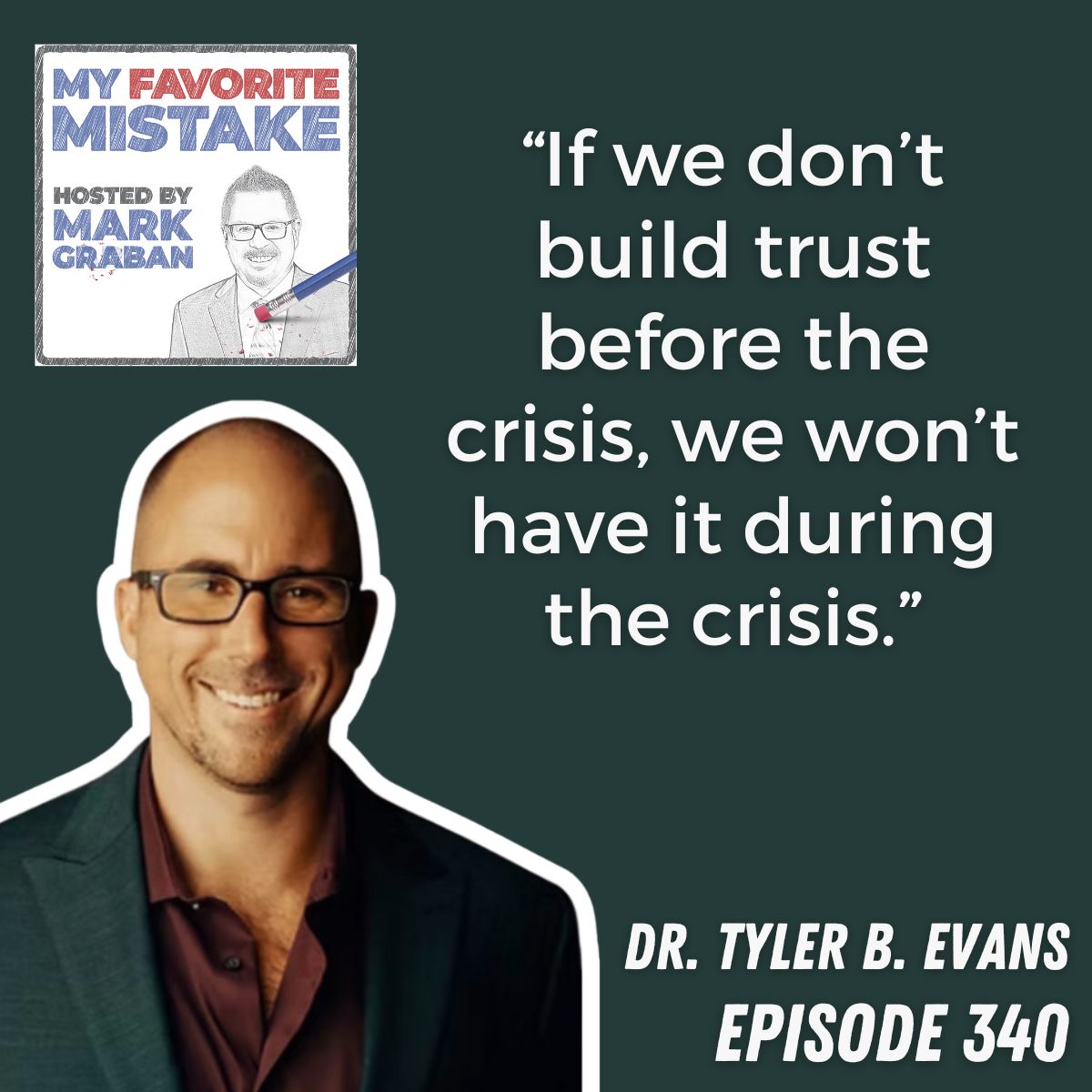
My guest for Episode #340 of the My Favorite Mistake podcast is Dr. Tyler B. Evans, an infectious diseases and addiction medicine physician, public health leader, and author of Pandemics, Poverty, and Politics. He is also the co-founder and CEO of the Wellness Equity Alliance, a national organization focused on advancing health equity for historically marginalized communities.
Tyler shares a career “mistake” that initially felt like a compromise: giving up his dream of working in global health abroad to take a job in the United States. What seemed like a detour led him to work with Native American communities in Wyoming, build refugee health programs in New York, and serve in leadership roles during the COVID-19 pandemic — ultimately shaping his mission and impact.
We discuss the politicization of public health, the erosion of trust in expertise, and why solidarity among healthcare professionals may be essential to restoring confidence. Tyler reflects on lessons from smoking reduction efforts, seatbelt laws, and pandemic response, emphasizing that public health measures are fundamentally about protecting communities — not restricting individual freedom.
Along the way, we explore how scientific understanding evolves during crises, how leaders can communicate uncertainty responsibly, and what it means to learn — rather than assign blame — when mistakes happen.
Themes and Questions:
- What's your favorite mistake?
- What felt like a “mistake” about giving up a global health career path — and how did it shape Dr. Evans’ mission?
- How are health outcomes in rural America similar to those in parts of the Global South?
- Why has public health become politicized in recent years?
- What role do media, echo chambers, and distrust of expertise play in shaping public opinion?
- How should leaders communicate evolving scientific understanding without losing credibility?
- What lessons can we learn from seatbelt laws, smoking reduction efforts, and other public health successes?
- When is it worth engaging someone who strongly disagrees — and when should you “pick your battles”?
- How can healthcare professionals build solidarity and restore trust before the next crisis?
Scroll down to find:
- Video version of the episode
- How to subscribe
- Quotes
- Full transcript
Find Dr. Evans on social media:
Watch the Episode:
Memorable Moments from the Conversation:
Click on an image for a larger view
Subscribe, Follow, Support, Rate, and Review!
Please follow, rate, and review via Apple Podcasts, Podchaser, or your favorite app—that helps others find this content, and you'll be sure to get future episodes as they are released.
Don't miss an episode! You can sign up to receive new episodes via email.
This podcast is part of the Lean Communicators network.

Other Ways to Subscribe or Follow — Apps & Email
Introducing Dr. Tyler B. Evans
Mark Graban: Hi, welcome to My Favorite Mistake. I'm your host, Mark Graban. Our guest today is Dr. Tyler B. Evans. He is an infectious diseases and addiction medicine physician, a public health leader, and an author whose career is focused on serving historically marginalized communities. Dr. Evans is the co-founder and CEO of Wellness Equity Alliance, a national public health organization. He has held several leadership roles across government and nonprofit healthcare, including serving as Chief Medical Officer for New York City during the first COVID surge and later leading large-scale vaccination efforts across multiple states. He is also the author of the new book, Pandemics, Poverty, and Politics, which examines how inequality, misinformation, and politics shape public health outcomes and what we can learn from past and present crises. Dr. Evans, thanks for being here on the podcast. How are you?+4
Tyler Evans: I'm well, great to be here. Thanks for having me.
Mark Graban: It is an honor to have you here. There is a lot to talk about with your book and everything that has happened and is happening. But first, I am fascinated to hear your answer to our opening question. From the things you have done, what is your favorite mistake?+1
A Career Shaped by an Unconventional Path
Tyler Evans: My favorite mistake occurred when I finished my clinical training in infectious diseases. All I really wanted to do was work in Africa and the Global South with organizations like Doctors Without Borders (MSF) to help historically marginalized communities across the world. My “light bulb moment” to get into medicine happened in the late 1990s and early 2000s as a student working in places like South Africa and Uganda. It was a famous time because figures like Nelson Mandela were thought leaders, and anti-retroviral medications were changing the HIV landscape. I was very excited to work in that space.+4
However, I was in a relationship at the time, and real life happens. My partner wanted me to return to the United States to get a “real job”. So, I came back to work in the most unconventional place I could find: the Indian Health Service on the Wind River Reservation in Wyoming. That experience ultimately helped shape my career. As of last week, we just entered an agreement with the Northern Arapaho—the tribe I used to work for—to help scale up tribal health programs in Colorado. It worked out in the end.+4
Mark Graban: Was it that job in Wyoming that seemed like a mistake at the time, or was there more to it?
Tyler Evans: The mistake was giving up my dreams of working in the Global South to return to the United States. I really wanted to be working outside of the U.S.. I made a conventional decision which ultimately had unconventional outcomes.+2
I have always been a big thinker and wanted something different. Working in the Global South in the 90s wasn't as “sexy” or popular as it is now. Mentors like Paul Farmer guided me through that adventure, and I wanted to help the poorest people in the world. But while working in Wyoming with Native Americans as a community health director, I found the mean survival age was 54, which wasn't that different from what I experienced in Sub-Saharan Africa. It was a compelling opportunity to see the challenges we have in the United States. Local health can be global health; Wyoming was a concrete representation of that.+4
Later, I moved back to New York because of the relationship and became the Director of Infectious Diseases and the Director of Gender Affirming Care. I also built a refugee program. My career was cultivated through these accidental steps, and it worked out. During the COVID-19 pandemic, I realized we had some of the worst mortality outcomes compared to other developed OECD countries. We have a lot of work to do here in the U.S.. Once we fix our public health problems in the next 20 to 30 years, then I can export these models to other countries.+4
Mark Graban: Since you are still relatively young, the opportunity to pursue challenges in Africa or other parts of the world still lies ahead. Wyoming to New York is quite a jump, and it points to the variation in health outcomes across the country based on location and wealth.+1
Geography as a Social Determinant of Health
Tyler Evans: It's not as much of a jump as you’d think. The thinking behind my book was that whether I am in South Sudan, Southern Wyoming, or the South Bronx, the conditions and “feeders” of health outcomes are very much the same. While the scales of disease magnitude differ between South Sudan and the Bronx, the factors influencing those outcomes are identical. In my book, I give readers visual scenarios of these different environments and ask them to choose which is which. It is a challenge to distinguish between them. Even though we are in the U.S., these areas are often not that different.+4
Mark Graban: In England, they call it the “postcode lottery,” where your place of birth dictates your outcomes. I saw a map of life expectancies in the U.S. that looked almost exactly like a political map of red versus blue counties.+1
Tyler Evans: Absolutely. Geography is a social determinant of health. Classical definitions of social determinants include the neighborhood and built environment. We know there is a correlation between geography and health. Historic redlining in urban environments led to the polarization of wealth and subsequent healthcare disparities. For example, the Bronx consistently ranks at the bottom of healthcare indicators across all counties in New York State. The irony is that there is considerable physical access in the Bronx, including two academic medical centers and several Federally Qualified Health Centers (FQHCs). However, it isn't just about physical access; it's about transportation, perception, and trust. Geography determines access and outcomes whether the distance is a hundred miles or ten blocks.+4
The Politicization of Public Health
Mark Graban: You mentioned access, which is often cited in rural communities losing hospital funding. You talk about the desire to depoliticize public health, but the reality is that it is now highly politicized. Things that wouldn't have been polarized a decade ago—like vaccines or nutrition recommendations—now are. How do you see this?+3
Tyler Evans: Public health and healthcare should be more integrated and should not be politicized at all. Public health is literally a public good, a common good for all meant to create safeguards for our communities. There is a hyperfocus on vaccinations as the only manifestation of public health, but it includes maternal and child health, environmental health, occupational health, mental health, and substance use.+2
Public health is being politicized today because of an attack on expert opinion. The core driver of public health is science; we must act on evidence in the public's interest. A great success story in public health is tobacco control. By banning smoking in public buildings, restaurants, and bars, we have seen significant success rates. Smoking prevalence is likely down to close to 10% now. This is incredible, especially since cardiovascular disease and cancer are the top killers in the U.S.. Smoking was the number one preventable cause of death, and while it is now closely trailed by obesity, these remain preventable. We achieved this success by following the evidence and implementing health education.+4
Public health is for all communities, regardless of “red” or “blue” status. Infectious diseases do not understand political lines, whether they are county lines or state lines. They naturally have a predilection for people who lack safeguards. It is curious that masks and vaccinations have become trigger concepts. This stems from the attack on expert opinion; people don't want to be told what to do and are living in echo chambers rather than listening to actual experts. Technical expertise is why the United States is such a successful country; we built an incredible infrastructure for tech and biomedicine. We must move away from pushing against the expertise that keeps us safe.+4
Building Solidarity and Trust
Mark Graban: Factors like social media and fractured news channels seem to be making the echo chamber problem worse. Is there anything that can bring us back to a shared perspective?+2
Tyler Evans: We need the emergence of a solidarity movement among healthcare professionals—doctors, nurses, epidemiologists, and frontline workers. Regardless of whether we are in red, blue, or purple states, we need to band together to socialize a uniform message. Currently, the message is fractured by “talking heads” and politicians who are providing “expert” opinions on things like public health.+4
Organizations like the American Public Health Association and various national associations for community and territorial health must bring leaders together so we are all singing from the same sheet of music. We need to talk to constituents, local politicians, and interfaith leaders because, ultimately, we all want to protect our population’s best interest.+1
Mark Graban: People don’t like being commanded. If we look at seatbelts as a public health issue, usage is much higher than it used to be. However, in the 1980s, people complained that seatbelt laws and crackdowns on drinking and driving were “communist”.+3
Tyler Evans: Seatbelts are a perfect example of a public health measure. We know now in 2026 that these were great measures. Effective implementation of public health measures requires a combination of rollout strategy and education. With COVID-19 vaccinations, everything happened so quickly. Childhood immunizations were successful because the rollout was gradual, focused on education, and centered on protecting children and teachers. During the pandemic, measures were forced upon people so quickly they weren't ready, and we weren't working in lockstep.+4
If you have two doctors arguing about a diagnosis, the patient’s confidence in the institution is compromised. Healthcare professionals must be on the same page. Doctors wear white coats—a “costume”—to provide a sense of expert knowledge that makes people feel comfortable. We need to find solidarity and let politicians out of these conversations. It is not their space. Instead, we should invite community and interfaith leaders who have the trust of the people to voice concerns. We should not gaslight or provoke people; even though it can be frustrating to explain these concepts, it is worth it if we can change a few opinions.+4
Facts vs. Opinions in Media
Mark Graban: There is a difference between an opinion and a fact. Senator Daniel Patrick Moynihan famously said everyone is entitled to their own opinions, but not their own facts. I’m wondering about the role of the media, which often tries to “both sides” an issue. If it’s raining, I want a meteorologist to tell me the fact that it is raining, not bring in two experts to argue about whether it is raining or not.+3
Tyler Evans: Giving talking heads with radically different views of a fact a platform is disruptive because it allows people to assume they are experts when they are often not. Having a panel of experts with slightly different ways to approach the same core beliefs is fine. However, journalistic transparency is a slippery slope. For example, in my organization, Wellness Equity Alliance, I don't let the whole team listen to disagreements within the executive leadership because it can impact their confidence. Healthy discourse is good, but it is up to leaders to decide when those discussions are ready for “prime time”.+4
We are in a “leaderless world” in many ways. We’ve gone thousands of steps backward since the 1960s because we don’t have the right leaders in the right positions to guide us. We need more “adults in the room” to decide when these discussions are appropriate so people don't misinterpret what is being said.+3
Mark Graban: If I am in Kentucky and it isn't raining, I can report that fact without being a trained journalist. A meteorologist tells us what is likely to happen tomorrow, and a climate scientist tells us what happens in future decades. It seems that the further out we get from immediate reality, the more likely there is to be disagreement.+3
Tyler Evans: In healthcare, there are phenomena that lay communities cannot see, such as the prevalence of a microscopic infectious disease. We still need experts to make sense of what is currently happening. I often go on local news to explain where we are with flu season or COVID-19 cases. There is nothing inherently divisive about that. Just as a firefighter tells people how to protect their homes from inclement weather, public health leaders provide protections. People don't usually have strong, divisive opinions about fire protection, and we should apply that same perception to public health. During the pandemic, many people didn't understand public health, leading to “armchair epidemiology”. We still need the experts—the “weathermen” and “firefighters”—to make sense of things you cannot see.+4
Learning from COVID-19 Errors
Mark Graban: In April 2020, I drove from Orlando to Los Angeles. In Texas, the state police were wearing masks and taking things seriously. By July, certain counties and cities decided the pandemic was over. It seemed the pandemic spread faster than politicians could figure out how to gain votes from it.+3
Tyler Evans: It is dangerous when politicians spread disinformation or lies. Telling someone it's safe to go outside when there is a fire can lead to fatalities. With infectious disease, it's harder to draw a linear connection because of the delay in symptoms. Politicians won't fix this; it's up to public health leaders to stick together and adhere to the same principles across the country.+4
We missed connecting with communities during the pandemic. Even in California, we told people they had to do things without explaining them properly. During an emergency response, you don't have much time, which is why we need to establish trust ahead of time through town halls and community partners.+4
Mark Graban: We should also distinguish between being “wrong” and scientific knowledge evolving. I spoke to someone who was convinced masks were useless because the virus is smaller than the gaps in the mask, failing to realize the virus travels on water droplets that can be caught. Once someone is convinced they are right, it is really hard to change their mind.+2
Tyler Evans: You have to pick your battles. Time is a commodity. If I am convinced a person is beyond reaching, I acknowledge their opinion and move on. However, public health is not about the individual; it's about the community. While I respect individual autonomy in healthcare decisions that don't impact others, we must intervene when decisions hurt the public.+4
Measures like seatbelts, tobacco bans, and masks are community safeguards. In East Asian societies like Japan or Korea, face masks existed long before the pandemic. Those cultures are community-based rather than individualistic; they wear masks to protect the group. I wish we had more of that selfless balance in the U.S..+4
Mark Graban: In 2026, if I see someone in a grocery store wearing a mask, I think they are protecting themselves. But in Japan, it's a beautiful mindset of not wanting to get someone else sick. Some things evolved; for instance, closing beaches in LA seemed wrong because outdoor gathering is safer. Eventually, the understanding changed. Also, early on, vaccines were said to slow the spread, but with Omicron, that protection changed. People used that to claim the science was “wrong” when it was actually evolving.+4
The Future of Public Health Preparedness
Tyler Evans: When public health officers began putting out executive orders, many people had never heard of a “health officer” before. In NYC, people don't like being told what to do. A challenge in public health is that we didn't take emergency preparedness as seriously as we should have. We weren't quite ready for COVID-19. Some health officers made decisions with the best intentions but without a full understanding of the emerging disease. Not all public health officers are infectious disease specialists. We needed those specialists on speed dial.+4
In the future, we will be more prepared. Public health needs a synchronized connection, perhaps through the Surgeon General and a uniform core of public health professionals across the country. For those still wearing masks in 2026, if they are sick, that is great. However, some are still acting out of fear beyond actual risk, and we need more education. Sometimes “less is more.” In medicine, using two condoms or two pairs of gloves is actually less effective because it creates friction or over-complication.+4
Mark Graban: Dr. Tyler Evans, the book is Pandemics, Poverty, and Politics: Decoding the Social and Political Drivers of Pandemics from Plague to COVID-19. Hopefully, we are better prepared for when this happens again. Is it going to be another hundred years?+2
Tyler Evans: No, it will be before that, but hopefully, we'll be prepared.
Mark Graban: Congratulations on the book. I hope people in power read it and learn from an expert. Thanks for sharing your story and expertise.+2
Tyler Evans: Thanks, Mark. Appreciate it.