
What happens when emotion quietly overrides evidence in leadership decisions? Timothy R. Clark shares a pattern of hiring mistakes driven by emotion—and how those experiences shaped his thinking about psychological safety, vulnerability, and better decision-making.
Listen:
Check out all episodes on the My Favorite Mistake main page.
My guest for Episode #217 of the My Favorite Mistake podcast is Dr. Timothy R. Clark, an organizational anthropologist, and founder/CEO of LeaderFactor, based in Salt Lake City, Utah.
Tim pioneered the field of data-driven cultural transformation and ranks as a global authority in senior executive development. He earned a Ph.D. in Social Science from Oxford University as a British Research Scholar and was a Fulbright Scholar at Seoul National University in Korea.
Tim is the author of five books, including his most recent, The 4 Stages of Psychological Safety. I’ve learned so much from this book, his training class, his podcasts, and more.
In this episode, Tim shares his favorite mistake story about a pattern of being overtaken by emotion when making a decision. What did he do about this pattern and what did he learn about hiring people for his company?
We also discuss the concept of “psychological safety” and what leaders need to do to create conditions where people can feel safe speaking up about mistakes, ideas for improvement, and more.
I feel honored that Tim endorsed my new book:
”Making mistakes is not a choice. Learning from them is. Whether we admit it or not, mistakes are the raw material of potential learning and the means by which we progress and move forward. Mark Graban’s The Mistakes That Make Us is a brilliant treatment of this topic that helps us frame mistakes properly, detach them from fear, and see them as expectations, not exceptions. This book’s ultimate contribution is helping us realize that creating a culture of productive mistake-making accelerates learning, confidence, and success.”
timothy r. clark
Questions and Topics:
- Instead of the question I normally start with… how do you define “psychological safety”?
- How would you explain “vulnerable acts”?
- Why is it so much more helpful for leaders to MODEL behaviors??
- You can’t just demand that people “should” speak up in the hierarchy (healthcare or otherwise)??
- Why is the safety to learn from mistakes required for innovation to thrive?
Scroll down to find:
- Video version of the episode
- Quotes
- How to subscribe
- Full transcript
Find Tim on social media:
Video:
Quotes:
Click on an image for a larger view
!["[New hires] don't arrive ready to be themselves or ready to learn because they've come out of punished vulnerability, which to a certain extent is trauma. And so they bear the impact of that experience, that experience lingers into the future." - Timothy R. Clark](https://www.markgraban.com/wp-content/uploads/2023/06/My-Favorite-Mistake-Timothy-R-Clark-Quote-1.jpg)
Subscribe, Follow, Support, Rate, and Review!
Please follow, rate, and review via Apple Podcasts, Podchaser, or your favorite app — that helps others find this content, and you'll be sure to get future episodes as they are released weekly. You can also financially support the show through Spotify.
You can now sign up to get new episodes via email, to make sure you don't miss an episode.
This podcast is part of the Lean Communicators network.

Other Ways to Subscribe or Follow — Apps & Email
Automated Transcript (Likely Contains Mistakes)
Here is the cleaned-up transcript with relevant diagram triggers inserted.
Mark Graban: Episode 217, Timothy R. Clark, author of The 4 Stages of Psychological Safety.
Timothy R. Clark: Trying to figure out, oh, okay, which mistake? I have many to choose from. I have a whole menu.
Mark Graban: I'm Mark Graban. This is My Favorite Mistake. In this podcast, you'll hear business leaders and other really interesting people talking about their favorite mistakes, because we all make mistakes. But what matters is learning from our mistakes instead of repeating them over and over again. So this is the place for honest reflection and conversation, personal growth, and professional success. Visit our website at MyFavoriteMistakePodcast.com. To learn more about Dr. Clark, his book, his company, and more, look for links in the show notes, or go to markgraban.com/mistake217.
Well, hi everybody. Welcome to My Favorite Mistake. I'm Mark Graban. My guest today is Dr. Timothy R. Clark. He's an organizational anthropologist. He's the founder and CEO of LeaderFactor, which is based in Utah. I'm really excited that he's here. I love his book. He's the author of five books, including his most recent, The 4 Stages of Psychological Safety. Tim has a PhD in social science from Oxford University. He was a British Research Scholar. He was a Fulbright Scholar at Seoul National University in Korea. So I'm real excited. I've learned so much, Tim, from your book, your podcast, and the training class I was able to do last year. Welcome to the podcast. I'm gonna try not to be too awkward or starstruck here.
Timothy R. Clark: No, thanks, Mark. I'm delighted to be with you.
Mark Graban: Thank you. And I'm gonna have to remember, like, I hear your voice a lot when you're doing the podcast with Junior, and I'm gonna have to keep reminding myself that I get to interact with you.
Timothy R. Clark: Hey, just so you know, we're friends, so we're just gonna have a conversation. Makes it nice.
Mark Graban: Sure. Well, thank you for that. So, I'm gonna deviate a little bit, and I told Tim that I was thinking of doing that here. Normally the first question is about favorite mistakes, and we're gonna get to that. But I think it's important maybe to ground the conversation a little bit, Tim, if you would, if you give your definition of psychological safety, please.
Timothy R. Clark: Right. So five words: a culture of rewarded vulnerability. That means I'm going to reward your acts of vulnerability and you're going to reward my acts of vulnerability. And out of that, if we do that consistently, then that creates a prevailing norm where we can both model and reward vulnerability. That creates an astonishingly powerful environment or culture where we can really reach our potential and do work that we otherwise couldn't do. So that's my definition.
Mark Graban: Yeah. Well, thank you for that. And we'll have a chance to talk more, I think, after the favorite mistakes story. But maybe just one other quick recap. You know, with the four stages of psychological safety—inclusion safety, learner safety, contributor safety, and challenger safety—one thing I try to do on the podcast, and I hope I've done with you, is that level of inclusion safety where you feel accepted and respected.
You know, inviting you to the podcast, I think is an act of welcoming inclusion. But I do appreciate—and this is more of a comment than a question, but I wanna hear your reaction to it before the favorite mistake question—the candor that my guests exhibit, or the vulnerability to share a story about a mistake. It is something that I'm deeply grateful for. Not just because it creates content for a podcast, but it's just very generous of people. And I can't say it's strictly because I've created a comfortable environment for that. But what are your reactions to that?
Timothy R. Clark: Yeah, my thoughts on that… Well, it takes me to, I think, what is a principle that I see over and over again, and that is that there is a direct correlation and a positive relationship between vulnerability and your ability to learn. So the more vulnerable we can become in our conversation, in this dialogue, the more we're gonna learn. Because we're willing to explore, we're willing to dig, we're willing to excavate, we're willing to examine things at a deeper level. We are trying to remove the inhibition, the fears, the doubts. And so what does that do? It allows greater learning. So that's what I would say; where we achieve that, we tend to have better experiences.
Mark Graban: So maybe it's an opportunity now to learn from your story and your reflections on it. I'll jump to the main question then, here, Tim. With the different things you've done, what would you say is your favorite mistake?
Timothy R. Clark: Well, you asked me this a few days ago, so I've been reflecting on it, trying to figure out which mistake. I have many to choose from. I have a whole menu.
Mark Graban: I've learned—I'm sorry to interrupt—but yeah, this is not a question you put people on the spot with.
Timothy R. Clark: No, no, I know. But I tried to be reflective and I identified a pattern. This is maybe a category of mistake that we all make, and I've certainly made it more than once. But it's a mistake where I was overtaken by emotion in making a decision. So think about the way we make decisions. Well, typically we bring some data and evidence, we bring some kind of logic, some kind of logic tree to a decision, and then we make a decision.
Now, of course, I think it was Daniel Kahneman that said, we are not thinking machines that feel, we are feeling machines that think. So that helps us understand that the thinking brain and the feeling brain are interconnected. Not only interconnected, you can't pull them apart. And so when we make decisions, we have the intellect at work, but we also have emotions at work. And that interplay is very important, and we don't even fully understand how that works. But the mistake that I've made more than once is when I allowed the emotions to kind of commandeer or control or overtake the process.
Mark Graban: Can you give an example before we talk about what you did about it? An example kind of illustrates.
Timothy R. Clark: Yeah. So I made this mistake twice. The first time, I hired the wrong person. And I did it because… well, let me share a statement with you, Mark, that I think is very instructive. This is a statement that will always stay with me. It's by Gertrude Himmelfarb. She's an American historian. She passed away three or four years ago, but she said, “Nothing is as seductive as the assurance of success.” You gotta let that sink in. Nothing is as seductive as the assurance of success.
So I remember—going back to the mistake—I hired this individual, this was years ago, to an executive position. And the evidence wasn't really quite there, but the assurance of success that this person gave me created such a hope and a desire that it would work out. And I felt myself, in retrospect, realizing I was a victim of confirmation bias. I was telling myself, “Oh yeah, this is gonna work.” So in the absence of the evidence that I really needed on the intellectual side, I let my emotions and my hopes and my aspirations dictate the decision.
And I had tremendous buyer's remorse after this, because the individual was not able to perform anywhere close to the assurances that they gave. Now here's the sad part. I did this again. You think, oh, you know, rookie mistake. Okay, but I did do it again. I did it one more time and I could kick myself for it, because again, the evidence wasn't there, but the assurances were there. The assurances were there, but they were not based on the evidence. And I went with the assurances instead of the evidence, and again, I met with really stinging and bitter unintended consequences that I had to absorb after the fact. So twice on that, Mark, and I paid a heavy price for that. And it took me a while. I just wasn't vigilant, alert enough, disciplined enough. And I made the mistake twice. And it was a killer.
Mark Graban: Well, I appreciate you sharing that. And I mean, you know, people make mistakes like these. The thing is about learning from them and not beating ourselves up for 'em. Did, in both cases, did you have to come to the realization of that person needing to be removed then from the organization?
Timothy R. Clark: Both times. Yeah. And so then you're faced with the sunk cost issue, and you're thinking, okay, you know what? We'll just invest more. They're gonna get there. They're gonna get there, and you invest more. And at some point, you just have to cut your losses and move on. But even that is so difficult because you have invested a lot, and you're so hopeful that things are gonna work. But again, you are engaged in some level of self-deception because you're not truly objectively, impartially looking at the evidence. Your confirmation bias is still at work, and you're dismissing the lack of solid evidence that this person is performing. And so you're not being completely honest with yourself, or at least you're trying to be really hopeful, and then you're delaying the inevitable, which is you gotta take the person out.
Mark Graban: Yeah. I mean, it seems like there's a situation where we either might not want to admit that it was a mistake, or we might make a mistake on top of the mistake of trying to stick with the person too long. The other side might be true too, where you get rid of somebody right away, and then you think, “Well, maybe that was a mistake. Maybe I should have coached them up.” There's no easy answers to decisions like these. We make the best decision you can in the moment.
Timothy R. Clark: It's true. But you know, what's interesting, Mark, is I've been managing people for a long time, and I can't think of one single example where I would say, “Oh, we took this person out too early.” I cannot think of one example, but I can think of plenty where we said, “Oh, we waited too long.”
Mark Graban: Yeah. You hear that a lot from executives. So after a couple of cycles of going through this, what did you discover? What did you learn? What did you do about it?
Timothy R. Clark: The old adage: hire slow, fire fast. I have become just much more patient and methodical about hiring and about disciplining myself to focus on the evidence. Now, I don't mean to say that we should be dismissive of gut or instinct or intuition. I'm not saying that at all; those things are very important. In fact, we don't fully understand the interplay of the thinking brain and the feeling brain. We don't understand how the brain works to synthesize information and to draw conclusions sometimes. So we have to pay attention. If we're feeling something, we're having a misgiving, we're having a doubt, we're worried about something—we have to pay attention to that intuition. Those instincts are very important. So I'm not at all suggesting that we're just dismissing that.
But what I am saying is, at least for myself, I had to learn to be very careful about allowing myself to be persuaded early based on reassurances, based on claims. “I can do this, we can do this. We're going to do this. We can achieve this.” Where's the track record? We have to see a demonstrated track record. We have to see some significant evidence of what might be possible. So I've become much more careful about demanding to see the evidence in the track record.
Mark Graban: Yeah. Well, I appreciate you sharing the story and the reflections. It's a vulnerable act to share that with an audience. So, I appreciate that. It goes to show you're not alone. Many guests on the show have talked about how it took a couple of repeats of a mistake for it to really then start to register and for the awareness to build of, “Okay, I need to start doing something differently.” So you're not alone in that with these difficult decisions that leaders and entrepreneurs like yourself face. So I hope you feel like I'm back to terminology, rewarding your vulnerability. No punishing you. “Tim, what's wrong with you? Why didn't you know better?”
Timothy R. Clark: No, no, not at all.
Mark Graban: “Why didn't you learn faster?”
Timothy R. Clark: Yeah. And I'm very happy to share about that because the human mind and the human brain are always looking for ways to economize. We're looking for cognitive shortcuts. We're looking for efficiencies. And so therein lies a temptation to tell ourselves a soothing story about maybe trying to get somewhere faster, to be more efficient. And I have to come back and tell myself again, and again and again—and I tell the team this—find the price. Pay the price. Don't even think about the concept of a shortcut. Shortcuts don't exist. Find the price. Pay the price. This is the only way to sustainable performance. And it's the only way that we can really build ourselves and build others for long-term success. So those are some of the things that I tell myself now.
Mark Graban: So I think we have this great opportunity to take a deeper dive into psychological safety, realizing for the audience, we're scratching the surface. I highly recommend Tim's book, The 4 Stages of Psychological Safety. There is so much free knowledge and education that you and your team give away, Tim, through podcasts and webinars and YouTube videos. It's all out there for everyone. And I hope they will also buy the book.
So, I want to delve in. There are a few specific questions that I have from trying to be a student of this, trying to help others learn. One, I'd like to go back and unpack the word “vulnerability” a little bit. Back to your definition of psychological safety as a “culture of rewarded vulnerability.” Cause you know, it's interesting, people hear a word and they're like, “Oh, I know what that word means.” But they might be thinking something different than your definition. Before asking for a definition, one thing I hear people respond to is that they hear the word vulnerable, and they think, “Oh, that sounds weak. I don't wanna be vulnerable, I don't wanna be weak.” Or that being vulnerable is like sharing a personal story, like, “Let me be vulnerable with you,” and they might tell an embarrassing story. But that's not really the way you explain or define it, right?
Timothy R. Clark: No, vulnerability is exposure to the risk of harm or loss. That's what it is. So you are deliberately exposing yourself to that risk of harm or loss, but you have to in order to do the things that matter in life. So for example, here's the premise: Human interaction itself in all of its aspects is a vulnerable activity. So we're not gonna do anything productive without being vulnerable.
It turns out that often the more vulnerable you can become, the better that you can do things. For example, you can't be yourself without being vulnerable. If it's expensive to be yourself, then you won't. If it's risky, you'll engage in very predictable behavioral patterns such as armoring and masking and modulating and code-switching. These are the things that humans do when they don't feel interpersonally safe. It's expensive. And so they are adaptable creatures; they're going to engage in behaviors that will help them with self-preservation, with loss avoidance, which makes sense.
So back to your original question, what is vulnerability? Deliberately—well, not always deliberately, but often deliberately—exposing yourself to that interpersonal risk. But in doing that, it opens up the possibility of all of these rewards. And so if you're not willing to be vulnerable, then you're stuck. You're stuck in your personal development, you're stuck in your relationships, you're stuck in your learning, you're stuck in your contribution, you're stuck in your ability to innovate. You're stuck.
Mark Graban: Sure. But when you talk about the role of leaders, and I think earlier you talked about modeling and rewarding vulnerable acts… If someone's new to a team, and we think of examples of vulnerable acts—asking a question, saying “I don't know how to do something,” saying “I could be wrong,” “I made a mistake,” “Maybe there's a better way”—those are all vulnerable acts in the sense that somebody could ignore you or punish you or attack you for using your voice and for speaking up.
And it's interesting when you see somebody come into an organization from surveys that you can say is generally speaking, a relatively psychologically safe environment… When someone's new to a team and they're joining from an organization where they did get yelled at for not knowing something, they got punished for simple human error, it's interesting to hear people's reflections. It's not like they can flip a switch and say, “Oh, I'm in a safe space now, I can change my behavior.” Because they've been conditioned that speaking up isn't just risky, it's been demonstrated that it's risky.
Timothy R. Clark: Yeah. They have evidence. And so even if they move teams and they go from one team and they come to your team, they do not arrive ready to go. They don't arrive ready to be themselves or ready to learn because they've come out of punished vulnerability, which to a certain extent is trauma. And so they bear the impact of that experience. That experience lingers into the future. And until there's evidence to the contrary that they can see—as they do threat detection—that, “Oh, look what everyone else is doing. Look what Mark is doing. He's engaging in these acts of vulnerability and he's being rewarded for doing that.”
And it registers and it registers and it registers and you build up this new evidence that says this, “It looks like you can do this and not be punished, but actually be rewarded.” And so then the person has to be re-socialized and then amazing things can happen. But if you're the leader, then don't assume that people are coming to your team and they're ready to go. So one of the things that I like to say, Mark, is that as the leader, you have the first mover obligation to create the conditions for psychological safety. The leader is responsible for conditions, and that responsibility never goes away. Nor is it a responsibility that you can delegate or even abdicate even if you wanted to. That's just part of the job.
Mark Graban: Yeah. So can you explain a little more… the one thing I think is really powerful about this framework that you lay out: it's not enough for leaders to encourage people to speak up or to encourage vulnerability or to say that it's safe. Like why is it so much more powerful for a leader to lead by example? Think of in a workplace where the CEO is very willing to say, “I made a mistake,” or “I've got an idea, but I don't know that it's perfect, so let's go test it and see.” Why is that modeling so much more helpful?
Timothy R. Clark: Well, first of all, it shows the way. We say in writing, “Don't tell me, show me.” So someone needs to show us how this is done. We need a model that we can imitate. That's how we learn. We learn through imitation, especially behaviorally. So I need to be able to say, “Oh, look at Mark. That's how you do it. So that's what it looks like.” So now I have a model that I can follow, I can imitate.
Number two, I need evidence that I can do it and that I won't be punished. So I just need a body of evidence that tells me that it's okay, that I won't be punished, that I'll be rewarded for these vulnerable acts. So if the leaders are telling us, “Oh, you need to speak up,” but they have not created the conditions that would allow us to speak up, they are essentially asking us to muscle through the fear. Yeah. Well, who's gonna do that? A few outliers will do that, but everyone else will not do that. And it's not only ineffective, Mark, I would go so far as to say it's disingenuous to even ask if you haven't created those conditions, because you're responsible for those conditions as the leader. That's your job.
And so I talk about this and I call this “rhetorical reassurance,” where the leader gets up in front of people and says, “Hey, hey, we're gonna have psychological safety. Now go ahead and speak up.” What changed? You think you're gonna legislate that with your words? This doesn't work. You can't do this by decree or by fiat. It doesn't work that way.
Mark Graban: Right. There's this phrase, and I don't know if I got it from you, but this idea of the word “providing.” I think like if you hear someone say, “We're gonna provide psychological safety,” I'm like, well, you can provide donuts for the meeting. But psychological safety is not that simple. It's not something you buy or install. It's not a project.
Timothy R. Clark: Install. I like that. Yeah. And by the way, it's delicate and it's dynamic. It's perishable. And so we don't… it's not a project where, “I got that done. Let's move on to the next priority.” This is ongoing. This requires constant modeling, constant reinforcement. It's an eternal process in culture.
Mark Graban: Right. And when you talk about people being brave or courageous or powering through… like when in healthcare environments, I cringe when I hear discussions around nurses or people speaking up in a power dynamic where they're not the most powerful person. And you hear people say things like, “Well, you should speak up. You should challenge that surgeon. It's your professional responsibility.” And I'm like, that just does not seem helpful or effective. It's not even rhetorical reassurance. It's more like a demand.
Timothy R. Clark: Right. And there's so much risk. So let's go back to the fact that we typically work in hierarchies, which means that there are power differentials. And when the power distance is large, then what you're asking me to do—if you're asking me to challenge someone that's higher in the hierarchy—you're asking me to assume a much greater risk. So the potential liability, the potential exposure and the potential liability for me personally, is massive. Furthermore, I'm probably socialized to give deference to the chain of command. And that's what we call authority bias.
And so think about the obstacles. I've gotta overcome the authority bias, the exaggerated deference to the chain of command, the personal exposure and liability, the potential for repercussions, reprisals… I have to overcome all of that. And you're just telling me I should do that? Excuse me. So how do we get realistic about what it requires for the person that's subordinate to actually engage in that behavior? We have to enable that to happen, or it's not going to happen. That's why the flight attendant doesn't challenge the pilot. That's why the nurse doesn't challenge the cardiothoracic surgeon. That's why the overhead crane operator does not challenge the foreman on the shop floor. And so unless there's a way to equalize this and remove at least most of the threat of punishment and adverse consequences, then we don't do it.
Mark Graban: Right. And what you're pointing out there, I think is how it's so situational. And I think it's interesting to see when you work in different cultures, different organizations, different environments, or even bouncing between teams… none of us—well, it's quite often that we feel a different sense of psychological safety in those different teams, even though we're the same person bringing our own history and experiences or personality into a situation.
Where, to not make it about me, I think of people I've worked with in professional settings where they were just beaten down over decades, conditioned to just keep your head down. “Don't speak up, don't be a troublemaker.” Say, “Well, that person's not brave,” but how much do you bet a lot of these people with their family, if they're coaching a team at their church, wherever, they're probably asking questions and challenging the status quo? And that different environment is allowing them maybe to be themselves in a way that their workplace, sadly, is not.
Timothy R. Clark: Isn't that true? So you've just raised an amazing point, Mark, which is: we traverse across often many different microcultures in life. We get up in the morning, we're at home, what's that like? And then maybe we go to the gym, and then maybe we go to work, and then maybe we go to the book club, and maybe it's the food truck around the corner, and then maybe we coach a little league team after that.
And each one, as you say, is a different culture, has a different level of psychological safety. And what if work is an oppressive environment that does beat you down? And I find it interesting the language that you just used, because this is so often been used where “Don't cause trouble.” Well, hang on a second. Let's break this down.
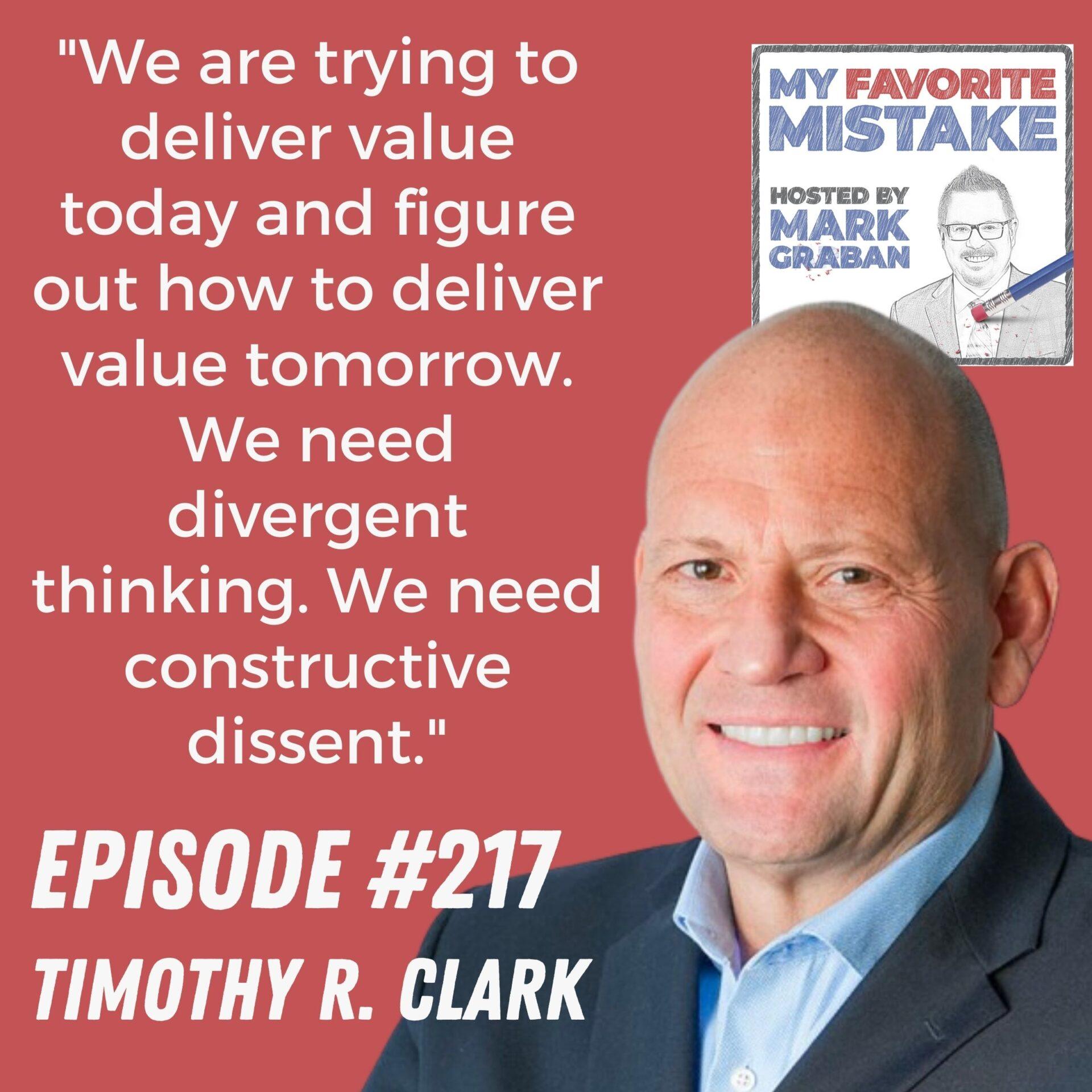
We only do two things in organizations. We do execution and we do innovation. And execution means delivering value today. And innovation means delivering value tomorrow. Execution is about the reduction of variance. Innovation is about the introduction of variance. Innovation requires divergent, non-linear thinking. It requires constructive dissent. So when someone says, “Don't cause trouble,” what are you talking about?
We are trying to deliver value today and figure out how to deliver value tomorrow. We need divergent thinking. We need constructive dissent. So this just flies in the face of what it requires to build up the adaptive capacity of an organization. But you're absolutely right, Mark. For some people, perhaps many people, it's been rung out of them. They don't do it. They don't even challenge the status quo. It's been made very clear to them that that's not welcome behavior, and yet we need it in every organization. That is so paradoxical.
Mark Graban: Right. And I'm sure you could look at a history of how many different tech companies that had some great innovation, and they were growing and they had an innovative phase, and then they level out and they fossilize and then they end up dying. How much of that is—it could be due to technology changes or what have you—but how much of that is due to that culture creeping in now of leader behaviors that stifle innovation? And then maybe they start yelling and screaming and demanding more innovation, like, “Well, no, that doesn't put us on track.
Timothy R. Clark: Yeah, it's really true. I did a Harvard Business Review article a few months ago on the innovative side, and the connection between psychological safety and innovation. And the central finding that I put in the article is this: The quality of interaction regulates the speed of discovery. So how are we interacting? Can we interact with vulnerability? Can we act with candor? Can we interact with challenging each other? If we can, that quality will regulate the speed of our discovery. But if we can't do that, then we limit ourselves. We block our own progress. And that's what it comes down to. People have enormous abilities to innovate, to be creative, to make improvements, but a lot of times they get shut down.
Mark Graban: Well, I hope, you know, between what you're teaching and sharing in different ways, that inspires some people to rethink some things. Maybe there'll be a discussion where a leader says, “Hey, I was making that mistake of punishing people for speaking up.” And as you shared a little bit with your story, Tim, maybe they start challenging things and taking on some new practices the way you did. So I think what you're sharing… I know it's opening some people's eyes and inspiring them to move in that direction of, as you say, both modeling and rewarding vulnerable acts. I appreciate what you're doing to help teach and share and inspire people on that.
Timothy R. Clark: Well, thank you. Yeah. I think if you think about what courageous leadership really means, to be courageous is to invite the challenging behavior, to invite the dissent. To give people a license to disagree and say, “We really need you to use that license.” That may be the supreme test of a leader: to be able to receive all of that and appreciate all of that, and process all of that and really unleash the power of the team that way.
Mark Graban: Yeah. I love, not just as you say, not just tolerating dissent, but encouraging it. There's a big difference there.
Timothy R. Clark: Big difference. Yeah. Yep.
Mark Graban: Well, today, again, we've been joined by Tim Clark, his company is LeaderFactor. The book again, is The 4 Stages of Psychological Safety. And maybe one question here to wrap up: the four stages framework… the fourth stage, challenger safety, as you described, that's the innovation zone. There are different things we need to do to get there. So on the theme of this podcast, I'm gonna ask you about just one of… why is that safety to be able to admit mistakes and to learn from them… why is that so important if innovation is going to thrive?
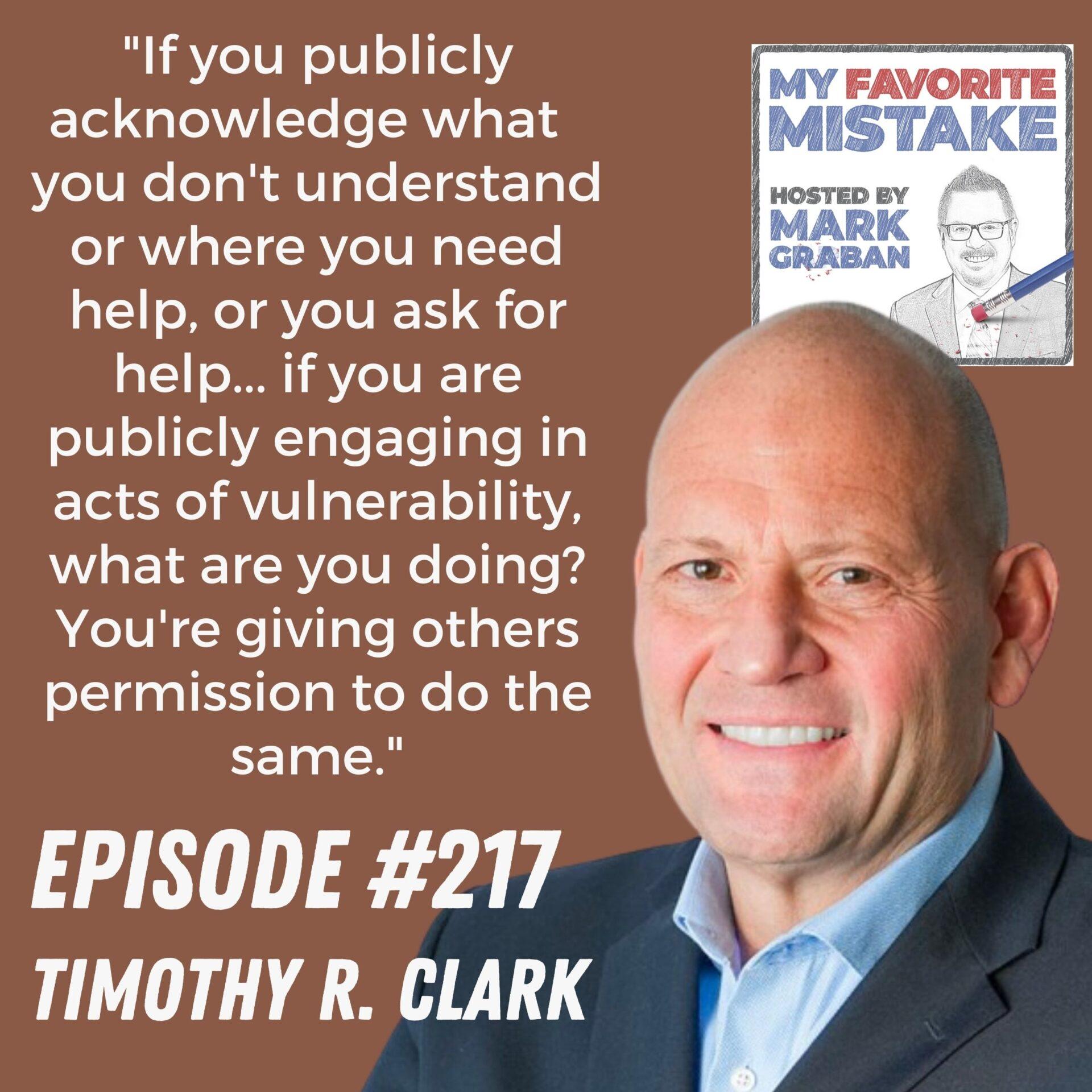
Timothy R. Clark: Well, if we go back, Mark, psychological safety is a function of respect and permission. So if you share your mistakes, if you publicly acknowledge what maybe you don't understand or where you need help, or you ask for help… if you are publicly engaging in acts of vulnerability, what are you doing? You're giving others permission to do the same. So that's the second requirement for psychological safety. Number one: respect. Number two: permission. Through your own vulnerability, you give others permission. And then they are much more likely to engage in those acts of vulnerability themselves.
Mark Graban: Yeah. It's very well said. So Tim, thank you so much. It's been a real honor and a treat to have you here on the podcast. Really appreciate you taking the time and sharing so much with us today.
Timothy R. Clark: Oh, thanks. It's been a privilege, Mark. Thanks so much.
Mark Graban: Thank you. Well, again, thanks so much to Tim for being a guest here today. To learn more about him, his amazing book, his company, and more, look for links in the show notes or go to MarkGraban.com/mistake217. As always, I want to thank you for listening. I hope this podcast inspires you to reflect on your own mistakes, how you can learn from them or turn them into a positive. I've had listeners tell me they started being more open and honest about mistakes in their work, and they're trying to create a workplace culture where it's safe to speak up about problems, because that leads to more improvement and better business results. If you have feedback or a story to share, you can email me MyFavoriteMistakepodcast@gmail.com. And again, our website is MyFavoriteMistakePodcast.com.
This episode explores emotional decision-making mistakes and how they affect hiring, leadership, and culture. Timothy R. Clark shares why psychological safety and rewarded vulnerability are essential for learning and innovation.