
What happens when a campaign plan collapses—and when physical pain and anxiety refuse to be ignored? Congressman Adam Smith shaes how early political mistakes and deeply personal health struggles reshaped how he thinks about truth, leadership, and learning from mistakes.
Listen:
Check out all episodes on the My Favorite Mistake main page.
My guest for Episode #215 of the My Favorite Mistake podcast is Congressman Adam Smith (D-WA). I'm very honored to have him here.
Rep. Smith represents the 9th District of the State of Washington. He was reelected to his 14th term in 2022 and has been the top Democrat on the House Armed Services Committee since 2011. He served as chair of the committee from 2018–2022 when the Democrats controlled the majority in the US House.
The Congressman is also the author of a new book, available now, Lost and Broken: My Journey Back from Chronic Pain and Crippling Anxiety.
Congressman Adam Smith joins the show to share his “favorite mistake,” taking us back to his very first political campaign—a run for Washington State Senate when he was a young, untested law student. He explains the core assumption that shaped his entire early campaign strategy, why that assumption was so wrong, and how the realization nearly came too late. Smith walks us through the moment his carefully constructed plan collapsed, how he recalibrated under pressure, and what ultimately allowed him not just to recover, but to win.
We then shift to the deeply personal journey behind his book Lost and Broken, in which Rep. Smith chronicles years of chronic pain, crippling anxiety, misdiagnoses, and ineffective treatments. He reflects on the mistakes he made while seeking help, the systemic mistakes he believes are far too common in healthcare, and the long and winding path toward finding the right professionals and the right answers. Smith shares what he learned about the roles of perseverance, self-awareness, and self-advocacy in healing—and why the quick fixes often offered by the medical system can lead people further away from the root cause of their suffering.
A major theme in the conversation is his evolution in how he thinks about mistakes themselves. Smith describes how he learned to stop beating himself up, why admitting mistakes is both freeing and necessary, and how political leaders—and all of us—can benefit from more openness around mental health and human fallibility. He also offers thoughtful insight into how anyone can avoid similar missteps in their own healthcare journey, how to recognize when something isn’t working, and how to look honestly at problems without becoming overwhelmed by them.
This episode blends political story, personal struggle, leadership wisdom, and mental-health insight—showing how one leader’s hardest lessons became the foundation for resilience, recovery, and continued public service.
Questions and Topics:
- Asked on June 1st: Is the U.S. avoiding the national mistake of a debt default?
- In the book, you share some mistakes… why is it helpful to do so?
- For readers to realize our elected leaders (like all people) make mistakes?
- How have you learned to not beat yourself up over mistakes?
- Is it a mistake to not want to see a psychotherapist?
- How do people know when they should seek help for mental health concerns??
- Tell us about the perceived need for a politician to keep mental health problems quiet… going back to VP nominee Thomas Eagleton… a year before I was born, getting replaced as the nominee after past bouts of depression were revealed…
- Is the public getting more accepting of admissions of mental health issues?
- Doctors failed to get to the root cause of your problems by just pushing pills?
- You CAN get better — it was a long journey to find the right caregivers?
- Tell us about your book Lost and Broken — how did it come to be?
- Did it help you process that stress?
- From the book: “My own reelection campaign in 1994 presented challenges, as I have described, but I learned from them. I made mistakes.” — what were those?
- Did it get easier to run as the incumbent over time?
Scroll down to find:
- Video of the episode and a clip
- Quotes
- How to subscribe
- Full transcript
Find Rep. Smith on social media:
Video:
Quotes:
Click on an image for a larger view
!["And this is why it's my favorite mistake, that the [campaign]plan absolutely blew up in my face. And the reason for it was I just didn't know what I was getting into." - Rep. Adam Smith](https://www.markgraban.com/wp-content/uploads/2023/06/Rep-Adam-Smith-My-Favorite-Mistake.-Quote-2.jpg)
Subscribe, Follow, Support, Rate, and Review!
Please follow, rate, and review via Apple Podcasts, Podchaser, or your favorite app — that helps others find this content, and you'll be sure to get future episodes as they are released weekly. You can also financially support the show through Spotify.
You can now sign up to get new episodes via email, to make sure you don't miss an episode.
This podcast is part of the Lean Communicators network.

Other Ways to Subscribe or Follow — Apps & Email
Automated Transcript (Likely Contains Mistakes)
Mark Graban: Episode 215, Congressman Adam Smith.
Rep. Adam Smith: Well, it's really sort of the defining moment of my career. It's funny when we talk about going on and doing this, you know, I thought about, certainly I made a lot of mistakes as I was trying to deal with my chronic pain and my anxiety.
Mark Graban: I'm Mark Graban. This is My Favorite Mistake. In this podcast, you'll hear business leaders and other really interesting people talking about their favorite mistakes, because we all make mistakes. But what matters is learning from our mistakes instead of repeating them over and over again. So, this is the place for honest reflection and conversation, personal growth, and professional success. Visit our website at MyFavoriteMistakepodcast.com to learn more about Representative Adam Smith's new book titled, “Lost and Broken,” look for the link in the show notes or go to markgraban.com/Mistake215.
Mark Graban: Well hi everybody, welcome back to My Favorite Mistake. I'm Mark Graban. My guest today, I'm really honored to be joined by Congressman Adam Smith. He represents the 9th District of the State of Washington. He was reelected to his 14th term in 2022. He's been the top Democrat on the House Armed Services Committee since 2011. He served as chair of that committee from 2018 to 2022. Congressman Smith is also the author of a new book. It's available now, it's titled Lost and Broken: My Journey Back from Chronic Pain and Crippling Anxiety. So thank you for being here, Congressman. How are you?
Rep. Adam Smith: I am, I'm doing great. Thank you. I appreciate the chance.
Mark Graban: Yeah, well thank you for being here. And before we jump into the favorite mistake question, these are fast-moving times. I'm recording this on June 1st. Does it look like the US is avoiding what might be the national mistake of a debt default?
Rep. Adam Smith: It does. Politics is a complicated business, but the House last night passed with 314 votes, an overwhelming bipartisan majority. The Senate is its own unique animal, as I've learned, but it seems like they're going to get that done. I heard possibly today, possibly Saturday. But look, I mean, it was a huge risk, but it looks like we're going to avoid it, knock on wood.
Mark Graban: Well, we hope so. So thank you for addressing that real quickly. But I really appreciate you being here, not just to talk about your book and the important subjects there, but as we ask other guests here on the podcast: Looking back through your career, what would you say is your favorite mistake?
Rep. Adam Smith: Well, it's really sort of the defining moment of my career. And it's funny, when we talk about going on and doing this, I thought about—certainly I made a lot of mistakes as I was trying to deal with my chronic pain and my anxiety, mostly in terms of medication I took. But if I'm being perfectly honest, My Favorite Mistake will always be when I decided to run for the State Senate. I was a 23-year-old law student. Not a very good law student either, by the way. I didn't have a job. I was trying to figure this out. I'd been involved in politics locally, and I just took this leap. I spent 18 months focused on the idea that if I could convince people that I could win this seat, I would raise the money necessary to win.
Rep. Adam Smith: I modeled my campaign actually after Patty Murray. She had been elected to the State Senate. She was the only one who had beaten an incumbent Republican, and she raised $175,000. 90% of that money came from five groups. So I figured if I convinced those five groups… there was never any chance that those five groups were going to believe that a 23, then 24-year-old lawyer was gonna win. I spent all this time working on this and I woke up in June of 1990, 18 months into it, with my plan completely in tatters. You know, the money had not come in and I was dead in the water. That was the huge mistake without question.
Mark Graban: Wow. And was it the case where you were running against an incumbent? Or was it more a matter of age and experience that was a barrier, you think?
Rep. Adam Smith: The interesting thing was, I was running against a Republican incumbent and the Democratic campaign committee—the State Senate Democratic Campaign Committee—believed it was a seat we could win. So they were recruiting this whole time. They just didn't think that I could win. And I completely missed that. I'd keep hearing these rumors, “Oh, there's this Kent City councilperson who they're talking to about running.” It's like, “But wait a second, I'm running.” I just was completely ignorant of the fact that these people never, for one second, thought that I had a chance to win this seat.
Mark Graban: So you didn't make it through the primary, is that correct?
Rep. Adam Smith: Oh no, I won.
Mark Graban: Oh, you won the primary.
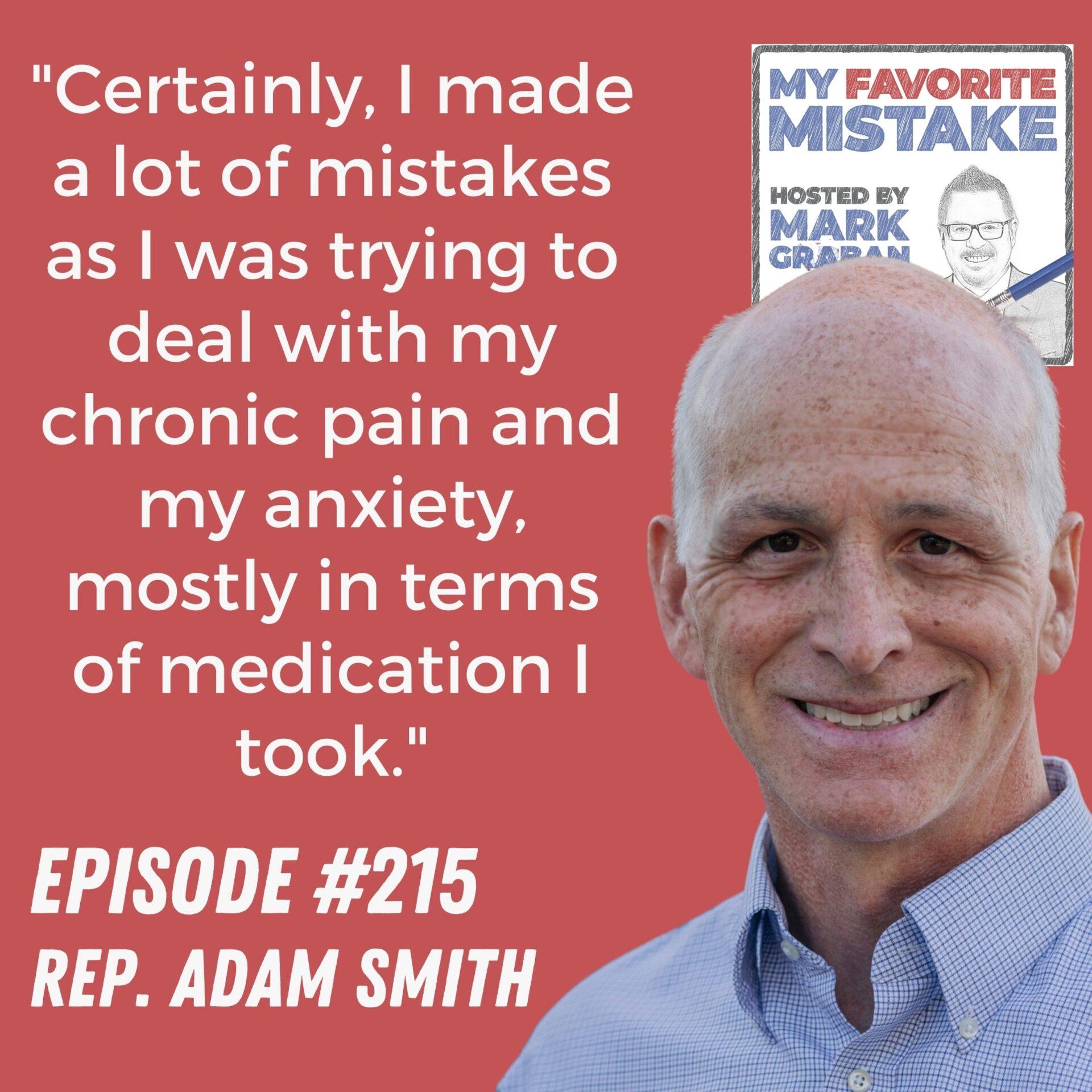
Rep. Adam Smith: Oh, no, there never was a primary because… and this is why it's My Favorite Mistake, that the plan absolutely blew up in my face. And the reason for it was I just didn't know what I was getting into. Literally didn't know what I was getting into. But the thing I like about that is I think in life that's frequently the case. And what I really learned—I believe passionately in thinking about things. But I also have come to learn about the “paralysis by analysis” problem. You're never going to know for a hundred percent certain. If it's something meaningful, if it's something you really want to accomplish in life, if you're waiting around for that moment that someone says, “You're guaranteed it's gonna happen,” it ain't gonna come.
Rep. Adam Smith: All right. So you have to take calculated, educated risks. Now in the future, I tried to calculate them a little bit better and educate them a little bit more. But then the second thing about this that I really learned is… it's an overstatement to say it this way, but what I learned was there's always a way to win. Just gotta keep trying. And I found a way to win that was totally different. My entire plan was gone. I found a different way to do it. I outline this in the book actually, because I'm talking about problem-solving. And one of the challenges with healthcare these days is if you have something wrong with you, either mentally or physically, how do you get the correct diagnosis and how do you get the correct treatment?
Rep. Adam Smith: Our healthcare system isn't as helpful in that regard as you would think, stepping into it. So if you're gonna solve the problem, you gotta think, you gotta be creative, and you have to take responsibility for finding those solutions. And I sort of dovetail those two things together, cause that's what I did back in June of 1990 when I found another way to win.
Mark Graban: So I definitely want to come back to the questions around what you went through with your health and advice or recommendation for others. So from that first campaign when you lost, did that at least create some name recognition or something that set yourself up for…
Rep. Adam Smith: What's funny about this is you're missing the point. I didn't lose. I won.
Mark Graban: That is my… I'm so sorry.
Rep. Adam Smith: I just didn't win the way that I thought I was gonna. No, and I can understand. Look, there was a poll up in June of 1990 and I was behind 61 to 12. Okay. But I found another way and worked my way through a very difficult problem by simply refusing to give up and also being mindful of the fact there are a lot of different paths out there. You just gotta find the one that works for you.
Mark Graban: Well, so I'm probably turned red and or as purple as your shirt in embarrassment from… thank you for clarifying and correcting my mistake. I'm not one to go and edit these things out. I think it's helpful.
Rep. Adam Smith: No, that's fine.
Mark Graban: Not trying to prove a point about making mistakes, but I appreciate in your book how readily you have admitted mistakes along the way. What's your view on why that's helpful to do so? And is it more difficult for you being a politician or a leader to admit mistakes?
Rep. Adam Smith: Well, I think in some ways it can be. But again, that initial occurrence in my life when I was trying to win that seat and I had figured out sort of… it really taught me about how do you succeed? You do not succeed by ignoring reality. And that was another big thing that came to me in my mental health challenge in particular. The number one most important thing in dealing with your mental health is you have to be honest with yourself about what you're afraid of, what you want, what you're happy about, what you're unhappy about. There are all kinds of incentives in our lives to kid ourselves about that stuff. And similarly in politics, you know, you wanna believe your own press clippings.
Rep. Adam Smith: But I knew at that moment, 1990, I had to strip this bare and go, “What's going on here?” All right. If I hold some fanciful notion that everything's fine, I ain't going to get there. So, yeah, I think being willing to admit it… and it's one of the things I'm really afraid of about the modern world here is we seem to be going in the opposite direction. Like, people just think, “Never admit you were wrong. Never admit it cause it makes you look weak.” I don't know, I think it gets you to the truth, and a bedrock belief of mine is the truth shall set you free if you can honestly assess it and understand it. So in politics, I think the tendency is to be less like that because, you know, I'm a politician.
Rep. Adam Smith: Back in 1985 I said it, I was right. It's like I'm really more interested in being right now in this situation and honestly evaluating it. But yes, I think there's a lot of pressure in society to never show that weakness. And I really think that's something we need to reverse.
Mark Graban: Yeah, yeah. I agree. I think it shows strength to admit making a mistake, being wrong, learning, adjusting, moving forward. So back to your campaign and… you had painted a picture that was pretty bleak, the outlook for that initial campaign for State Senate. I think I made the mistake of making an assumption or jumping to a conclusion in my head of, “Oh, you lost.” So back to the story of what really happened. Did you realize that you needed the course correction and that new path? Or did someone else give you a wake-up call?
Rep. Adam Smith: Well, I realized that I needed the course correction because the people who were supposed to give me money didn't give me money. Fair enough. I didn't have the money. But ultimately, I had hired this intern from the University of Washington and he was my only employee. I had a lot of friends helping me out. I'd grown up in the community that I was running in and I had been working on democratic campaigns in my teens and while I was in college and law school. So I had some low-level connections. But I met with this guy who I just hired to be my campaign manager… as a matter of fact, he interned for a quarter. And I was basically like, “We're screwed.”
Rep. Adam Smith: And he said to me something I'll never forget, he said, “Ah, we'll find another way to win.” And my thought was, “You're an idiot.” Okay, let me tell you what's going on here. You don't know what you're doing, all right. You haven't worked on the campaigns like I have. We have no money. What are you talking about, ‘We'll find another way to win'? But among other things, he convinced me to borrow $2,500 against my credit card to fund the campaign while we tried to figure out what we were gonna do. And keep in mind I was like really poor at that point in my life. And the idea of borrowing that much money against my credit card also seemed insane. But he really sort of inspired me to not give up. And then long story short, we basically figured out you can reach voters—or you could back then anyway—in a more affordable way.
Rep. Adam Smith: I went door to door and we did targeted mail. We really figured out how to target our message to the group of people that we needed the most. And we worked relentlessly for four months and turned it around.
Mark Graban: Yeah. And what was the margin of victory then, as that turned out?
Rep. Adam Smith: Well, the key part of this, which is a little complicated, is we had a primary. There was only the two of us in the race, me and this other Republican, but Washington state is weird. It was back then we had the jungle primary. So even though there were only the two of us, we had a primary election which amounted to a beauty contest of a very small number of voters, like 12,000 people, 20% turnout. So we targeted those voters, got an artificially high percentage in the primary, which belatedly convinced those people that, “Huh, what do you know about that? He could win.” So there were only seven weeks between the primary and the general, and they gave me a bunch of money. And we won 51.7%. It was the election of my life that I vividly remembered the exact number at the end of it, and won by like 850 votes.
Mark Graban: So in the book, you note it's one thing to admit mistakes. In the book, you write about the need to learn how to not beat yourself up over mistakes and kind of ending a cycle of, as you described it, anger and self-loathing. Was that something you were able to work through on your own? Or was that mental health professionals who helped you on that journey?
Rep. Adam Smith: Mental health professionals without question. I think that was the challenge. Cuz keep in mind as I'm telling the story about my orientation, my orientation is to see mistakes and work feverishly to correct them. But I was a little obsessive about that, and I was a little obsessive about not wanting to make those mistakes and if I made them, to try and correct them. And what the mental health professional really taught me was that there's a way to do that that is healthy and helpful, but if you have insecurities, you will do it in a way that isn't helpful. And really that's what they told me. I'll just say what the guy said to me, the psychologist, when I sat down with him. He read my questionnaire that I filled out for him and said, “You don't think you have a right to exist.”
Rep. Adam Smith: And I really didn't know what he meant by that. But really what he means by that is, as humans, we all need to develop what they refer to as a healthy narcissism. Understand there's a very unhealthy narcissism out there as well. But a healthy narcissism is you understand that you are worthy as a human being or as he put it, you are worthy of love just because of who you are, period. Me, I felt like I had to prove it every second of every day. I never got sort of that basic security as a child that I'm like, you know, people just aren't going to love me or want to be around me unless I'm getting the job done. So I put this enormous amount of pressure on myself to get things right.
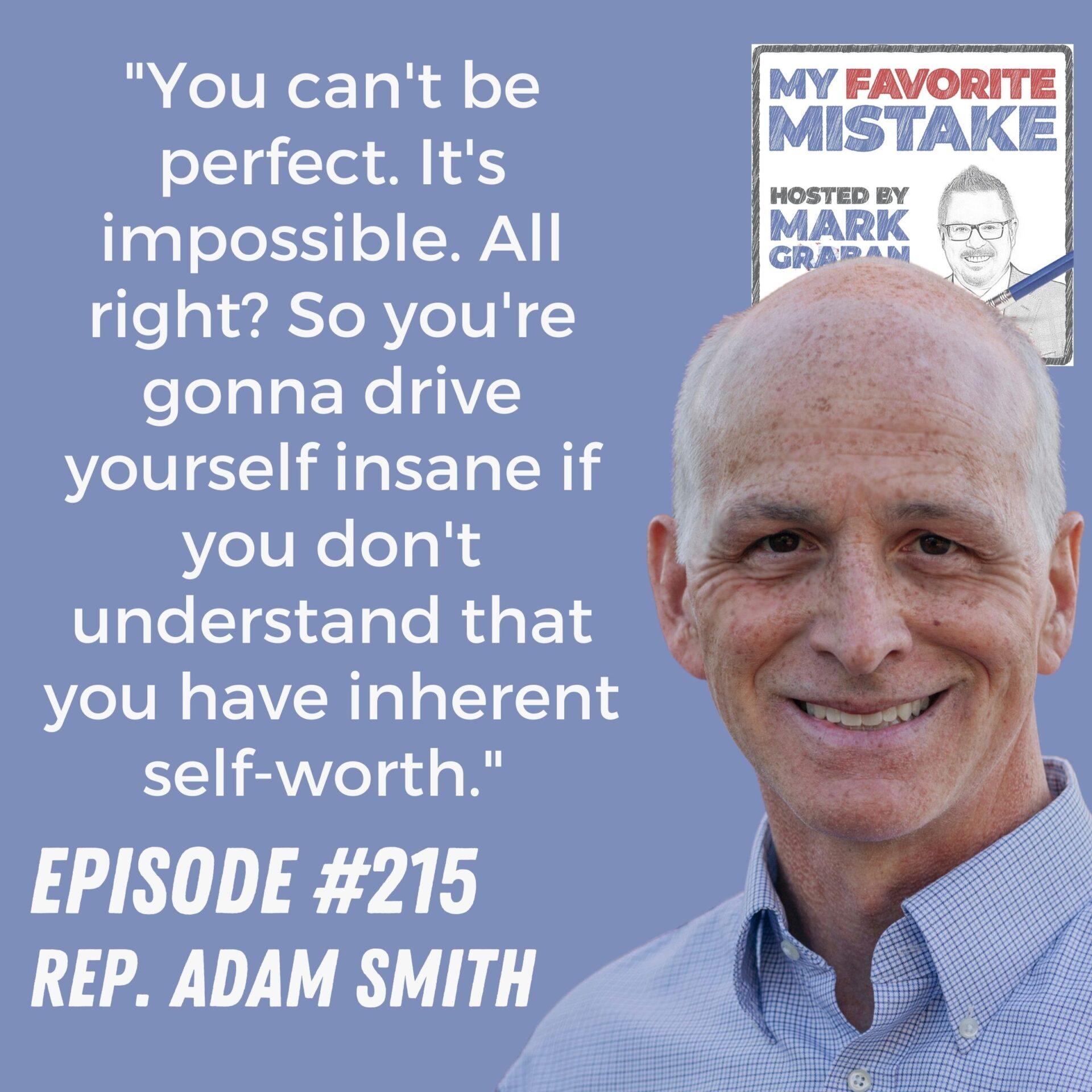
Rep. Adam Smith: And if I didn't get it right, it crushed me and I was obsessed with fixing it. And then I was of course also obsessed with not making the mistake in the first place. And there's a positive side to that. I mean, it motivates you, it makes you think, it makes you work, but you also… you can't be perfect. It's impossible. All right? So you're gonna drive yourself insane if you don't understand that you have that inherent self-worth. And yes, it matters if you make a mistake if you wanna try. But it's not an existential threat. It's not this, “I'm no longer worthy as a human being because I messed up.” And that's what my psychologist—and I went through a dozen of them…
Rep. Adam Smith: It was hard to find what actually was helpful. But the one I finally found, and then we did like three and a half years worth of psychotherapy because I refused to accept what he was saying to me. In my mind it was like, “Wait a second, you're saying it doesn't matter what I do?” Which isn't exactly what he was saying. So we had this long-running argument where I tried to prove to him, “Well here's all the stuff I've done wrong. How am I not responsible for that?” So it's not that you're not responsible for that, it's that it doesn't take away your self-worth. And it took me a long time to understand and accept that.
Mark Graban: Yeah. So I think a lot of people still struggle with the idea of reaching out for mental health support. They may view that as a sign of weakness instead of viewing it as being based in strength to admit the need or the possible need to get help. What advice do you have for others on how people know if they should seek help for mental health concerns? Or is even questioning that reason enough to ask for help?
Rep. Adam Smith: Well, that's one of the things I wrestled with. I mean, literally, I never even considered the possibility that I had a mental health problem. So I think the first piece of advice I would give, I think everybody… you don't necessarily need to seek help, but read the basics of what mental health is. Read about the need for a healthy narcissism. Read about the need to be honest with yourself about your fears and what you like and don't like. What's going well, what's not going well. Get a baseline understanding of what it means to be mentally healthy. And I think you need to work on it in the same way that you work on your physical health. You don't necessarily need to go like I did to 12 different therapists and spend three and a half years in psychotherapy.
Rep. Adam Smith: But I think it is important, just like it's important to understand how what you eat affects your health, how exercise affects your health, to understand how you mentally look at the world affects your mental health. Cuz that's the other piece. Once you get past the sense of self-worth, it's cognitive behavioral therapy—understanding that you will feel emotions that are very real, that you don't have to chase after. If a situation happens, and there's an initial feeling of insecurity or anger, that's not necessarily right. You can control how you mentally react to the circumstances around you, but you have to work at it. Depending on who you are, there's a very natural reaction to feel anxious or depressed or angry or whatever out of proportion to what actually is happening.
Rep. Adam Smith: So I think everyone should read the basics of that and have an understanding of that. Now, whether or not you need treatment is a tough call. In my case, I mean, my anxiety wouldn't go away. I mean, I felt a feeling of existential threat 24/7. Obviously, there was something deeply wrong there. But I think it is helpful just like if you twist your knee, do you go to the doctor? Maybe not for the first couple of days, but then you do. I think with mental health it is okay to seek treatment even before you are a hundred percent convinced that you've got a big problem.
Mark Graban: Yeah. And if you twisted your knee and were coming into the halls of Congress on crutches, people would not be judgmental about that. They might say, “Oh, I wonder if you're clumsy,” but that's not really that big of a judgment. But with mental health, people are still fairly judgmental. I was gonna ask you about the perceived need for a politician to keep mental health problems quiet. Thinking back to a year before I was born, vice presidential nominee Thomas Eagleton was replaced after it was discovered he had passed bouts of depression. Current times Senator John Fetterman had not just his stroke, but admission and treatment for depression.
Mark Graban: Within this past year, do you think the public is becoming more accepting or is there still political risk that some people like you and Senator Fetterman are willing to take on?
Rep. Adam Smith: I'd say both. I think in the last three or four years, there's been a significant change. When my problems first hit me in 2005 and then came back in 2013, without a shadow of a doubt, I felt I had to make sure people didn't know about it except for the people very, very close to me. And I spent a lot of time trying to cover for that because I felt there was a strong stigma against mental illness. And I felt that people would think, “We can't have our member of Congress who's lost his mind basically.” Now in the last three or four years, there's been a really positive public effort to talk more about it and to reduce that stigma. But the stigma is still very much there cuz most people, they just don't understand it.
Rep. Adam Smith: They don't know what does it mean that you have anxiety or depression? And it is treatable. It's absolutely treatable. And all of us, whether it's mentally or physically, rarely are you gonna find someone who's a hundred percent all the time. Okay. We all have our ups and downs, but mental health has had that stigma that it is somehow like it's this line you cross over. If you have a mental health problem, now you're officially a “crazy person” who we have to be afraid of. When it's no, it's part of the overall health of all of us as human beings.
Mark Graban: And hopefully society does come around to realize that suffering from a mental health condition is not the person's fault, that there are causes. And as you described, there are treatments. One thing that you touch on or you get into in the book… you said, or at least implied, that doctors failed to get to the root cause of the problems, that they were quick to jump to pills as a solution. Can you tell us about some of that part of the journey?
Rep. Adam Smith: Sure. Pills and surgeries. And look, there are all kinds of factors that combine to make this happen. Our healthcare system pays for quantity, not for quality. If you see a healthcare provider for two minutes or two hours, most times they get paid the same. So the effort to sort of dive in and actually figure out what's going on… within our healthcare system, the incentive is to make a quick decision, do something. And also as a patient, you want the quick fix. You know, I think we all feel like, “Let's go get on with our life and if there's something physically or mentally wrong with us, let's fix it so we can get back to what we're doing.” There are all kinds of incentives that push you to make quick decisions.
Rep. Adam Smith: And right now, one of the quickest decisions is “take this pill and you'll be better.” And you know, of course, the pharmaceutical industry does a very aggressive job of pushing that message to the point where I… and let me be a hundred percent clear here. If I can go back a decade or so here, I'm not gonna go all Tom Cruise on you. Okay? There are people who no doubt need medication. I don't doubt that. I am also 100% convinced that we way, crazy over-prescribe them. We are too quick to go to antidepressants, too quick to go to pain medication. And something that isn't talked about a lot is too quick to go to anti-anxiety medication.
Rep. Adam Smith: You know, benzodiazepines are incredibly helpful at reducing your anxiety in the short term, but they really block your ability to ultimately get better and can have you build tolerance. I'm talking about Clonazepam, Xanax, that kind of thing. I was on and off that for gosh, six years. I think we go for the quick fix and medication is one of those quick fixes. I think antidepressants are prescribed to people all the time that aren't necessarily getting at the root cause. And it's undermining one central message that I believe in—and I realize politically I can get in trouble with this message—but you can get better.
Rep. Adam Smith: You can make choices and make decisions that will put you in a position to get to a better place. Too quickly people wanna say, “Oh my body, this is just the way it is. There's nothing I can do about it.” And the pill tries to fix it and that's all I can do. You can actually both mentally and physically do things to make yourself better. Now, to be a hundred percent clear, there are some people whose problems are much more severe. I'm not saying it's easy, I'm not saying absolutely everybody is in that case, but I think we are really quick to sort of absolve ourselves of responsibility for taking steps to fix the problem when there are solutions out there that can help at least help make you better. Perfect? Probably not, but better. Certainly.
Mark Graban: Well, in that line of “you can get better,” your story as you lay out in the book was a long journey. You've told us some of it here today of going through many, many providers trying to find a good fit, trying to find different treatments. What gave you strength to keep fighting through that challenge? Let's say… I don't know if you ever thought of sort of saying, “Well, was the life in Congress a stressor that you didn't need anymore?” that helped or…
Rep. Adam Smith: It was several steps. First of all, just for your listeners, I went to well over a hundred different providers over the course of this journey. A lot of those were physical therapists. And so a lot of this was on the chronic pain side. It was probably about a dozen therapists desperately searching for the solution going forward. But I think the main thing that kept me going was… one of my strengths is I just refuse to give up, keeping trying to find an answer until it finally comes up. I think that helped me enormously. I just had a belief that there had to be a better way to deal with this, but that can be hard. Initially I felt like, “Okay, I got a mental health problem, I got a physical health problem, there's people that know how to deal with these, let's go find these people.”
Rep. Adam Smith: But it turned out it was a lot more complicated than that. The help doesn't always come. Not everybody's good at their job. Okay? That's just the way it goes. Like Seinfeld used to have a bit where every time someone recommends a doctor, they say, “Oh, he's the best.” He's like, “Statistically speaking, somebody had to graduate from the bottom of the class. Right?” They gotta be out there somewhere. And more than that, it's just a matter of having a problem-solving mentality. And I think the medical profession, they don't communicate as well. I mean, they got a lot of stuff to learn, don't get me wrong. I mean, all the science, everything, they gotta figure out… but they have to also learn how to communicate with other people and with patients.
Rep. Adam Smith: That's the part that tends to fall off by the wayside. And you don't have those conversations that can get you to that. And yeah, you know, I did during the course of this… well, early on in 2005 when I had my anxiety blow up, I assumed it was cuz my life was too complicated. I used to constantly think back then, “Can I make my life work?” I got two small kids living in Tacoma, Washington, and I'm flying back and forth to DC. I'm up for reelection every two years, all that stuff. And when I snapped, my conclusion was, “My life doesn't work.” honestly, after the 2006 election, I thought I was gonna walk away, but then I got better.
Rep. Adam Smith: But in the end of the day, it wasn't about my life. In fact, one very true thing that somebody said to me early on in this process was, “It's not the amount of stress in your life, it's how you process it.” Now, at the time she said that, I thought that was crazy. And to some extent, the amount of stress absolutely makes it more difficult. But if you don't know how to process stress, you're gonna struggle no matter what circumstances you are in. And that's really the more important part. Now certainly there are horrific things that can happen to us that can put enormous stress on us, but learning how to process it is incredibly important.
Mark Graban: So I wanna ask about the book again. It's titled Lost and Broken and your decision to write the book and share the story in that way. Was there a decision point between trying to put that behind you versus the idea… did writing the book help you process what you had gone through in addition to wanting to help others?
Rep. Adam Smith: Yeah. Well, I'm a very analytical person and as I'm finally coming out of this… so, 2013 is when the anxiety hit, 2014 the chronic pain hit. I went through all those different people. 2016, as I chronicle in the book, was kind of rock bottom after my third hip surgery, second total replacement, and the recovery just wasn't happening. Then by 2019, after I found the psychologist, found the muscle activation therapist who finally helped me, and I was starting to get better as we headed into 2020, my initial thought was I wanted what the military refers to as an “after-action report.” I wanna be okay, right? While it's fresh in my mind, what really happened? How can I learn from this? But then as I started to write it, I thought about the fact that—anxiety, depression, chronic pain—tens of millions of people in this country go through some combination of those three things.
Rep. Adam Smith: And I felt I could contribute to the conversation about how to help people deal with that. And there's so many of them. So that's what convinced me to write it and then to try to get it published.
Mark Graban: Well thank you Congressman for sharing your story through the book and through interviews you're doing, including here. Again, going through the book, many references to mistakes. I appreciate your openness about that. Not just some of the challenges that you went through and mistakes you described in your care. I wanna ask one other question tying it back to campaign mistakes. You talked about a reelection campaign in 1994. You said you made mistakes, you learned from them. What was that mistake and did that provide additional learning?
Mark Graban: You've been reelected 22 times, so you got things figured out, but were there some other early mistakes that were learning opportunities?
Rep. Adam Smith: Oh, certainly. Briefly on that, the thing about 1994 was… so 1990, I had that race. 25 years old, I get elected in the State Senate. I mean, it just was fantastic. And my life turned around in so many ways. And then 1994 comes up and I'm up for reelection. And those of you who don't remember, '94 was not a good year to be a Democrat. It was a brutal reelection campaign. And I had not been the hunted before, if you will. I say to this day, from a mental perspective, you're better off being the challenger than you are being the challenged. If it's a… I know incumbents usually win, but mentally I've got something that they're trying to take away.
Rep. Adam Smith: And man, I was not prepared for the mental challenge of that. I thought, “Hey, I won the tough one. It's gonna be all good from now on, right?” Oh no. And I was very angry about that. And I lashed out in ways that were not helpful. Now, as always, I never stopped working. I doorbelled, I worked and everything, but… I don't think I chronicle it in this book, but the guy who was running against me, Mickey Reston—he passed away a long while ago, so I don't wanna be overly critical—not the sharpest tool in the shed, let's just put it that way. He was very aggressive and everything. I actually lost a couple of debates to him because I was angry, distracted, and also thought this guy… “Are you kidding me?”
Rep. Adam Smith: And it really taught me that no, running angry is not what people are looking for. Not that type of anger, number one. And number two, you gotta think through this stuff. What's obvious to you is not necessarily obvious to the people you're trying to convince. So chill, don't be so negative about it. If you are that angry about it, you shouldn't be doing it. Okay? And I could tell you stories, you would not believe some of the things I said and did during the course of that campaign, but once it was over and I managed to survive, I was like, “Yeah, wow, that was a big… that's what it's like to run as an incumbent in a brutal race.”
Rep. Adam Smith: And that was a valuable lesson for my campaigns going forward.
Mark Graban: So that did get easier, that feeling of being hunted every two years?
Rep. Adam Smith: Yeah. Well, I don't know if it got easier. The next time I really faced a race like that was 2010, another terrible year to be a Democrat. And I was nervous, but I processed it better. I adopted the idea that I was going to be the “Happy Warrior,” you know? Yep, it's a fight, but I'm in it, I'm loving it and I'm gonna do just fine. That was more of a public face than an internal reality. But it did help me get through 2010, I think, mentally in a better place, certainly than '94.
Mark Graban: Well, Congressman, thank you so much for being a guest here. We've been joined again by Congressman Adam Smith from the 9th District of the State of Washington. His book, again available now—I'll put links to this in the show notes—is titled Lost and Broken: My Journey Back from Chronic Pain and Crippling Anxiety. So thank you for everything you've shared. I hope people will check out the book. Thank you again for writing it.
Rep. Adam Smith: Thank you very much. I really enjoyed the conversation. Appreciate it.
Mark Graban: Well, thanks again to Congressman Adam Smith for being here today. It was a real honor to have him here on the podcast and to share and talk about such important issues. To learn more about his book Lost and Broken, look for a link in the show notes, or you can go to markgraban.com/mistake215. As always, I want to thank you for listening. I hope this podcast inspires you to reflect on your own mistakes, how you can learn from them or turn them into a positive. I've had listeners tell me they started being more open and honest about mistakes in their work, and they're trying to create a workplace culture where it's safe to speak up about problems, because that leads to more improvement and better business results.
Mark Graban: If you have feedback or a story to share, you can email me at MyFavoriteMistakepodcast@gmail.com. And again, our website is MyFavoriteMistakepodcast.com.
This episode explores campaign mistakes alongside lessons from chronic pain and anxiety in leadership. Rep. Adam Smith shares insights on mental health, resilience, and learning from mistakes with honesty and clarity.