

Dr. Melisa Buie spent years trying to avoid failure — until she realized the bigger mistake was disappearing after a win and treating rest as the finish line instead of part of the cycle. The author of Faceplant: FREE Yourself from Failure's Funk shares how leaders can process mistakes without getting stuck, why “fail fast” falls flat, and how a pre-mortem can prevent the next faceplant.
Listen:
Check out all episodes on the My Favorite Mistake main page.
My guest for Episode #349 of the My Favorite Mistake podcast is Dr. Melisa Buie, an operational excellence leader with deep experience at semiconductor and photonics companies including Lam Research, Coherent, and Applied Materials. She has a PhD in Nuclear Engineering from the University of Michigan, taught graduate engineering courses at San Jose State University for nearly a decade, and is the author of Problem Solving for New Engineers and the co-authored Faceplant: FREE Yourself from Failure's Funk.
Melisa's favorite mistake is one she didn't recognize until ten years later. After publishing her first book while juggling a full-time job, teaching, and raising her son as a single parent, she was exhausted — so she did nothing to market or promote it. She told herself she had earned the rest. What she actually did, she now sees, was choose invisibility, not just for herself but for a message that could have helped a lot of new engineers. The lesson wasn't that rest is bad. It was that she had mis-timed it, treating rest as the finish line instead of part of the cycle.
In our conversation, we get into why platitudes like “fail fast” tend to fall flat, why pre-mortems can prevent faceplants that postmortems can't, and the four autopilot reactions Melisa calls the Conspirators — the machine, the magician, the statue, and the satellite. We also get into how separating the facts of a failure from the story we tell ourselves about it is often the difference between getting stuck and getting free, and what happens when organizations inadvertently create cultures where failure isn't safe.
Themes and Questions:
- What's your favorite mistake?
- Was not promoting your first book really a mistake, or just what had to happen?
- How do you think about the difference between rest and disappearing?
- Where do platitudes like “fail fast” and “fail forward” fall short?
- What's the right level of struggle for someone trying to learn something new?
- Can you walk us through the four Conspirators — the machine, the magician, the statue, and the satellite?
- What does it look like to separate the facts of a failure from the story we tell ourselves about it?
- How should leaders respond when a team member has just failed and the amygdala is firing?
- What's a pre-mortem, and why is it more useful than a postmortem?
- How do you respond to people who push back on pre-mortems as “being negative”?
- What happens to innovation in cultures where failure isn't safe?
- How are you thinking about AI as a partner in problem solving?
Scroll down to find:
- Video version of the episode
- How to subscribe
- Quotes
- Full transcript
Find Melisa on social media:
Watch the Episode:
Memorable Moments from the Conversation:
Click on an image for a larger view



Subscribe, Follow, Support, Rate, and Review!
Please follow, rate, and review via Apple Podcasts, Podchaser, or your favorite app—that helps others find this content, and you'll be sure to get future episodes as they are released.
Don't miss an episode! You can sign up to receive new episodes via email.
This podcast is part of the Lean Communicators network.

Other Ways to Subscribe or Follow — Apps & Email
Transcript
Intro
Mark Graban: Faceplants, failures, and mistakes — we all have them. Most of us spend a lot of energy trying to avoid them, hide them, or just push through the funk they leave behind. But what if there's actually a better way to process what went wrong? One that actually frees you up instead of keeping you stuck. That's what we're going to be talking about today.
I'm Mark Graban, your host here on My Favorite Mistake, and our guest today is Dr. Melisa Buie. She's an operational excellence leader with deep experience at a number of semiconductor technology companies, working at the intersection of engineering and continuous improvement. She has a PhD in nuclear engineering from the University of Michigan. She's taught graduate engineering courses at San Jose State University, and she's the author of two books. Her first is Problem Solving for New Engineers, and her latest book, which she co-authored, is Faceplant: Free Yourself From Failure's Funk. It's all about how we recover and move forward after things go wrong, so as you can imagine, it's a perfect fit for this show. Melisa, welcome to the podcast. How are you?
Melisa Buie: I'm well, Mark. Thank you for having me today.
Mark Graban: It's great to have you here. You were kind enough to share a draft of the book. I loved it and was happy to endorse it. I'm glad I didn't faceplant or trip over all the F's in the title.
Melisa Buie: There's a lot of alliteration, definitely.
Mark Graban: I love the alliteration, and I'm going to say it once more: Faceplant: Free Yourself From Failure's Funk. We talk about helping friends — I'm not nitpicking, but in a friendly way, it could have been “Faceplant: Free Friends From Failure's Funk.” But what you have is a perfectly fine title, of course. So we'll talk about the book. We'll dig into this great topic together. But first off, I don't know if I should ask you, what's your favorite faceplant? I'm going to ask you the usual question: what's your favorite mistake?
A Favorite Faceplant: Choosing Invisibility
Melisa Buie: Well, I'm going to say it's a faceplant, because I think it's a big one. My current favorite faceplant is one that I didn't even realize was a mistake until like 10 years later, which is now. I published my first book while juggling a full-time job, teaching multiple classes at San Jose State, and raising my son as a single parent. By the time the book came out, I was completely and totally exhausted, and I did absolutely nothing. I didn't do marketing. I didn't do promotion. I basically walked away.
At the time, I told myself I'd earned the rest. I realized I was tired, so I stopped. But what I really did was choose invisibility — not just for me, but more importantly, for the message in the book. My first book, Problem Solving for New Engineers, was a tool that would have been so helpful for new engineers, and essentially I let it go into obscurity, for the most part.
The realization about this and the impact of it didn't really hit me until I published my second book. I remember sitting down to start the marketing and thinking, “But I'm done. I can't do this again.” And then it clicked for me: publishing isn't the finish line, it's actually the starting point. This is where it all starts. I'd already made this mistake once before, so the lesson for me was: if I don't share this work, I'm not just holding myself back. I'm withholding something that could be valuable and could help so many other people. Now I think about visibility as part of the responsibility of creating something meaningful.
Rest as Part of the Cycle, Not the Finish Line
Mark Graban: Going back to your life as it stood at that time, would you say not doing more to promote the book was a mistake? Or was that just — you didn't have the energy. You were tired. Was that just how it had to be at that point? Maybe the mistake was not revisiting the book later when you had more energy. It sounds like a timeless message to come back to and share again.
Melisa Buie: I don't want to make it sound like rest is not important. Rest is essential. The mistake was mis-timing. I mis-timed the rest. I treated rest as the end of the process — I'm going to keep running, I'm going to keep going until the end — instead of having rest be a part of the cycle. What I needed was not to disappear, but to create rest in a sustainable way so that I could keep showing up after I recovered. The lesson wasn't “don't rest.” The lesson was “don't disappear.”
Mark Graban: Our bodies, our brains tell us when we need rest, and we can try to not listen for a while. Is that part of what I hear you saying? You're not using the word burnout — that's different than being tired. But is part of the lesson, easier said than done — you have a child, different things going on in life — to avoid the situation where you're so tired that you can't be visible?
Melisa Buie: Right. The thing is, I didn't have to try to do everything. That was one thing that was so overwhelming — “okay, I've got to do everything.” But the thing is, you can do a few things and just do them consistently, and that would make a huge difference. Even something as simple as showing up once or twice a week on LinkedIn to talk about ideas, to keep the book alive, share what's going on. But it was just too big in my head at the time, and so I disappeared.
Breaking Down a Big Problem Into Small Actions
Mark Graban: There's a lean management lesson that sounds familiar, perhaps to you and to many of the listeners who are into that same management approach. This way of thinking about being able to break down a problem — a big, huge problem like “I need to do more to market this book.” How do we break that down into subsets of the problem? How do we focus on the handful of high-impact countermeasures we can do? It's the same thing businesses face. The big, huge problem might be “our business is really struggling,” or “we're not growing revenue,” or “quality is really poor.” Those are also big, potentially overwhelming problems.
Melisa Buie: Right. They are. If we don't want to let those problems overwhelm us, then showing up consistently, taking small actions, is a really important way to make progress and to continually improve.
Mark Graban: Small steps done consistently is better than nothing. We still might see the gap between what we could be doing if we had infinite time and infinite energy, but none of us do.
Measuring Impact: The Metrics That Actually Matter
Mark Graban: I see you being very visible. The LinkedIn algorithm is correct in showing me when you post about the book and different stories. What are your reflections on how that's going? I'm not prying into exact sales numbers, but how would you evaluate the experiments and the countermeasures so far with this book?
Melisa Buie: I'm an engineer, so measurement and metrics are really important. I could look at things like likes or comments on my LinkedIn posts, or I could look at book sales from the retailers. But those are really indirect measures. They're not really things that tell us the impact our work is having on people. So when we look at whether something's impactful, what I look for are the reviews. I look for the comments that people write to me, or they pull me aside at a conference or a meeting and say, “You know what? This made such a huge difference for me.”
I was at a book signing recently, and somebody showed up the next day, called me, and said, “I was reading this last night and I remembered something that happened to me when I was six years old, and it has lived with me the rest of my life.” The incident was that the nun at her school had hung her picture upside down. Up to that point, she thought she was this great artist. The nun hung her picture upside down and didn't say anything, so she just took it to mean, “Oh, I'm not creative.” And she lived with that the rest of her life. This was a woman who was my age. These are things that we realize when people tell you these stories, or they write about them in reviews or in the comments on LinkedIn. These are the things that really make a difference. Or when people share and repost. Those are the important metrics for me.
Revisiting the First Book
Mark Graban: Do you have thoughts of going back and either relaunching or republishing the problem-solving book? It's what, 10 years old? It probably doesn't require too much of a refresh to put it back out there when you do have the energy and you can take lessons learned from the ongoing promotion of Faceplant back into that book.
Melisa Buie: One thing I've started doing is posting a lot more, as I'm doing now while I'm marketing this book, and also taking the opportunity to do some marketing and promotion for the first book, because it's still a really valuable tool for new engineers first getting into their early careers and learning how to solve problems in a way that's going to be consistent and reliable. Those are still really valuable techniques and tools from many years of doing problem solving in industry. So yes, I am taking the opportunity to do that. There's a possibility we may do a revamp on it. Still in the thought stage right now.
Mark Graban: And maybe part of the lesson learned is to find the right time for that. Don't take on so much to the point where you end up too tired.
AI as a Problem-Solving Partner, Not a Replacement
Mark Graban: Problem-solving methodologies are something you can learn, you can practice, you can get better at. That's pretty timeless. You might just need to add a chapter about, “Well, how do we use AI to help us with our problem solving?” My suggestion would be: don't try to outsource the problem solving to AI.
Melisa Buie: Make AI your partner. If we try to outsource anything to AI, we're going to be in trouble. We're going to lose our humanity, we're going to lose our creativity. But if AI is our partner, then it's less that we have to remember. We can use it like our best friend in the process. It can be a really valuable way to enhance the existing information that we have without turning everything over and letting it be the leader. We're still the leader. We just need a partner: “Hey, what happens with this 1980s piece of equipment when this –” “Oh, okay, yeah, I can help troubleshoot.”
Mark Graban: As a thinking partner, you might not have an experienced human continuous improvement coach to look over your shoulder and check your reasoning, check your logic at sketching out attempts at root cause analysis. You could ask AI, “Does this causal analysis seem to follow a logical flow?” It may or may not have a good answer, but hopefully it would help you think through it better.
I'm still barely scratching the surface of trying to experiment with this myself. What does that partnership look like?
Melisa Buie: I think this is a great time to experiment. Speaking of experiments — AI is constantly changing, so luckily there's a lot of opportunity for more experimentation. We can jump in and just start trying things. There are a lot of different AI products out there and a lot of different philosophies around it. Many opportunities to experiment and try things.
The Right Level of Struggle for Learning
Mark Graban: Let's bridge into the book. The title again is Faceplant: Free Yourself From Failure's Funk. It's fair to say anytime we do something new, we're experimenting or trying to be innovative — there's risk of a faceplant, right?
Melisa Buie: Definitely. Studies have shown that the more we struggle in learning something, the more it sticks.
Mark Graban: I'm going to say that's not true with differential equations. I don't know how I survived that class, but that did not stick.
Melisa Buie: Outside of differential equations.
Mark Graban: I think generally, generally, I would agree. You have a PhD in nuclear engineering — I'm guessing diffy Q was not a problem for you. Sorry to interrupt. Back to your real point that I hijacked.
Melisa Buie: As we learn a new skill, as we learn new things, the more we get our hands dirty and struggle to learn it, and then practice it — that's when we become really adept at it and we learn much more effectively.
Mark Graban: Is there an optimal level of struggle in your experience, where too much struggle, thinking back to language in your book, that might feel like failure's funk and someone gives up, as opposed to continuing through to the point of, “Okay, now the struggle was worth it”?
Melisa Buie: I'll talk about another one of my faceplants early in life. Trying to learn another language. If I had jumped into Russian 3 at the university, that would be a really silly thing to do, because there was no way I could avoid a faceplant in that case, especially if I'd never had Russian 1 or 2. So jumping in way at the deep end when you have no prior experience is setting yourself up for a really bad experience. But jumping in, trying small experiments, learning little bits at a time until you can get to the level where you're not — using the language we use in the book — you want to step outside your comfort zone. But you don't want to go so far that you're in your fear zone, and then it's impossible to learn, because that's when your amygdala's going to kick in and you're going to be in trouble.
Why “Fail Fast” Falls Flat
Mark Graban: For sure. We can't think or process things or do good problem solving when the amygdala takes over and we're in fight, flight, or freeze. It sounds like the lesson is: don't do everything you can to avoid failure. The book is more about processing and working through these failures, right?
Melisa Buie: The more we try to avoid failures, the less we're going to grow. So if we want to grow as human beings, we are going to need to embrace struggle. We're going to need to embrace mistakes and errors, because we're going to be constantly stepping outside of our comfort zone if we're trying to learn. We want to make sure that we're focused in that area of our life. We're not in our comfort zone. We're definitely not comfortable. But we're not too far out, and we're struggling just enough so that we're learning. In that case, we're still going to make mistakes. Michael Jordan — how many shots does he miss? He talks about failure. He's got like a 50% hit rate, probably.
Mark Graban: I'd be surprised if it was — I mean, it might be slightly under 50%.
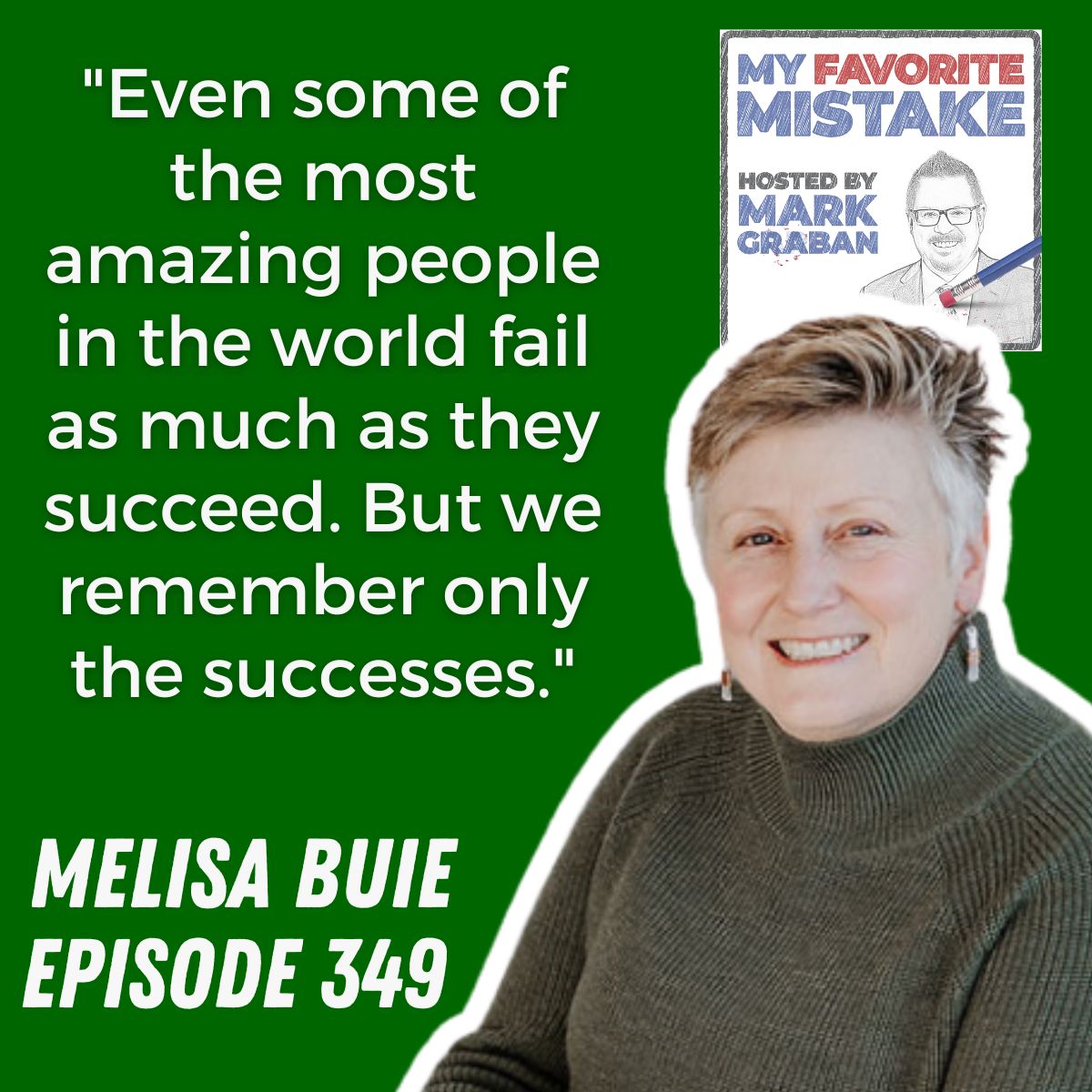
Melisa Buie: Even some of the most amazing athletes, amazing people in the world, they still fail as much as they succeed. But we remember only the successes.
Mark Graban: And he did not win a championship every year, if you want to look at that as an outcome. Part of our reaction to failure is a matter of expectations. Nowadays, Steph Curry and other top players in the NBA, they don't expect to hit every shot. Maybe part of being great is that — you take the shot because you think you can make it, but at some point they probably have to come to the recognition that nobody shoots a hundred percent. We can Google this — his career shooting percentage was 49.7%.
Melisa Buie: Yeah, just under 50%.
Mark Graban: We have certain areas of our life where we don't expect to hit every shot. If you look at growing up, we play on team sports and we know that we're going to win some and we're going to lose some.
Melisa Buie: We're not always going to be the state champions. Win some, lose some. But that same student who plays on the baseball team, who plays on the football team, who plays on the tennis team — every sport — and may expect to lose some games there, put them in the classroom and they bring home a B, and their parents ground them. Well, the message that's sending is failure is bad under these circumstances. We have expectations that we fail in certain areas, but we don't fail in other areas of our life. Or maybe the expectation is that we don't fail at all, ever. And we end up having a very, very small life when that's the case.
What we wanted to do with Faceplant is provide a structure, provide a way that, independent of the area of our life, we could find that freedom that exists to learn and grow.
When Workplaces Punish Failure
Mark Graban: I'm going to call out a mistake I made as soon as I said it. I was thinking, “Oh, faceplant, face palm.” I said Seth Curry, who is also an NBA player, the brother of the far more accomplished Steph Curry. So I will correct myself there for posterity. I would love to talk more about the inner struggle. A lot of times here on the podcast or in my work, we think about the organizational struggle or the organizational dynamics. I might be fine with a well-structured improvement experiment not panning out the way I thought, and I could say, “Well, we learned something and we're going to iterate, and we're going to move on.” You better hope your boss agrees with that mindset, though, right?
Melisa Buie: That's another place where we see that it's not safe to fail — in our workplace. Many times we inadvertently create cultures where failure is not okay, rather than creating cultures where curiosity and experimentation are the standard. If we've got a workplace like that, what we're doing is shutting people down, and we're going to limit innovation. We're going to limit creativity and curiosity, because people will move into protection mode and they are not going to take any chances. They're not going to risk getting called out, or a bad performance review, by taking a chance. If we essentially punish people for failing, that's what we're doing.
Mark Graban: People are going to not take any risks.
Melisa Buie: Right.
Why “Fail Fast” and “Fail Forward” Fall Flat
Mark Graban: Let's talk a little bit about organizational language before we come back to the inner struggle or things we can do in everyday life. I think we're aligned when you say there could be some issues with the common platitudes like “fail fast” or “fail forward.” Why do some of those motivational slogans fall flat?
Melisa Buie: Part of the reason they fall flat is because there's no substance to it. There's nothing behind it to back it up that acknowledges what's so for us when we fail. It doesn't matter where we fail, it doesn't feel good. Where is that acknowledged in “fail fast” or “fail forward”? There's no acknowledgement of that. If we don't acknowledge the whole human experience around failure, then that's where we start falling short and things start falling flat.
When we don't prioritize the importance of spending time really looking at and reflecting on what happened, and separating out the facts from our story about it — or what we tell ourselves about it — we collapse those very, very often. That's how it lives for us. That's how the failure lives.
For my situation, when I went through divorce, the message I told myself was, “The reason this happened is because I'm not lovable.” Well, no — separate it out. The truth is that our relationship didn't last. That's the truth. Yes, it failed. But it's important that we separate these things out and get really clear about the facts, and then get really clear what our story is, what our emotions are, because that's where all the hard stuff is. If we spend time in reflection, getting clear on all of that, we can then get to the other side, where we can be curious and really start exploring what else is out there. That's where the freedom is, on the other side of that reflection.
Giving People Time Before Problem Solving
Mark Graban: I've been in or around situations where a coworker made a mistake and they didn't face a punitive response from anyone in the organization. But to your point, people still feel bad. The inner struggle about processing the mistake or the failure that came from it can still be a real barrier. I remember once, trying to jump a little too quickly into root-cause-analysis mode, and the person I was working with thankfully said, basically, “Maybe later today.” They wanted a little time to just process. I don't want to get over — feeling bad about it, or at least let the amygdala calm down. We did that later in the day. I've been taught to do problem solving when the problem is fresh, but later that day was certainly timely enough where, if I hadn't been a little more attuned to the situation, I might have pressed on and pressed through, and he might have begrudgingly gone through the root cause analysis, but we might not have progressed as much as I think we did later on.
Melisa Buie: If our amygdala is triggered, we are in fight, flight, freeze, or fawn mode. When that happens, our prefrontal cortex is not engaged. It's not working at full capacity. So trying to troubleshoot or problem solve during that time is going to be really difficult, because you're not getting the full person. They're not fully available. Giving them time to reflect on what happened is a really valuable use of time. They can calm down and get to a place where they can start talking about it effectively and really engage in problem solving.
The Four Conspirators: Autopilot Reactions to Failure
Mark Graban: I think we have time to cover two other things. One is some of the inner reactions to failure — you call them the autopilot responses to failure: the machine, the magician, the statue, and the satellite. Can you walk through those briefly, and which one tends to show up most for you?
Melisa Buie: These nicknames or these personas that you've just described are essentially nicknames for fight, flight, freeze, or fawn. For me, my immediate go-to is to freeze. It's like, “Oh, I don't know what to do,” and my brain shuts down. I don't know what — I can't respond, I can't think. Which is really difficult when you're on stage or something.
Mark Graban: And that's the statue.
Melisa Buie: That shows up the most for me. We tried to make it a little more fun, so we took these four basic responses from the amygdala and gave them nicknames, and then talked about typical responses. One of the things that we do is we call the amygdala and these responses Conspirators, so they're out to get us. We're just trying to make it fun and lighten it up a little bit, because this is a really serious topic.
Mark Graban: It is. Part of the advice or the countermeasure — you can't say, “Okay, well I tend to freeze, so don't freeze.” That kind of pressure is not effective, right?
Melisa Buie: It really doesn't work. But what you can do is spend time going through this time of reflection, and then get to the other side. The more you practice this cycle — it's essentially like a PDCA cycle — the more you practice this cycle, spending time in reflection, getting curious, and then engaging in other action. Doing that over and over, what you do is you allow your amygdala to calm down. The more you train it — “Oh, I don't need to react so defensively every time I make a mistake here, because I'm not going to get fired. We're going to talk about it and we're going to figure out what happened in this particular case.”
The more we practice, the more we can get to that place of freedom on the other side, and the faster we can get at it. Now with every new situation, it's probably going to take some time to get through it. Once you have a realization, “Oh yeah, this one's different,” we just keep going forward. The more we bring that sense of curiosity and mindset of experimentation to the problem, then we bring a faster pace to it, because it's not so heavy. It's not so serious. Regularly now, I'm just like, “Oh, well, that was a faceplant. Okay,” and move on. Whereas before, I'd be like, “Oh, that's going to be so serious. What am I going to do?”
Mark Graban: I was just going to say, thankfully, you being on the podcast didn't create a statue response. Your prefrontal cortex is firing well, I think, here, Melisa.
Melisa Buie: Well, good.
The Pre-Mortem: A Proactive Tool
Mark Graban: Maybe one other thing to cover. A lot of organizations use what are often called postmortems, after an issue, after a project. Software development and other industries — sometimes people use terms like “after action review.” But you bring up this really interesting practice of a pre-mortem. Talk us through that concept, and why we're better off doing pre-mortems. And then let's talk about how we can use that as individuals.
Melisa Buie: I think the pre-mortem is a really, really valuable tool for us as individuals and for organizations. When you're starting a project, if you go into it looking at what could go wrong and what the risks are ahead of time, it's a really valuable tool. “Oh, well, hey, you know what? We can avoid that situation.” And then you just keep revisiting it. “Oh, well, what would have happened if we did this?” So you keep revisiting that tool along the way and adding to it.
One of the things that we do, we adapt for the individual is what we call an “expectation disconnect.” It's like, “Oh, I'm having Thanksgiving dinner with my in-laws next week. There's a lot of opportunities for faceplants there.” If I look at what my expectations are going into it and make sure that those are grounded in reality, I can then try to avoid as many faceplants as possible in that scenario. It's a really great tool for looking ahead to figure out what the potential risks are and what might go wrong, and then reining in or making plans for how you might behave in a different way and ground your expectations so that you don't have an expectation that it's going to be a love fest.
Mark Graban: Don't have unrealistic expectations.
Melisa Buie: Exactly.
FMEA, Pre-Mortems, and the “Being Negative” Pushback
Mark Graban: I love that idea of being proactive. In engineering and continuous improvement speak, this is an acronym that could only be developed by engineers or statisticians: FMEA, failure mode effects analysis. That is a very engineering thing to do, of thinking through literally what could go wrong with this product, what could go wrong with this process? How likely is it? I write a little introduction to this concept in practice in my book, The Mistakes That Make Us. How likely is it? What's the severity if it happens? And what's the detectability of the problem?
You might think about the odds that I steer the conversation into an uncomfortable or bad direction that leads to a Thanksgiving dinner argument. The risk is non-zero, but the severity, depending on the people involved — I'm just using a general scenario here — the severity could be high. The detectability might be: “Oh, well, if you start to go there, somebody elbows you or kicks you under the table, or you catch yourself, like, ‘Okay, no, no, no, no, no. Let's go back to talking about football.'”
Melisa Buie: Or, in my house, that would be the topic that gets everybody in trouble. So we'll avoid football.
Mark Graban: Sure. It's very individual and situational. Maybe it's just so ingrained — I've had some people push back on this FMEA or the concept of a pre-mortem: “Well, that's being negative. Don't plan for problems. Don't plan for failure.” If we want to pretend like everything's going to go perfectly, my engineer brain says the problems, the failures, the faceplants are going to be worse. But there are some people that have that mindset. I've run across it. Have you?
Melisa Buie: Yeah, definitely. One of the things I've encountered, particularly with FMEAs and trying to lead those development sessions, is that people get so hung up on the terminology. “Oh, what's a mode? What's an effect?” The thing is, it really doesn't matter. Keep the end goal in mind. What are we trying to accomplish here? Just throw spaghetti on the wall. We'll figure out all that stuff later. Let's not get bogged down in what's a mode and what's an effect. Let's look at: how can this thing fail? What can happen? Let's get it out there. Then we can go back and look at which fits in which column.
In terms of measuring those things, that's a really tricky thing too. “Oh, what's a seven and what's an eight?” It's a judgment. Go to a one and a two. Go to a 1, 2, 3. Make it so that it's really simple when you're getting started, so that if you're arguing about things, you're missing the whole point of the exercise.
Mark Graban: It's about being proactive and thinking things through and thinking about the actions that we can take to prevent a faceplant.
Melisa Buie: Right.
Closing: Faceplants Will Happen — Reflect, Learn, Grow
Mark Graban: I think about language. Postmortem is an interesting phrase, because I think it means after death, right? Wait — to do a postmortem on a project doesn't mean the project is dead. Maybe the project is over. After-action review has different roots. You can call it a pre-action review or a before-action review. People love creating acronyms for these things. We're on the same page. The more important thing is to try to be proactive, prevent faceplants, but learn how to be — I don't know if “resilient” is the right word, but prevent faceplants while recognizing mistakes, failures, faceplants still happen.
Melisa Buie: They do.
Mark Graban: The way we react is key. I'll give you the last word on that.
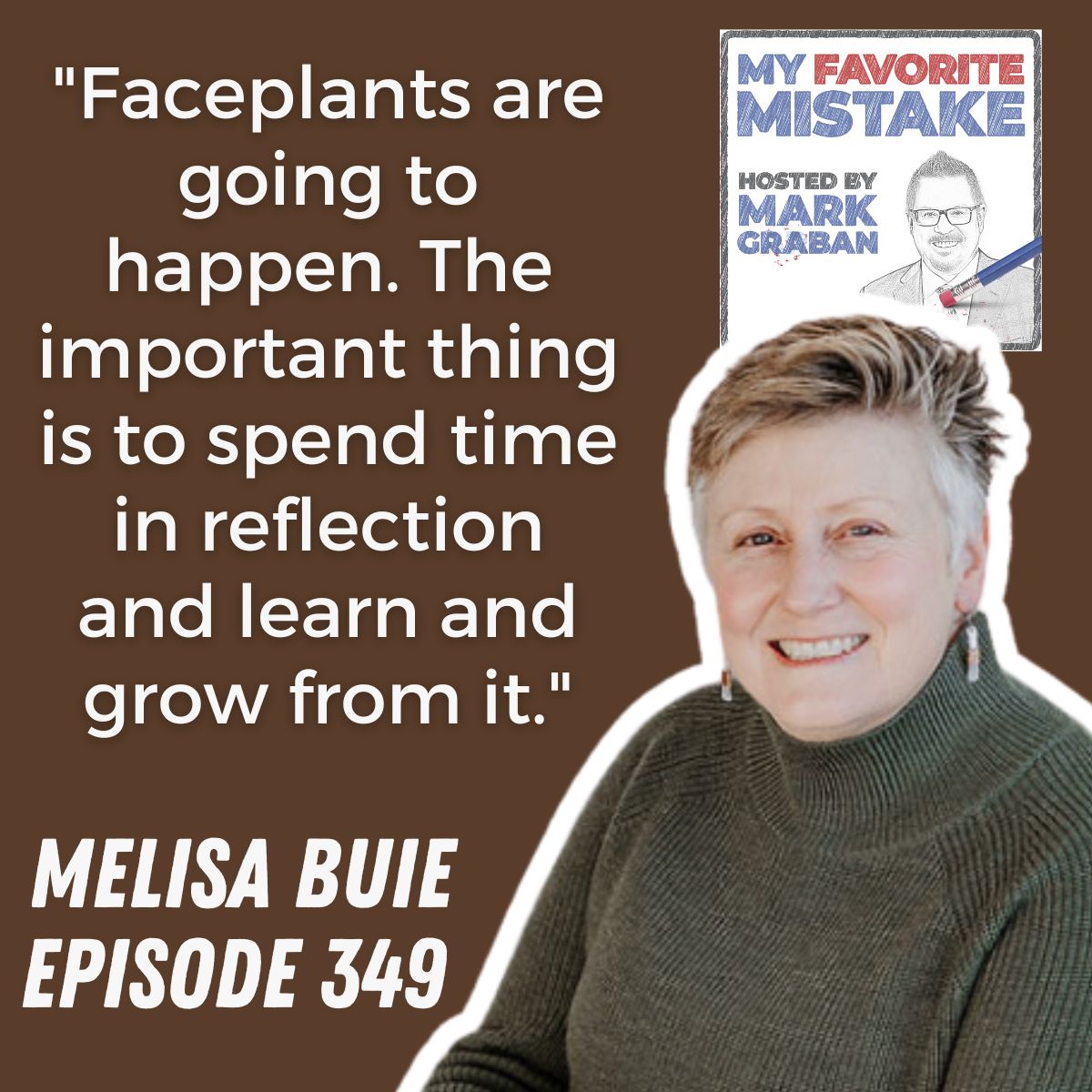
Melisa Buie: It's really important to just remember: faceplants are going to happen. Failures, mistakes, errors. The important thing is to spend time in reflection and learn and grow from it. And then you're all good.
Mark Graban: Well, Melisa, thank you so much for being a guest here today.
Melisa Buie: Thank you.
Mark Graban: Dr. Melisa Buie has been our guest today. The first book — if you have a new engineer in your life or about to be a new engineer graduating this year, check out Problem Solving for New Engineers. And then the latest book, again, is Faceplant: Free Yourself From Failure's Funk. So Melisa, this has been great. Thanks for being here.
Melisa Buie: Thank you for having me, Mark.
Mark Graban: Not a faceplant on your part. Not at all.