
To save a few thousand dollars in legal fees, six-time Silicon Valley CEO Mike Grossman acted as his own lawyer on a routine contract — and nearly torpedoed the acquisition that would later save his company. He shares how a single ambiguous sentence almost cost millions, and what it taught him about knowing the limits of his own expertise.
Listen:
Check out all episodes on the My Favorite Mistake main page.
My guest for Episode #355 of the My Favorite Mistake podcast is Mike Grossman, a six-time Silicon Valley CEO who spent nearly three decades leading early-stage, venture-backed technology companies. Before becoming a serial entrepreneur, he worked at McKinsey, Johnson & Johnson, and Intuit. His new book, Failure Is an Option: Reflections of a Silicon Valley CEO, collects 44 essays on what running a startup actually looks like when the cameras are off.
Mike's favorite mistake was deciding to act as his own lawyer. To save a few thousand dollars in legal fees, he personally handled a distribution contract with Experian and thought nothing of it. Years later, when Dun & Bradstreet moved to acquire his company, he reread that contract and realized a single ambiguous sentence could be interpreted to block any sale without Experian's explicit permission. His board told him not to worry. His mentor, Bill Campbell — the “trillion-dollar coach” — told him the board was wrong and that he had to get Experian to release him from the clause. He did, the deal survived, and the lesson stuck: he never served as his own lawyer again.
From there the conversation goes well beyond contracts. Mike makes the case that the most common layoff mistake is cutting too little rather than too much, and explains why staged cuts become a “death by a thousand cuts” that erodes a leader's credibility. He argues that Silicon Valley oversells itself as a meritocracy when luck and timing often matter more, and that overstating a company's mission turns into performative noise. He's also candid about the behaviors that make bad news safe to share — reacting calmly, refusing to hunt for a scapegoat, and staying transparent about finances, losses, and the deals you don't win.
It's a thoughtful look at the gap between how startup success gets narrated and how it actually feels, and a reminder that humility and openness aren't soft skills — they're how leaders build the trust they need when things get hard.
Themes and Questions:
- Why acting as your own lawyer to save a few thousand dollars can put millions at risk, and how one ambiguous sentence nearly killed a company-saving acquisition
- How to tell when to bring in outside expertise versus figuring it out yourself, and the real value of pattern recognition and experience
- Why the most common layoff mistake is cutting too little, not too much
- How staged headcount reductions turn into “death by a thousand cuts” and quietly erode a leader's credibility
- Why luck and timing often matter more than the Silicon Valley meritocracy myth wants to admit, and what humility looks like in practice
- What leaders actually do to make it safe for people to surface bad news early instead of burying it
- Why being transparent about finances, losses, and lost deals builds the trust you can draw on when things get difficult
- When a company's mission is genuine versus “performative BS,” and how to keep a team motivated when the financial scorecard is ugly
- How do you create a culture where people feel safe admitting mistakes?
Scroll down to find:
- Video version of the episode
- How to subscribe
- Quotes
- Full transcript
Find Mike on social media:
Watch the Episode:
Memorable Moments from the Conversation:
Click on an image for a larger view
Subscribe, Follow, Support, Rate, and Review!
Please follow, rate, and review via Apple Podcasts, Podchaser, or your favorite app—that helps others find this content, and you'll be sure to get future episodes as they are released.
Don't miss an episode! You can sign up to receive new episodes via email.
This podcast is part of the Lean Communicators network.

Other Ways to Subscribe or Follow — Apps & Email
Automated Transcript (May Contain Mistakes)
Introducing Mike Grossman and “Failure Is an Option”
Mark Graban: Hi, welcome to My Favorite Mistake. I'm Mark Graban. Our guest today is Mike Grossman. He's a six-time Silicon Valley CEO who spent nearly three decades leading early-stage, venture-backed technology companies. Before becoming a serial entrepreneur, Mike worked at McKinsey, Johnson & Johnson, and Intuit. Over his career, he's raised capital from 12 venture firms and lived through everything from a $400 million acquisition to fire-sale endings.
His new book out now is called Failure Is an Option: Reflections of a Silicon Valley CEO — 44 essays on what running a startup actually looks like when the cameras aren't on. So Mike, welcome to the podcast. How are you?
Mike Grossman: Thanks very much, Mark. Thanks for having me on.
Mark Graban: It's great to have you here. Congratulations on the book. Thank you for writing a book that doesn't just filter out the bad to present the good of being a perfect entrepreneur and a perfect leader with a perfect track record. I really do admire the approach you took in the book.
Mike Grossman: I appreciate it. When I decided to write a book, I was thinking about how to go about doing it. What I realized was that most business books are either how-to books — how do you sell, how do you market, how do you raise money — or they're effectively the hero's journey, some form of biography or autobiography that is burnishing a legacy.
I don't really relate to either of those books. I wanted to do something different. I wanted to provide more of an authentic view of what it actually feels like to run one of these companies, because in my experience, they are not the hero's journey. They're a rollercoaster of unpredictable consequences.
Mark Graban: We'll come back and talk more about the book. To me, it's heroic to speak candidly about struggles and mistakes and failures, or whatever word we use. I know you're expecting this question before we go back to the book. Mike, what's your favorite mistake?
The Favorite Mistake: Acting as His Own Lawyer
Mike Grossman: Favorite mistake. Let me give a little bit of backstory. I went to law school even though essentially my whole career has been in business. I went to Harvard Law School back when dinosaurs ruled the earth. I spent a couple of summers working in law firms, and that's important to this story.
Many years on, it was the first of the six companies that I've run — a company that I co-founded. We'd had a kind of wild journey for many years, but eventually got to the point where we were starting to make meaningful progress. We forged a deal with a company named Experian, a big data company. The context in which we were dealing with Experian was directly competitive to Dun & Bradstreet, D&B. In fact, our product, which was trade credit management software, competed with something that D&B offered.
In order to save some money, I decided that I would act as my own lawyer. When it came to the relationship with Experian, I wouldn't contract it out to somebody else. I would actually deal with the contract. It didn't look that complicated. It was a relatively short distribution arrangement. So I dealt with it myself and thought nothing of it.
A couple of years later, we were making very significant progress. Dun & Bradstreet contacted us and expressed interest in buying our company. For various reasons, Experian wasn't in a position to do likewise, and of course we couldn't share with Experian that we were having this conversation with Dun & Bradstreet.
We went down the path, and I started to review all of the contracts, again in the spirit of saving money and not paying a ton of legal fees. I got to the Experian agreement, and I read it and thought, “Uh-oh. I didn't think it said this.” I read it a second time, and a third time, and I realized with horror that I really had made a very significant mistake.
It was a sentence that could be read in two ways. The way I had read it was harmless, but it could equally be interpreted to prevent us from selling the company to anybody without Experian's explicit permission. I didn't know what to do.
Two Conflicting Pieces of Advice
Mike Grossman: I went to the board of directors, and they all read the sentence and said, “Don't worry about it. Your first reading is the most likely interpretation. Let's just see if D&B notices it. It'll be fine.”
Then I went to Bill Campbell — the trillion-dollar coach, if you're familiar with that book. He was my mentor and friend, and he advised a lot of people in Silicon Valley. He looked at it and said, “No, your board of directors is completely wrong. I completely disagree. They're going to catch it. It's going to destroy the deal. You have to contact Experian. You have to convince them to let you out of the deal.”
I couldn't believe that was the recommendation, or figure out how I would actually pull it off. But I did what he advised. I listened to him instead of the rest of the board. Thankfully, the guy at Experian listened. I said, “This deal would mean a lot to us, and I can't tell you who it's with, but I'd appreciate if you'd let us out of the contract.” And he did.
Sure enough, a week later, D&B noticed. They read the contract and said, “You've got a big problem. We can't do this deal.” And I said, “No, the deal has been ended.” In the end, the acquisition was completed. So it worked out, but this was an enormous mistake.
I call it my favorite mistake because not only did I learn something significant, but thankfully it worked out in the end. It wasn't irreparable. I was able to fix it, thanks to some very good advice, a very gracious person at Experian, and a little bit of luck.
Mark Graban: I'm glad it didn't have catastrophic impacts to you, but it illustrates how there's still an opportunity to learn from a mistake that didn't cause a huge failure, instead of just judging the outcome. That shows some good reflection. I appreciate you doing that.
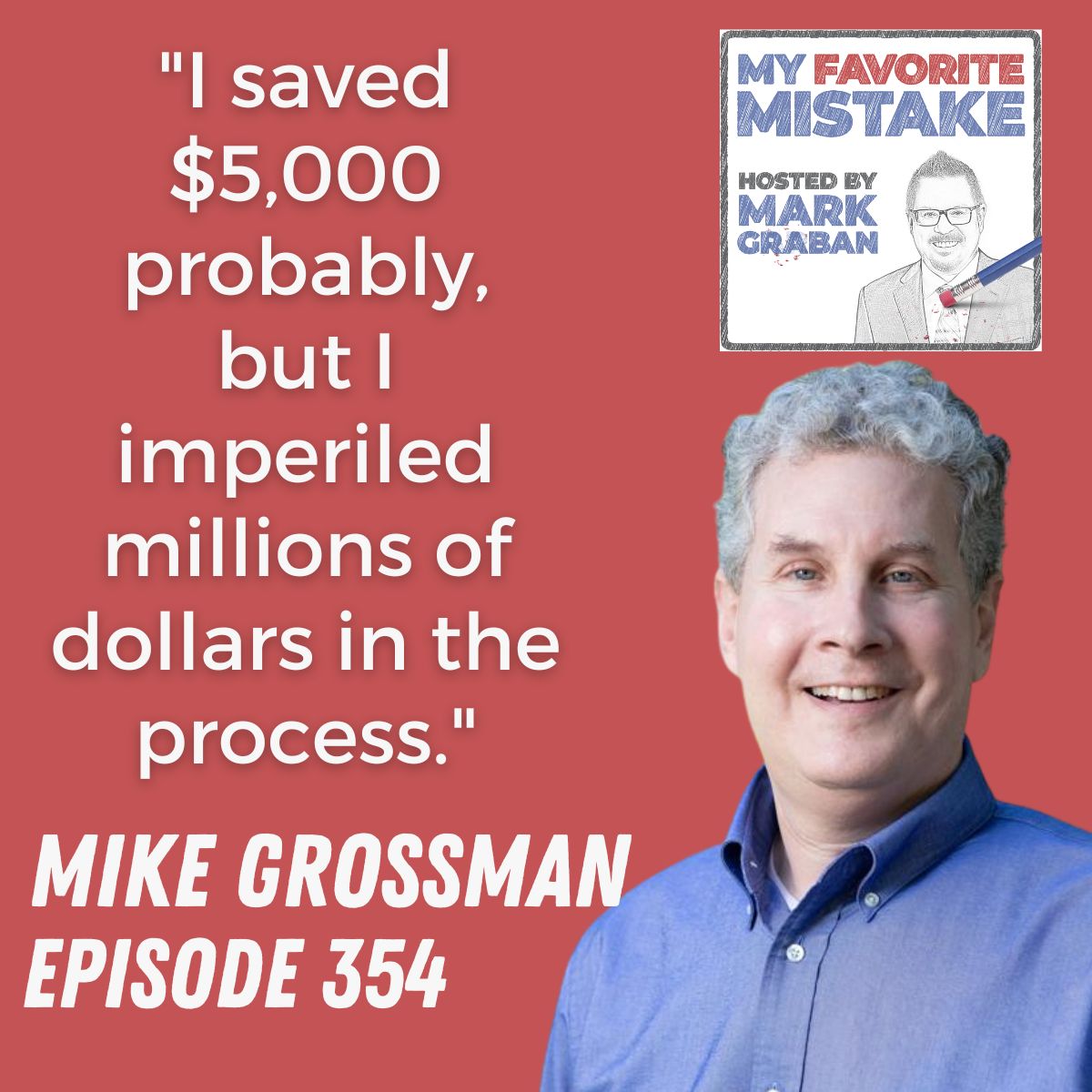
Mike Grossman: I saved $5,000 probably, but I imperiled millions of dollars in the process. I thought it was one of the most significant mistakes I've ever made. The fact that in the end it worked out was fortuitous. But it was really dumb, and I've never made that mistake again. I made many other mistakes, but not that one.
Knowing Your Limitations and the Value of Experience
Mark Graban: So the countermeasure was to stop serving as your own attorney.
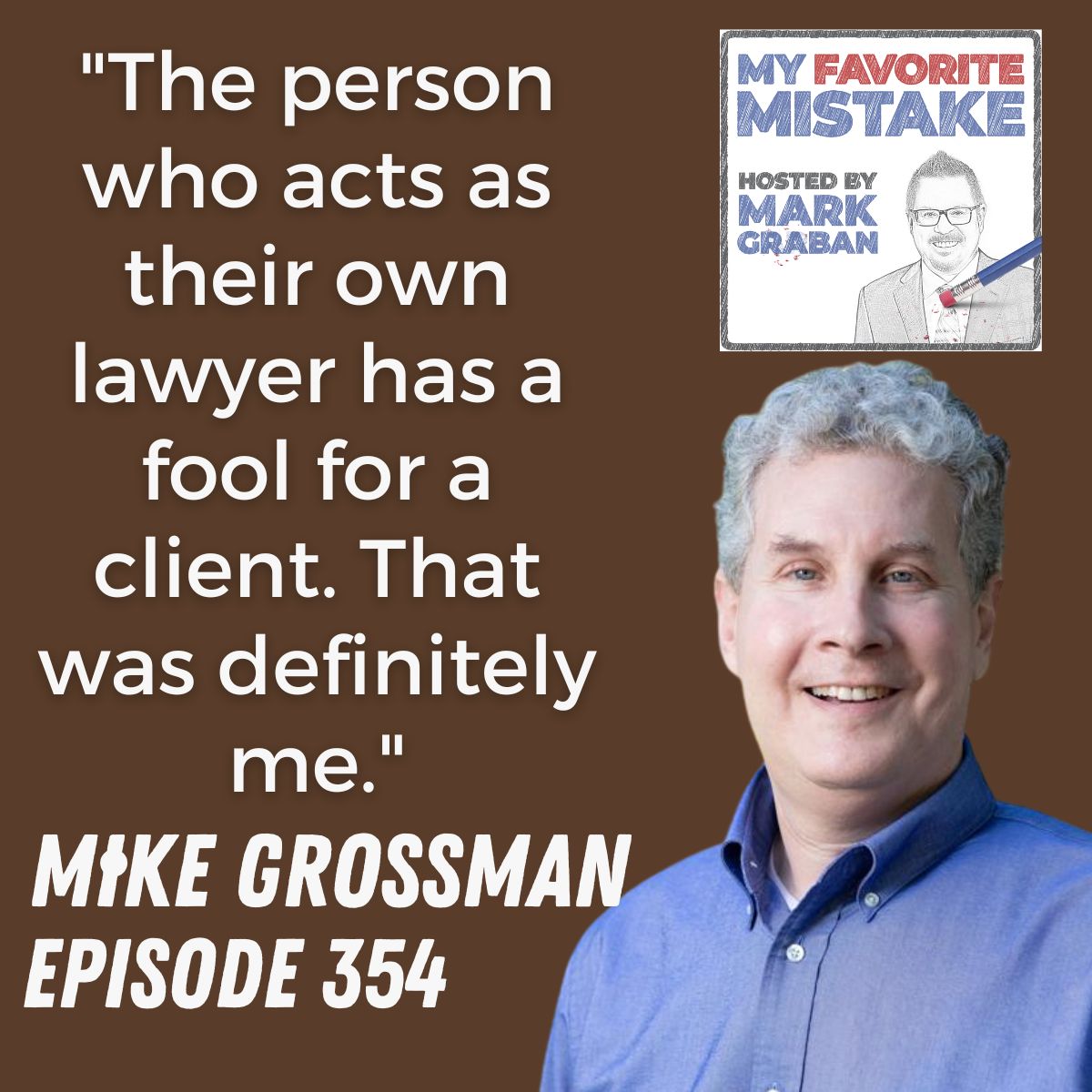
Mike Grossman: That's right. And to recognize that even though I went to law school and ostensibly am sort of a lawyer, there's an old adage: the person who acts as their own lawyer has a fool for a client. That was definitely me.
Mark Graban: Is it a matter of getting somebody with fresh eyes on the situation — somebody more detached and impartial? Is that a mistake another attorney might also have made?
Mike Grossman: It's possible. But there is something to be said for experience. Early in my career, I dismissed the value of experience, before I had all this gray hair. I thought, “If you're really motivated, you work hard, you're adaptable and smart, you can figure out pretty much anything.” On some level I still believe that. But now, with the benefit of lots of gray hair and a lot of decades of mistakes and failures, I do think experience has significant value. It's pattern recognition. If you work with a lawyer who's seen many of these agreements, they're more likely to see that it's not written in the best possible way. And I suspect in today's AI environment, it would probably be picked up automatically. At the time, we didn't have that benefit.
Mark Graban: That mindset you describe — we're smart, we'll work hard, we can figure anything out — that's the mindset you need to be an entrepreneur, right?
Mike Grossman: I think so, and I think it's true. In a lot of cases you just have to figure it out as you go. The benefit of experience is that you often can get from point A to point B quicker, because you've seen what not to do in many cases. But you can get from point A to point B if you're proactive, industrious, and adaptable, regardless of experience.
Mark Graban: It seems like there's a general lesson here. I'm not an attorney, and for other listeners who aren't attorneys, we can't make that exact same mistake. But the general lesson is knowing your limitations, or knowing your lack of experience in a certain area. Even if you could figure it out, when should you bring in an expert? That might include everything from building a landing page to building a website — things where you're like, “Well, I could do it, but should I?”
Mike Grossman: Absolutely. The other part of the lesson is that it's sometimes easy to be penny wise and pound foolish. As an entrepreneur, you constantly have to make decisions about what you invest in, and you have to be very careful about how you spend money. If anything, I think people tend to have a systemic bias toward spending too much money rather than too little. But there are moments — usually the moments with the greatest potential significance or ramification — where it's necessary to spend more rather than less.
Mark Graban: Even in a big company environment, you're giving me a flashback. I've used this phrase in other episodes, but when I was at General Motors 30 years ago, there was this common expression: “We'll save money no matter how much it costs us.”
Mike Grossman: That's a good quote.
Mark Graban: There's a similar penny-wise, pound-foolish thing — and a lot of it was really just short-term thinking. We can save some money today; it might come back and bite us next week.
Mike Grossman: I agree with that. In some sense, it's a question of how much you invest in different forms of insurance as a company. If you spend too much money on what might go wrong, you end up wasting a lot of money. But if you spend too little, sometimes things actually go wrong.
Making It Safe to Share Bad News
Mark Graban: The premise here in this series is that mistakes can be really useful teachers. You've shared an example of that. But in an organization, we can only learn from mistakes if people feel safe admitting them. Stepping back to your experience as a CEO, how do you create an environment where people feel free to surface bad news early, instead of hiding it until it might be too late?
Mike Grossman: I think the key is in how you react when bad news is shared. I've always been of the view that it's good when people share bad news, and you need to acknowledge that — not because the news itself is exciting, but because if bad news is made visible, you can actually do something about it.
In the companies I've run, one of the main things I've emphasized is that no one's going to get shot for sharing bad news. If anything, they're going to be complimented for making it visible and keeping things authentic. When people see that it's real — that it's not just rhetoric — that when bad things happen they can talk about it and they're not blamed for it, and you're not looking for a scapegoat or just giving somebody a hard time, you're focused on working through the problem — you end up in a much better environment.
I've certainly been in companies, or been recruited into companies, where I don't think that was the culture prior to my joining. One of the things I try to work on, because you'll see patterns where people try to sweep bad news under the rug. They don't want to get in trouble, or they don't want to get other people in trouble. There are a lot of reasons people hide bad news, but it's never a good thing.
In some sense, I think of business as all about solving problems. That's what we do. We try to solve problems that emerge in the short term, and we try to anticipate problems that might emerge in the long term. Much of it is around problem solving. You can't solve a problem if you don't acknowledge that the problem exists.
Mark Graban: As a leader, you can't get involved in solving the problem if people aren't bringing it forward to even be acknowledged.
Mike Grossman: Exactly. I've been in environments where people just want to talk about good news, and that's not a sustainably successful approach, because what ends up happening is the problems get neglected.
Mark Graban: I love how you put that — there needs to be real action, not just rhetoric. People get burned if it's some version of the boss saying, “I've got an open door policy. You can bring anything to me.” If you don't get a good reaction, you might think, “Well, the door's open, but I'm not going to use it again.”
Mike Grossman: Absolutely true. I couldn't agree more. Rhetoric is easy. But if you really want to make values real, you have to live them. It takes a while to build trust with people on a team that way, and it's very easy to lose it if you're not being real or authentic, or you're just being performative. But if you mean it and you live it and demonstrate it, and have a team that over time operates that way, it not only leads to greater success, it's a lot more fun. It's a much better environment to work in.
The Most Common Layoff Mistake: Cutting Too Little
Mark Graban: To talk about something that's not fun — you have three essays about layoffs and headcount reductions. You write about being, quote-unquote, “the lord high executioner.” One thing that was really interesting: you say that when CEOs are in a position where reducing headcount seems necessary, it would be a mistake to trust your instincts. Let me hear it from you. What's the most common mistake, or at least a common mistake, when it comes to layoffs and numbers?
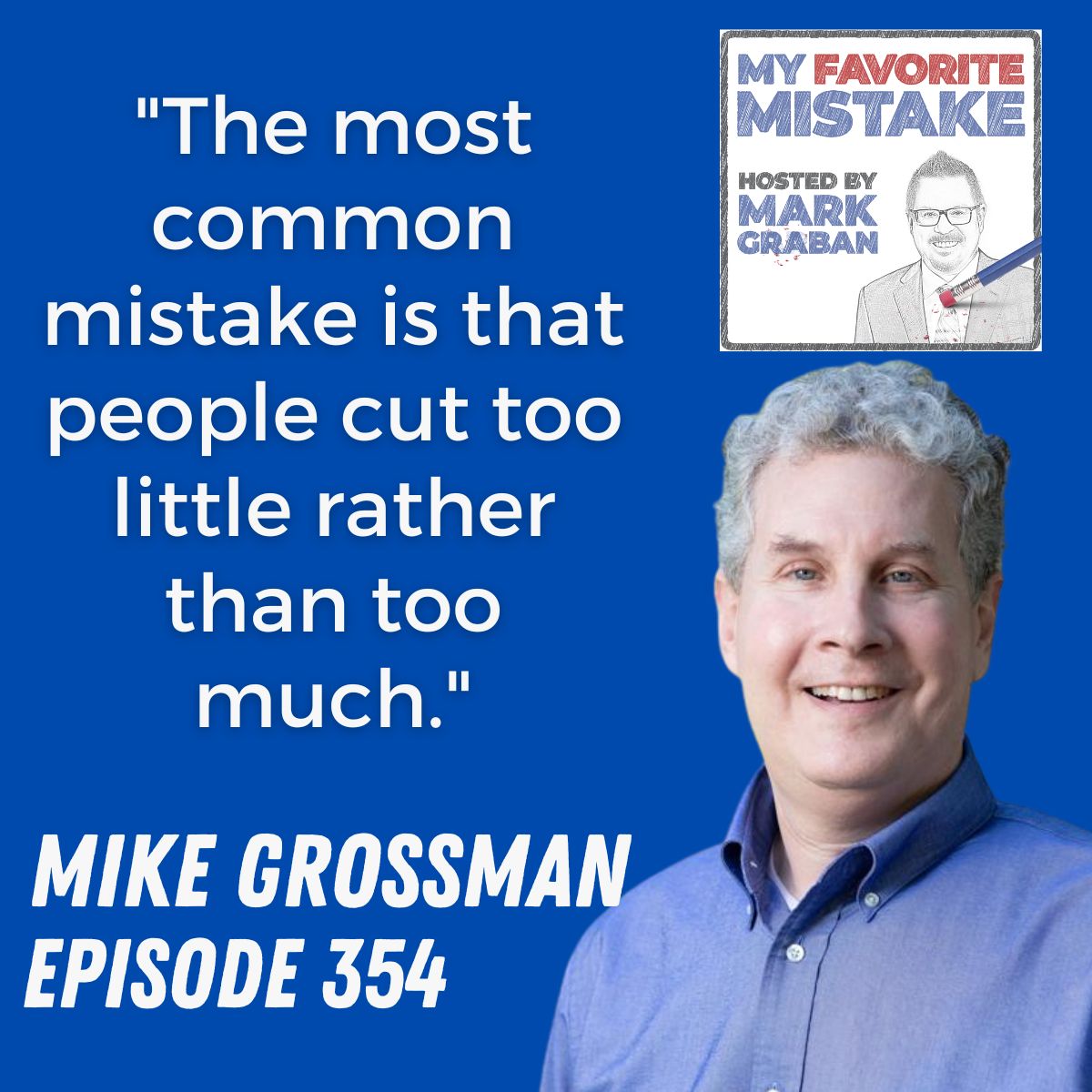
Mike Grossman: I think the most common mistake is that people cut too little rather than too much, and there are a couple of reasons for that. The first is that if you have a team of a certain size, you can sort of imagine how to bring that down to some extent, but beyond some threshold, it's very hard to envision it working. Often what I've found is that if you bring it down to that first level, you realize immediately that you actually could have gone further in the first place — and then it's much harder to do that.
The second reason is that most people are nice and they don't want to lay people off. It's a miserable thing to have to do. So people avoid it because it's very unpleasant, and the consequence is that they try to minimize it where possible. In my experience, it's better to be very tough-minded about it. Empathetic, yes, but tough-minded at the same time. Because in the end, you're running a business. The long-term viability of the business is what you're trying to figure out, and sometimes that requires difficult decisions and boldness, even if you're dealing with something very unpleasant that has adverse consequences for people.
Mark Graban: How'd you arrive at that rule of thumb? Was it experience, a mistake?
Mike Grossman: It maybe wasn't my favorite mistake — it was my second favorite mistake. But it's on the list. I didn't do it right the first time. I did exactly what I'm describing. I had a company that needed to reduce headcount, and we reduced it 40 percent. I actually had one venture investor who suggested we should reduce headcount by something like 80 percent, and I thought he didn't know what he was talking about — he didn't know much about the company.
So we went down by 40 percent, and we got there, and I realized, “Oh, I actually could have gone down by 60 percent instead of 40, and in fact should have.” Then I adjusted and went down 60 percent. And then in the longer term, I realized the guy was right all along, and I should have gone down by 80 percent.
The problem with doing it in stages is that you end up losing credibility. You go in front of the team and say, “We have to do this. It's very painful, but this is it.” And then three months later you have to come back and say, “Well, it really wasn't it. Now it's it again.” It ends up being a death by a thousand cuts, and it's not a good situation to find yourself in. I learned that lesson painfully and have tried not to make that mistake again.
Commitments, Trade-Offs, and Short-Term Pressure
Mark Graban: It's a mistake to make a commitment that you can't guarantee you can hold to — just in general in leadership, right?
Mike Grossman: In life, right? Now, of course, conditions can change. So even if, in a very authentic, high-integrity way, you make a commitment, the situation can change and you're forced to adjust. That's a little bit different from when it's really an unforced error, or an error based on inexperience. If you make a commitment but you actually had the information necessary to make the right decision, you really want to keep the commitment. But in the case I described, I realized I had made a mistake. The 40 to 60 percent was an enormous amount of money the company really needed to save, and yet I had effectively made a commitment that we weren't going to go down further.
So I delayed doing it again because I felt that I couldn't. But in the end I had to, because the business needed to survive. Otherwise, if you don't make these decisions, you don't lose 40 or 60 percent — you lose 100 percent, because the business goes out of business, and that doesn't help anybody.
Mark Graban: Are there times where there's a real battle between long-term viability of the company and short-term pressures, whether that's cash-flow pressure or your investors putting pressure on you? How do you navigate that?
Mike Grossman: That's a very challenging issue to navigate. The context in which I've run companies has been venture-capital funded. These are companies in the early days, always on the verge of running out of money. You need to survive to be able to have long-term success — otherwise you go out of business. So you're forced very often to make trade-offs in the short term based on resource constraints. If you could wave a wand and have a lot more money to spend, it would be much easier, but it doesn't really work that way.
Mark Graban: It would be a mistake to think it's easy, for sure.
Mike Grossman: It's a lot harder than I realized when I first started, that's for sure.
Why Luck and Timing Beat the Meritocracy Myth
Mark Graban: One other thing you wrote about: it's well known that Silicon Valley sells itself as a meritocracy, but you make the argument that luck and timing often matter more. I'm sure that could be tough for people to accept. How do you tell the difference, or how do you explain those dynamics to people — that luck and timing might matter more than you'd like to admit?
Mike Grossman: There are certain prerequisites to build a successful company. You really do have to work hard. You have to have a team that works hard and that's talented. You have to be addressing a real customer need, and you have to do that in a good way. You can't get away from that. If you don't do those things, you have no chance. But just because you do those things doesn't mean you're going to succeed. You might or you might not, and a lot of that has to do with timing and luck.
What happens a lot of times is that a company will succeed in a big way, and the folks involved would like to believe that's a reflection of how great a job they did. It is, to some extent, I'm sure. But it also has to do with these other factors. I've seen it in my own life. The sixth of my six companies had a very good outcome at the end, better than the previous five. But I can honestly say I didn't think I did a better job at that company than I had done at some of the others. More profoundly, I didn't think the management team or the team overall was better. They were good, but not necessarily better than other companies I had run with very good teams — and yet the outcome ended up being very different.
So in my view, there's a certain amount of humility that's important when running an entrepreneurial business. You have to try to do the best you can, and often that'll work out. To some extent you can make your own luck, but you also have to accept that you don't control everything. Control what you can control, and sometimes, as I write in the book, things just happen. Sometimes those things are good, sometimes they're bad. That's life. Entrepreneurial business is a microcosm of life. Good things and bad things happen in a kind of random sequence. It reminds me of a comment my grandfather used to make about the stock market. He said, “The stock market goes up and down, but not necessarily in that order.” That's basically my view of the fortunes of entrepreneurship.
Mark Graban: It makes me think of a related expression you hear in ads or disclaimers: “Past performance does not guarantee future results.” You win some, you lose some. You're the same person in different situations, but I sense you're not the same CEO each time, because you seem really driven to learn and gain experience — hopefully a better version of yourself each time. But that still doesn't mean a past success guarantees a future success, right?
Mike Grossman: That's right. My values, I think, have been consistent throughout. Certainly I'm much more experienced now than at the beginning, and that has both strengths and weaknesses associated with it. But let's say I do it again and run a seventh company, which actually interests me. It's impossible to know how well that company will do or how I'll approach it. It'll totally depend on the dynamics of that situation — the company's strengths and weaknesses, the team's strengths and weaknesses. I'll try to apply the experiences I've had, but what I've learned is that you can't be too literal in applying what you've experienced, because every situation is different.
In fact, it was around company five where I thought to myself, before I joined, “I've done so many of these things now, I've kind of seen it all.” Then I got into the new role, and on my second day I thought, “I haven't seen this before.” Maybe if you did 100 of them, you'd really see it all. But certainly with an N equals six in my case — and I've been on a bunch of boards as well, so if you count those, N equals 15 — every situation is different. The dynamics are different, the world is different, and it's unpredictable how it plays out.
Mark Graban: It's funny — you shared that hypothesis that you've seen it all. Better to have an incorrect hypothesis shot down on day two than down the road. Better to learn that sooner than later. So there's the humility. We could say we're humble, but there are some humbling experiences.
Mike Grossman: On humility, I think one of the best aspects of regarding things that way is that you don't assume you know the right answer. You don't assume that an answer that applied well previously, in a different setting or a different company, will necessarily work. You might have it as a hypothesis. You might say, “I've seen a version of this before. I think this might work.” But it's important to realize, maybe not. These things are not apples to apples. You can apply pattern recognition to some extent, and that gets you maybe 80 percent of the way there, but the other 20 percent often makes the difference between success and failure.
Mission Versus “Performative BS”
Mark Graban: Building off of values a little bit — one other thing you write about is how a lot of Silicon Valley companies have really aspirational missions, but ultimately money becomes a factor. How do you keep a team motivated on the mission when the financial scorecard is challenging?
Mike Grossman: What I've seen is that it comes back to the issue of what motivates people to work for one company or another. Most of the people who work in the Silicon Valley companies I've been part of have alternatives. It might take them a month or six months, but they're going to find another job doing something more or less similar. So the question is, why do they choose your company? If the answer is that it's all only based on money — if you have a group of people that is just very commercial, or mercenary maybe would be a more judgmental word — if that's their nature, then if you hit any sort of financial adversity, they'll immediately leave. That's not a great scenario.
But if you have a group of people who really like working together, and they like what the company stands for, and they like the company's mission, and you're genuine about that mission in terms of what you're trying to do for customers and how people treat each other within the company — if you can build an environment that people are really motivated by and feel good about, they're much likelier to stick when things don't go as well financially, because there's a sense of community and purpose.
I've always thought that in any company I'm in, the goal is to get people to feel like this is the best company they've ever worked for. That's an elusive goal — not everyone's going to feel that way. But that's got to be the goal. When I think about how you build a great company, some of that is financial results and impact on customers, but some of it is that issue relating to the people who work in the company — them feeling like, “This is really a great place.” It doesn't mean it's easy, and it doesn't mean the company always does well, but it's a place that aligns with their values. It's the right aspiration.
Mark Graban: It seems like it can become a cliche. Back in the HBO series Silicon Valley, there was a running joke about making the world a better place. That sounds good, but let me make up a scenario. Say somebody's got a fintech company that does some really technical grunt work — credit card processing, that sort of thing. Is it a mistake to try to attach too much of a “making the world a better place” mission, as opposed to saying, “We're a company that serves customers, it saves them money, we make money, and that's okay”?
Mike Grossman: Yes. If you overstate a company's mission in the Silicon Valley way you're describing, it just becomes an exercise in performative BS. It's not credible. The truth is, a lot of companies — maybe most companies — I think of them as widget companies or widget businesses. There's no really higher-order purpose the company is serving. I've always preferred running companies that do have a genuinely higher-order aspiration. But many are not like that, and many successful businesses are just providing a product or service that meets a need. So it's important not to overstate that.
Having said that, within your little part of the world, you are having an impact on a lot of people. You're having an impact on the people who use your product or service. You're having an impact on the people who work for the company. You're having an impact on the people who have invested in the company. You have a lot of constituents. Even within the employee group, you're having an impact indirectly on their partners and their families. So without overstating what grand purpose you're serving, it is important to think about that whole ecosystem and say, “Within this little part of the world, we're going to try to make it better. We're going to try to do a really great job for everybody, at least as best we can.” If you can do that, you're much more likely to end up with a motivated team, happy customers, and a successful company.
Mark Graban: I appreciate the way you're recalibrating that in a local way. The expression is “making the world a better place.” We could make our company, our workplace environment, a better place. We can have a great workplace, and that has impacts beyond your compensation package. I've seen studies that show an impact not only on mental health but on physical health when you have a highly engaging, positive work environment. That doesn't mean there's never any stress, but on the whole, a workplace that treats people well really does have a big impact on our health and our lives.
Mike Grossman: I certainly believe that. And more broadly, if you can make your little part of the world a better place, in some sense you are making the world a better place. You're at least contributing to that possibility.
How Transparent Should Leaders Be About Finances?
Mark Graban: Maybe one other thing to ask about. Mike Grossman is our guest, and his new book is Failure Is an Option: Reflections of a Silicon Valley CEO. One other thing you reflect on is the level of honesty — you could frame it as radical candor or transparency. In your experience, how much should employees know about the finances, the bank balance, the burn rate? What did you learn about finding the right approach?
Mike Grossman: My bias is to be very open about all that. Here's the burn. You obviously can't talk about certain confidential information — things like what Person A is paid, or Person B is having some sort of problem and you've got to keep some of that confidential. But generally, I think you share almost everything with the larger group. I don't think it's done that way in a lot of companies, but I think it should be. You want people to know what's happening, but also to trust that they're being treated in an open, honest, and direct way.
One of the benefits — the reason to do that — is because it's the right thing to do. Let me just say that. But there's also a practical benefit: if you really walk the walk in terms of that approach, then when things get difficult and you really need people's trust, you've earned it.
Mark Graban: Extending that a little bit — is there benefit to being pretty transparent about, say, retrospectives on customers you didn't win? On why you lost to a competitor, or why a customer didn't renew?
Mike Grossman: A hundred percent. Generally, you set goals as a business, and you achieve some and you don't achieve others. Where you haven't achieved it, you should be completely open about the fact that it wasn't achieved, and try to deconstruct why not. Where customers are concerned, if you want to be great at serving customers, the only way to do that, in part, is to be absolutely real and authentic about when you don't do things well, because then you can fix it — not just for that individual customer, but systemically, for all customers.
I believe in being open about victories, but also open about defeats and improvement opportunities. In fact, I think most of the time should be spent focused on the things that need improvement, because that's how you build a great company. If you only talk about the things that are going well, all of the problems will fester. Of course, you do want to talk about things that go well, too — you don't want to only focus on the things that aren't going well. But you need to see the full picture. I have a strong conviction about that.
Handling People Issues With Discretion
Mark Graban: One of the most difficult things I've seen is when a company has its first hire that doesn't work out — the quote-unquote bad hire. That doesn't mean a bad person, but for various reasons it doesn't work out. Sometimes there are HR-related issues you have to be careful about. But are there times where an open and honest retrospective on a hire that didn't work out can be a good learning opportunity for the company, or even just the executive team?
Mike Grossman: Yes, but you have to be careful when you're moving somebody out of the organization. I would never, in front of a company meeting, say, “This person has been let go, and this is why.” You have to be careful and respectful of the person who's been impacted. But you can talk generally around the need for the company to be faster-moving, or more analytical, or more collaborative. There are certain themes you can emphasize. People can, to some extent, read between the lines at times. But you do have to be sensitive to people.
Mark Graban: You don't want to damage somebody's reputation, especially if it was a matter of fit — somebody who, again, isn't a bad performer or a bad person. They're very likely to be successful somewhere else. You have to be careful about that. And I should ask you as an attorney — it could become a legal issue.
Mike Grossman: Oh, sure, it absolutely could. There's a liability, or potential liability, side of it. But when it comes to difficult people-related issues, the reason to be cautious and discreet has more to do with integrity and respect than anything else.
What Almost Didn't Make the Book
Mark Graban: One final question. There's a lot of candor and discussion of failures and mistakes in your book, and I admire that. Was there one of the 44 essays, or any of the stories, where you wondered, “Should I really include that?”
Mike Grossman: Yes, I suppose so. In a couple of the stories I talk about, I tried not to mention the names of people who reported into me, either directly or indirectly. But I do mention some of the names of people where it was, you know, selling the company to another organization, where there were certain challenges in the interaction. So I thought on a couple of occasions, “This is pretty open, what I'm talking about.” But in the end, I tried to be respectful in all the stories I described.
That really comes back to the objective of the book. I want to make people understand what it really feels like. In order to do that, it's important to explore not just good news, but the challenges that people face. It's not just operational. It's emotional, it's ethical, it's deeply personal. So yes, I wrestled with several of the chapters. But in the end, I didn't stop myself from including any of them.
Mark Graban: Well, thank you for doing that, and thank you for the book. I'm grateful that your team sent a copy, and I recommend people go get the book. It's available now. Again, the title is Failure Is an Option: Reflections of a Silicon Valley CEO. Six-time CEO, maybe seventh time to come. Mike Grossman, thank you again for being a great guest here today.
Mike Grossman: Thank you, Mark. Thank you very much.