Jason Sherman shares the startup mistakes that taught him the hard way about co-founders, “smart money” versus just money, and why MVPs should accelerate learning, not complexity. It’s a candid conversation about judgment, incentives, and how early decisions quietly shape everything that follows.
Listen:
Check out all episodes on the My Favorite Mistake main page.
In this episode of My Favorite Mistake, I talk with Jason Sherman, an entrepreneur, startup advisor, and educator who has spent years working with founders on early-stage product and business decisions. Jason has built and led startups, taught entrepreneurship, and coached teams on how to turn ideas into experiments that actually generate learning. Along the way, he’s also made his share of painful mistakes.
Jason shares a formative startup experience where early choices about co-founders, partners, and funding created problems that weren’t obvious at first. We explore how “money without wisdom” can quietly steer a company in the wrong direction, how misaligned incentives show up later as conflict, and why optimism can mask weak governance. Jason reflects on how his thinking about trust, alignment, and decision rights evolved as a result of this experience.
We also dive into MVP thinking through a Lean lens, drawing on Jason’s work teaching founders to focus on learning rather than overbuilding. He explains how MVPs lose their purpose when they become feature-heavy substitutes for clarity, and why smaller, sharper experiments create faster feedback and better decisions. For founders, leaders, and anyone navigating uncertainty, this episode reinforces the idea that mistakes aren’t just inevitable — they’re essential inputs to better judgment when we take the time to study them honestly.
Questions and Topics:
- What was the situation you found yourself in when this mistake first became visible, and what decision had led you there?
- At the time, what assumptions were you making about your co-founders or partners that later turned out to be incomplete or wrong?
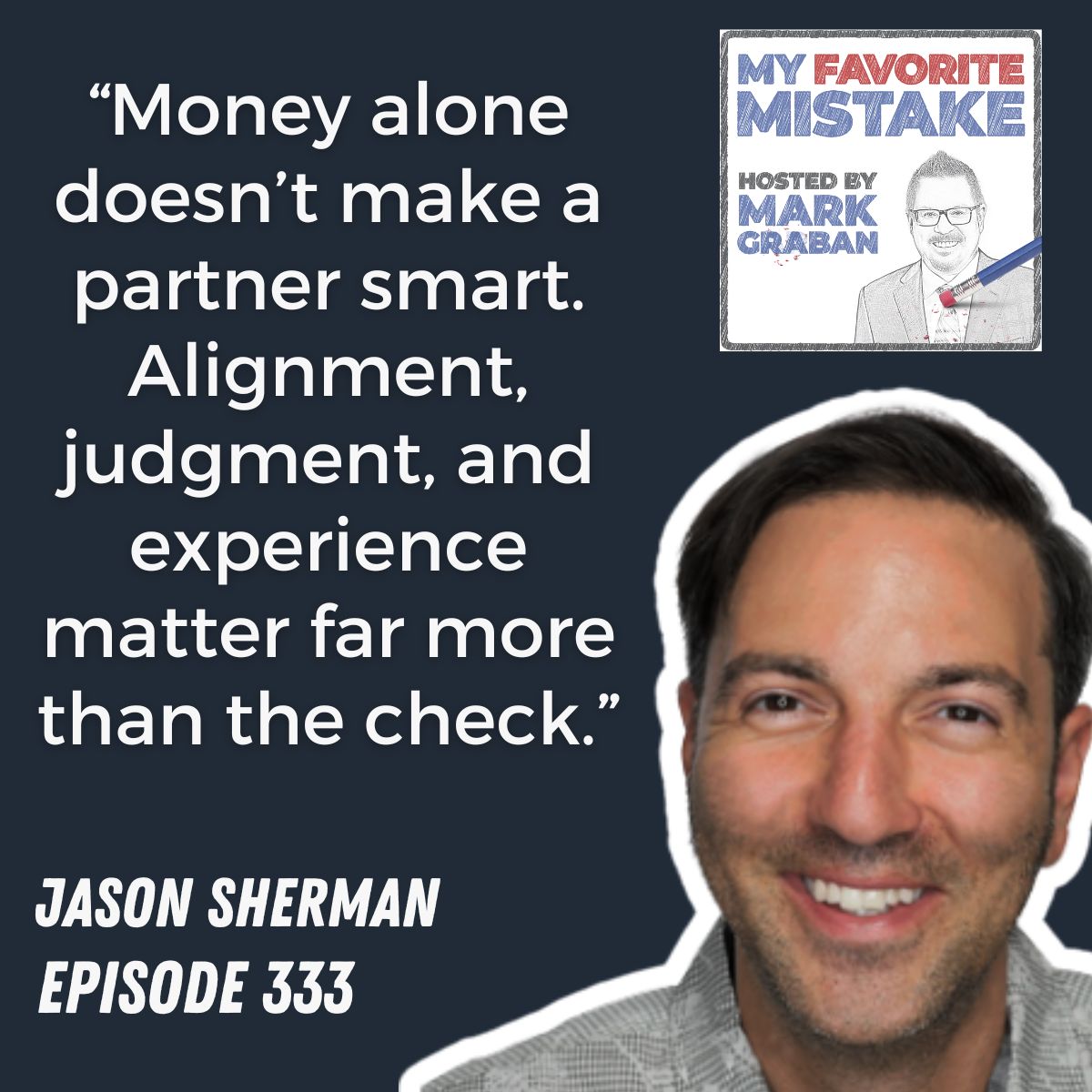
- How did you think about “smart money” back then, and how has your definition changed based on experience?
- Looking back, what early warning signs were present that you either missed or rationalized away?
- How did this mistake affect not just the business, but your own confidence, judgment, or leadership approach?
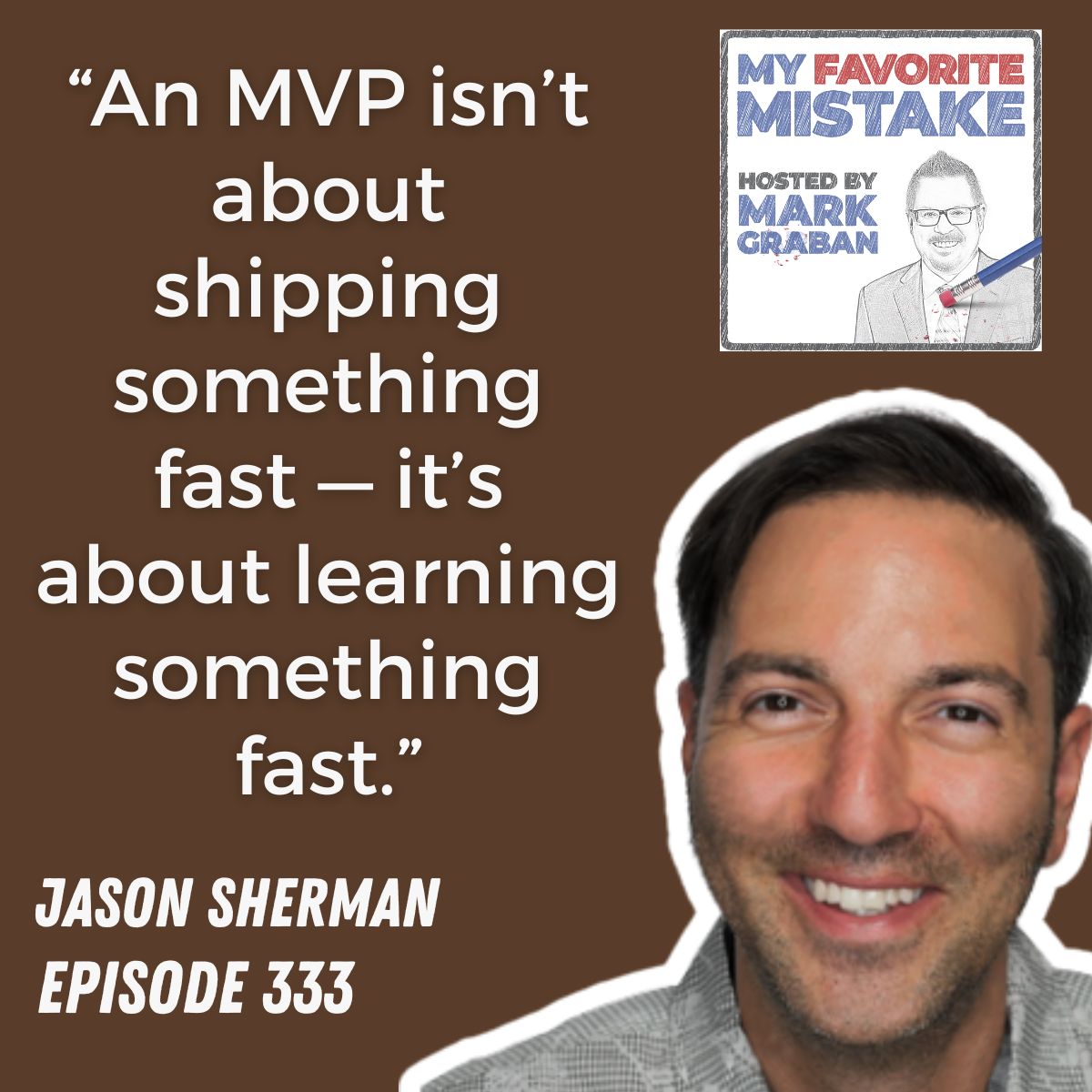
- What did this experience teach you about MVPs and the difference between learning quickly versus just building more?
- How do you now think about alignment, incentives, and decision rights when starting something new?
- For founders listening who may be early in a similar situation, what questions do you wish you had asked sooner?
Scroll down to find:
- Video version of the episode
- How to subscribe
- Quotes
- Full transcript
Find Jason on social media:
Video of the Episode:
Quotes:
Click on an image for a larger view
Subscribe, Follow, Support, Rate, and Review!
Please follow, rate, and review via Apple Podcasts, Podchaser, or your favorite app—that helps others find this content, and you'll be sure to get future episodes as they are released.
Don't miss an episode! You can sign up to receive new episodes via email.
This podcast is part of the Lean Communicators network.

Other Ways to Subscribe or Follow — Apps & Email
Automated Transcript (May Contain Mistakes)
Introduction and Background
Mark Graban: Hi, welcome to My Favorite Mistake. I'm your host, Mark Graban . Our guest today is Jason Sherman . There are many labels for Jason . He's an entrepreneur, filmmaker, author, and tech innovator whose career spans startups, media, and education . He's the CEO and co-founder of Spinnr, which is a video-based friendship app designed to address the loneliness epidemic . And he also leads Vengo AI, a platform that pushes the boundaries of how consumers interact with technology .
He's been featured in outlets like The Wall Street Journal and USA Today, he lectures at universities, mentors founders, and is the author of an entrepreneurship book from about 10 years ago . Strap on your boots. His work blends practical startup experiences, a journalist's curiosity, and a filmmaker's storytelling instincts . So Jason, thanks for being here. Welcome to the show. How are you? .
Jason Sherman: Thank you, man. It's exciting . I'm excited to talk about some cool things I haven't really talked about before .
Mark Graban: Yeah. It'll be good to hear your stories and reflections, and there's a lot to talk about . One other label I'm curious about, which was in your bio that I didn't mention, is that you're a classically trained violinist . Did you pursue music, or tell us about that real quick .
Jason Sherman: In a nutshell, my parents put a violin in my hands when I was two years old . So really, my whole life was all about learning music, languages, culture, art, doing plays and orchestras . My parents were both retired school teachers, so as you can imagine, they were teaching my brother and me everything you can think of . One of the things we learned was how to play the violin . We went on to perform even with Liza Minnelli on stage . So, lots of cool things .
Mark Graban: Yeah, that is very cool . We recently had guest Melissa Robinson Winemiller, who was a professional French Hornist for probably about 20 years before switching careers . I loved playing timpani and percussion . We almost put together an orchestra even though I didn't really do that .
Jason Sherman: Strings, horns, and percussion. Yeah. That's great. I love the French horn. That's a beautiful instrument .
Mark Graban: And it's also very difficult to play, I think, as horns go . But alright, it's good to know a little bit more about the person behind the story . But Jason, let's go ahead and jump in regarding the different things you've done in your career . What's your favorite mistake? .
Mistake #1: The Lawyer and the “Social Network” paranoia
Jason Sherman: You know, when I first saw that this was the topic, “My Favorite Mistake,” I wanted to highlight something. I thought to myself, “Wait a minute. Not all mistakes are created equal” . There are mistakes that you make yourself—that you and your team make—and those teach you better methods . But then there are situations that you're put into . It puts things outside of your control, and because you were put into them, you realized, “Oh, that was a big mistake” .
There is a story that I've never told, and if you'd like to hear it, that's why you're here . This is a story I've never told anybody, not even people close to me, because it really traumatized me in some ways . It was the moment where I decided things have to go a different way .
It was 2010. This is now 15 years ago . It was the beginning of my startup journey, not my entrepreneurial journey, but my startup journey building tech startups . I was at the end of releasing my first feature film that had just won film festivals . Running off of that adrenaline, a lot of people asked me what I was going to do next .
I decided I wanted to jump into technology again because I'm a huge tech nerd . I realized that apps were starting to become really popular. Facebook was popular. The movie The Social Network was just about to come out, which is a big problem for what I'm going to tell you .
I met someone through the movie that wanted to work on something with me . I told him I'm working on a new tech platform . He decided to join up with me . I'm technology. He's business . He decided, “I'll be the CEO. You be the CTO” . I'm building the platform, working on the pitch deck, and working on the documentation . He didn't know anything about running a startup. His contribution was financial .
Halfway through building this thing, The Social Network comes out . He became paranoid. He realized that we need a lawyer .
Mark Graban: Have you worked on the product at that point? .
Jason Sherman: We don't even have a platform working . I had the beginnings of a framework, some demos, some mockups, some documentation . He wants to get a lawyer and documentation, and he's adamant: “I'm not going to work on this with you until we do that” .
So I was forced to go with him to see this lawyer, and she wasn't cheap . We were spending thousands of dollars meeting up with this woman to get information that today you would just ask GPT for and get in five minutes . We're spending weeks at this office getting documentation and contracts, and we still don't have anything built .
I'm working on this product, trying to get things done, getting people at universities to notice us . He hasn't done anything yet . He's simply just been putting in money, but he's been forcing me to pay half of the legal fees even though I'm doing all the work .
There comes a day when I'm frustrated. He wants me to put in more money—maybe a thousand, two thousand dollars . Remember, this is 2010. I'm in my thirties. I don't have a ton of money. I work full-time as an entrepreneur . I sat there and said, “Listen, I can't put in this money. This lawyer is making me not be able to pay my mortgage. I'm going broke. And I'm doing all the work” .
And this is what he said to me that changed everything. My favorite mistake. He said: “You think the work you're doing is worth more than my money?” .
I didn't hesitate. Not a nanosecond. I said, “Absolutely, yes. If it wasn't for my work, we would have nothing. All we have is a pile of contracts from some lawyer that we spent thousands of dollars on. That means nothing without a product” .
That day we decided to cut ties, shut down the company, and part ways . I decided I am never making the mistake again of bringing someone on board only because they have money, number one . Number two, I am never talking to a lawyer again when it comes to a startup until I have a platform that is running, that has users using it, and traction .
Mark Graban: Oh, that's a mistake to learn from . The CEO said he watched the movie and became paranoid. Were they worried about someone stealing the IP? .
Jason Sherman: I believe what he might have thought was that I was going to build this without him because he saw how fast I was moving and how I was in control . He had no control over anything. He didn't have access to the code or the pitch decks . Since he wasn't getting stuff done, I think he started to get worried that I was going to just take off without him, which is what I ended up doing at the end of the whole thing anyway .
Mark Graban: It's been a long time since I've seen the movie. Did Mark Zuckerberg cut some people out? Or am I remembering that he stole Facebook? .
Jason Sherman: It's not that he cut people out. He stole Facebook from the Winklevoss twins . The twins brought the Facebook concept to him, paying him to build it. He built it, but he called it Facebook and said, “No, it's not yours” . The reason we know that's true is because they ended up having to settle for a lot of stock and money, which they then sold and bought Bitcoin with, and now they're worth billions .
Mark Graban: I'm being paranoid about saying the wrong thing about somebody, but we're not going to get sued for talking about that. There's a movie about it .
Jason Sherman: Yeah, it's based on a book that was written .
Smart Money vs. Dumb Money
Mark Graban: Is there a general lesson or advice around “smart money”—someone who isn't just writing a check but has experience, connections, and domain knowledge? .
Jason Sherman: It's a hundred percent true . You can get an investor that gives you $5 million, but then that's all they do, and you're still left to yourself to scale . Scaling a startup is the most difficult thing to do . To get 10,000 or 50,000 customers, we need someone that strategically has partnerships and can place us automatically in all these portfolio companies .
Mark Graban: That's totally different than the person being smart. They might be a good fit for certain investments compared to others .
Jason Sherman: Yeah. You have people like Peter Thiel and others that have invested in Facebook, Airbnb, PayPal . Finding those early on and then selling at the peak—you're a smart investor. But it doesn't mean you're a smart entrepreneur. There's a huge difference . I would argue, like I've met Mark Cuban before. He's a great guy. But how much does he know about the trenches of really building a small startup in today's market? .
My point in saying that is they don't really understand what we go through, so they're very harsh . You would look at our startup—team, technology, platform, knowledge—and check all these boxes, and still VCs don't invest . The era of technology, traction, team, and revenue doesn't matter as much anymore. Now it's the era of connections . If you went to MIT and built this project that got sold to Google, you're going to get funding without a product—just a pitch deck .
Mark Graban: That's interesting to hear because some Silicon Valley people are always talking about meritocracy, but that's not necessarily how it really works .
Mistake #2: The Co-Founder Fallacy
Jason Sherman: Not at all . My other favorite mistake… was after that startup I cut ties with . I started saying, “Okay, well now I'm going to try a different approach.”
The first part of the mistake is: Don't look for co-founders .
Mark Graban: That's common advice, like “If you're the tech person, you need a business person.” But you're saying don't do it? .
Jason Sherman: I will die on the hill that disagrees with that . Y Combinator and all those accelerators say you have to have a co-founder . I'm going to say: do not look for a co-founder .
Here's why: You need to become an expert. Whatever it is you're building, you need to become an expert not just in building it, but the business of it, the marketing of it, understanding the industry around it . If you ever want to become the CEO, that's what the CEO does . By getting a co-founder, you're giving that stuff away to other people and you're no longer an expert .
You have to try to build as much of your product as you possibly can by yourself . Learn how to do some basic coding. With AI at your fingertips, you can whip up a prototype in 24 hours . Get as far as you can, and then co-founders will be attracted to you .
Mark Graban: Does that include being at a point of having your MVP—a minimum viable product—more than a concept? .
Jason Sherman: That is what I do. I get to the MVP level so that I can show a VP of Marketing, “Hey, try my platform. What do you think?” . You hold so much more leverage at this point. They can't say, “Give me 50% of your company.” They can ask for 10%, maybe 20% at most, because you've already done the legwork .
Mistake #3: Building Too Much (Pre-Lean Startup)
Jason Sherman: The second part of that mistake is actually that when I broke off and started working on other projects with other people, we made the mistake of building way too much .
Mark Graban: Way beyond minimum .
Jason Sherman: We built full-fledged platforms that would rival eBay and Craigslist . We built this thing and it actually worked really well, but it was so big. It had so many features . Because it was so big, we couldn't market it .
Then The Lean Startup comes out . I read The Lean Startup and it changed everything for me .
Mark Graban: Great book .
Jason Sherman: I immediately realized that startup was a huge mistake, a waste of time, but I learned how to build a really big platform .
2013 was the pivotal game-changing year for me where I decided to finally go back to my original idea from 2005 and start building that by myself . I was able to build an MVP and get 10,000 users at colleges in 2013 . I was able to attract a talented high school student who wanted to help me . I was able to attract a VP of Marketing who is still with me today, 12 years later . That startup was able to get into an accelerator in New York, raise a couple hundred thousand dollars, and get up to half a million users .
Then of course we hit a funding wall in 2015/16 . We shut down the company, but I learned everything .
Mark Graban: There's a mistake people make related to Lean Startup where they associate it completely with bootstrapping. I mean, thinking about revenue—what lessons did you learn from that other company? .
Jason Sherman: Spinnr is a child of that parent . You have to look at your first users as the best user feedback to help your UI/UX get as good as it can before you release to the public . We always launch everything in a beta phase . If you do not launch in a beta phase, you're making a big mistake .
I was hired as a consultant to build a behemoth of a platform once in like 2018 . I tried to push my methodology on them. They didn't want to listen . They just kept building and building. Eventually, they kicked me out of the company because it wasn't going anywhere .
Core value proposition means one feature . Then you show them a survey: “Which of the five features do you want next?” If 82% say they want a specific feature, that's the one you build . Iterate, feedback. That's a cycle that you just never get out of .
Mark Graban: And part of MVP is something that people are not just willing to pay for conceptually, but they actually give you their credit card number .
Jason Sherman: Exactly. And diving into that, how much are they willing to spend? Is it 99 cents? Is it $500? .
The Pivot: Spinnr and Vengo AI
Mark Graban: I want to ask you about Spinnr. It's described as a video-based friendship app. Tells us about that .
Jason Sherman: The big app I had built in 2013 was called InstaMore. It was a video dating app . But investors don't like investing in dating apps . The pandemic came and I realized that people were hurting just for friends, not dating . The US Surgeon General declared the loneliness epidemic a nationwide emergency .
We spent two months doing some heavy marketing just to see what the waters were like. We realized that dating was dead. But friendship was untapped . Everyone is on social networks, which are not friendship. Social networks are showing off or acting like an idiot .
Spinnr is all about being authentic . It's about talking to people based on your hobbies and your interests. We built something that was an amalgamation of all the things we love about the internet—private chat rooms, profiles showing personality—but removing all the things we hate: influencers, ads, trolls, scammers . Our AI detects and removes up to 800 words not allowed on the platform .
We ended up getting somewhere around 30,000 users in the first year . We tried to raise money, but investors wanna see a million users or a million dollars in revenue . Everyone loved the AI aspect of Spinnr. ChatGPT comes out, I'm like, holy crap. I immediately tweaked the one in the app. People were like, “Oh my God, how can we use this ourselves without Spinnr?” Light bulb. Vengo AI was born .
Mark Graban: So is the business model that people pay to use the app? .
Jason Sherman: We decided to just make it a free app . We were going for the users because we know if a social platform can get network effects, then investors will pour in . But we couldn't get that many people to join without funding for marketing . Once you get to a million users, we had a monetization plan ready to go—unlocking new features, premium placement .
Mark Graban: Jason, I want to thank you so much for sharing a lot of mistakes, stories, and lessons learned . Look for links in the show notes to his website, Spinnr, and Vengo . It's been really great to meet you.
Jason Sherman: Yeah, man. It was my pleasure. It was a lot of fun .