

Dr. Julia Garcia built a performing arts collective before she understood the business model — and later walked away from a tech startup she believed in because her sense of self-worth had quietly collapsed. She shares why hope is a cognitive science, not a feeling, and how even a “mustard seed of maybe” can restart forward motion when everything stalls.
Listen:
Check out all episodes on the My Favorite Mistake main page.
My guest for Episode #345 of the My Favorite Mistake podcast is Dr. Julia Garcia — psychologist, author, and host of the live audience talk show podcast “The Journey with Dr. J.” She's the author of The Five Habits of Hope and has spent nearly two decades working with educators, students, and business leaders navigating some of life's hardest moments.
Dr. Garcia's favorite mistake is a familiar one for early-stage entrepreneurs: she built an organization before she understood the business model. Her performing arts collective — blending keynote speaking with poetry, music, and theater — grew to a roster of 10 to 20 people. The problem was that the model required everyone to travel together, and the economics couldn't support it. A second, harder setback followed when she had to walk away from a mental health app she'd built for young girls experiencing harassment on social media. The app had traction, a team, and real community support. But a cross-country move, a young son, no family nearby, and her own eroded sense of self-worth made it impossible to continue. She never set up a single investor meeting. That one, she says, was the hardest to recover from.
Both failures shaped her thinking on hope — and she draws a sharp distinction between hope and resilience. Resilience, as she sees it, has been co-opted by a push-past-it culture that encourages people to power through without addressing root causes. Hope is different. It's a cognitive science: when we feel hopeful, the brain strengthens the pathways responsible for planning, persistence, and problem-solving. You don't need much of it — just a mustard seed, a maybe moment — to interrupt a cycle of hopeless thinking and start moving forward again.
Key Themes / What You'll Learn
- Why building a passionate, talented team is not the same as building a viable business — and how to spot the difference before it costs you
- How a collapsed sense of self-worth can quietly block action, even when opportunity is right in front of you
- Why hope is a cognitive science, not a feeling — and what actually happens in the brain when we lose it
- The real difference between hope and resilience, and why resilience culture may be making burnout worse
- Why suppressing difficult emotions doesn't protect you — it steals your ideas, your voice, and your potential
- How a “mustard seed of hope” — a single maybe moment — is enough to interrupt a spiral and restart forward motion
- Why hopeful teams outperform resilient ones, and what leaders can do to build the emotional environment that makes that possible
- The connection between psychological safety and hope, and why neither is a soft nice-to-have
Scroll down to find:
- Video version of the episode
- How to subscribe
- Quotes
- Full transcript
Find Julia on social media:
Watch the Episode:
Memorable Moments from the Conversation:
Click on an image for a larger view



Subscribe, Follow, Support, Rate, and Review!
Please follow, rate, and review via Apple Podcasts, Podchaser, or your favorite app—that helps others find this content, and you'll be sure to get future episodes as they are released.
Don't miss an episode! You can sign up to receive new episodes via email.
This podcast is part of the Lean Communicators network.

Other Ways to Subscribe or Follow — Apps & Email
Why Hope Outperforms Resilience — with Dr. Julia Garcia
My Favorite Mistake, Episode 345
Introduction: Poetry, Performing Arts, and Starting Young
Mark Graban: Hi, welcome to My Favorite Mistake. I'm your host, Mark Graban. Our guest today is Dr. Julia Garcia — or Dr. J, as many call her. She's a psychologist, author, and speaker dedicated to helping people through the science of mental health. For nearly two decades, she's worked with educators, students, business leaders, and individuals facing life's toughest moments, helping them break through fear, doubt, and hopelessness to build lasting habits of healing and hope. She's the author of The Five Habits of Hope, and she hosts a live audience talk show-style podcast called The Journey with Dr. J, which blends conversation and poetry. Welcome to the podcast. How are you?
Dr. Julia Garcia: Thank you so much for having me. It's taken us so long to make this happen — if you're listening, this has been a long time in the making. We've had to reschedule so many times, so I'm really excited to be here.
Mark Graban: Illnesses, back and forth — it's winter, it happens. But I'm glad we stuck to it. I do want to ask you first: this is the first time I've heard someone describe a podcast combined with poetry. Tell me a little about that.
Dr. Julia Garcia: I've been speaking professionally my entire career. I started really young and had no idea what I was doing, and I did not like talking about myself or sharing my story. So I would write and perform poetry. That's how I would introduce myself — how I would kick things off. I did a lot of poetry at speaking events because I wasn't comfortable talking about myself directly, but it was a way I could communicate something I was really passionate about artistically. The audience got to know me right away — who I am and what I care about. It was a way I got comfortable quickly, and it's something I infuse in everything I do.
Mark Graban: We'll see if your answer to the next question starts with a poem. No obligation, but we'll see. The question you're expecting — we always start here: what's your favorite mistake?
The Favorite Mistake: Building a Business Without a Business Model
Dr. Julia Garcia: I have so many mistakes. It's hard to choose. But early on in my career, I would say my favorite mistake came down to this: ignorance is bliss, but not always in business. I was at a point where I was building an organization and I didn't understand the financials behind it. I was taking the concept of motivational speaking and combining it with creative arts — poetry, music, theater, skits. We would go into our clients' spaces, mostly schools, and do performances, keynotes, and inspirational programs infused with art.
What I didn't realize was that I was building an organization that couldn't travel and make money. As a keynote speaker, you also get paid for your time — the travel, the logistics. And with a roster of 10 to 15 to 20 people, the business model didn't support the financial reality. I was building a business without any idea what I was doing.
That said, it's my favorite mistake because during that time we built something like a family within our group and our community. We did things that were really meaningful and impactful locally. But the model didn't work because it wasn't feasible for all of us to travel together. That's what pushed me to go out on my own.
Mark Graban: Which was hard.
Dr. Julia Garcia: Very hard. And in no way am I comparing myself to Beyonce, but I felt like when she left Destiny's Child — I thought, I can't go without my group. It was scary. Which is part of why, early on, I leaned so heavily on poetry.
Mark Graban: Poetry and songwriting are related, so that tracks. That's a pretty common entrepreneurship challenge. In tech circles there's the Lean Startup movement — did you come across that?
Dr. Julia Garcia: I actually was part of that. So in my speaking work, I also listen, research, and survey people around the world. I was getting a lot of qualitative data on the experiences young girls were having on social media — self-harm, harassment, people attempting to take their lives. It was serious. So I decided to use technology and apply the Lean Startup approach. I built an app with a grant I won. It was very scrappy. I learned basic coding, designed every wireframe myself, did all of it just to get an MVP out there. We immediately had about 2,000 people on a signup list and thousands using the product.
Mark Graban: For anyone unfamiliar with the lingo, MVP stands for minimum viable product.
Dr. Julia Garcia: I was an athlete, so for years I thought it meant Most Valuable Player. I was like, wait — what does this mean? You can't just take that term.
Mark Graban: One of the core lessons from the Lean Startup methodology is separating two questions: can we build this, technically? And should we — is there a business model that makes it viable? What you're demonstrating is learning from both of those and moving forward.
The Harder Setback: Walking Away from the App
Dr. Julia Garcia: That app was the hardest one to come back from. When it quote-unquote failed, I wouldn't get out of bed. I was struggling. We had raised money, we had a team, and then I moved and uprooted everything. I had a very young son. I went back to grad school. I didn't have my team anymore, and I was in the Bay Area feeling like a big fish dropped into a huge ocean. I couldn't find childcare. I had no family nearby. And I never set up a single investor meeting — not one. Even though I had introductions.
I felt like I couldn't do it. So I let it go. And that was one of the hardest things, not just because I lost the business or couldn't keep doing the work I believed in, but because I felt like I had let people down — the team, the communities that had rallied around us, the girls who were using the app.
Bouncing back from other setbacks, coming up with new ideas — that part wasn't the problem. If you're an entrepreneur listening, the ideas are not your problem. It's the emotional rollercoaster of navigating the wins and losses, and building not just a career but a lifestyle you can actually sustain.
Mark Graban: Did those experiences feed directly into the book — The Five Habits of Hope? Was staying hopeful through those setbacks part of what you were working through?
Dr. Julia Garcia: Definitely. All of those experiences gave me clarity on why hope is so valuable. When I studied the science of it, that was one thing. But experiencing what happens when you don't have hope — when you're pursuing your passions, building a business, following your dreams and the hope drains out — that's something else entirely. I actually wrote this book coming out of another business failure, another tech company. The book is really me saying: no matter what happens, I'm never going to lose hope. And here are some tools for navigating the emotional side of that.
What Hope Actually Is — and What It Isn't
Mark Graban: Let's step back for a minute. Hope is a word we all use, but how do you define it? What is it — and what isn't it?
Dr. Julia Garcia: Let's start with what it isn't. Hope doesn't mean happy. I think that's a big reason people dismiss it as corny or cheesy — they're not feeling happy right now, so they assume they can't be hopeful. But those are different things. They can be connected, but they're not the same.
Hope also isn't false positivity. It's not “everything is great” when your arm is broken. It's not pretending. Hope is feelings-processed. It means being able to recognize sadness, disappointment, and anger, and navigate those feelings in a way that keeps you moving forward.
When we feel hopeless, the brain shuts down the very systems that help us move forward — motivation, goal setting, even our immune response. But when we feel hopeful, the brain releases dopamine and strengthens pathways in the prefrontal cortex, which is the area that helps us plan and persist. Hope is the single greatest predictor of success because it allows us to problem-solve, adapt, and keep going. We know how powerful it is partly because we know what happens when we don't have it.
Mark Graban: So would it be fair to say hope is the belief that things can be better — not that they automatically will be, but that we can take some steps in that direction?
Dr. Julia Garcia: Yes, and I'd add that it also comes back to how we see ourselves and our own worth. A lot of people who feel hopeless also feel worthless — and those two things are often found together. When someone feels worthless, they're less likely to reach out for help, ask questions, or take action. I never set up one investor meeting, even when I had the introductions, because my sense of self-worth was in the way. That's how powerful this connection is.
You can push through a lot of things on strong will alone. We're in a high-performance, hustle culture right now — do, go, grow. But that's not sustainable.
Hope vs. Resilience: Why the Distinction Matters for Leaders
Mark Graban: Let's talk about resilience, because I think there's a real connection to burnout here — which is a massive topic in healthcare. Nurses, physicians, other healthcare professionals were experiencing serious burnout even before COVID. And I've heard people push back on organizations sending them to resilience training instead of addressing the root causes.
Dr. Julia Garcia: I'll be honest — I don't really speak on resilience. I rarely even say the word. I think the actual word is fine, and there are a lot of well-meaning people doing great work in that space. But I think culture has taken resilience in a direction where people are pushing past their limits without addressing root issues.
When it comes to burnout, people don't know what to do. They're trying everything, throwing solutions at the wall. So if you're attending a resilience training, that's not wasted — at least there's movement, there's action, there's space to build from. Culture takes time to shift, especially in large organizations, and any step that creates space to say “that was useful, what's next?” is meaningful.
Earlier in my career I did a lot of work around equity. I used to joke — not very funny — that organizations wanted me to solve racism and sexism in 45 to 60 minutes. The expectations were impossibly high. My real goal was always to come alongside an organization, understand their big picture, and figure out how to support that for the long haul. And that means trying things that don't work.
Mark Graban: And learning from them. Hopefully in an environment where people feel the psychological safety to try something, fall short, and not be punished for it — where leaders treat it as a learning opportunity rather than a failure.
Dr. Julia Garcia: Exactly. And that emotional safety connects directly to what I call the risk habit in the book — taking emotional risks. Whether that's identifying something that's blocking your team, reaching across the table and saying “here's what it is, here's what I'd like it to be, here's how I'm willing to help” — that takes real courage. Change is uncomfortable even when it's good, and most of us are wired for comfort.
The Cost of “Calm, Cool, and Collected”: How Suppression Steals Your Voice
Mark Graban: In the book you talk about being calm, cool, and collected — presenting that way publicly. There's pressure in workplaces to do the same. When did you realize that approach can actually make things worse?
Dr. Julia Garcia: Every time I would go into a space — and I've spoken in Toyota events, Verizon offices, high school gyms, detention centers — I would walk away thinking: if we didn't have this space right now, would these people ever connect in a meaningful way? There's a culture of performance almost everywhere. Heads down, not really greeting each other.
What really shaped my thinking was the anonymous writing exercises I use in my work. I would ask people to write things down without putting their name on it, and what I heard was the depth that they were withholding. It would rock your world. Some of the things shared in those anonymous forms, in people's own handwriting, never get said out loud in any meeting or presentation. That shaped how I wanted to continue my work.
Mark Graban: What were some of the patterns you saw around burnout and disconnection?
Dr. Julia Garcia: People are speaking, but they're not saying anything. We're suppressing what we really need to say and feel. And suppression will steal your ideas, your potential, your relationships, your voice. It will steal everything.
And social media amplifies this. There's enormous pressure to curate a version of yourself where everything looks great, you're “killing it,” everything's working. Even when people share struggles on LinkedIn or Instagram, it's still often packaged in a way that looks magical. We're inundated with performance mode — and when it's all the time, we stop being present. We stop being allowed to make mistakes and grow from them.
That's actually why I love what you're doing with this podcast. It's basically countercultural to what we know in content today. People are tired of the performance. They want authenticity. But it's hard to share a struggle because you have to be emotionally developed enough through that hardship to share it safely.
Honesty Is the Foundation of Hope: A Live Exercise with Mark
Dr. Julia Garcia: Let's try something. I want to walk through an exercise I use — and listeners can work through this too. Think about something you struggled with that you never opened up about, never told anyone. You just strong-willed through it. Fill in this prompt: “I struggled with…” or “I struggled because…”
Mark Graban: Okay. What I wrote down is: I struggle because I don't like reaching out to people in a way that feels salesy.
Dr. Julia Garcia: How did it feel just saying that?
Mark Graban: A little bit of embarrassment and self-judgment. I feel like I shouldn't have that problem. Most of my business comes from writing, content, books — things that help people find me. That's worked better in some years than others. When I have gaps, I know I should do more outreach, but that's not naturally my style. And now I'm judging myself for judging myself.
Dr. Julia Garcia: We have a saying for that: stop shoulding all over yourself.
Mark Graban: Yes.
Dr. Julia Garcia: What would it feel like to stop doing that?
Mark Graban: It would feel better. There's still a real business challenge there that I feel hopeful I can solve. But the self-criticism doesn't help.
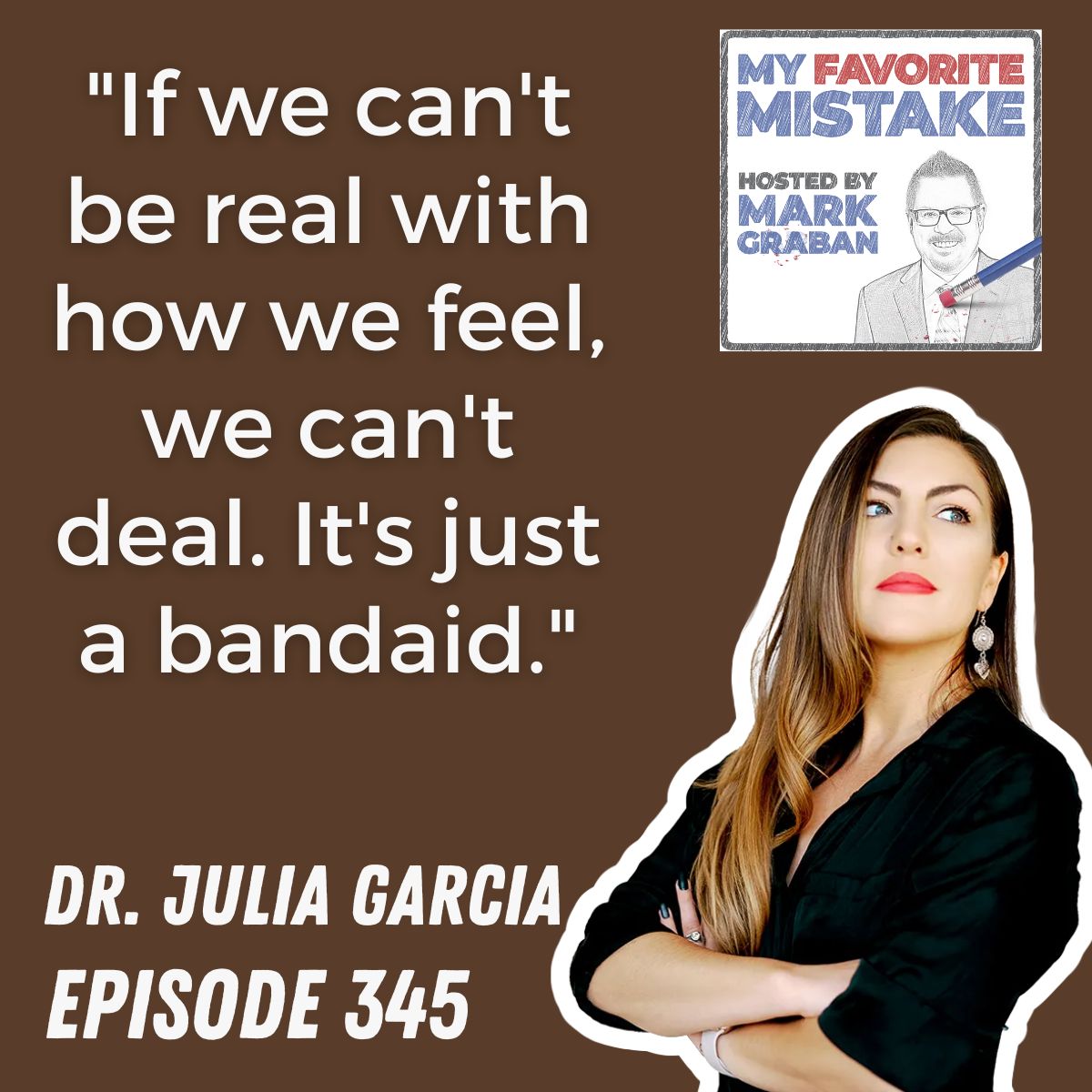
Dr. Julia Garcia: You said something important: “if I'm being honest.” There is no hope without honesty. When we're honest — even when the feelings are uncomfortable — we activate parts of the brain that can actually start to work through things, instead of avoiding them. If we can't be real with how we feel, we can't deal with it. You might find a bandaid. But until the honesty is there, it's just a bandaid.
Now — second prompt. Two words. When you think about that struggle: “I felt…”
Mark Graban: I felt regret. Maybe even some shame. Like I've missed opportunities — not just for myself in terms of revenue, but real opportunities to help people. I have ideas worth spreading. And I've let fear get in the way.
Dr. Julia Garcia: And would it be fair to say you're a high performer?
Mark Graban: Yeah. And going back to childhood — academic performance set certain expectations that don't always translate into real-world performance. There's this internal standard of what you should be doing, and when you fall short of it, that feels bad.
Dr. Julia Garcia: That's a lot of pressure. And here's a small shift: what if instead of “doing,” it's about “discovering”? Not what you do, but who you are. Does that take off a little pressure?
Mark Graban: I think it does. I can define myself as more than my professional labels — as a husband, brother, uncle, friend, member of a community. And I don't fail in those roles the same way. Not perfectly, but I'm not failing.
What Funerals Taught Dr. J About Identity and Worth
Dr. Julia Garcia: Something came to mind that I want to share. I've been to a lot of funerals in my life — from a young age, more than weddings, many of them for very tragic things: domestic violence, drug overdoses, gang violence. And no one ever talked about what anyone did in their career. It would come up briefly in a bio, but when people actually spoke about that person, it was about who they were and who they were willing to be in this world.
Being willing to be brave and vulnerable — that speaks more than anything. You being willing to do that on a podcast with someone you just met tells me a lot about who you are. That's where the power is. When we allow ourselves space to be honest, we can start to discover more and more of who we really are — before the world started telling us who to be and how to make it look.
Mark Graban: Thank you. Can I turn it back to you?
Dr. Julia Garcia: Actually — one more question for you. What are you hopeful for?
Mark Graban: I'm hopeful that at least some healthcare organizations will do what's necessary to help people feel safe speaking up at work. Psychological safety — how safe do you feel disagreeing with your boss, sharing a mistake, identifying a risk? I sometimes get labeled as too negative, too critical. But the other side of that coin is: I'm pointing it out because I'm hopeful we can fix it. That's why I'm here. I wouldn't bring it up if I thought it was hopeless.
Planting Seeds: The Role of Coaches, Leaders, and Culture
Dr. Julia Garcia: Something my first real therapist told me has stayed with me for years. It was the parable of the sower and the seed — how seeds fall on different kinds of soil, and only some of them take root and grow. What that helped me understand is that my job is to throw the seed. I'm not responsible for the soil.
For consultants, coaches, keynoters, writers — what we do is come alongside and help plant seeds, help build the foundation. But the organization has to build the systems to support growth after we leave. When you understand that, you can let go of the high-performer mindset that says you have to do it all yourself.
Mark Graban: I love that analogy. In my last book, The Mistakes That Make Us, I used a gardening metaphor around cultivating culture. I started my career in environments we would now call toxic — though we didn't use that word then.
Dr. Julia Garcia: That was not a word.
Mark Graban: Leaders would get frustrated that the plants weren't growing and would get down on their knees and yell at the plant — as if that would work.
Dr. Julia Garcia: Or rip the plant out entirely.
Mark Graban: Right — “you're in the bottom 10%, you're out.”
Dr. Julia Garcia: And you're like, wait — that's a perfectly good seed. This is a sequoia tree. What are you doing?
Mark Graban: Sometimes it just takes time.
Dr. Julia Garcia: Exactly. And if something isn't worth the time, it's probably not worth the investment. Especially when it comes to culture. If you want a quick culture fix, you are not going to like the results in a year or two.
A lot of systems have a hard time acknowledging there are unhealthy roots that need to be uprooted before anything new can grow. You can't replace something without uprooting it first. And you can't uproot it if you don't acknowledge it. The process is uncomfortable. But there are still good things in the soil. Not everything is rotting. If we don't acknowledge the root problems, though, there's no sustainable path forward.
The Mustard Seed of Hope: A Small Practice That Rebuilds Momentum
Mark Graban: If someone listening is struggling with hopelessness — what's one small habit they could start practicing today?
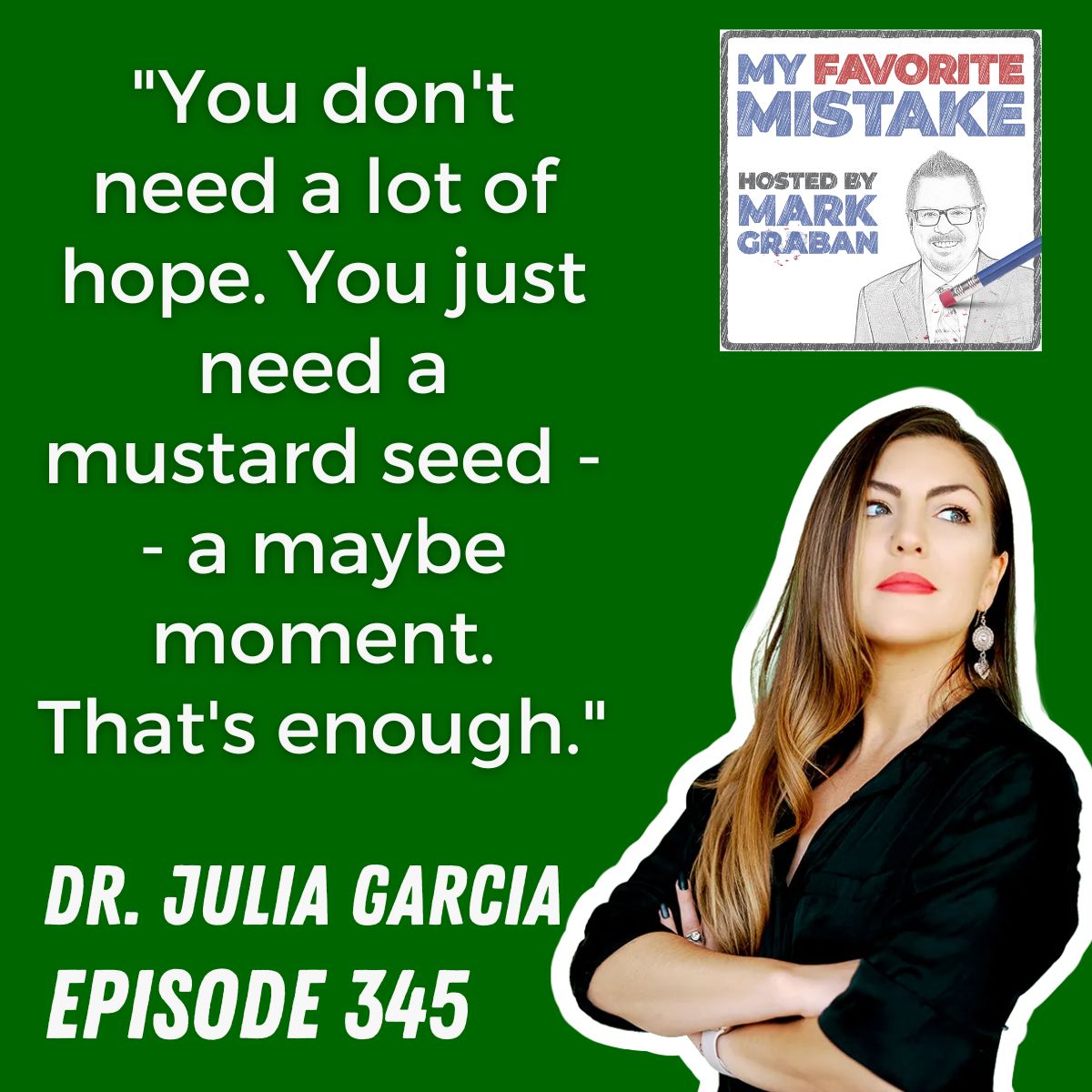
Dr. Julia Garcia: The brain gets into cycles and builds neuropathways that shape how we think. So I come back to the seed analogy. A mustard seed of hope is a maybe moment. That's all you need. It debunks the idea that you need a lot of hope — you don't. You just need a tiny seed. And that seed can break up the thought patterns that pull us into hopeless despair.
So just think: maybe I can start another business. Maybe I deserve real love in a relationship. Maybe I can become healthier in this area of my life. Maybe my voice is needed — exactly as it is, without sounding like anyone else.
That maybe moment creates momentum. Because hope doesn't solve our problems — it activates the parts of our brain that help us solve them. You don't have to have a lot of it. Just maybe.
Why Hopeful Teams Outperform Resilient Teams
Mark Graban: Tell us about the science behind why hopeful teams outperform resilient teams.
Dr. Julia Garcia: Hope is a cognitive science. Even though it's about how we feel, it's measurable. There are actual predictors of success tied to higher levels of hope. When people are more hopeful, they're more collaborative, more willing to problem-solve together. They're better at what I call the power of the pivot — adjusting when needed instead of staying stuck. Hope is a strong predictor of success in teams because it equips people with the tools to work together and keep going through the ebbs and flows of business.
Mark Graban: It sounds like hope deserves to be elevated alongside psychological safety — which is often dismissed as touchy-feely, but teams with psychological safety measurably outperform those without it.
Dr. Julia Garcia: Absolutely. And the reason so many people leave their jobs is management — specifically, the emotional environment their manager creates. Great managers exist. But what makes people stay is the emotional environment: how does my manager handle stress? Do they have emotional regulation? Do I feel inspired to be led by this person?
People don't want to just plug and play anymore. They want to feel part of something. Even if you work at a data company, if you're leaving your family every day to come into that space, you want to feel like it matters. The emotional environment is the root of why people leave or stay. That's not fluffy. That's the data.
Closing
Mark Graban: Very true. Thank you, Dr. J. Links to The Five Habits of Hope, The Journey with Dr. J podcast, and Dr. Garcia's TEDx talk will all be in the show notes. Thank you so much for being a guest today, for sharing your story, and for turning the tables and asking me a few questions. I really appreciate it.
Dr. Julia Garcia: Thank you for being part of this with me — for allowing this to be a space where I felt not just excited, but connected, seen, and heard. Thank you for being real with me.
Mark Graban: Thanks again.