
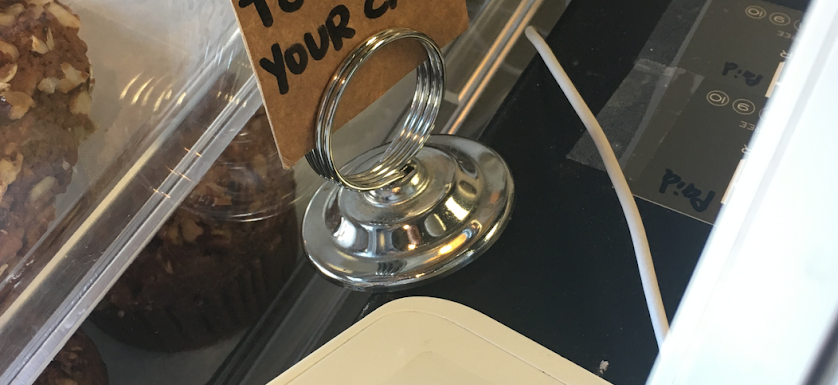
I took this photo at a coffee shop in 2017, during the transition from magnetic-stripe cards to chip cards.
The handwritten sign said:
DON’T FORGET TO TAKE YOUR CARD ?
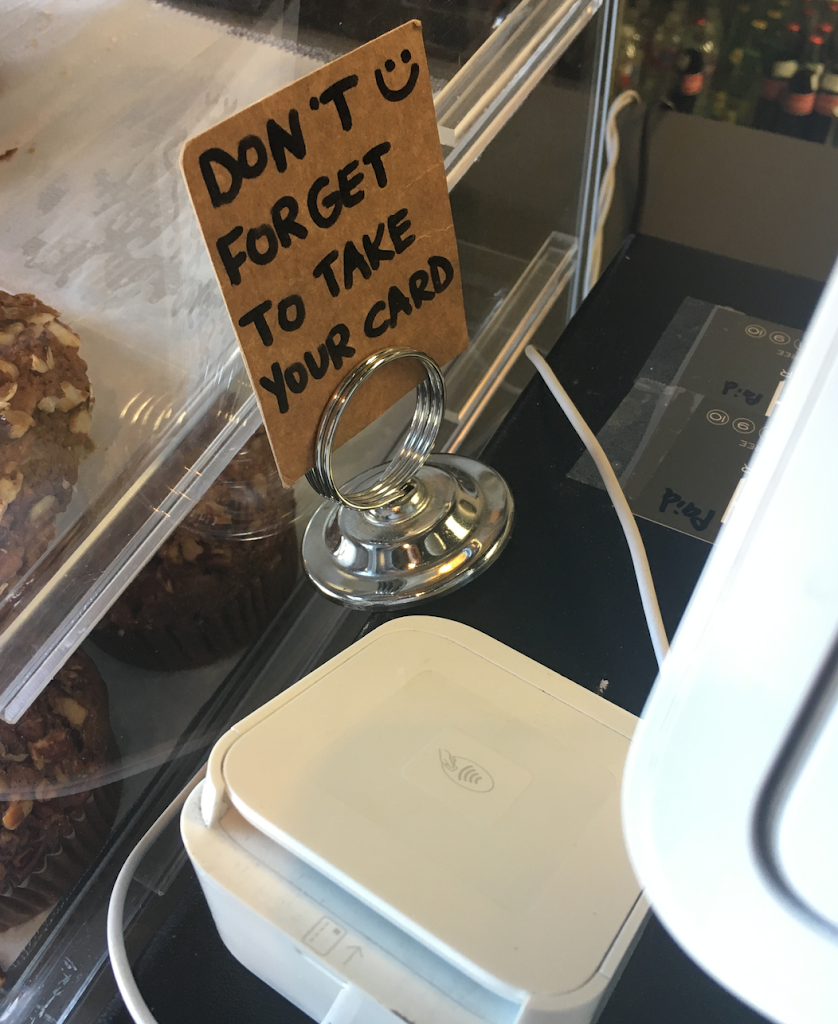
The smiley face was a nice touch. But signs like this usually tell us that something has happened often enough to become a recognized problem.
Customers were apparently completing their purchases, picking up their coffee, and walking away without their credit cards.
The Chip Card Changed the Process
With the old magnetic stripe, you swiped the card and immediately put it back in your wallet. The card stayed in your hand for only a second.
Early chip-card transactions changed that sequence:
- Insert the card.
- Leave it in the reader.
- Wait for authorization.
- Remove it after the machine says the transaction is complete.
That waiting period created an opportunity for distraction. The customer might start talking to the barista, reach for the drink, move aside for the next person, or simply follow the familiar mental script: The payment went through, so I’m finished.
The transaction was complete, but the card was still sitting in the machine.
That’s not necessarily carelessness. It’s a predictable error created by a change in the process.
Does the Sign Work?
Maybe.
A sign can provide a useful reminder, particularly when it appears exactly where the mistake occurs. This one was handwritten, visible, and positioned next to the reader. It was probably better than saying nothing.
But the sign still depends on the customer:
- noticing it,
- reading it,
- remembering it at the right moment,
- and not being distracted.
That makes it a warning, not mistake-proofing.
The wording is also interesting. “Don’t forget” describes the desired mental state, but it doesn’t change the process. It’s another version of “be more careful.”
People rarely intend to forget a credit card. The problem is not a lack of motivation. The problem is that the process allows the transaction to feel finished while the card remains behind.
ATMs and Gas Pumps Often Use a Stronger Control
Compare this with many ATMs.
The machine returns your card before dispensing the cash. You cannot collect the money and walk away while the card remains inside because the process sequence prevents it.
Many gas pumps use a similar approach. The pump does not proceed until you remove the card. The system makes card removal a prerequisite for moving to the next step.
That is much stronger than displaying:
Please remember to remove your card.
The equipment controls the sequence:
Remove the card, then continue.
This is a form of mistake-proofing. The system either prevents the mistake or makes it much harder to complete the process incorrectly.
Why Not Do the Same Thing at the Coffee Shop?
The challenge is that the coffee-shop transaction is structured differently.
At an ATM, the machine controls the entire sequence. It can withhold the cash until the card has been removed.
At a gas pump, the payment terminal controls whether fueling begins.
At the coffee shop, payment approval may be the final electronic step. The drink may already be made. The employee may have turned to the next customer. There may be nothing left for the card reader to withhold.
The terminal can beep and display “Remove card,” but it cannot physically prevent the customer from walking away. The transaction has already succeeded.
The point-of-sale system could theoretically delay printing the receipt, releasing the order to the barista, or completing the transaction on the register until the card is removed. But that would require tighter integration among the reader, the register, and the shop’s workflow. It might also slow the line or create new problems.
So the coffee shop may not have had a practical way to create the same kind of interlock used by an ATM or gas pump.
The sign may have been the best available countermeasure at the time. But it was still a relatively weak one.
Better Options
Other countermeasures could reduce the risk:
- A louder and more distinctive removal alert
- A flashing light around the card slot
- A terminal positioned directly in the customer’s line of sight
- A cashier prompt before handing over the drink
- A reader that does not show the transaction as complete until the card is removed
- Contactless payment that never requires the card to leave the customer’s hand
That last option has become increasingly common. With tap-to-pay or a mobile wallet, the customer taps the card or phone and immediately puts it away. The process eliminates the condition that created the mistake.
That is often the best form of mistake-proofing: remove the opportunity for the error rather than repeatedly reminding people not to make it.
What Does the Sign Tell Us?
The sign is evidence.
It tells us that customers had probably left cards behind before. Perhaps it happened often. Someone noticed the pattern and tried to help.
That is better than blaming customers or doing nothing.
But the next question should be:
Can we change the process so people don’t have to remember?
A sign may be an appropriate temporary countermeasure. It can also be part of a layered solution. But when the same warning remains in place indefinitely, it is worth asking whether the organization has accepted a recurring problem instead of addressing its cause.
“Don’t forget your card” is polite advice.
“Remove your card before the process can continue” is system design.
And “tap your card without ever letting go of it” may be better still — that prevents the problem for sure.