

Dr. Jen Fry shares how an eight-month silence with her best friend became her favorite mistake — and why conflict avoidance, not conflict itself, is what really damages leadership cultures, teams, and relationships.
Listen:
Check out all episodes on the My Favorite Mistake main page.
My guest for Episode #341 of the My Favorite Mistake podcast is Dr. Jen Fry, a sports geographer, tech founder, TEDx speaker, and organizational change consultant who works at the intersection of conflict, culture, and leadership. She's the founder of Jen Fry Talks and author of the new book I Said No: A No-Nonsense Guide to Setting Boundaries, Speaking Up, and Having a Backbone Without Being a Jerk.
Jen's favorite mistake is a disagreement with her best friend of over ten years — a miscommunication that led to eight months of silence. It wasn't a dramatic betrayal. It was a small misunderstanding that neither of them knew how to resolve at the time. Then Jen's mother passed away, and her friend sent a card. That single act of reaching out, despite months of hurt, changed how Jen thinks about reconciliation, conflict, and the kind of people she wants in her life. She describes it as her favorite mistake because the depth of the relationship afterward — and the understanding she gained — would not have been possible without it.
From there, the conversation opens up into territory that matters for any leader. Jen draws a sharp line between nice and kind — arguing that niceness is often weaponized to keep people quiet, while kindness requires honesty, accountability, and the willingness to speak up even when it's uncomfortable. She makes the case that conflict avoidance, not conflict itself, is what damages teams, relationships, and cultures. If your boss hates conflict, she says, everyone will hate conflict — because they have no choice.
We also dig into feedback: why most adults were never trained to give or receive it, why anonymous feedback does more harm than good, the important difference between being defensive and defending yourself, and why people pleasing quietly wrecks reputations and results. Jen brings a perspective shaped by coaching college volleyball, founding a tech platform, studying peace and conflict at the graduate level, and growing up in a biracial family where she saw very different cultural expectations around speaking up.
Themes and Questions:
- Learning from a friendship fallout — how a small miscommunication led to eight months of silence and a deeper understanding of reconciliation
- Why conflict avoidance costs more than conflict itself — in relationships, teams, and organizations
- The difference between nice and kind — and how niceness gets weaponized to keep people quiet
- Why people pleasing wrecks your reputation, your relationships, and your results
- How leaders set the tone for conflict — if your boss avoids it, so will everyone else
- Why most adults were never trained to give or receive feedback — and what that costs organizations
- The problem with anonymous feedback and why being the middleman helps no one
- Defensive vs. defending — why asking clarifying questions isn't the same as shutting feedback down
- Why “just keep the peace” and “be the bigger person” are advice that protects the wrong people
- What it means to build a culture where disagreement happens at the speed of the meeting, not after weeks of strategizing
- How Jen's background in peace and conflict studies, college volleyball coaching, and growing up biracial shaped her understanding of boundaries and speaking up
Scroll down to find:
- Video version of the episode
- How to subscribe
- Quotes
- Full transcript
Find Jen on social media:
Watch the Episode:
Memorable Moments from the Conversation:
Click on an image for a larger view
Subscribe, Follow, Support, Rate, and Review!
Please follow, rate, and review via Apple Podcasts, Podchaser, or your favorite app—that helps others find this content, and you'll be sure to get future episodes as they are released.
Don't miss an episode! You can sign up to receive new episodes via email.
This podcast is part of the Lean Communicators network.

Other Ways to Subscribe or Follow — Apps & Email
Introducing Dr. Jen Fry: Sports Geographer, Tech Founder, and Conflict Expert
Mark Graban: Hi, welcome to My Favorite Mistake. I'm your host, Mark Graban. Our guest today is Dr. Jen Fry. She is a sports geographer, tech founder, TEDx speaker, and a sought-after educator and speaker who works at the intersection of conflict, culture, and leadership. She's the founder of Jen Fry Talks, an organizational change firm. She's also the author of the new book I Said No: A No-Nonsense Guide to Setting Boundaries, Speaking Up, and Having a Backbone Without Being a Jerk. So Jen, welcome to the podcast. How are you?
Jen Fry: Great. I appreciate you having me here.
Mark Graban: It's great to have you here. Your PhD is in Sports Geography from Michigan State University. That sounds like a really interesting field. Tell us about that.
Jen Fry: First I will say that Michigan State is the best Big Ten school. So if anyone who's listening wants to fight me, we can fight about that. I'm a former college volleyball coach and a geographer. I have a love of globes, maps, and all that stuff. I did my dissertation on the racial experiences of professional Black female volleyball players in Europe. What does it look like? What does it feel like? I don't think many people realize that your PhD — you literally can do what you want about whatever you want. For me, I really wanted to have this how-to guide for Black athletes who are going to go play overseas to understand what it looks like from a geographical perspective in terms of culture, how it's going to feel — all of these things that many times people don't realize when they go play overseas because it's very much romanticized. You'll see people's Instagrams and it's like, going to France, going to Spain. It doesn't talk about the ugly underbelly. I really want people to know what you need to know to have a good experience where you're not blindsided by things that you wish you would've known, and then making you leave the country or the game earlier than you really wanted to.
Mark Graban: Very interesting. We're going to talk about conflict later on, not to start off with some conflict, but I have a Northwestern University football helmet above my head here. It's my — I think — the best Big Ten school.
Jen Fry: Everyone makes mistakes, including going to that football school. I can't hold your mistakes, Mark. Everyone makes mistakes, my friend.
Jen's Favorite Mistake: A Friendship Lost to Silence
Mark Graban: Well, we're off to a fun start here. So we're not going to talk about my mistakes. Not a mistake, but if you think so, so be it. Let's talk about your favorite mistake, Jen. What's your story?
Jen Fry: I will say that my favorite mistake will probably be — and this is such a fascinating thought, like what's a favorite mistake? I think my favorite mistake is a disagreement I had with my best friend that ended up with us not talking for about eight months.
Mark Graban: Oh, what happened?
Jen Fry: I say it's my favorite mistake because it was just a misunderstanding that I don't think I was prepared at that point to understand how to navigate through. And maybe she wasn't either. It was a mistake first off of not understanding how to reconcile it. It became my favorite mistake because when we reconciled, it meant more. There was more depth and there was a better understanding of the type of people I wanted in my life.
We had this disagreement in August and we didn't talk for months. Then my mom passed away in June and I got a card from her. Her card said, “Had I known when and where your mom was buried, I would've sent flowers.” It made me realize the type of people I wanted to have in my life — that we would have this big blowup and haven't talked in months, but she still felt the need to send me a card, understanding the really hard moment I was going through. Many people at that point — I don't know if I would've done that, to be transparent. I would've been like, oh, I'm sorry. But to have someone that was willing to open the door and send a letter, and didn't know what would happen from it — I think that spoke a lot about her.
In a weird way, it was my favorite mistake because the mistake of not talking or reconciling when it happened led to a deeper relationship and a deeper understanding of conflict, reconciliation, and all of those things. Had that not happened, I wouldn't have had the depth of understanding that I do now. It was a mistake in not having the conversation to fix the situation when it happened. But what it led to was more depth, more growth, more humanness than I would've ever anticipated.
From Personal Conflict to Studying Peace and Reconciliation
Mark Graban: Not to pivot away from that story completely, but is part of that the inspiration for your book, or is that just part of this growing interest and understanding how to navigate conflict? How to recover from conflict?
Jen Fry: I think it set it up. Randomly enough, in 2017 to 2018, I actually did about 80% of a master's in peace and conflict studies.
Mark Graban: Okay.
Jen Fry: I had one more semester to go and I was talking to a classmate. She was talking to me about this class she was taking and I was like, I really like that class. This major seems a lot more fun. In the span of 24 hours, I literally changed my major. The grad director was like, are you for real? I changed it that fast and it was instrumental in changing my life. I had literally 80% of a degree in that field.
But what I think it did was give me a foundation of understanding the importance of reconciliation. Sometimes when you have relationships with people, there has to be space for you to grow. Sometimes that means you'll grow and then come back together and it'll just be a little bit more different. That's what it gave me space to do — to understand reconciliation in a very different way that I had not thought about before.
Why Small Miscommunications Lead to Big Fallouts
Mark Graban: Was it an old friend, a long time?
Jen Fry: We had been friends for over ten years.
Mark Graban: And so then that must have been something significant. I'm trying to delicately pry.
Jen Fry: It was just a miscommunication of treatment of each other. It wasn't that big of a deal. Neither of us did each other dirty. It wasn't anything crazy. It was literally a miscommunication of how we each expected to be treated. Without dialogue. Without communication. It wasn't anything big. Neither of us did each other wrong. It was just a miscommunication while I was going through starting my PhD.
The thing about it is sometimes when you look back, you're like, the conflict wasn't as big to have those results. I think sometimes we don't really want to acknowledge that some of the conflicts we've had have been over very small things. Especially nowadays — back in the day you would see people at school, at work, you would see them all the time. So there'd be opportunity to reconcile. When you live apart from people, there has to be a very intentional act. You have to be willing to put yourself there to be able to reconcile. You have to be willing to make the phone call, send the text message, send the email, send the letter. It's a very different way now — one person has to be willing to put themselves out there to start the reconciliation process.
Mark Graban: Before that happened, in your mind, was it so definitive, like, I'm not going to reach out to that person again? Or was it more just never feeling like doing it?
Jen Fry: I think with situations like this, you still feel hurt. It's about how do you get over that feeling of hurt to make the first step? How do you navigate that part? For me, that was part of it. I still felt hurt. She felt hurt. How you come together and make the first move when you're still feeling hurt — that's the challenge.
How Conflict Shows Up Everywhere — Personal, Professional, and Organizational
Mark Graban: With what you're studying about conflict, is that more related to friendships, family situations, workplace conflict? I mean, people are people.
Jen Fry: Everything. Conflict affects everyone in all of those ways. How you manage conflict as a family member bleeds over to how you manage it with friends. It bleeds over to how you manage it with your work. It bleeds over into everything.
Why “I Said No” Almost Had a Very Different Title
Mark Graban: Let's talk more directly about the book then, and what you've learned, what you've researched, what you've been writing about. The title I Said No makes me think of an expression I've heard more in recent years — no is a complete sentence. Tell us your thoughts on all of that.
Jen Fry: It actually was going to start off with the title Kind Asshole, because that's what I think I am. I'm not nice. I think people will weaponize niceness to get people to do things that they don't want to do. So I don't consider myself nice. I consider myself kind, but I'm also an asshole at points. We have all of that intersecting.
I was in a book academy with Lovie Jones, and she just said, you are not well known enough to cuss in your book title. And also you have to think about what things do you want. Who do you want to buy the book in the future? Do you want schools to buy it? I thought about it and to me, I Said No is a phrase that people have a very hard time with. They have a hard time naming it, sticking to it. This to me feels more powerful — to give people the ability to just say, I said no, and that's it.
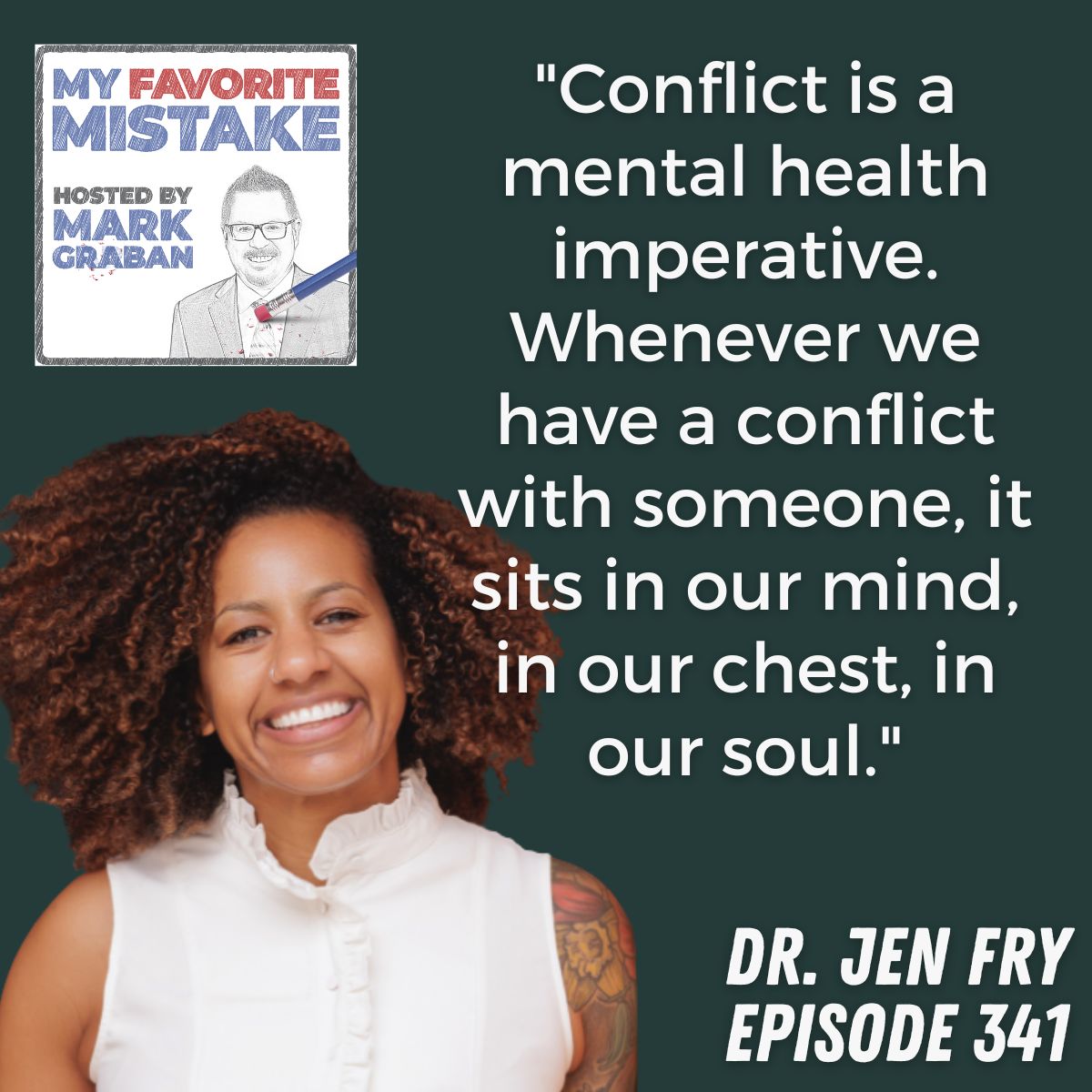
It's a book about self-advocacy, setting boundaries, saying no — all the things that people have a really hard time with but that drain them and affect them. Conflict is a mental health imperative. Whenever we have a conflict with someone, it sits in our mind, in our chest, in our soul. We think about it all the time. We talk to people about it all the time. If I can help people navigate that — not easier but simpler. It's a very simple thing, but it's not easy. If I can help them do it simpler, then I think I've done part of my job.
Why People Pleasing Wrecks Relationships, Reputations, and Results
Mark Graban: I'd like to dig into nice versus kind a little bit. Said another way, you're not a people pleaser.
Jen Fry: I was actually thinking about this. I think people pleasing wrecks relationships.
Mark Graban: Why is that?
Jen Fry: Because when people please, they do it and they're resentful. They might not do everything that they say they're going to do, so they're ruining their reputation. I like when people are like, well, I'm just a people pleaser. But if you're not fulfilling what you committed to, all you're doing is ruining your reputation. If you do it half-assed, all you're doing is ruining your reputation.
The people-pleasing part is — if you tell me you're going to go on a trip with me, and you just say yes to people-please me, and then within a week before the trip you say no, you're not people pleasing. You're making the situation even worse. That's why when people are like, I'm just a people pleaser, I'm like, you're not making anything easier. You're actually making things way harder because you're so resentful in the middle of doing it. You're not doing it to your best ability. You're not creating a great product. You're just like, ugh, fine, I'll do this. No one wants to work with someone who's doing that.
I'm not going to do something just because someone wants me to. I tell people I'm pretty hard to peer pressure.
Mark Graban: I hear more people using the term people pleaser with negative connotations. People saying, I'm too much of a people pleaser, starting to recognize that that's not good for them. Being a pushover. Doing things, not even being pressured — just rolling over. Or like you said, even worse, when the walk doesn't follow the talk.
Jen Fry: You now are ruining your reputation. People can't trust your word. To me that's even worse. It's like, oh, John will say yes, but he's not going to do it. Who wants that reputation? The whole people pleaser thing I think is far worse because of the output. And then we have to hear about how you're exhausted, how you hate doing it, but you're just going to do it. No one wants to hear that.
The Difference Between Nice and Kind — and Why It Matters for Leaders
Mark Graban: One other thought on nice versus kind. I've had a friend, Karen Ross, a guest in episode three of the podcast. We're paraphrasing what she's taught me — nice is about thinking about your feelings, not wanting to hurt your feelings. Kind is more about being helpful. I think that feedback you got about not cussing in your book title, that was kind. Otherwise, I might say, well, I don't want to hurt her feelings. I disagree with the title, but I don't want to say something. Niceness might not have been helpful. What do you think?
Jen Fry: I'll say this. White women are programmed to be nice. It is built into all aspects of DNA. White women are taught: we have to be nice. It means we don't say anything negative. We're worried about people's feelings. We don't hold people accountable. Niceness is keeping the peace. Niceness is, I don't want to be a problem. Niceness is, I don't want to speak up, and if you're going to speak up, I'm going to keep you quiet as well. To me, niceness does no one any good. There's nothing there.
Mark Graban: That niceness can be complicit with a lot of bad, harmful things.
Jen Fry: Yeah, because I don't want to hurt their feelings saying something, so I'm just not going to. I don't want people to be nice. Niceness does no good for anything. I want you to be kind. Kindness means you have to speak up. Kindness means you hold people accountable. Kindness is a very different way of thinking about stuff. It's a way of saying, I understand that this feedback might hurt your feelings, but I want to be kind and make sure you have it instead of you not being told the truth.
Being told the truth should override anything. People are so afraid of not being thought of as nice. We even see niceness weaponized — if a young girl says no to a guy, “oh, you're not being nice to them.” Nice in some ways means you don't have body autonomy. You can't say no, you don't give consent. We hear it with little kids. If a little kid says no to wanting to do something, the parent says, you're not being a nice kid. They should be able to say no. They should be able to have body autonomy. How is niceness always weaponized against us? People use niceness to try and force you to do things.
You don't think I'm nice? Okay. I'm going to sleep well in my king-sized bed with two fans. You're not going to use niceness to try and force me or bully me into doing stuff.
Growing Up Biracial and Seeing Two Different Expectations Around Speaking Up
Mark Graban: How were expectations for you growing up, or to generalize it, for Black women — how is that different than the generalization about white women?
Jen Fry: My mom was white. I grew up with my white family. I was a part of it. I saw what it looked like. I had a mom who was like, just be nice. It's okay. She would rather just not say anything, don't do anything. I grew up seeing this. I grew up watching it happen.
Think about whenever we see on social media — someone will say something really rude and somebody will be like, that's not right, and then someone else comes back and says, you're being a jerk, that's not nice, why would you say that? That generalization is from a lot of work across all aspects of it. That's why we see the stereotype of Black women being aggressive. That's where we see the idea of Black women being loud and all this — because we've had to push boundaries to get the things that we need. When we're in a room and we're the ones saying something, we're not being nice. We're not playing along.
I've literally seen a white mom, a white family, white sisters be placated by this whole nice idea, that they wouldn't say anything. And I had this Black family where we have to be strong and loud and assertive — not aggressive, but assertive. Niceness I see weaponized so much. I think it's weaponized against little kids in ways that can cause real harm. If a child says no — well, just be a nice kid, don't say anything. We've got to get rid of the nice term.
Mark Graban: Did you grow up then with influences from your dad's family and your mom's family to see that? Was there a pretty direct comparison?
Jen Fry: I grew up with mostly my mom's family, so I saw this in living color of what it looked like for white women — no arguing, no conflict, none of that. I saw it firsthand and what it looks like and what it feels like. I see so many times that conflict in families is thought of as bad. If you make waves, if you say something, if you disagree, it's a bad thing. The whole “just keep the peace.” I have a shirt that says “I've outgrown being the bigger person.”
When you're the bigger person, you're meant to just take everything. You don't get to say anything. “Well, just be the bigger person.” Why do we have to be the bigger person? The other person is sleeping well. They're sleeping great at night. But keep the peace — the person that keeps the peace has the hurt stomach. The person over there saying whatever they want is living their best life.
Mark Graban: Yeah.
Jen Fry: Many people think about coming from the holidays. How many people, especially women, were told to keep the peace? I guarantee a lot. “Well, you know, I know grandma says that, or uncle says that, but we only see them a little bit. Just keep the peace, be the bigger person. You're younger, just be the bigger person.” Forget all that.
Why Conflict Avoidance — Not Conflict — Is the Real Problem
Mark Graban: It kind of ties into something I was going to ask you about, related to the book. You argue that conflict isn't the problem — avoidance is. In workplace scenarios where people keep the peace, don't speak up when they disagree, that often just papers over fault lines or rifts. Then at some point things blow up down the road. Similar things can happen in personal relationships or family. How do you help people lean into the conflict? Is it a matter of approaching conflict differently? Instead of assuming all conflict is bad, is it a matter of how we go about it?
Jen Fry: I think it's two different things — personal versus professional. When we talk about conflict in the professional realm, it has to be the way leadership sets the bar. If I'm a person that is willing to engage in conflict and you are not, and the second I send an email that you feel is conflict and you go to your boss and your boss shuts me down — well, no conflict's going to happen. That's what we see with people who are willing to have the conversation. Another person goes to the boss, and the boss whose conflict-avoidant shuts it down immediately.
If you want to have an office where people can navigate conflict, and then as a byproduct innovate, you have to allow conflict to occur. But that means you also have to have guardrails around what that looks like. You can't just have a free for all. You have to have some type of guardrail. People don't think about it that way. If you have a boss who hates conflict, everyone's going to hate conflict.
Mark Graban: Right.
Jen Fry: That's the reality of it. No matter how much you are okay with it, if your boss doesn't like it, you will not like it. Because you can't. You can't get involved with it. Your job will be on the line because now you're the aggressive person. Now you're the problem. All of these things — you get put on a PIP and then you're out because you're trying to navigate conflict.
Disagreeing With the Idea vs. Feeling Personally Attacked
Mark Graban: There's an insecure leader or insecure colleague who will confuse disagreeing with the idea versus being personally attacked. The healthiest workplace environments, the ones that lead to the most innovation or success, are environments where we can disagree, people don't take it as a personal attack, we talk things through, or we collect data to figure out what is the best idea. Do you have tips on how to handle it when someone construes constructive feedback as a personal attack?
Jen Fry: I think the reality of the situation is that adults aren't being trained on how to give or receive feedback. There's this assumption that we know how to do it. We don't. You go and say, the way you designed this pen, I think it could be designed better. And the response is, oh, he hates me. They're just trying to help — the pen doesn't click the way you have it. People don't give very specific feedback, and I think the first thing is you give too general. If I have more and more questions, your feedback wasn't specific enough.
Another thing is sometimes feeling like you have to give feedback just because the opportunity is there — versus, do you have actual feedback that's going to make the thing, the person, the situation better?
Building a Culture Where Disagreement Happens Immediately
Jen Fry: One of the things I've really tried to work on is being excellent at receiving feedback. Good, bad, otherwise receiving it. As a person who has employees, I know I have a good culture of feedback when someone will immediately disagree with me.
Mark Graban: You're not even having to invite it.
Jen Fry: No. Because they've learned it's welcome. My chief of staff — I'll be like, I think the title of the book should be such and such, and she'll say, no, that's bad. I'll be like, okay, well then what should it be? I'm not offended. I'm just like, okay.
Ask yourself: if your staff takes forever to disagree — they have to get people behind them, figure out who's going to be the person to talk about it, when to bring it up, look at your schedule, pick the right day — “okay, this day's good, and you're going to start with ‘hey, things are going great, how was golf?'” If people have to strategize to bring up conflict, that's a problem. It should be in the middle of the meeting. “I don't agree with that. I think we should put the cheese on the left side versus the right side.” People should be able to disagree at a quicker speed versus having to build up the confidence and the strategy to go talk to you.
Mark Graban: It does sound like you have a good culture. If somebody was coming in new to an organization and they might not know that feedback is welcome, I think a leader should go out of their way to invite it. But thinking back to something you said earlier, like saying yes to the trip and then canceling at the last minute, that's way worse than saying no. What's just as bad is inviting feedback but not really wanting it, or inviting feedback and reacting badly to it. Sometimes people fool themselves. They'll say, oh, I'm open to feedback. No. Experience shows otherwise.
Jen Fry: They're open to feedback of what they determine is good feedback. You have to be genuinely open. I also own a tech platform, and let me tell you, tech has humbled me in ways I didn't know existed. You have to be really open for feedback and growth when you own a tech platform. After I pitch and if I don't win, I go to the judges and say, can I get feedback? What feedback do you have? I'll jump on a call because I want to know. I'm a person who thinks I should win everything. That's just what I think. Some of the feedback will hurt. I'm not saying that when you get feedback it doesn't hurt. Some of it's going to sting. Especially when you thought you did well. That's the worst — where you're like, yeah, I killed it, and then they give you feedback and you're deflated.
You have to be willing to take it, sit with it, process it, talk to someone about it. You have to be willing to open yourself up knowing that you might get feedback on something totally different from what you expected. Something that you thought you were a boss at, and you're actually not. It sucks and it hurts. But if you do want to be a boss at it, that's how you do it — by getting that feedback.
What Most People Get Wrong When Giving Feedback
Mark Graban: What are some of the mistakes people make in trying to give feedback? When feedback is open, when we're giving feedback to somebody who's open to it, we still may step in it. We still may go about it the wrong way. What are some things we shouldn't do?
Jen Fry: I think when you try to give super general feedback, that leaves someone with more questions. We're making a better pen, and the feedback is, the pen's not working. Okay, no kidding. What's the feedback? People don't give very specific feedback. The first thing is you give too general. If I have more and more questions afterward, your feedback wasn't specific enough.
Another thing is sometimes feeling like you have to give feedback just because the opportunity is there, versus asking: do you have actual feedback that's going to make the thing, the person, the situation better?
I also think about the idea of brutal versus empathetic. “I'm just going to be brutally honest.” But do we need brutally honest? If you're giving brutally honest feedback, how many people have actually listened to someone being brutally honest with them? Versus empathetic. A lot of times, brutal is just your emotions leading the way and you don't care about what you're saying to the other person. If I'm giving you brutal feedback, I don't care about anything. I just want to say what's going to feel good for me. Empathetic feedback — you have to think a little bit more, and that thought can save relationships. I'm giving this feedback because I want you to be better, versus I'm just going to say the thing because I'm annoyed or ticked off.
Mark Graban: That brutal feedback — I could see a dynamic where somebody shares valid feedback in a mean way, and then the reaction is negative toward the meanness, and somebody confuses that with, well, they didn't want to hear my idea. Maybe the problem was how you said it. We want you to speak up. We want you to feel psychologically safe to speak up and to be authentic. But that's not a license to be an asshole.
Defensive vs. Defending: A Critical Distinction for Leaders
Jen Fry: A hundred percent. Sometimes people take any questions as defensiveness. I did a podcast recording where I talked about defensive versus defending. Say we're in a dialogue and you're giving me feedback. If I ask any questions, I'm being labeled defensive. Then it becomes, “Jen, you're just being defensive. I'm just trying to give you feedback.” It becomes combative because the person giving the feedback doesn't know the difference between defensive and defending.
Defending — I'm going to ask questions. I'm going to ask for more clarification. I want a better understanding. Defensive — I'm trying to justify, I'm interrupting. Understanding the difference matters because many times when people give feedback, they want a monologue, not a dialogue. They just want to give it to you. And when you're like, “Can I have more? I don't understand” — “Oh, you're being defensive.” No. You just don't know the difference.
Mark Graban: You're making that difference very clear. When we think about speaking up in the workplace and we want everyone to have a right to share their view, to disagree with the boss, that doesn't mean everybody gets their way. The person you're giving feedback to has the right to disagree in return. That's different than trying to shut someone down. Defensiveness is more about wanting someone to just shut up now.
Jen Fry: A hundred percent. It's about shutting someone down and not hearing everything. You have a right to ask for clarification. But so many times people just want to give everything.
Why Anonymous Feedback Does More Harm Than Good
Jen Fry: When you are giving feedback from someone else and you're trying to anonymize the hell out of it, don't give that feedback. What happens is, say Mark and I work together, and I don't want to give this feedback to Mark. So I go to our boss, Stacy. “Hey Stacy, can you give this feedback to Mark?” Then Stacy goes to Mark and says, “Hey, I have this feedback. I can't tell you who it's from, when it happened, or what it's about. I can't tell you anything. I just have to give you this feedback.” That's not feedback. You're not allowing me any chance to respond to anything. You're just going with this person's story.
Mark Graban: Right.
Jen Fry: Without the details, I could say, well, actually this is what happened. Don't do that. If the person can't give the feedback themselves, don't be a sucker and be the middleman to give the feedback. Nothing positive will come from that. All it does is create a culture where everyone walks on eggshells. They don't know who they're going to get — anonymous feedback and all of that.
If the person says, “I'm afraid to talk to Mark” — why are you afraid? Are you afraid he's going to punch you in the face? Are you afraid he's going to cuss you out? What are you afraid of? Most of the time they'll say, no, it's not that. Well, then your fear is your fear. It's not Mark creating your fear.
What happens is someone says, “I'm afraid to talk to Mark,” and it makes it seem like Mark's the problem. Mark isn't the problem. The person who doesn't understand how to navigate conflict is the problem. Now they make Mark the issue, and HR comes in: “Hey Mark, can we have a talk? I've heard that some people are afraid to give you feedback.” That's not Mark's issue. That's those people's issue. That's how problems in the culture develop — because the manager isn't saying, “Hey Jen, I understand you're afraid, but you still have to have that conversation with your coworker.”
What Volleyball Coaching Taught Jen About Feedback and Leadership
Mark Graban: I wanted to ask from your perspective as both a volleyball player and as a coach. Were there lessons learned about receiving and giving feedback? I imagine if a coach said, “Hey Jen, you've got to hit more of your serves in,” it's like, okay, that's not helpful feedback.
Jen Fry: As a player, I was horrible at feedback. When I was in high school, I was the worst teammate ever. It was such bad. I saw a video of me when I was a junior and I was like, burn this right now. It should never see daylight. I was a bad teammate in high school.
The biggest thing I learned as a coach is that when you are bad at conflict, your team becomes bad at it. One thing we don't fully realize is when you become a leader, especially a new leader, everyone you're leading — sports, industry, whatever — is becoming your guinea pig. You go from being an assistant to now leading. You have in your mind: here is how these things are going to happen. But everything is theoretical. Once you actually get into it, you start to realize all the theoretical things you had planned — maybe you can't do them. How you want to train people, how you want to manage — everything was theoretical, and now you have to have the work behind it.
I learned really quickly that in the beginning phases, everyone's your guinea pig because you are tinkering with how things are actually going to be practical and realized. I wish I would've known that more. And that you have to give very specific feedback to be successful. If you want to be successful, you have to be very specific with your feedback so that people can trust your word. They can trust that the feedback is going to be specific and going to help them.
Watching Yourself on Video and the Humility of Self-Awareness
Mark Graban: What did you see of yourself in that video? I'm guessing it wasn't about your form and how you were playing, but something about how you were treating teammates.
Jen Fry: It was more about how I reacted to my mistakes and their mistakes. I just wasn't being a good teammate in my reactions. Now when I talk to people, especially young athletes, I tell them that they have to work on being a good teammate, and it's all about managing their emotions.
Mark Graban: In a team setting, players get upset about not playing as much as they think they should, not being the starter, maybe being the best player on the team and other people not pulling their weight. There are a lot of causes of conflict beyond just interpersonal conflict.
The Role of Parents in Team Conflict — and Why They Should Stay Out of It
Jen Fry: There are so many conflicts now. It's rampant. So much of the team conflict — a high percentage — comes from the expectations that parents have, and those expectations drizzle down to their athletes. Parents are always like, “When should I talk to the coach?” I'm always like, never. You shouldn't be talking to the coach.
We had one parent on a thread who was talking about how this kid is sad about not playing. We were all like, that's not even your kid. Go talk to the coach. Because what if the coach says, okay, I'm going to play Sarah over your kid? What now? What are you going to do?
Parents want to come in and save so much. You can't. I understand you have expectations, but you can't save it. A lot of expectations for their kids, for money, for the experience — it just leaves a lot of parents frustrated and burnt out.
The Letter That Changed Everything
Mark Graban: Hopefully getting better at leaning into conflict, doing it the right way, giving and receiving feedback, setting boundaries — the things that you write about and talk about — are helping a lot of people. Go check out Dr. Jen Fry and her website. There's a lot there about her work and speaking and different services. JenFryTalks.com. There will be links in the show notes. Thank you for sharing your story, what you learned from it, how it helped impact the work and the impact you're having on others. Really appreciate you being here.
Jen Fry: I will always say: Sarah sending that letter has completely shaped how I feel about friendships. It shaped how I view reconciliation. It changed me in so many beautiful ways I didn't even realize it would. I hope that anyone listening to this — if a friend reaches out to them, at least take the call. It is a really hard thing to do when someone has hurt you, frustrated you, whatever it is — to take the call and have the conversation. Because time can help things and space can help things. That's my hope for people.
Mark Graban: That's great. Thanks again, and congratulations on the launch of the book and best wishes for everything you're doing this year.
Jen Fry: Thank you, Mark. I appreciate that. This has been an amazing podcast. Thank you.