
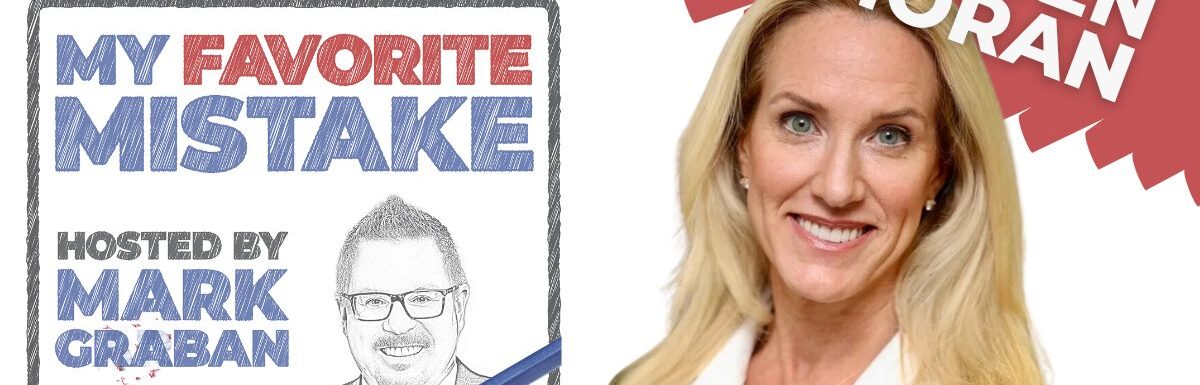
Dr. Jen Moran's favorite mistake was buying a dental practice her attorney and accountant told her not to buy. They quit when she went ahead. The appraisal came in at about 5% of the asking price and gave the practice's goodwill no value at all. She saw patients and staff worth building on. Her second mistake, an impulsive technology purchase, was the one she had to undo — and how she did it shaped her reputation.
Listen:
Check out all episodes on the My Favorite Mistake main page.
My guest for Episode #369 of the My Favorite Mistake podcast is Dr. Jen Moran, an AACD board-certified restorative dentist who founded Water Tower Dental Care in Chicago in 1997. She spent 17 years away from practice raising her four children and overcoming breast cancer. Today she sees patients at Water Tower again and at Hinsdale Dentistry. She also runs JMK Wellness, where she shares the oral health and wellness products she uses herself.
By everyone else's judgment, Jen's favorite mistake was buying the practice in the first place. She had spent four years as an associate at two practices and was a single mom carrying school debt. The practice for sale in Water Tower Place ran on the lowest tier of dental insurance, a capitation plan that paid the dentist about $2 a month per enrolled patient. It looked busy but didn't turn a profit. Her attorney and accountant told her not to buy it, then quit when she did. The appraisal came in at about 5% of the asking price and gave goodwill no value. She paid roughly half the asking price, and her parents co-signed the lease.
What the appraisal couldn't see was the people. The practice had patients from Leo Burnett, DDB Needham, and Boeing who were happy with their care, and a hygienist whose skill and rapport impressed Jen on her first visit. Over the next several years, Jen moved patients off that insurance in stages, working directly with HR departments at their employers, until the practice was fully fee-for-service. She says that for the first few years she expected it to fail nearly every day. She credits luck and location along with the plan.
Her second mistake carries the sharper lesson for leaders. Around 2003, she bought an early CEREC same-day crown system without doing much research, trained her team, and placed about 50 restorations. She didn't trust their fit, seal, or appearance compared with lab work. So she sold the machine back at a 50% loss and redid every one of those restorations at no charge. She didn't conclude that new technology is bad. Water Tower now runs three CEREC machines. She concluded that she should read the reviews and talk to dentists who have used a system before buying it.
We also talk about the business coach who taught her about KPIs, profit sharing, and treating the team as part owners; the monthly team bonus tied to practice productivity; her concerns about private equity ownership of dental practices; why dental work done overseas so often needs repair; and the right way to use a sonic toothbrush (hold it still and stop scrubbing).
What You'll Learn:
- Why an appraisal can value goodwill at zero when the patients and staff are what make a business work
- How a practice on capitation insurance can look busy and still not make money
- How she moved patients and their employers off low-tier dental insurance and onto fee-for-service care
- What a business coach taught her about KPIs, sharing profits, and trusting the team
- How a monthly bonus tied to practice productivity gives every team member a stake
- Why she took a 50% loss on new equipment and redid about 50 restorations at no charge
- How she evaluates new technology now while still pushing to try better methods
- Why she believes private equity ownership tends to push out long-tenured, highly skilled staff
Scroll down to find:
- Video version of the episode
- How to subscribe
- Quotes
- Full transcript
Find Jen on social media:
Watch the Episode:
Memorable Moments from the Conversation:
Click on an image for a larger view
Subscribe, Follow, Support, Rate, and Review!
Please follow, rate, and review via Apple Podcasts, Podchaser, or your favorite app—that helps others find this content, and you'll be sure to get future episodes as they are released.
Don't miss an episode! You can sign up to receive new episodes via email.
This podcast is part of the Lean Communicators network.

Other Ways to Subscribe or Follow — Apps & Email
Episode #369: Dr. Jen Moran, Dentist and Founder of Water Tower Dental Care
Mark Graban: Hi, I'm Mark Graban. Welcome to My Favorite Mistake. Our guest today is Dr. Jen Moran. She is a board-certified restorative and cosmetic dentist in the Chicago area, and she founded Water Tower Dental Care back in 1997. She practices there and at Hinsdale Dentistry. She is also a painter and scenic artist, a mother of four, and a breast cancer survivor, and she is the founder of JMK Wellness, where she shares the oral health and wellness products she actually uses and recommends.
So, Jen, thank you for joining us. How are you today?
Dr. Jen Moran: Oh, thank you, Mark. I'm glad to be here, and I am doing well. It is crazy hot in Chicago today, but luckily today I got my air conditioning repaired, so I'm doing well.
Mark Graban: That's bad timing for an air conditioning problem. Or maybe that's just when we're more likely to discover it, when it's hotter.
Dr. Jen Moran: Could be that, too. Could be just bad timing, yeah.
Mark Graban: Okay. Well, I'm glad things are better. You have no trouble remaining cool under pressure. I don't think there's pressure here.
Dr. Jen Moran: Hopefully.
Mark Graban: On the podcast, you're smiling and ready to go. We like a dentist who smiles, right? That's a good sign. So there's a lot we're going to talk about in the episode, but first off, I'm curious, from your career, what's your favorite mistake?
Buying a Dental Practice Everyone Said Not to Buy
Dr. Jen Moran: So I have two in mind, and I think really the bigger one, my favorite mistake, was going ahead and buying Water Tower Dental Care. It was a dilapidated DMO practice where both my accountant and my attorney said, “Bad choice. Don't do it. If you do it, we quit.”
Mark Graban: So what's a DMO practice, real quick?
Dr. Jen Moran: A DMO practice is a practice that is only surviving on the lowest level of dental insurance. It is like an HMO, where you sign up and you have a list you can go to. That doctor gets $2 a month for every patient that signs up, and then gives free cleanings and free X-rays. So really the bottom line at this practice was almost negative.
Mark Graban: So you were getting that advice not to do it. Give us some of the context then. You were just out of dental school, is that right? And why would they have even…
Dr. Jen Moran: No, I had done an oral surgery externship after, and then I associated for two years at one practice, and then I associated for another two years at another practice. At that point I decided it was time to buy my own, so that is when I started looking. I looked at a few different practices, and this one I found because my friends had just looked at it, and they said, “You know what? It wasn't for us, but why don't you go look at it?” And I made an offer over the phone because it sounded like it was exactly what I was looking for, and they said, “Come on in. Let's go take a look at it.”
Mark Graban: And so the advice you were getting was pretty clear, if they were saying they weren't going to work with you anymore. Did they just think that type of practice was an inherently bad business model to be buying into?
Dr. Jen Moran: Yes. They saw it as something that wasn't going to be profitable. So if you're an attorney, an accountant, and a bank — a business that is not currently profitable, that is asking a six-figure number to purchase it, because it had the appearance of being busy. There were patients coming in, patients coming out, dentistry getting done, employees being paid, but it did not actually turn a profit. It was not decorated well. It was 1970s shag carpeting. It still had the little window where the receptionist hid behind it. There was nothing about it that spoke to anybody but me that this was a good business move.
What She Saw That the Numbers Missed
Dr. Jen Moran: So basically, Water Tower Dental Care, which was Water Tower Dental Associates at the time, did not speak to anybody as a good business decision besides me. I had a gut feeling. As I went to see the practice, I saw the shag carpet, I saw the paneling and the un-updated equipment, but what I also saw was amazing patients coming in and out and a competent staff.
Now, the doctor was ill, his nephew was running the front desk, he had a temporary hygienist at the time, which I didn't realize, and it was a temporary assistant. And I saw this hygienist working so well, with such charisma and such really technical skill, that I was blown away by her. And I was watching executives from great companies — Leo Burnett, DDB Needham, we had Boeing patients — all coming in with this really low-level insurance but getting good work that they were happy with. And by good work, I mean good cleanings. The dentistry itself was leaving a bit to be desired, but the doctor was fun and lovable, and everybody liked him when he was there.
So I saw it as an opportunity to come in and really educate not just the patients, but the companies that were providing the insurance, in a better way to help their employees care for their teeth. And it really spoke to me on a strong level, on a gut level. At that point, I was a single mom with nothing but school debt, so I felt like I had nothing to lose. Somebody was going to buy it, so why not me? And I decided to pursue it despite all the advice not to.
Mark Graban: So it seemed like a better opportunity to buy a practice and take that chance than to just continue as an employee in someone else's practice?
Dr. Jen Moran: Yes. At that point, for four years, I had learned what I wanted to do and what I did not want to do. The freedom to make those decisions yourself, when you've spent so much time educating yourself and developing your skills, to be able to practice your way, was really important to me at that time. And then to be the one, sink or swim, that was solely responsible for the success or the failure of your endeavor, whatever it was, whether it was a dental practice, a medical practice, a small business — I wanted that. I wanted to be the one solely responsible and on the hook.
Mark Graban: So you saw it as, I don't know, think of it as a parallel to a house and these shows we might watch, like a fixer-upper opportunity? That was part of the vision, to come in and — it's like, oh, we can redecorate an office.
Dr. Jen Moran: Yeah. It was something where, even though I still paid a premium over what it was valued at, it was still a price I could afford. I did go to a few banks and I got turned down, but I went to one, and he basically said, “Give me 10-year projections over all your expenses and how you're going to pay this loan.” And it was kind of this sweetheart, slid-the-paper-across-the-table, like, “She won't be back.” And I was back, right? I came back with my thoughts and my projections based on the numbers I had. I could get into this practice, which in my opinion, with a smart plan, had so much potential to be something way beyond what it was that day.
Her Advisors Quit and the Appraisal Came In at 5%
Mark Graban: You've really got me intrigued here, because we're at a point in the story where you're making a decision against advice. You might be overpaying for the business. So I want to hear how it played out. First off, did the accountant and the lawyer follow through on their…
Dr. Jen Moran: They left. They said, “Nope. We've got this place's number. It's a bad choice. We don't want to be a part of it.” So I hired a different attorney and a different accountant.
Mark Graban: That's easy.
Dr. Jen Moran: Yeah, it's easy enough, you know? And so I had it appraised. It was appraised so low. It was appraised at about 5% of the asking price. So basically, just like in many businesses, they broke it down to the hard goods: what the equipment was worth at that time, what the lease was, and then it had goodwill, which they put at zero value.
They didn't know the goodwill was the gem. That was the diamond in the rough. They did not realize. The goodwill is happy patients with great incomes from great companies coming in on their lunch hours during the day. We are working four days a week from 7:00 to 4:00. This is a great place to be. And they just couldn't see it.
So they left. I managed to do it with other people. I got my bank loan. I paid so much. I paid about 50% of their asking price, but remember, it was appraised at 5% of the asking price.
Mark Graban: Sure.
Dr. Jen Moran: So I paid that amount, and I got my 100% loan, and they said, “Okay, do not shop in the mall until this is paid off. You go up and down this service elevator.” And I did that. And it was two years to educate the patients off that insurance and talk to the HR people at the companies, and then it was two years off the next, two years off the next, until finally we were what's called fee-for-service reimbursement. So we're not on any list. You come to us, you pay us, your insurance writes you a check. And the only way you can do that is to give them such good care and treat them so well that they are willing to stay with you and would not get the same level of care anywhere else. And that became our motto on day one and has not changed to today, even though I was missing for so long.
Mark Graban: So I'm familiar enough with Chicago that the Water Tower name is familiar. This was literally in, or still is in, the Water Tower shopping center? Not just nearby?
Dr. Jen Moran: It is. So the ninth floor of the professional suite is in Water Tower Place. You do not ride up the beautiful glass elevator. There is a different professional suites elevator around the other side of the main floor, and you have all different types of doctors and dentists, and there's a jewelry store up there. That's the only retail. There's a pharmacy. Northwestern has a surgicenter on the floor. And it was right there, and we overlook Michigan Avenue, the Mag Mile. In 1997, when I purchased it, I mean, it was the place to be.
Mark Graban: Correct me or fill in if there's a layer to the story I'm missing. So it sounds like this is in the category of a favorite mistake where everyone else was calling it a mistake, but you made it work.
Dr. Jen Moran: Yes.
Mark Graban: We don't get many of those on the show. I love that version of a favorite mistake story. By whose judgment a mistake?
Dr. Jen Moran: Yes.
Mark Graban: Well, good. In the waves, in the ups and downs of a business, was there a time in the early years where you thought, “Oh my God, they were right, this is a mistake”? Or did you just keep seeing the potential and keep working at it?
Dr. Jen Moran: I think it was nose to the grindstone right away. I had this huge loan, I had a daughter, I had my school loans, and then just to sign the lease, I needed my parents to co-sign. So now they're on the hook. They didn't have to put money down, but if I did not make my lease payment, they were going to go after them. And they were not wealthy people. They basically put their house up because they believed in me. They believed that if I thought this was going to work, I would make it work. So probably every single day for the first few years, I thought it was going to fail.
So just keep going. Just keep going. Make sure you can make it here. Make sure you can make it there. I begged that hygienist to stay with me. She stayed with me for maybe seven whole years, right? And she was a huge help in that development of the practice.
The Business Coach Who Changed How She Led
Mark Graban: Now, at one point you hired a business coach.
Dr. Jen Moran: Yes.
Mark Graban: Tell us about what led to that, and hopefully that helped.
Dr. Jen Moran: So I may be her favorite mistake. I was at a course. I don't know which one. Let's say maybe it was an AACD — the American Academy of Cosmetic Dentistry — course. It could have been a Hornbrook course, and I saw Jen speak. Jen Robertson was up there speaking about things like KPIs, as they're called today. We were not calling them KPIs. Treating your team as part owners of the practice, sharing the profits, training them, and trusting them. She was talking about using softer language, understanding your patient, understanding how they think, understanding your employees, and how to hire using different types of personality testing.
She was bubbly, she was bright, she was intelligent, and at the end of this lecture, I walked up to her and I said, “I have to work with you. I have to have you as my coach.” And she's like, “Well, here I am in Laguna Beach, and I have this beautiful territory. I can't come to Chicago.” And we proceeded to talk the rest of the night, and she said, “And I'm quitting, and I'm coming to Chicago, and I'm going to be your coach.”
And so she left the management group she was with. She started on her own, and she came to be my coach. And together we grew Water Tower. Now, she was not a partner. She was paid as a coach. But she was so integral in my understanding of how to treat both the patients and the team, and understanding what motivated them. She kept us alive, and so many of those systems are still in place today.
What Dental School Doesn't Teach About Running a Practice
Mark Graban: Well, that's great. I've talked to a lot of different types of medical providers on the show, from different clinical backgrounds, and one of the common themes is that, like in your case in dental school — fair to say you really don't get taught much about running the business? The focus is on the clinical care.
Dr. Jen Moran: Oh, that's 100% true. I don't know if it's different today.
Mark Graban: I have a friend who's a veterinarian and says the doctors of veterinary medicine come out of school today in that similar situation of, “Well, the business part, you'll figure it out.” That seems to be the approach. Now, I'm sure there are books and seminars, and I've had some people on the show that tried to figure it out as they went, and they failed the first time, but they learned from it and succeeded in their second practice. I'm glad your story was making a success out of the first.
Dr. Jen Moran: And there was no real good reason why mine would succeed over anybody else's. Probably a little bit of luck, definitely choosing location, and maybe doing things a little bit differently. At the beginning, we were not bottom-line driven at all, and we went to the HR people at those big companies, and I think that was a big help. They were so willing to listen. Dentistry is such a minor piece of the overall benefits package that they were just randomly picking whatever seemed to cover the most, not really understanding what they were getting or what they were offering to their employees, when in their heads they were offering something really wonderful. So it really helped, and they were very receptive to speaking to us.
Why the Dentist-Owned Practice Model Matters
Mark Graban: So it sounds like part of the strategy was trying to improve the environment, the design of the clinic, building on strengths of what sounds like some great people, and the change in the insurance. And it sounds like now restorative and cosmetic dentistry is steps above in terms of the level of services being provided, and a better business model?
Dr. Jen Moran: No. The dentistry we offer is really the same dentistry that is offered in most dental practices. We offer dental hygiene. You come in, you get your cleaning, you get your X-rays. You can get your teeth whitened. Restorative basically means if you have something wrong with your tooth or part of your tooth, we'll repair it. So we'll do fillings, we'll do sealants, we'll do onlays and crowns and bridges and veneers and full-mouth rehabs and implants, right? So we do it all. We do have more training in the anterior aesthetics and the understanding of the functionality in it, but it's not a specialty. We're general dentists.
It is merely a better practice model. The type of insurance we allow to dictate the kind of treatment we can provide — and that's a big problem, not just with insurance right now, but with corporations owning dental practices. When you get outside business investors involved, it limits your ability to maybe pay that front desk person a little more than market value because she's been there for 30 years and she knows your patients. They come in and they fire her to hire somebody off the street and pay them less, and now the overall environment changes and you start to lose patients, and they don't see that as, again, the goodwill of the practice. So to have that dentist-owned private practice is the model that's better.
Private Equity Pressure and Sharing the Gains With the Team
Mark Graban: As I've moved and found dental care in a few different cities, I tell you, I gravitate toward the private practice — a solo dentist or a small team of dentists, where it's a practice. You see more and more of what look like brand names of chains, and these might be private equity-owned companies that go out under a brand name. I've gotten care at one of those in different cities. Tell us more about the competitive pressure. How have you had to adapt to keep thriving as a solo dentist-owned practice?
Dr. Jen Moran: So I'm not an owner right now. I am an associate right now. I did sell the practice and stayed home to raise my kids, and then went back. But I know that both practices have built themselves such a reputation that they don't feel threatened by patients leaving for perhaps a lower-priced or better-hours kind of practice. Occasionally you'll have one that'll leave, and then they'll be right back. And so the threat comes from them wanting to purchase the practices.
Now, neither owner has told me that they've been approached, but I'm sure they have, and I'm sure the temptation is there because of the outlay of cash they are willing to give you upfront. Dentists are usually hardworking people that earn a nice living. They are not severely wealthy. They are not the biggest house on the block, the nicest car, but they are doing well and taking care of their families. The big companies come in with numbers that are multiples of eight, 10 of your EBITDA, which is a number I didn't even know when we were starting this practice. But that's a number that is thrown around a lot now. That's the temptation — that you will be so tempted to give in and change that private practice model, which in my opinion, and in most opinions, will in turn hurt patient care.
Mark Graban: And might not be good for the employees?
Dr. Jen Moran: Definitely not.
Mark Graban: You think definitely not?
Dr. Jen Moran: Yeah. I think that they come in and the value is not there, that they don't care about the employees as much as the bottom line. You know, “Why is this one making $30 an hour when she could be paid $25 an hour?” And we could say, “Well, because she's designing CEREC crowns by herself, and then she stains them and glazes them, and has been doing it beautifully for 20 years and honing her skill.” And they come in and they're like, “Nope, assistants don't make that kind of money.” And that's a different story.
We offer a beautiful bonus system where, depending on the overall productivity of the practice, they can get an hourly rate increase — not total, but for the month. So it goes back over the month and says, “Okay, everybody gets an extra $3 per hour for last month.” So everybody has a little skin in the game, and I don't know that any private equity practice would come in and say, “Hey, that's a good idea. Let's just take a little off that bottom line and share.” I don't think that's how it works.
Bonus Mistake: An Early Same-Day Crown Machine
Mark Graban: There are other questions I want to ask you about the landscape of dentistry and cosmetic dentistry, and maybe think about it from the standpoint of those of us who are dental patients. But you mentioned up front that you had two mistakes. Can we get a bonus mistake story?
Dr. Jen Moran: Sure. This one is maybe a little more techy. I love new technology, and in about — I might get the year wrong — let's say about 2003, the first CEREC machine came out. The pitch was: we can do same-day crowns, same-day inlays and onlays, no more temporaries, make them right in the office. They'll be beautiful, same material. So I bought the first one, and it was a huge purchase. I remember when I wrote the check, I thought, “Ha, that's the biggest check I've ever written,” right? It wasn't a loan. It was a huge check. Bought the technology, trained the team, and it was like having the very first Pong game on Atari in, like, 1992 or whatever it was.
Mark Graban: No, it was the late '70s. I'm old enough to remember.
Dr. Jen Moran: Oh, whatever it was. I just remember the little green dots. If you remember, it was on a black screen with green dots, with a syringe foam trying to capture what we're used to getting in an impression, to then mill it in the office and then place it in the patient's mouth.
We put about 50 restorations in, and I couldn't sleep at night. I didn't think they were sealed as well as the lab would make them. I didn't think they sat as well. They didn't look as good. They weren't as shiny. And I sold that machine back for a 50% loss and redid all the restorations I put in at no charge to those patients.
So that was a big mistake financially. It was a big mistake because it was impulsive, and I didn't do my research, and I didn't wait to see what the technology would do. But it was my favorite mistake because it really solidified for me what kind of dentist I was, where my integrity was, and it really helped my reputation with the patients. Every single patient, I said, “Hey, you know what? Thanks for letting me use that new technology. The more I think about it, the less I like it, and please allow me to put something better in at no charge to you.”
Mark Graban: Wow.
Dr. Jen Moran: I feel that earned a patient for life. They were very happy to have that.
Mark Graban: Oh, I bet.
Lessons on Being an Early Adopter
Mark Graban: And I'm sure you were not the only dentist who made that same purchase based on the pitch and the promise and the appeal. Sometimes with technologies, people say never buy the first generation of a technology. Or even like with a car — I grew up around the auto industry — never buy a car the first year it's out, because you've got to work the kinks out. It's going to be better. We know with our phones, there's always going to be new features, and maybe you're better off waiting a little bit. Was that part of it, being too early of an adopter?
Dr. Jen Moran: That was totally it. Yes. It was early. The concept was great, and honestly, today we have three CEREC machines, and everybody is using scanners. As it evolved and was given feedback by the dentists, it is a much better product. At Water Tower we do a lot. We're even doing front-teeth veneers with the same-day technology — the same concept that I had purchased back in 2003 — but now we're on, like, the 100th iteration, and it is a fine-tuned, good product. I was a little resistant at first, but it is there, and it's exactly what it was supposed to be doing 23 years ago.
Mark Graban: Well, I'm glad. It sounds like your takeaway from that mistake was not to say technology is bad or don't try that again. There are probably always newest, latest, and greatest technologies coming out, and it sounds like it's probably made you cautious about being a super-early adopter.
Dr. Jen Moran: Yeah. I do love the new technology. I probably take a little more time to read the reviews now and talk to doctors who have used it. I do like to try things, though. I do always want to try something different, something better, in every single procedure. It probably drives my clinicians, my assistants, nuts, but I think they also appreciate that it's always trying the better thing.
Sonic Toothbrushes and the Mistakes Most of Us Make
Mark Graban: So there are new technologies. Most everyone has probably transitioned from traditional X-rays to digital X-rays.
Dr. Jen Moran: Oh, yes. We had done that even before I sold the first time. Digital X-rays are even better today. They are just as clear as any print ever was, and I would say far better. And they're fast. There's so little radiation involved. It's wonderful.
Mark Graban: So a lot of these technologies have a clear benefit for everybody involved. I'm trying to think how long ago — it was probably 15, maybe 20 years ago — I had a dentist recommend what was, at least to me at the time, a new technology: an ultrasonic toothbrush. Is that at this point a proven technology, or is it just, if you want to, it's okay?
Dr. Jen Moran: I think everybody should have an ultrasonic toothbrush. I think the Sonicare toothbrush technology is saving teeth. It is the reason we have fewer dentures in the world. It is so good. The newest one, the stroke on that is 61,000 strokes per minute.
Mark Graban: Wow.
Dr. Jen Moran: You couldn't brush like that if you tried, right? And it really makes a difference. When you're really using your Sonicare and you're using it correctly, for two minutes, at the gumline, you can't go back.
Mark Graban: You mentioned one of those possible mistakes that, gosh, I'm probably making too: not positioning or angling the toothbrush properly, right? When you say the gumline, that might be higher up than you might think it needs to be.
Dr. Jen Moran: Yeah, it sounds funny. You're not actually putting it up onto your gumline, but you are angling it so that the bristles are cleaning the most critical part, which is that piece where the gums meet the tooth, right? They're not attached, so for at least one to three millimeters they're just sitting up against the tooth, and you want to get in there. So come right along that angle. A couple of bristles will be on the biting surface and a couple of bristles will be along the gum, and you can even close your eyes and feel it. So just feel that you're getting all those areas along your gumline, all the way in the back, all the way on the inside, and you will have a cleaner mouth.
Mark Graban: And then a mistake I make, after having grown up with manual brushing: is it a mistake to be moving the Sonicare? I see your eyes widening, for those who are just listening. You're really supposed to keep it in a zone, move it very slowly, and let the brush do the work?
Dr. Jen Moran: So it'll give you two minutes. You just hold it. Hold it still, because it's vibrating up and down, right? All those strokes are doing their work. So if it's two minutes for your whole mouth, it's 30 seconds per quadrant, and it stops. It gives you that pulse, right? So outside upper, move it around, inside upper — 30 seconds each quadrant. You don't have to scrub. Now, we all want to do just a little. I even catch myself. And on the newer Sonicares, if you notice the end lights up, that means you're pressing too hard.
Mark Graban: Okay. I've had one of those that gave a little bit of pulse feedback if you were pressing instead of letting it… And I've even had one — and these don't last forever, the batteries conk out or something happens — where there's a pulse every 30 seconds as that prompt to move.
The $499 Dyson Toothbrush
Mark Graban: Have you seen the press release? I just happened to see an article the other day about this new Dyson toothbrush.
Dr. Jen Moran: That baby has been on my feed in two different group chats. I have, and I didn't get to do a deep dive, but as I looked at my chats, this is what I learned, and correct me if I've missed something. It's a sonic toothbrush. It has a camera that will show you what you're looking at on your app.
Mark Graban: In your mouth. A camera in your mouth.
Dr. Jen Moran: Yes. In your mouth. And it is a water flosser as well. As everybody said, it's ugly, but so what, right? We all want to try it, but nobody wants to spend $500 on a toothbrush. So that's what I know about it.
Mark Graban: $499.
Dr. Jen Moran: $499.
Mark Graban: And of course, in this day and age, it claims that there's AI technology that helps direct the water jet stream to the right place within your mouth. It'll be interesting to see. With the Dyson vacuum cleaners, everyone thought it's an outrageous price for a vacuum cleaner, so I'm pretty sure…
Dr. Jen Moran: But it works, right?
Mark Graban: …we'll buy them. The fans, the different technologies. Maybe the price will come down over time. I'll tell you, I'm not tempted by a $500 toothbrush.
Dr. Jen Moran: I am. You know what? I think Dyson should send them to us, don't you think? We'll test them for them.
Mark Graban: You're more qualified to evaluate that. If you try one, send me a note. I'd love to hear your follow-up, or if you post a video review online.
Dr. Jen Moran: I will.
Veneers, Lumineers, and Getting Dental Work Overseas
Mark Graban: Another change in dentistry, or technology if you will — maybe there are two dimensions to this. One is the big, super-white veneers, and the other is that some people are traveling overseas or to Mexico to get that work done. How often are people making a mistake, in your judgment, either in terms of what they're putting in their mouth or where they're going to do it?
Dr. Jen Moran: So you would have to judge the mistake on that particular patient's experience, right? At Hinsdale Dentistry, I am taking over for a Lumineers doctor, and Lumineers were a thin, very opaque product. Kind of like Kleenex to a veneer. It's not really a different product. It's a veneer. There are many patients that are very happy with very opaque, Chiclet-looking Lumineers. Very happy. And they want them again. They'll see a video of somebody with Lumineers, and they want them just the way they are.
So are they making a mistake? Only if they're put in poorly. If there's marginal leakage, if they are causing occlusal trauma, if the bonding isn't well and they're cracking and falling off and causing gum disease, if the cement is not cleaned off, then yes, that's a mistake that is causing them health detriment. If they're happy and they're healthy, it's up to them to determine if it's a mistake.
Now, today, I believe that is a less universally desired look. I personally prefer beautiful dentistry that looks like beautiful teeth. I don't want you to say to anybody, “Hey, good veneers. You got your teeth done.” You want, “You have a beautiful smile. I love your teeth.” So that's my goal with the lab work we do. I just put a case in today that was so beautiful, almost profanity came out of my mouth. Luckily he was a friend of mine, and it may have come out. But it was so good, I had to take a picture and send it back to the lab. And this was a different product I hadn't used. It's called LiSi, and it just had such lifelike qualities. I was thrilled with it. And at the end of the day, that's what I really want.
So are they making a mistake? It's totally up to them. I think if you're picking a dentist today that is only doing that kind of dentistry, that may be a mistake. You might want to look at their work and say, “Hey, show me some of your current work,” and see if it matches.
The overseas piece, I would say, is almost always a mistake. The reason it's cheaper is because they don't have the same regulation and standards of care. They don't have the same qualifications, education, certification, and that's a problem. You hear a lot about the kids on TikTok looking at Turkey teeth, where you went in to get something which could be maybe a no-prep veneer by somebody who has extensive training, and it turns into a completely whittled-down crown tooth that isn't adhering and it's coming off. You need root canals, you've got gum disease, because there wasn't that education and regulation. So every single time somebody goes overseas for their dentistry, I would say that's a mistake.
Mark Graban: Do you end up doing any sort of repair or rework or redo?
Dr. Jen Moran: Yes. So there's something called biological width, which is a very distinct measurement from where the end of a restoration can be to where the gum attaches to the teeth. And when you don't have training and you just go in there and start drilling and slap a hunk of porcelain on a tooth, and it gets deep under the gumline, now the gums cannot heal without surgery. So the gums are now impinged upon. They're always swollen. They're always bleeding. There's nothing the patient can do. That's one of the biggest problems, despite the fact that they may look bad and fall off easily.
So yes, a lot of redos. I had one poor girl whose dentist — which was not a dentist, it was a veneerist in Miami, in the United States — in mid-prep, while she was in temporaries, got closed down. And she came to us to finish, and we couldn't discount it enough that she could truly afford what a veneer costs, and here she was in temporaries. So I hope she comes back and we can do something to help her.
A Dentist's Own Veneers: Function Before Aesthetics
Mark Graban: Your teeth look great. Do you mind if I… It's probably fair game to ask a dentist: what kind of work have you done on your teeth? You have naturally straight, nice-looking teeth.
Dr. Jen Moran: So I'll tell you, that's why I'm a dentist, right? I had peg laterals growing up. My side guys here grew in like little points instead of rectangles. And so I had bonding as a kid for years, and it would break off, and he would say to me, “Someday you can have veneers. They're made of porcelain.” So in dental school it was new, and I had one of the prosthodontic professors give me four veneers. I wish I had a picture I could send you. They were hideous. They were yellow. They didn't match each other, but they were veneers, and we were all excited. First technology.
Mark Graban: Early adopter syndrome again.
Dr. Jen Moran: Yes. And I was so happy I didn't have these little pegs anymore. And then many years later at Water Tower, after I had taken many courses and restored many smiles, I said, “Well, now it's my turn.” So I did 10 veneers — that's the standard. You want to veneer what's in your smile so that when you're smiling and talking, you don't see different colors of teeth, and there's no drop-off.
So I did those, and I was missing a piece in our education. While I was at another advanced cosmetic dentistry course, my front tooth broke, just right down the center. Cracked off, and it was just from my bite. So I became an example to everybody about how function has to lead the aesthetic. It was the way my bite was that caused that to happen.
So after that I had Invisalign. I actually had braces first, full bracketed braces over that set of veneers, and then I did this set of veneers, which are now 16 years old. So my top 10 teeth are veneers — let's call them porcelain restorations, because the difference between a veneer and a crown is really how far up the backside they go. Most of mine go all the way up to the gumline on the backside, because I had to change my bite and add some width. And with good care they can last a really long time. We expect 15 to 20 years, and I'm on year 16.
Mark Graban: Okay. Well, you're expected, as a dentist… You're taking care of your teeth.
Dr. Jen Moran: You would hope, right? Not all do, right? You would hope.
Mark Graban: Sure. Looks like it.
JMK Wellness
Mark Graban: So again, Dr. Jen Moran, as we wrap up, tell us a little bit about JMK Wellness and what that company is.
Dr. Jen Moran: Ah, so it's new. I felt every single day I was being asked, “Well, what toothpaste should I use? What floss should I use? What should I do?” And I was saying the same things over and over every day. And I just thought, “Well, let me put a site together.” I already had a website, so I said, “All right, let's put my favorite things together.” And then it turned into, “Well, do you use that red light mask? Do you use that lotion?” So I just started putting together things that I loved after testing them personally, and it's starting to grow, and we're developing our own product, and hopefully it continues to grow from there.
My kids are part of it, so it's Jen Moran and Kids Wellness, and they are now helping me with the finances. My one daughter, Megan, is the CFO, and then I've got one in charge of my social media. And I will tell you, she's phenomenal. The first video I took was from under my chin, and she's like, “Oh, Mom, you know, light, and up.” And then she said, “You've got a big forehead. Let's change your hair.” And I still send her… She's like, “Send me this,” and I send them, and she's like, “Nope. Nope. Do it again.”
Mark Graban: She's saying, “Mom, it's a mistake. Do it again.”
Dr. Jen Moran: It's a mistake, right? That was one of my favorite mistakes. So it's growing, and I look forward to seeing where it goes, and hopefully as we develop more of our own personal products, that's where JMK Wellness will really thrive.
Mark Graban: Good. Well, I'll put a link in the show notes, but tell us, what's the website?
Dr. Jen Moran: That one is just jmkwellness.com.
Mark Graban: All right. Well, that's easy. You never know sometimes. That's great that you could get that address. So, Dr. Jen Moran, thank you for sharing your story as a dentist and a business owner, and your lessons learned along the way. And if anything, also some good reminders about using our sonic toothbrushes properly. We covered a lot. This has been fun. Thank you so much for being here.
Dr. Jen Moran: Oh, thank you, Mark. It has been a good time.
Mark Graban: Thanks.