
Audie Penn fixed a problem no one else could—and lost his job because of it. In this episode, he shares how solving the “unsolvable” exposed deeper leadership, culture, and dignity-of-work issues that every organization needs to confront.
Check out all episodes on the My Favorite Mistake main page.
My guest for Episode #18 of the “My Favorite Mistake” podcast is Audie Penn, an operational performance consultant at Audie Penn Consulting.
In today's episode, Audie tells a story about a job that he got fired from early in his career. Audie got results, but got fired, he thinks, for making people look bad for solving what had been viewed as a long-unsolvable problem. We talk about the importance of relationships and organizational politics and his lessons learned from that episode. He's now become a successful consultant, proof positive that we can build upon mistakes to end up stronger and better off for them. We also talk about what Audie calls “the dignity of work,” which I think is a very important concept.
You can listen to or watch the episode below. A transcript also follows lower on this page.
Video Podcast:
Quotes:
Subscribe, Support, Rate, and Review!
Please subscribe, rate, and review the podcast — that helps others find this content and you'll be sure to get future episodes as they are released weekly.







Automated Transcript (May Contain Mistakes)
Here is the cleaned-up transcript. I have removed the timestamps, corrected stammers and filler words (like “um,” “you know,” “uh,” “so yeah”), and smoothed out the conversation flow for readability.
Mark Graban: Episode 18, Audie Penn, Audie Penn Consulting.
Audie Penn: My favorite mistake is probably… I ended up being fired from that position.
Mark Graban: I'm Mark Graban. This is My Favorite Mistake. In this podcast, you'll hear business leaders and other really interesting people talking about their favorite mistakes because we all make mistakes, but what matters is learning from our mistakes instead of repeating them over and over again. So this is the place for honest reflection and conversation, personal growth, and professional success. Visit our website at myfavoritemistakepodcast.com. Thanks for listening. And now on with the show.
We're joined today by Audie Penn. He is an operational performance consultant at his firm, Audie Penn Consulting. Audie, how are you?
Audie Penn: I'm well today. Thank you. How are you doing?
Mark Graban: All right. Thanks for joining us. Where are you joining us from?
Audie Penn: I'm about an hour west of downtown Chicago, in the wonderful state of Illinois.
Mark Graban: We're going to have a chance to talk about some of the work that you do, and I think your story will maybe provide a bit of a transition into that. But Audie, what would you say is your favorite mistake?
Audie Penn: My favorite mistake happened at one of my first organizations where I learned about the whole Lean and Operational Excellence scope of information. Actually, it came along at a good time. I applied some of what I had learned and made some pretty significant changes rather quickly. I think the mistake that I made in that process was just moving too aggressively, probably even as an individual, rather than being connected to the broader organization. I upset a few of the leaders by solving a problem that, quite frankly, had seemed unsolvable up to that point.
They taught me the tools and I had simply applied them and discovered some problems in the way that the Kanban system was set up. I made the problem go away, and that actually upset a couple of the leaders. I ended up being fired from that position.
Mark Graban: Wow. It's hard to understand why an organization would turn on one of their own, if you will. Maybe for context—because I think not everyone in the audience knows—in a nutshell, what's your elevator speech about Lean as a methodology? And can you then also, second elevator ride, maybe explain what is Kanban before we dig into the details?
Audie Penn: Sure. My elevator pitch is connecting both the gaps in leadership presence and operational purpose to achieve the promises of operational excellence and Lean. Often when I share that with people, there's enough there to spark some interest and continue the conversation.
Kanban in itself is simply an alternative method to scheduling an operation where the demand from the customer actually triggers the movement of inventory and material through the system. It's much more responsive to what's actually being consumed in a process or an organization than, say, an MRP with a push signal.
Mark Graban: This quote-unquote “Lean” approach has origins in a phrase, “lean manufacturing” or “lean production.” I do work with this methodology in healthcare, so we might often refer to lean healthcare. But getting a little bit more into the nuts and bolts of the story: you were working for an organization to help improve operations, to improve material flow. Why did the organization respond in a way—or maybe it was just one person who had the authority to do this—why did it lead to you being fired?
Audie Penn: I think you've nailed it in terms of identifying the root cause of this. There was an individual in that organization in the chain of command under which I was reporting that felt a bit intimidated by my ability to solve this problem. If I give a little bit more context here: the organization had just opened this factory less than two years prior. It had brand new equipment—actually only one of three pieces of equipment in the world with this capability and configuration. It had never been on schedule in the time that it had been in operation.
I didn't know that at the time. The manager that hired me came in and said, “Get it on schedule, and I'll be back in two weeks.” He was off on vacation. And that's exactly what I did. It took me about four weeks to do it. What I had discovered was a gap in their replenishment calculations and what showed up on the Kanban signals. I made the adjustment, and lo and behold, not only did we achieve schedule position, but we sustained schedule position. I think it was an embarrassment for this expert in operational excellence. And I was removed.
Mark Graban: I had jotted down the word “embarrassed” before you said it. I've seen in organizations where people will hang their hat on a level of performance being just the way, not only the way it's always been, but somehow the way it has to be. In healthcare, the discussion might be around infection rates, hospital-acquired infections, or employee harm. I think it might help people sleep at night if they convince themselves this is an unsolvable problem. And then oops, lo and behold, Audie or somebody like you in an organization shows it was solvable. This changes from being a technical issue to a sociopolitical issue within an organization, right?
Audie Penn: Yes, absolutely. And I think that's where my naivete really showed up. Again, I was very young and wasn't really paying attention to politics. The funniest part about this story is the following week after I was terminated, the director of HR called and actually offered me the job back. But I had such a sour taste in my mouth that I just really didn't want to go back into that environment. She also shared with me that the individual that terminated me was terminated himself. There were a lot of dominoes that seemed to have fallen at that point. But when you experience a culture like that, it's hard to find the desire to get back into it.
Mark Graban: They probably couldn't tell you reasons why he was fired. Was there a reason given for you being fired? Were you somehow called insubordinate, or was it where they just didn't have to give a reason?
Audie Penn: They had given me a reason, something about inefficient leadership skills or… quite frankly, it didn't make any sense to me when they gave it to me. It was the individual who was terminated and a lower-level HR manager. But at that point, it didn't matter. The relationship was over.
Mark Graban: Sure. That's understandable. So as you moved on from there—in this podcast, we're always talking about the lessons learned—did you end up in similar operational improvement roles? Was there a need to get a takeaway? Part of me hearing your story says this person who fired you was a unique one-off situation, but were there lessons learned about paying attention to some of the interpersonal or organizational politics dynamics?
Audie Penn: Absolutely. And that kind of goes back to my Lean elevator speech earlier about the intersection of leadership processes, relational processes, and operational processes being what's required to achieve those promises of operational excellence. What I learned from that was really understanding the relationships and influence at play, spending more time building those relationships and connecting across functions to be sure that there is an alliance in place and that something like this isn't going to happen again, or someone's not going to be surprised. It takes a little effort, but it's really not difficult to do if you're reaching out and you're concerned about the people that are around you and how the decisions you're making are going to impact their functions as well.
Mark Graban: I wonder, going back to the story that you told in that organization… and again, it could be you were just working for a bad manager, so I'm not trying to pin this all on you. But when I was especially a younger engineer, I was as guilty as anybody of having the answer and thinking that that was enough. You're like, “Well, I've got the right answer. The right answer is going to somehow magically win in the internal marketplace of ideas.” I'm struggling with how to articulate this—I wouldn't want to manipulate my boss to make him or her think it was their idea, but how can we bring someone along with us? That's something I've tried figuring out. I don't have all the answers to that.
Audie Penn: It's a great question. I probably spend as much time in the leadership space with my clients as I do in the operational space. I appreciate the question because it really helps me to articulate what it is I think I do differently than others. The language that I've landed upon is: I don't think what others are doing is incorrect. I think what others are doing is incomplete.
Let me expound on that. I think there are four elements that are required for success in any deployment—operational excellence, Lean, call it what you want.
The first is the strategy piece, which creates clarity around what's important. The second is the management systems, which in my language is about accountability and about development of people and processes. The third I've often heard referred to as the operating system or the performance system or the learning system. That for me is where most of the consultants that I've experienced in my own past spent their focus time. That is process improvement, eliminating waste, Six Sigma, improving processes through statistical analysis. That's three of the four. The fourth is the leadership space, which is about relationships. It's about conversation about both individual performance and team performance.
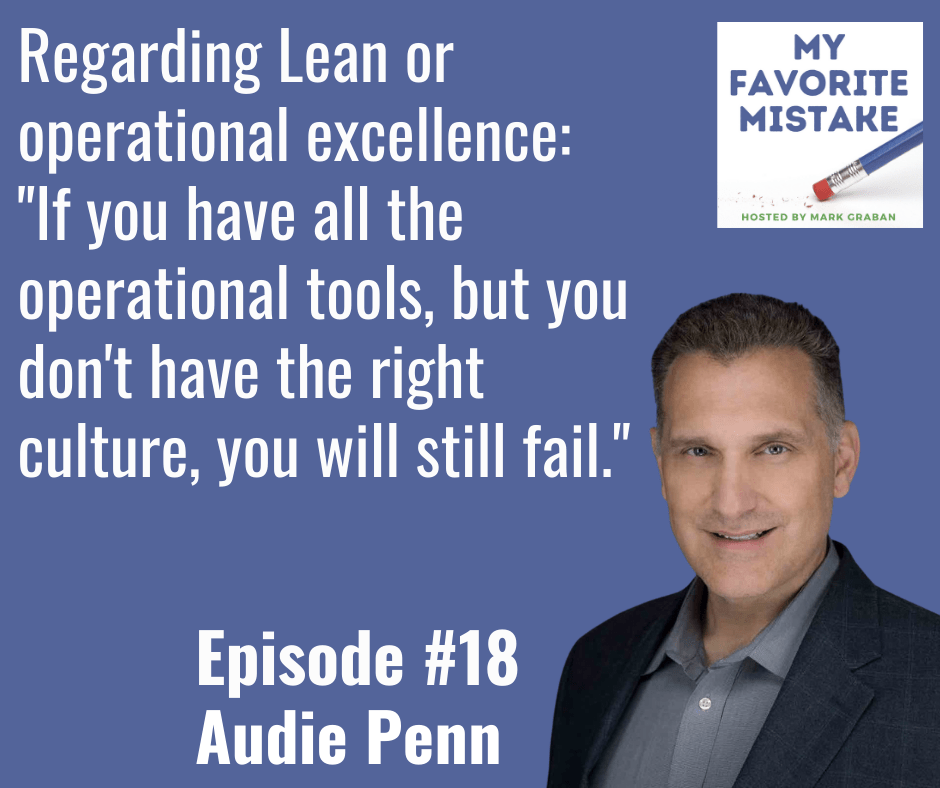
I've said for many years, without that culture, the best operational excellence or Lean deployment—you have all the operational tools, but you don't have the right culture—you will still fail. Some consultants focus on the leadership space and they don't understand the operational space. Again, it's wonderful to put it in place, but it's incomplete still. What I try to emphasize is we have to have the complete componentry in place if we actually want to achieve those significant promises of operational excellence.
Mark Graban: Again, our guest today is Audie Penn from his firm Audie Penn Consulting. And what is the website for your firm, Audie?
Audie Penn: It's audiepenn.com.
Mark Graban: We'll link to that in the show notes. Continuing the conversation a little bit, Audie, I know from some of the work you do and the approach that you share, there's a phrase you use that stands out to me because it seems really important when you talk about the “dignity of work.”
Audie Penn: That's really the connection to that culture that I'm referring to. A lot of the nomenclature that we hear in the recent past is that “high-performance culture,” but I think that can be confusing sometimes because it doesn't really help us understand what it takes to achieve it. For me, to truly understand and achieve that high-performance culture requires respecting every individual. Now that's one of the tenants of the Toyota Production System, one of the first foundational pieces. But as we build upon that respect for every individual, it means we are open to their ideas. We're inviting them into solving problems. We respect them no matter what culture they're from, no matter what they look like—everyone has value.
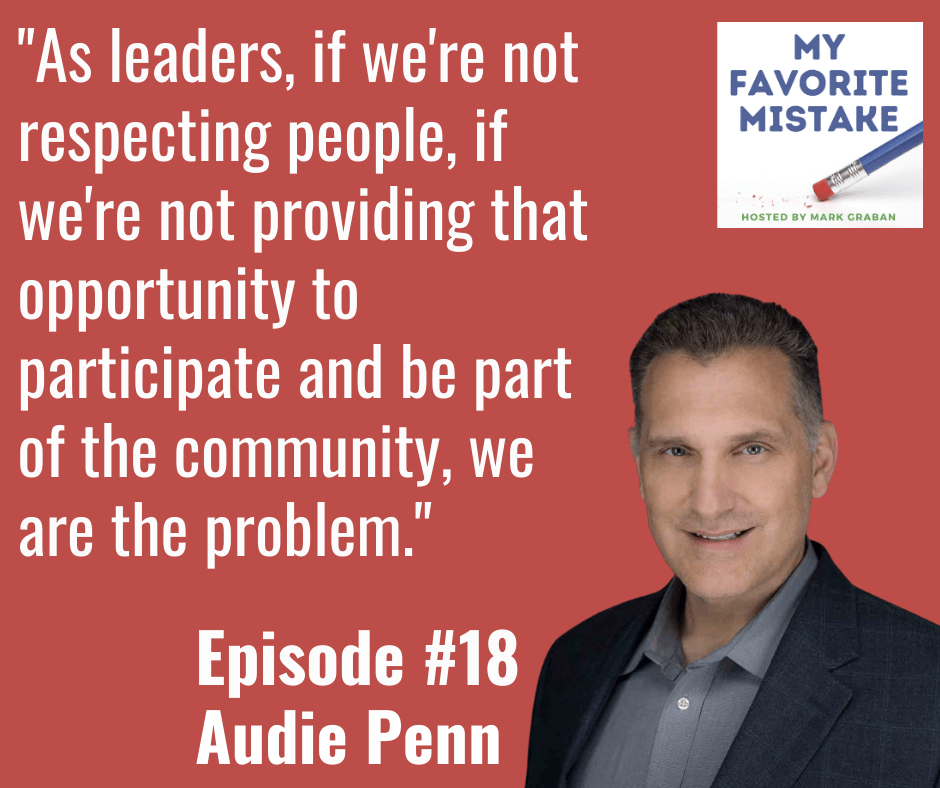
If we look at the dictionary definition of dignity, I think we're getting much closer to it. There's a certain level of respect that every individual deserves. And I think that's truly connected to this idea of dignity. As leaders, if we're not respecting people, if we're not providing that opportunity to participate and be part of the community, we are the problem. That's what I try to teach leaders. If you truly want to achieve that culture, then you have to see the people in your organization. You have to seek them out and encourage them to participate, and you have to learn to listen to them.
Mark Graban: What you've shared are some fairly specific manifestations of respect—not just saying we respect people, but translating that into actions. You touched on listening, engaging people, involving them. Tell us more about what this respect means. How do you coach leaders? Can they increase the level of respect they have, or is it more a matter of expressing that respect in different ways?
Audie Penn: I think part of it is showing that respect in different ways. There's also a piece there that I'm always looking for: the motivation that a leader shows up with. There are some subtle signals that tell me, “Are you motivated by serving yourself first? Or are you motivated by serving the organization and its mission?” That's one level of assessment that's going on for me all the time: a servant leader or not. Maybe there's a spectrum there.
There's a session that I do with leaders about making requests. What I try to teach them is a leader's role—and this is my opinion, and I teach it—is actually to establish clarity about outcomes. The simple language that I like to use is: “Here's what I want. Here's when I want it.” You can't add anything more of value as a leader. If you do, you start to actually dilute the value of the interaction. The next question is, “How can you help me achieve that?” That's the invitation for a group of people to actually come in and find a method to produce that outcome. Or as I teach, “Tell me why that outcome isn't realistic. Tell me why that timeframe isn't realistic and we'll make an adjustment.”
I have asked leaders this question: “If you're not establishing clarity about the outcome for your scope of responsibility, then who is?” The answer to that question is often shocking. They're very, very quiet for a few moments and they finally realize, “If I'm not doing it, no one is.” And that leads to the hesitation and the confusion that we experience in our processes. “I don't know what it is I'm supposed to be producing. I don't know how I will be evaluated as either successful or not.” Without that, I'm going to do the best I can, but I'm not sure what target it is I'm pursuing.
Mark Graban: I agree with what you're saying there. As much as we try to emphasize engaging the people who do the work and improving the work, leadership still has to help set the direction. But that doesn't mean that leaders have all the answers about how to execute in that direction. Tell us more about that dynamic.
Audie Penn: There's a couple of ideas that come to mind. One is, I think in the Western leadership space, there's this idea that a leader is supposed to have every answer for every problem for every person at all times. Quite frankly, that's just not sustainable. You can find some success in that thinking, but it is a recipe for overwhelm.
The other side of that equation is when we actually establish clarity as leaders, it gives us back a great amount of time. Why? Because we're spending so much time telling everyone how to do their job rather than helping those that truly need it. When we're able to see the full spectrum of the capabilities of our teams, we can show up where our teams need us.
One of my favorite questions is: “Why do we think we should tell everyone how to do their work?” I asked this to a group of executives at one point. And the one with the greatest voice in the group said, “Because we can.” That's exactly right, because most of our leaders come up through the organization and they've done it. But what we have to realize is that's not our role any longer. Our role is to establish clarity about outcomes, and then to evaluate the methods that our teams create to produce those outcomes.
Mark Graban: That's well said. Talking about how that role of a leader shifts, I'll put a link in the show notes to a video from a hospital in Indianapolis. My co-author, Joe Swartz, has a video of Rhonda, a pharmacy director who talks about the culture change as they engaged everyone in the pharmacy in problem solving and continuous improvement. Paraphrasing her, she says in the video something to the effect of, “I would not have believed how much time this now frees up for her as a leader.” She says instead of running to her with every problem, people now keep her informed. They'll come and say, “Rhonda, we have this problem earlier. Here's what we did about it.” So she's still involved. But what she said reminded me of what you were saying. Rhonda said that it now gave her time to be more strategic instead of just reacting to fires. She could actually think about the future of her department and of her team. And that seems like an element of what you were describing as setting those objectives, right?
Audie Penn: Absolutely. Yes. It's counterintuitive to most of us; we're simply not taught this different way. Language that I like to use is, “We don't know what we don't know.” And we need people like you and me to show up. I've got people like you and me in my own past that showed up, shared some new ideas with me, opened different doors and allowed me to then explore and experience these things for myself.
Mark Graban: I'm going to give a quick call back to Episode 17 of this series, Melanie Parish. She's the author of a book called The Experimental Leader. I think this would resonate with you, Audie. Melanie was talking about the need to shift from what we know—what we're certain about, because when we know something, we could be wrong—as opposed to going out and proving or disproving something in an experimental action.
Audie Penn: Absolutely.
Mark Graban: One other thing I wanted to ask you about, Audie. You talked earlier about how everybody in the workplace deserves respect, and I would agree with you. I think leaders need to give that respect to their employees, recognizing their employees want to do their best. Sometimes people will say—maybe it's different contexts—”respect is earned.” And I would think maybe that statement would be more true pointing them in the direction of leaders need to earn the respect of their employees, maybe while giving respect freely. What's your thought, Audie, about respect being deserved versus being earned and how and where does that apply?
Audie Penn: If we truly understand this idea of dignity, it's kind of a default. It's where we should start. The fact that we are human beings suggests there's a level of dignity that should be present no matter what. Through our choices, we can ruin the dignity that we deserve, but I don't know that we can actually start in a hole. I love your viewpoint that as leaders, we should consider that. We should be out there working to show respect and dignity to others so that we can get it back. I don't think it should start with the team members earning that dignity. That should be automatic.
Mark Graban: Sometimes people in leadership roles will demand respect. And it comes back to maybe your point: Why would they do that? Because they can, but that doesn't mean that's really the right approach.
Audie Penn: The language that shows up for me here is—and I express this in some of the work that I do—there's a difference between coercion and influence. When we understand those two differences, we can really start to see the difference in the leadership styles we choose and how those leadership styles are actually impacting the culture and the people around us.
Mark Graban: The leader who demands, quote unquote, “respect” makes us get compliance or subservience, which is not a path to organizational excellence. I'm guessing we would agree on that.
Audie Penn: Absolutely.
Mark Graban: Well, Audie, thank you so much for sharing your story, your reflections on that favorite mistake. I'm glad you bounced back and then some from that firing. Thanks for having the conversation on some of these other interesting questions of leadership and respect and dignity. Thank you for bringing that word dignity into the conversation.
Audie Penn: Thank you for your time. I appreciate it. And I enjoyed the conversation very much.
Mark Graban: Me too. Again, our guest has been Audie Penn, Audie Penn Consulting. You can find his website audiepenn.com and that'll all be linked in the show notes. Thanks again. Thanks for listening. I hope this podcast inspires you to pause and think about your own favorite mistake and how learning from mistakes shapes you personally and professionally. If you're a leader, what can you do to create a culture where it's safe for colleagues to talk openly about mistakes in the spirit of learning? Please subscribe, rate, and review the podcast. Our website is myfavoritemistakepodcast.com. See you next time.
This episode explores how solving problems without addressing culture and leadership dynamics can backfire. Audie Penn shares lessons on lean leadership, dignity of work, and why results alone are never enough.