
Kate Lowry — CEO coach, venture capitalist, and author of Unbreakable: How to Thrive Under Fear-Based Leaders — joins to share why reporting misconduct early in her career backfired, and what it taught her about the gap between good intentions and effective action. We get into how to recognize covert fear-based leadership, why psychological safety drives performance rather than softening it, and the practical tactics people can use when they're stuck under a leader who rules through fear.
Listen:
Check out all episodes on the My Favorite Mistake main page.
My guest for Episode #354 of the My Favorite Mistake podcast is Kate Lowry, a CEO coach, venture capitalist, and author of the book Unbreakable: How to Thrive Under Fear-Based Leaders. She developed her approach over decades across startups, venture capital, big tech, and management consulting.
Kate's favorite mistake happened early in her career, fresh out of college and working at McKinsey. She witnessed a colleague do something she believed was seriously wrong — something that could constitute blackmail, with the welfare of another employee hanging in the balance. Her instinct was immediate and absolute: this is wrong, and I'm going to tell everyone. She reported it and criticized the person sharply in reviews. It came back to bite her. She got marked down for not being a “team player,” and she carried that mark on her record through her remaining years at the firm.
The lesson Kate draws isn't that she should have stayed silent. It's that good intentions and zeal are not the same as effective action. The best ways to help people, she found, are often more sophisticated — and when you're dealing with sophisticated actors who have power over you, you need to bring equal sophistication. That insight runs through her coaching work today and through the practical tactics in her book.
In our conversation, we get into the difference between high standards and fear-based leadership, why psychological safety is about mutual trust rather than comfort, and how covert fear-based leadership — the polite, “West Coast nice” version — is harder to spot than the cartoonish yelling-and-throwing-things kind. Kate also explains her concept of clocking a leader's “emotional age” to predict their behavior, and she's candid about the lawsuit she has pending against a venture capital firm.
Themes and Questions:
- Kate's favorite mistake: speaking up about misconduct early in her career without understanding how the system would respond — Walk us through what you saw at McKinsey and what you did about it.
- The realization that workplaces are not designed to benefit the individual — When did you first understand that “HR is not here for me”?
- The gap between good intentions and effective action — You've said the best ways to help people are sometimes more sophisticated. What does that look like in practice?
- High standards versus fear-based leadership — How do you tell a demanding-but-compassionate leader apart from a fear-based one?
- Psychological safety as mutual trust, not comfort — Why do people confuse psychological safety with being soft?
- Covert fear-based leadership and “West Coast nice” — What are the quieter signals people miss?
- The cycle of fear: boss yells at manager, manager yells down the line — How much fear-based behavior is pathology versus learned survival?
- Reading a leader's “emotional age” to predict behavior — How does knowing someone's emotional age change how you work with them?
- Practical tactics for people who are stuck — What should someone do when they can't leave a fear-based environment yet?
- When a situation crosses from “leave” to “legally actionable” — How do you know when you've exhausted the internal paths?
Scroll down to find:
- Video version of the episode
- How to subscribe
- Quotes
- Full transcript
Find Kate on social media:
Watch the Episode:
Memorable Moments from the Conversation:
Click on an image for a larger view


Subscribe, Follow, Support, Rate, and Review!
Please follow, rate, and review via Apple Podcasts, Podchaser, or your favorite app—that helps others find this content, and you'll be sure to get future episodes as they are released.
Don't miss an episode! You can sign up to receive new episodes via email.
This podcast is part of the Lean Communicators network.

Other Ways to Subscribe or Follow — Apps & Email
Automated Transcript (May Contain Mistakes)
Introducing Kate Lowry and Unbreakable
Mark Graban: Hi, welcome to My Favorite Mistake. I'm your host, Mark Graban. Our guest today is Kate Lowry. She is, among other things, a CEO coach, a venture capitalist, and author of the book Unbreakable: How to Thrive Under Fear-Based Leaders. That title certainly caught my attention. It's a serious topic, and fear-based leadership is not something I'm a fan of, but I look forward to digging into what Kate has learned and what she shares with others in the book.
Kate developed this approach through decades of experience in different startups, venture capital, big tech, and management consulting. Her work focuses on helping people find agency and practical strategies when they're stuck under leaders who, I'll editorialize, unfortunately rule through fear and control.
Kate, welcome to the show. How are you?
Kate Lowry: Thank you so much for having me, Mark. It's great to be here.
Mark Graban: It's great to have you. The book has been out since last year. Congratulations on the launch, and I'm excited to discuss that topic. But first, as we do here, we'll see if this is related to experiences that you talk about in the book or otherwise. What's your favorite mistake?
The Favorite Mistake: Speaking Up at McKinsey
Kate Lowry: My favorite mistake was something early in my career. When I was fresh out of college, I was so gung-ho and happy, and also naive. What I did not understand is that most of the systems — the workplaces or hobbies or things that I was participating in — were not designed to benefit me.
For example, you join a company like McKinsey, and they invest tons of training and development in you, and that's great. College me would think, “Oh, they must care about me so much,” when really, consultants are the frontline product of a consulting firm. So R&D in you is R&D in their product, which is what earns them money.
Mark Graban: Sure.
Kate Lowry: Early on in my career at McKinsey, I saw the first time someone do something illegal at work. Being the very zealous young person I was, I immediately went, “This is wrong. I'm going to tell everyone that this is wrong.” I reported it to alumni, and I smashed this person in reviews and things like that.
Unsurprisingly, that definitely came back to bite me. I got slammed in reviews for not being a team player and things like that. You could debate how wrong what I saw was, but that was the first time that I really realized, “Oh, hey, HR is not here for me, and this company is not here for me.” If people do bad things in business sometimes, and they're a profit center, then no firm or hire on the ladder is going to help you when thinking about this. This is something that I had to deal with at a lot of different places in my career, and it was really hard to realize.
I had a teammate who was very upset — she was being mistreated, and I wanted to help her. That's when I started learning that the best ways to help people are sometimes more sophisticated. Because if people are going to be sophisticated actors against you, you need to bring equal sophistication up against them.
Mark Graban: I'm sorry to hear that. I'm not surprised, unfortunately — not because of the name McKinsey, but thinking of just large companies. One thing that resonates with me: I faced similar disappointment in adults. In my first job out of college, I didn't see things that would be a matter of illegal, but I saw things that were unsafe or unethical in different ways. I had that same reaction of, “Well, that's wrong and I should say something.” And yeah, that doesn't always work out.
Kate Lowry: I'm not a lawyer, so I can't say what's legal or illegal, but what I can say is that there are often things in these systems where people are very powerful that grate against people's values. It can be really hard. When you're a cog in a wheel, you don't know if you should make a fuss or not, but if you stay silent, it eats at you. That's a really tough position to be in.
Mark Graban: To me, a healthy culture would encourage people — they would say, “If in doubt, speak up. If you're not sure whether something is illegal or unethical, speak up, and there will be a non-punitive response if you were making a well-intended, candid report.” Are you at liberty to say what type of illegal act it was?
Kate Lowry: I observed someone threatening someone else in a way that could constitute blackmail, and the thing that was being held over the other person's head determined things like whether or not they could live in the country. Someone on my team was very upset about that. Again, I'm not a lawyer, so I can't say how illegal it was, but I can say that she was very upset.
What's so hard about being in these halls of power is that if you stay, you gain power that you can use yourself to be a positive influence. But to do that, you have to go through all of these hoops where people have power over you. At McKinsey, I had something like 20 managers, because you switch projects every two months. At that time, maybe 20% of the managers were people who really made your life miserable. It can be hard to know whether it's worth sticking around for that.
Now, in this era of fearless leadership where there's so much pressure for 996 and founder mode, it's generally quite hard, because all of a sudden it's like it's cool to be cruel. We're seeing people who are essentially saying, “Well, I'm big and powerful, so I have to do these X, Y, Z things, or else people won't respect me.” That's where I start getting concerned. I work with CEOs, I advise some plaintiffs, and I work with AI models, and so much of it is about being someone you like being — so that at the end of the day, you can go home and say, “I like and love myself, because I'm living my values.” That's becoming increasingly less common.
Does Cruelty Cause Success, or Coincide With It?
Mark Graban: There are some bad examples out there of leaders and people who are very successful, and some might draw an overly simplistic cause-and-effect connection: “That person is successful because they're cruel,” or “because they don't care about people,” or “because they're a sociopath.” Instead of looking and saying, “Well, maybe they're successful because they had a great idea and took action at the right moment. Maybe they would have been more successful not being a fear-based leader.” It's kind of an unknowable question to pose, but what are your thoughts around some of that?
Kate Lowry: I don't think it's unknowable. At McKinsey, I was trained in business best practices. At Meta, I was similarly trained. And the best HBR research from Harvard says that people do their best work when they feel safe. They do their best work when they feel like they're allowed to throw out big ideas and they won't get judged.
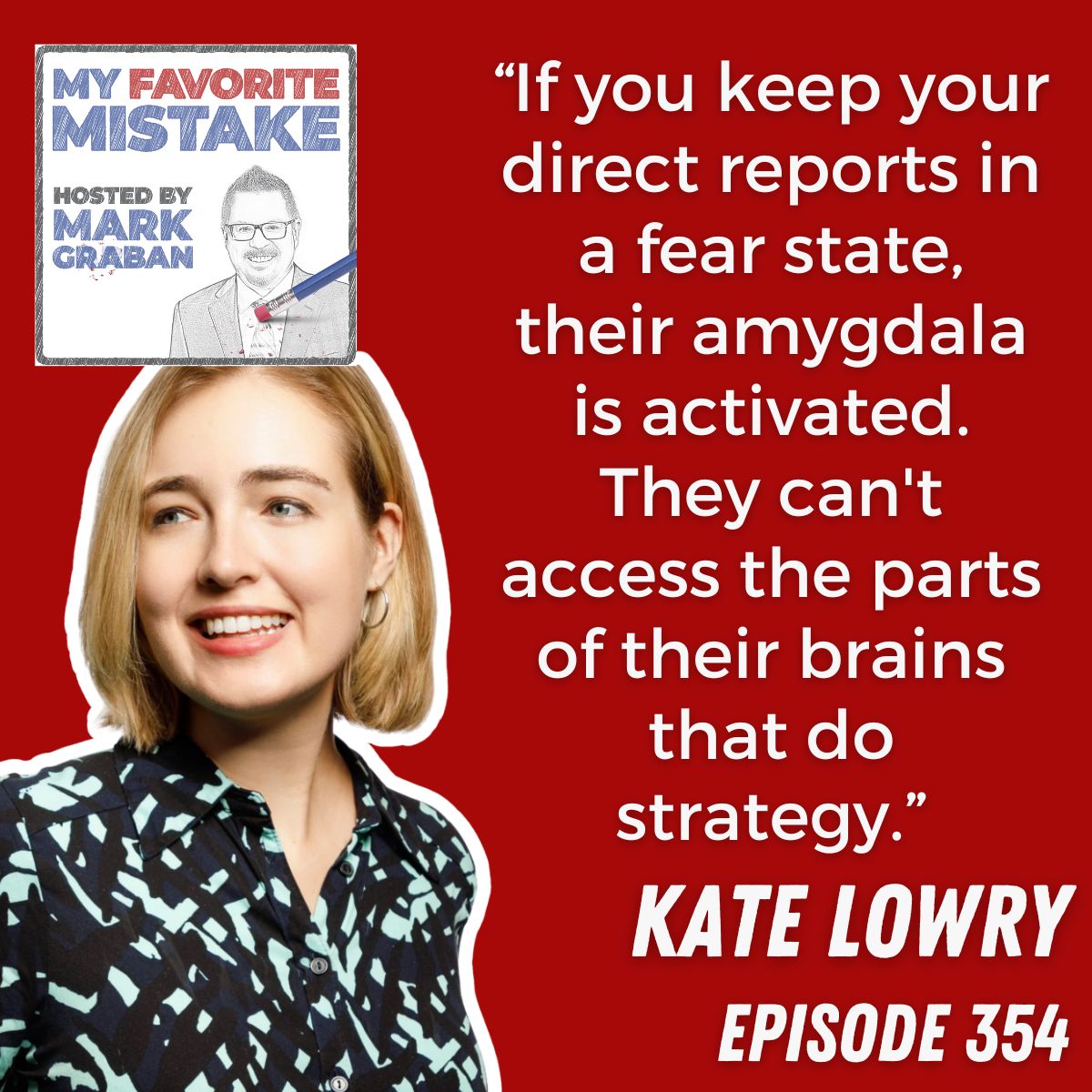
Fearless leadership really kills innovation, because if you keep your direct reports in a fear state, their amygdala is activated — it's called amygdala hijacking. They can't actually access the parts of their brains that do strategy and think about all this stuff.
Mark Graban: Feeling safe to speak up, feeling safe to disagree, feeling safe to report something that seems wrong — an environment of psychological safety doesn't mean no pressure. It doesn't mean we're sitting around eating ice cream all day and chilling out. I think sometimes people create this false connection between safety and comfort. They misunderstand what psychological safety is meant to be.
Kate Lowry: Psychological safety is not this soft, warm, fuzzy hug I'm going to give you at work. Psychological safety means that I trust you and you trust me, and we work together and collaborate because together we're greater than the sum of our parts.
If you're able to actually activate the potential of everyone at your company, that is a really huge deal. All of a sudden you have people performing at peak performance, rather than exhausted and burnt out and scared and wondering if they could be fired. I often tell my coaching clients, “I can't guarantee returns, because I can't guarantee you're going to take my advice.” But the average returns for founders in my coaching practice are something like a 10X return on fees within three months, because they have increased fundraising and close more deals. The reality is, when people are happy and supported and their very best selves, magical things happen.
Wrapping Up the McKinsey Story
Mark Graban: Before we talk about the book, maybe we should wrap up your story there at McKinsey. Not to put words in your mouth, but it sounds like you think, “Well, this was a mistake,” in the sense that it wasn't what you hoped it would be. I imagine you left before the punitive nature of things could harm you any more than it did.
Kate Lowry: I did end up leaving McKinsey after three years, which is pretty normal. But in my final year there, I was really scared, because my performance was extremely high — the teams I was on were telling me my performance was really high — but I essentially had a mark on my record. At McKinsey, if you finish as a business analyst or senior business analyst, you get what's called an offer to return. An offer to return means you can come back anytime in the next five years or so, and we'll give you your job back. Having that held over my head was hard, because with that comes conditional offers to pay for graduate school if you want to go.
So to say that I learned my lesson wouldn't be entirely true. To some extent, I became a team player, but I also learned how to play the games of the places I was sitting in. Every year I have been in workplaces, I get more reps. Now that I have a bunch of clients, I get reps at understanding behaviors from their lives as well as mine. But it's very hard. On my Substack, I had a piece come out last week called “They Will Harm You.” A lot of clients are very privileged, and sometimes when bad actors are trying to harm them, it takes me 30 minutes to convince them that the bad actors actually will be harmful — because they don't want to believe they're being pushed out of their companies, or that someone is trying to run a smear campaign against them.
I think McKinsey's a great company. I loved working there. I learned so much there. And at the same time, what I essentially learned is that in every ecosystem there are some bad actors, and that most ecosystems are not set up to handle that.
Why Profit Centers Get a Pass
Mark Graban: Like you said earlier, if there's a profit center — healthcare, unfortunately, is notorious for this. The top surgeon, clinically acclaimed, who treats people badly and creates an awful working environment. Hospital leaders often look the other way. This is a very well-known, consistent problem in healthcare, where that surgeon is acting in ways that harm other professionals and creating an environment where the patient is more likely to be harmed, and sometimes executives make excuses or just look the other way.
Kate Lowry: What I find is that these systems are about their own incentives. The closer someone is to creating profit for a company, the more behavior gets overlooked. If you're a star orthopedic surgeon, you can pretty much be an asshole to everyone in many contexts. You shouldn't be, but you can be. In tech companies, I see this particularly with the engineering and sales functions. If you're a star ML engineer, or if you're the highest-grossing salesperson, oftentimes behavior gets overlooked. In investing, it's the investors who have the biggest, best deals and the most prestigious companies. And so it goes. In pretty much every system, that's what it looks like, and it's deeply unfortunate. For many people, when they first encounter this, it's their first major, “Oh my God, life really isn't fair.” And it isn't fair.
Who the Book Is For
Mark Graban: Our guest again is Kate Lowry. The book is Unbreakable: How to Thrive Under Fear-Based Leaders. It sounds like the book is directed toward people who don't have a choice, or at least in the short term don't have a choice. They need to not just survive but thrive. But in your coaching, it seems unlikely that a fear-based leader is going to reach out to ask for help. They think they're great leaders. Does a board ever push somebody into coaching, or are you mostly working to help those who suffer under that fear-based leadership?
Kate Lowry: I tend to work with people in the ecosystems who have power in the ecosystem, because if I can shift their behavior, the environment gets better for everyone else. That's really important. However, to work with me, they have to demonstrate that they have at least a kernel of self-awareness and some interest in growing. Some leaders, I can't work with, because it's essentially become too late. They're surrounded by sycophants. They don't want to hear anything they don't want to hear. I'm essentially a sycophant blocker. If you are my coaching client, I will tell you, “Hey, that behavior's not okay, so you need to nip it in the bud.” Or, “Hey, that wasn't an ethical thing to do. We need to talk about that.” Or, “Hey, you're about to accidentally drive your company off a cliff. We have to talk about that.”
That draws certain types of people. I do have some clients who try to come in and bully me for certain things — “Give me all of these investor intros,” or, “I want all of your vendor connections. I only want that, and I want no coaching.” I tell them, “No, you have to be a coaching client, because if I'm going to vouch for you with my people, who are good people, you can't be a bull in a china shop. Get in line.”
Mark Graban: Or you'll turn them away. You have that choice.
Kate Lowry: Yeah. Being an independent coach is critical, because I can say to them, “I have no vested interest except that you are successful in the way that you define success.” And I'm nobody's man. I'm not paid by a venture fund. I'm not paid by a corporate player. I'm just there for them.
Mark Graban: One thing I thought about early in my career — the General Motors environment was absolutely a fear-based environment. I saw firsthand that style of leadership wasn't leading to good success. It wasn't even one of those situations where the environment was terrible but we performed well. Performance was terrible. Everything you described sounds true. People get scared, they stop speaking up, they start hiding problems instead of being able to solve problems.
One fear I had — I left that environment after two years to go to grad school — was, was there a danger of staying in that environment too long, to where it would start shaping me in ways that a young, naive, go-getter 21-year-old wouldn't want to recognize in a 30-year-old who had been shaped too much by that system? So I rejected it, I rebelled against it, I got out. But I was always thinking about some of these leaders who have been acting this way for 30 years. It's probably too late for them, but can we affect the next generation of leaders? Is there a better hope to affect the next generation of founders coming out of school, the next generation of CEOs, to help them see the research and the studies that point to what logically, rationally should be the choice of leadership style?
Hope for the Next Generation
Kate Lowry: What I can say is that it's never too late. I was once on a podcast interview where someone realized they were a fear-based leader while they were talking to me. I said to them, “Every day is the first day of the rest of your life.” All change starts with wanting to change, but it takes work.
I have so much hope for Gen Z. What I see is very polarizing. There are bad actors in Gen Z, but I also see a generation that is so much more awake. They see through what they would call corporate BS. They're much more inclined to start their own companies if they can't find companies that match their values. Many of them would rather make less money but be doing things they feel are ethically aligned with what they care about. That is really special, because it suggests to me that socio-emotional learning is happening, people are becoming more self-aware, and there's much more awareness around compassion, setting boundaries, and standing up for yourself. So every generation, I get more hopeful.
High Standards Versus Fear-Based Leadership
Mark Graban: Help us understand — when we think of characteristics or behaviors, some examples would help — distinguishing between a leader who is, let's just say, tough and demanding and hardworking and has high expectations, versus somebody who's fear-based.
Kate Lowry: Some of my employees might say that I have high standards. But there's a difference between high standards in a compassionate way, which says, “I see how much potential you have, and I know you can find great things. So every day I'm going to work with you, and we're going to raise the bar by five inches, because I know you can do it. I believe in you.”
That's totally different than a fear-based leader who says, “There's no such thing as equality. I'm either above you or you're above me. And so I'm going to step on you, and you better give me what I want.” People have different masks that overshadow this behavior, particularly in nonprofits or universities and admin roles. On the West Coast, it can be layered into “West Coast nice,” where people will say things like, “I'm just going to take the pen here on this project” — which means, “You're doing a terrible job, and I don't like it.”
If you find that after interacting with people you feel worse — you dread the meetings with your boss, you don't want to go to work on a Monday, when you have a one-on-one you come out feeling less competent than when you went in — that's a sign you're around someone who likely is using different types of control tactics. There are some very exceptional cases — sometimes it happens when someone very senior is stuck interfacing with someone very junior. But beyond cases like that, I really think people know in their gut when they're around people who aren't treating them well.
I was just talking to a client yesterday whose boss had been exploiting her and making her work two full-time jobs, only paying her for one. She knew in her gut that something was wrong, even though that boss was saying, “I care about you. You're the best. I could never do this without you.” She wasn't being treated well.
Covert Fear-Based Leadership
Mark Graban: The fear-based leadership that I was exposed to was almost cartoonishly obvious — direct threats, yelling, screaming, swearing, stomping your feet. Just cartoonishly overtly fear-driven, insulting, and demeaning. But I'd love to hear more about the polite fear-based leadership, the passive-aggressive kind. What I saw was just aggressive — aggressive or even manipulative fear-based leadership, where people might take a while to realize, “Oh, that person does not have my best interest at heart. They are using me. They are extracting work from me to my detriment. They're hanging fear over my head in a way that's destructive.”
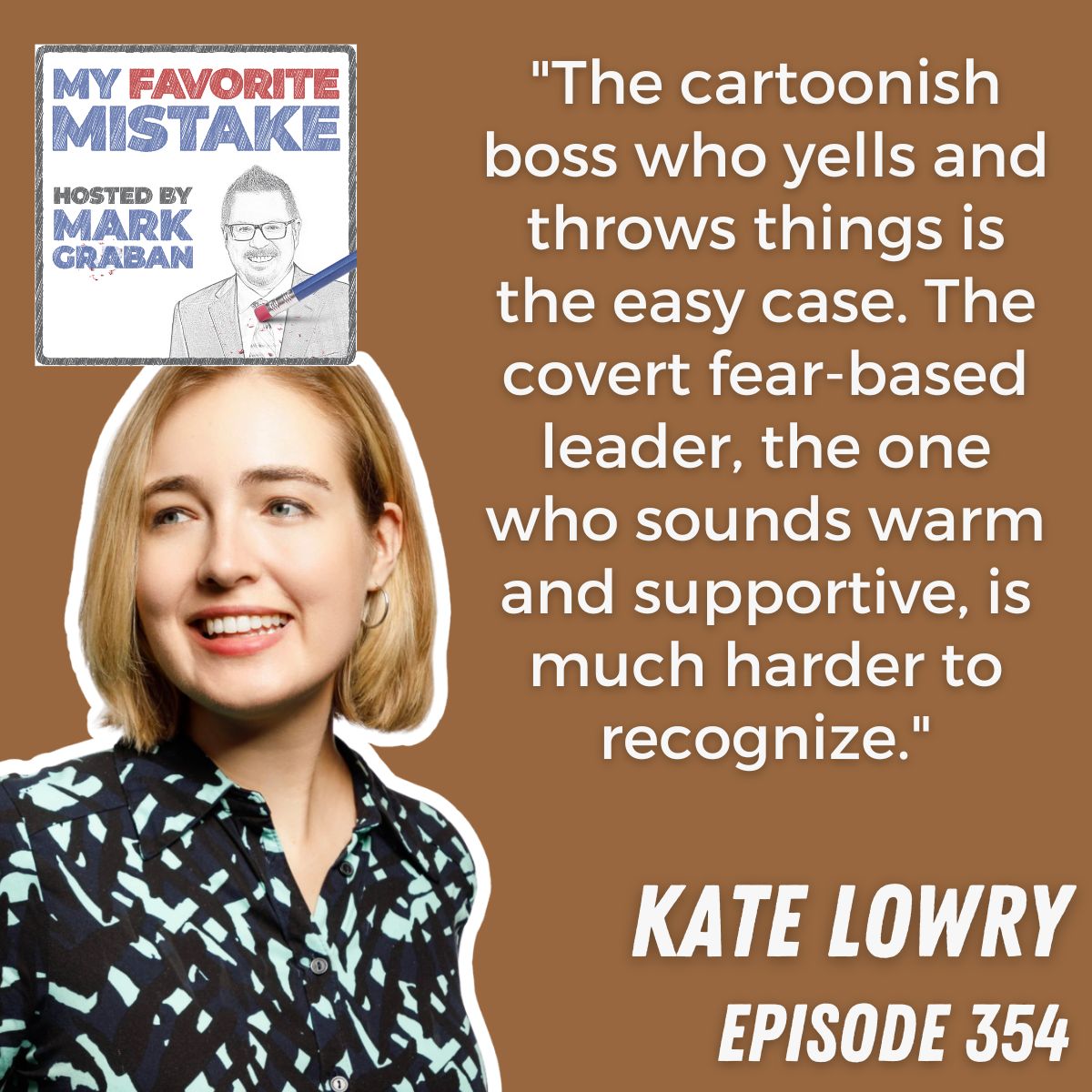
Kate Lowry: There are cartoonish figures, particularly in tech, where people have meetings where people yell and throw things, and that's very easy to recognize. But the second type, covert fear-based leadership, is harder to recognize. It is much more common with female fear-based leaders, where they might say things like, “This deck is totally worthless, but don't worry, I'm here for you. We're going to fix it.” Or they might say, “You remind me so much of my younger self. You have no confidence, and you'll never make it on your own. But if you follow what I do, I can help you get through this.”
Sometimes fear-based leaders like this — I have a friend who's stuck under a fear-based leader right now, and her boss goes on harangues about how they are collectively incompetent, can never do anything right, will never be able to do things the CFO wants, and so on. But I found that big tech is the quietest form of fear-based leadership. I used to work at Meta. We've seen Mark Zuckerberg saying the company needs more masculine energy, instituting 20% layoffs. Often you will have very subtle cues that you are not a culture fit, where people will say, “I'm just not sure that you're right for this project. Let me take it away from you.” That's how you're removing all your responsibilities.
In my case, I know several clients who have been pushed out — of startups or big tech companies — specifically because they either disclosed a disability, went on medical leave, or became a new parent. Oftentimes the messages are, “Oh, you're a parent now. We just don't want you to have too much on your plate,” while we're doing all the work that allows them to get promoted. Or, “You know what, we just don't need you here anymore.” It's very subtle, and the only way to pick up on it is by looking at the aggregate pattern. People will come to me and say, “I have a sense of unease. I feel like something's not right. I just got taken off five of the recurring meetings. I don't know why. How do I fix this?” Sometimes the answer is, you can't fix it if they don't want you there. So we're going to defend you as best we can, get you the most severance, help you get on protective unemployment, or take a leave, or do whatever it is that you need to do. But if people don't want you, you shouldn't stay in a place like that.
Are Fear-Based Leaders Acting in Bad Faith?
Mark Graban: The one thing I think is hard to figure out about fear-based leaders is they probably think they have good intentions, especially for the business. They might think fear drives performance — fear of being fired, fear of losing out on a promotion. They might think fear of punishment prevents mistakes. That's the hard thing to sort out. A fear-based leader might not be trying to actively harm others. They might not be a sociopath. They might just have gotten exposed to these models of fear-based leadership that they've started emulating, and they think, “We have to manage this way. That's the path.”
Kate Lowry: It's really hard. I bucket fear-based leaders into two categories. There are people who have very deep-seated insecurities — who have more actual pathology — who are fear-based leaders. And then there are people who are just copying what they see above them to try to survive. I talk about this some in my work at Insignia, the complaint that I filed, where allegedly I saw these patterns. In the TV show How I Met Your Mother, you see the cartoon where the boss yells at the man, who yells at the wife, who yells at the kid, who yells at the dog. There is a certain pattern where, when people at the very top shout and scream and pressure and lead by fear, the person below them goes, “Holy crap, I better go do that to the person below me.” Over time, it becomes embedded in the cultural norms, to the point where you can't separate who was like that to begin with and who just learned it.
Mark Graban: I'm having flashbacks to 30 years ago. The one leader in our factory who I would characterize as a bully — I thought he enjoyed being a bully. That's how it appeared. As I was getting ready to leave for grad school, I had nothing to lose. After seeing him put on a performance one day of yelling and screaming at one of the area production managers, I basically asked some form of the question, “Help me understand what happened and why you behaved that way.” I was open — like I was asking him to coach me. He very quickly traced it all the way up to the General Motors board of directors — probably six or seven levels up from him. He explained exactly what you did. He said, “Well, I'm only yelling at Todd because I got yelled at by Jack, and Jack got yelled at by so-and-so.” He didn't say, “I don't want to act this way,” but he very much excused it as, “This is how things are done here.”
Kate Lowry: I have so much empathy for that. I was raised in a family where both of my parents were fear-based leaders, and I was taught to be one. Take over the family dynasty — you're the daughter of a patriarch, learn how to be this way around other people. I tried that. I tried yelling at other people and being someone I didn't like being, and it was not for me. I realized that it does cause harm, and so I said, “Not for me.” Then I immediately did hundreds of hours of therapy, put myself in coaching, and read all the books. So to say that I have compassion for people who are fear-based leaders may be an understatement. Many of them have never known what it is to be safely loved unconditionally, and many of them don't know how to unconditionally love themselves.
I really have hope that they can be different, but most of them are not willing to go through the process of feeling remorse. Because if they realize the totality of the harm they've caused over a 50-year period of being in the workforce — that's rough. It's really, really rough. So most people shy away from that.
Practical Tactics for People Who Are Stuck
Mark Graban: I'm glad to hear you rebelled against that, rejected that, decided to break that cycle and forge a different path. But here you go bumping into it. I'm glad you're motivated to help people through the book and other things you do. If somebody is stuck in this kind of situation, you write that a lot of people's instinct is fight or flight — to fight back or to shut down — and you say both approaches are wrong. What do you recommend people do?
Kate Lowry: My book has something like 30 different tactics that you can try against fear-based leaders to preserve agency and autonomy. It's written having me battle-test them, both in elite halls of business, in families, and in community groups. One of the first things I say is that unsafe people don't deserve your whole self. You immediately need to be very mindful of the information that you share. Share the absolute minimum information about what you care about. Because if you say, “Oh my God, I'm so excited to go to my kid's Little League game on Friday,” they're going to make you work through the Little League game. If you say, “I can't wait to do this work initiative we've been working on for so long,” they'll kill the project.
Oftentimes that means that when you negotiate with them — in my book I call this negotiating with thieves — you have to approach them a different way, where you give them dummy initiatives that you want to be killed, and pick the one that you want to settle over. Same thing with resource expectations. If you need resourcing for your projects at work, you have to ask for twice as much as you want, because they will gleefully cut half of it to try to punish you.
People often don't understand that these leaders are very much motivated by attention. If you modulate your availability and how much attention you give them, it reasserts your leverage. Even just being offline for half a day because you're “offline” at the doctor or whatever can cause them to spiral and reassert that actually you have power over them.
Reading a Leader's Emotional Age
Mark Graban: You also write that fear-based leaders are actually very predictable once you understand their rules. What are some of the rules we need to be most mindful of?
Kate Lowry: Fear-based leaders are extremely predictable, but they essentially operate on a different radio channel than ethical people do. If we're on AM, they're on FM, and you have to figure out how to tune into their channel. One of the things I talk about is that if you can clock your executive's emotional age, you can then predict their behavior. Do they get bored in meetings and throw tantrums and have a very short attention span? Maybe they're an emotional two-year-old, which means you need to bring lots of snacks to your meetings, make them shorter, have lots of breaks, and have topics to distract them.
If you have a CEO who is — oops —
Mark Graban: Oh, we lost your video.
Kate Lowry: Let me try to turn it back on.
Mark Graban: Welcome back.
Kate Lowry: Sorry. If you have a CEO who is an emotional eight-year-old, they might be very obsessed with certain types of technology, or they have all these pet projects. Knowing what's really important to them does significantly matter, because if you know what motivates them, then you can predict what they're going to want and what they're going to need.
But in general, they will try to maximize the type of harm they can inflict. They want to assert that they're on a pedestal above you. If they don't feel dominant, they're going to try to step or press people down to make themselves feel dominant. There are ways to validate them that reinforce that you're respecting the hierarchy. And the way they see people is very one-dimensional. If you figure out how they view you — maybe they see you as the weak HR person, or they see you as the ally who executes for them — you can essentially play into those roles in ways that disguise what you actually do or what you actually care about.
Mark Graban: When you talk about that emotional age — I'm not going to name names, but I've heard a similar story from different people who had worked with a very famous CEO of multiple tech companies, who said he's basically a 12-year-old boy. Treat him that way, and expect him to act like a 12-year-old boy. He's about four times that age or more, but stunted apparently, at like a 12-year-old developmental level — but incredibly successful in spite of it. That's what's hard to figure out. I don't know if it goes into the category of “life's not fair” or just “life's complicated” — that sometimes people succeed in spite of themselves.
Kate Lowry: People so often don't realize that people's body ages don't often match their emotional age. For people who don't have strong, secure attachment figures as they're growing up, they often get stuck and don't fully mature. This is where you get statements like, “Oh my God, Steve is 80, but I swear he's just like a five-year-old.” Or, “This work project feels just like high school.” Being able to recognize that — I have a chart in my book that helps with that — means you can meet people where they're at. Some people have a body age of 50, but they don't have the emotional intelligence of a 50-year-old, so you need to act like they are younger than they are.
Mark Graban: You may luck out and work for somebody who is physically younger but, as people sometimes say, wise beyond their years. That's maybe a better workplace situation.
Kate Lowry: I get that a lot, where oftentimes with my clients — especially the other plaintiffs I help advise — I'm knocking heads for them, dealing with people who are 60, and saying, “No, I'm half your age, and I'm just as competent.” That's a different type of battle.
When a Situation Becomes Legally Actionable
Mark Graban: You mentioned it briefly — you have been writing and posting updates on your website, and there will be all sorts of links in the show notes to Kate's book and website and more. You have a lawsuit pending against a venture capital firm that alleges a pattern of fear-based leadership, discrimination, and retaliation. When does it cross a line from “this is a situation I need to just leave” to something that becomes legally actionable, or discriminatory, or hostile-work-environment level?
Kate Lowry: This is something I work on a lot with different clients who are stuck in power structures, whether it's that they have predatory investors or something else. What I can say is it's a very personal choice whether or not you take public action against someone. In my case, I felt like there were not enough role models in the industry calling out extra-legal behavior by very wealthy and powerful people. We're in an age where people need help. They need to know that it's possible to call out big players and hold them accountable, because we kind of have a cultural allergy to accountability right now.
For individuals who are struggling with this, what I would say is you have to show that you've exhausted internal paths. In my case, I did moderated feedback sessions with folks. I did advising with my skip level and my skip-level skip level, asking them for advice. I reported to HR. I asked to switch teams. I talked to HR again. I tried to settle privately. The public suit is really a culmination of three years of escalation, where I tried and tried and tried, and there was just no way to make it work.
For people who are in situations like that, I say, “If you're a whistleblower, come talk to me. I will help you regardless of whether you become a client of mine.” If you need help finding a reporter to talk to, if you need help finding a good lawyer, if you need help learning how to navigate these spaces where bad actors want to squash you — you're not alone. I heard from hundreds of tech workers after my suit came out, and they were all saying the same things: “My gosh, this happened to me too. I was scared to do anything.” Or, “I tried to do this, but I got stuck in arbitration.” Or, “I tried to do this, and the security threats got to be too much, and I just couldn't handle it.” It's genuinely hard, but sometimes people really do have to take a stand.
Mark Graban: There would be a lot of reasons for people to fear the repercussions — for their career, for their life, for their finances — to take that stand.
Kate Lowry: There are extreme consequences, which I live with daily, both professionally and personally. So I think it's not something that people should do lightly.
Closing Thoughts
Mark Graban: I appreciate you, Kate, for sharing your story, your stories, your book, and your efforts to help other people. Thank you for your leadership on an issue I think is critically important. The impact that fear-based leadership and related management or leadership dysfunctions have on people's lives is immense. The connections and research around bullying and bad work environments — not just having an impact on people's mental health, but on their physical health — is immense. Thank you for your leadership and for the visibility you're bringing to that issue. I certainly hope things work out for you, and for others listening because they're in a situation like that. I hope you're able to get yourself into a better situation, and that it inspires you to be a better leader. With that, Kate, I'll give you the last word.
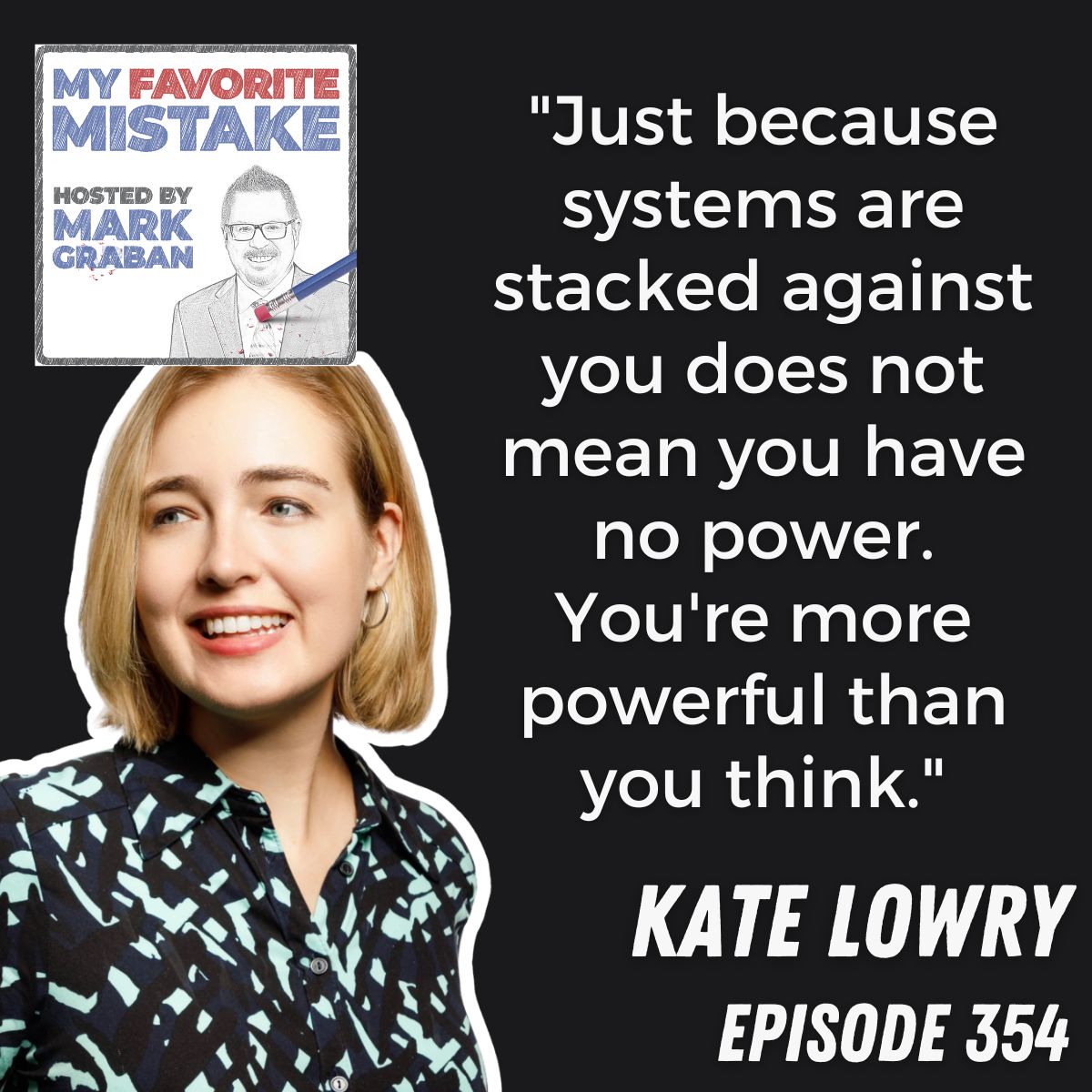
Kate Lowry: What I would say is, just because systems are stacked against you does not mean you have no power. You're more powerful than you think, and every person, including you, really matters.
Mark Graban: Thank you, Kate. Again, Kate Lowry — her website is katelowry.com. The book is Unbreakable: How to Thrive Under Fear-Based Leaders. Momentary interruptions — I'm glad that didn't throw you off. Kate, thank you so much for joining us and being a guest today. Best wishes to you.
Kate Lowry: Thank you so much for having me, Mark.