One simple question helped Jamie V. Parker unlearn years of command-and-control leadership—and finally reach a capable manager who felt overwhelmed, anxious, and stuck. In this episode, she shares the mistake that changed how she leads, coaches, and helps others improve.
Check out all episodes on the My Favorite Mistake main page.
My guest for Episode #8 of the My Favorite Mistake podcast is Jamie V. Parker, the founder of her consulting firm, Process Plus Results, where she is a trainer, speaker, and coach. She is also the host of a podcast called Lean Leadership for Ops Managers.
As many guests have said, Jamie shares her favorite mistake that she's made “so far.” She talks about working to change her leadership style away from the “command and control” approach that had been taught to her in the early stages of her leadership career. Jamie shares stories about a mistake she made in working to lead and coach others in a corporate setting. We'll learn the “question that changed everything” for her as a leader and how she eventually figured out how to get through to one manager who was really resistant to her coaching.
You can listen to or watch the episode below. A transcript also follows lower on this page.
Video Podcast:
Quotes:
Subscribe, Support, Rate, and Review!
Please subscribe, rate, and review the podcast — that helps others find this content and you'll be sure to get future episodes as they are released weekly.







Automated Transcript
Here is the cleaned-up transcript for the episode with Jamie V. Parker. I have removed the timestamps, stammers, and filler words, and corrected the spelling of “righting reflex” (which was phonetically transcribed as “writing”) to match the context.
Mark Graban: Episode 8, Jamie V. Parker, Process Plus Results Consulting.
Jamie V. Parker: I am a recovering command and control manager.
Mark Graban: I'm Mark Graban. This is My Favorite Mistake. In this podcast, you'll hear business leaders and other really interesting people talking about their favorite mistakes because we all make mistakes, but what matters is learning from our mistakes instead of repeating them over and over again. So this is the place for honest reflection and conversation, personal growth, and professional success. Visit our website at myfavoritemistakepodcast.com. Thanks for listening and now on with the show.
And we're joined today by Jamie V. Parker. She is the founder of her firm Process Plus Results. She's a number of things depending on the moment: a trainer, a speaker, coach, consultant, and author. She has written a chapter in an anthology book that I created and edited called Practicing Lean, so a great contribution to that book. And she has a new podcast called Lean Leadership for Ops Managers. So Jamie, thank you so much for being here today.
Jamie V. Parker: Thank you. I'm really excited to be here.
Mark Graban: And we'll have a chance to talk about some of your projects, including that new podcast, but we always like to jump right in with guests. So when you reflect on it, what would you say is your favorite mistake, Jamie?
Jamie V. Parker: So my favorite mistake, let's say so far, is actually a time when I made some poor choices in how I was leading a plant manager. So a little bit of background: I am a recovering command and control manager. I grew up in the days of just really command and control, authoritarian. It was bad. It was lawsuits and complaints, confidential alert lines. It was pretty rough. Starting in 2011, I really began this leadership transformation for myself and something that I was really proud of because I was making big changes in how I showed up as a leader and really who I was as a person.
This whole thing happened about five years into that transformation. So I wasn't that old command and control person anymore. I had started making a lot of changes and I had taken over a new territory. So I had this new team of plant managers. They weren't a new team; they were just new to me. And one plant manager in particular, I was really struggling with. The progress was so slow and the execution was so slow. Here we were a year later—he'd been on my team, I was his direct supervisor for a year—and it was still just not working. I was beyond frustrated, almost to the point of anger, and he was frustrated too.
He actually told me on that visit, about a year into this, “Jamie, you know what? I can't sleep before you visit my plant because I just have so much anxiety.” Because I was running plays across the country, I would only go there every couple of months. And he said, “I just have so much anxiety about you being here.” So it was not a good situation. And I didn't want to hear that at all. Of course, that didn't work for me. At the same time, we have a job to do. We've got to get work done. And the snail's pace business is just not working for me either. So I was banging my head against the wall.
I didn't know what to do, so I called a colleague, someone who knows both of us. They've got insights into both of our personalities and histories. I walked him through what was going on. He was asking a bunch of questions, doing all that good listening stuff. And then he summarized and he said, “All right, so Jamie, it sounds like you are not happy with the progress. Every time you visit, you're giving him more and more work that he needs to get fixed, because it's not fixing out at a rate that you're expecting. And you're scared to ease off a little bit. You're scared to maybe scale back, because you think that if you scale back, the pace is going to go even slower. But if you don't keep just really hammering things in with him, then you're not going to get any progress at all.”
And I said, “Yes, confidently. Yes, you're right. That's it.” And that's when he asked the question that changed everything. He said, “How's that working for you so far?” It was like, oh my gosh. It's in that moment that I realized I was doing this whole definition of insanity thing. I was continuing along this path—this path that was working in all of these other relationships—and expecting that something was going to change just because more time passed.
So that really was the lesson I needed to hear in that moment, that question to realize, “You know what, let me take a different approach.” So I immediately said, “Alright, I'm going to change this.” And when I went on plant visits, I would still see all the things that would drive me crazy. And when I stepped away, I would write them all down because I'm like, “Oh my goodness, this is so bad.” But I started to bite my tongue a little bit and not say as much or call out as much as I might have in the past. And I started making sure I was giving a little bit more positive reinforcement for the progress that was being made, even when I still maybe wasn't happy with the speed and the pace.
When I did my close out at the end of the visit, I went through this list of all the things and thought, “You know what, I'm just going to share really two priorities. Just going to share these two priorities.” And so I left with that. A couple of weeks later, we're talking every week. He said, “You know, Jamie, that was the best plant visit we've ever had. That was great.” I went back two months later after that visit. It was amazing. Night and day. Just the amount of stuff that they had done, the work that they were trying, the problems they were tackling. Just that shift in how I was showing up for him changed everything. And it was something that I was so resistant to do until my colleague challenged me with that question: “How's that working for you so far?”
Mark Graban: Yeah. Wow. So that's a great story. And there's a couple of different layers of that we can unpack. The one thing that came through, and tell me if I'm summarizing this correctly or not, is that you've kind of shifted in the approach from saying everything that was wrong, the laundry list of all the things that were not up to standard or things you wanted to fix, and instead saying, “Hey, here are the two top priorities.”
Jamie V. Parker: Yup, absolutely. Yup.
Mark Graban: And so did he elaborate on why? I mean, I guess I could guess, but why did he say that was more helpful to have that focus and to only hear about two things?
Jamie V. Parker: So the really interesting thing when I sat back and did this reflection—why is this working differently?—is that he never didn't know. So me pointing things out, the challenge wasn't that he didn't see them. He knew all of that stuff there. He just felt overwhelmed. He felt like, “Gosh, there's too much to tackle.” He felt like, “Maybe I don't actually agree with some of this. I know this is a company priority, but I've been doing this a long time. And I think my way's better.” So the issue wasn't that he didn't see it. So me bringing it to his attention wasn't helping the situation.
By just really prioritizing it, it allowed him to kind of feel confident about what would make a difference. So he wasn't afraid of “Will I disappoint? Will I do all this work, and then it doesn't get noticed because there's this other thing that takes attention away?” So that's how he was able to respond differently and not just work on those two priorities, but work on all of these other things too, because he saw them to begin with. He just needed some of that confidence and some of that fear to be taken away so that he could feel like, “Okay, I'm on the right path.” That's what was missing.
Mark Graban: And then, think of the power of a coach having—and I'm sure this colleague wasn't officially coaching, but maybe in the moment they were coaching—where they had the benefit of being a bit of an observer to the situation and asking that question. I think, is that a Dr. Phil question? I guess it depends on the accent and the tone, “How's that working out for you?” But that can be a wake-up call at times, right?
Jamie V. Parker: Absolutely. Yeah. And so definitely this person, this colleague that I called, was not in any sort of formal coach role, but it was a third party. It was somebody who could listen. He was using some good listening skills. He was asking good open questions. He was kind of sharing back: “So I think I heard right…” He was using those skills that we teach folks to do when they're coaching and being able to get outside of my head. Because one of the leadership lessons is that I had actually grown a little too cocky. I was a little too egotistical about all of this leadership progress that I had made and forgot that I need to continue to grow.
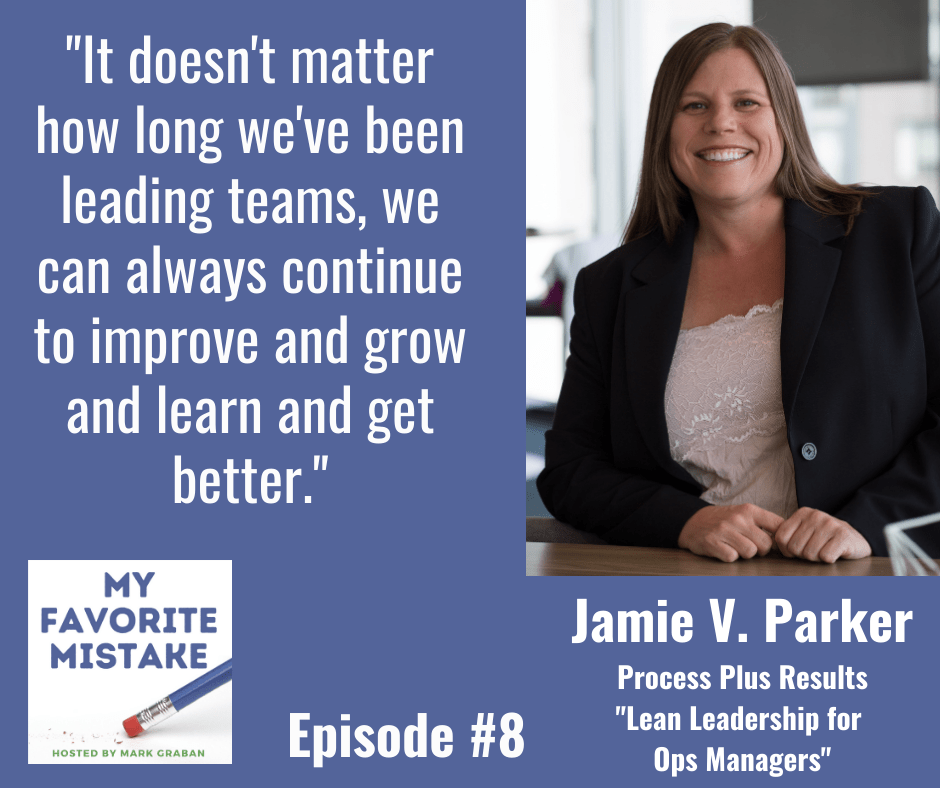
Because things were going so well in all of these other relationships and I was getting great positive feedback from all the other folks on my team, I kind of saw it as like, “Well, he's the problem. You know, he had a problem with his last boss, too. He's the issue, not me.” Realizing that it doesn't matter how long we've been leading teams, we can always continue to improve and grow and learn and get better. So that was also one of these pieces that I think that third party question helped.
Mark Graban: And it seems like it's one of those situations where breaking that cycle of frustration or shame or overwhelm or whatever that one plant manager was feeling… acting differently in your role as a leader helped change those dynamics to try to get some different, better results. And then, one of the themes we talk about here on My Favorite Mistake is applying those lessons to future situations. Can you think of ways, either directly or indirectly, that lesson has stayed with you to maybe head off a similar situation?
Jamie V. Parker: Yeah, absolutely. I actually have adopted that question “How's that working for you so far?” to be a provocative question that I use. I will sometimes use it with clients, but I really do use it a lot with self-management. And so, there are times when I may want a different outcome than I'm getting, but I'm feeling afraid, or I'm not taking action, or whatever's happening—I'm resistant in some way. And I've found that this question in particular—and there are other questions as well—but this one has been added to my list of when I am struggling with a bias for action. I'm unhappy with an outcome, and I have tasks that I could do—I've identified, “Here are some actions I could take, some experiments I could run”—and yet I'm not following through on them. Then this is one way that I use for self-management. And then also with clients too, because we all get into the space.
Mark Graban: Yeah. And we could all use a coach because sometimes we just don't see what's happening when we're in the middle of it. And I think back also, when you talk about the role of coach, and when I'm working as a consultant or a coach, I'm in a similar situation where you may know what the answer is, but that doesn't mean that being technically correct leads to others accepting that something is a problem to begin with or accepting that your “correct” solution is going to be acceptable to them. In recent years I've studied—I'm by no means an expert—but there's a branch of counseling from a clinical realm called motivational interviewing.
And one of the things they talk about in that approach is that I think what you were doing, and what I've been guilty of, is falling into something called the “righting reflex”—R-I-G-H-T. It's human nature to say, “That's wrong. You should do this.” I think especially when we're in a position of formal authority. So it's natural to do that. I think it kind of goes along the lines of not beating ourselves up for mistakes. And if this righting reflex is sort of innate human nature, we can be aware of it instead of blaming ourselves for it. And then there's that natural human reaction, what we often might call “pushback.” Like, “I was right. I told them what to do and they pushed back.” That's also not surprising human behavior, right?
Jamie V. Parker: Absolutely. And I think, you know, that “righting” thing… when I think about this conversation I was having with my colleague, when he kind of did that summary… now when I tell this story, I'm like, “Oh my gosh, I can't believe I was so confident in my ‘yes, exactly. Right. Like, yes, you nailed it.'” Because now that I'm removed and I see it in a different space, I'm like, “Oh my gosh, that doesn't sound very good.” And I think there's definitely some of that happening. And this colleague absolutely could have said, “Hey, Jamie, here's what I think you should do.” And I would have said, “No way. No way. I'm not doing that.”
Mark Graban: His righting reflex could have kicked in.
Jamie V. Parker: Yeah. But instead, he listened, he summarized, and he asked that really good question there that made me think. And now all of a sudden it was easy. It was in a split second. Like, I think I laughed, you know, in that uncomfortable laugh, but it was in that split [second]. I'm like, “I'm making a change. I'm doing this differently.” And up until that moment, I would have never considered taking that action. I would have said, “No, there's too much risk. That's going soft. That's too soft. We've got to hold people to standards.” It really was in that instant. But if he had said, “Hey, I think you should try this,” I wouldn't have done it. I would have pushed back and I would not have had a bias for action.
Mark Graban: And it seems like he asked a question that sparked your own thinking and reflection, when then you could then figure out “I'm going to try something different and see if I get different, better results.”
Jamie V. Parker: Absolutely. Yeah. Because once he asked that and I thought about it, I'm like, “Okay, there's really no downside.” Like I'm holding on to this… of creating this potential fear or risk. But really, you know what, there's really not a downside for trying something different here. And it's definitely not going to get better if I keep doing what I've been doing for the last year.
Mark Graban: Well, then the final thing I wanted to… if we're appealing back the onion, we're getting pretty close to the core of the onion. But early on, you used a phrase, “command and control leadership style.” And you had talked about even before the context of the story that you were already working to change those behaviors. And I'm sure there were some habits that got ingrained. So can you think back, when you entered the workplace, how was that command and control style sort of imprinted upon you in the workplace?
Jamie V. Parker: Yeah. You know, I mean, it was what I was seeing. How people were leading. And I can remember an instance as an example. This is like very beginning, I'm 21, 22, brand new in the workforce. And my manager at the time… we had a team member who had some major kind of performance… not performance like outcome, but things like showing up on time, calling in if you're going to be absent. Fundamental things. And this was in a company where, you know, it's a Fortune 100 company, lots of HR hoops to move through.
And my manager at the time was like, “Hey, I really want him to quit. And so I want you to see me, see how I do this.” And so I come into the office—I think I was like an assistant manager at the time, so I had some sort of potential reason to be there. And he's sitting across from this guy, sitting across the desk from this guy, and he starts the conversation. He says, “This is one of those conversations where I talk and you listen.” Well, I then used that when I became a manager and I started running my play at my locations, my stores. Because that's what I saw as, “Hey, this is a teaching moment.” And I did things like Friday afternoon 5:00 PM conference calls if you were red on the list, or if you were in the bottom quartile of the list.
Mark Graban: Punishment.
Jamie V. Parker: And you have to take the call from your office, which meant you weren't getting home until at least 6:30 at night. It was the incentive to get off the list. It was the incentive to get your performance up. Because I had sat in on those conference calls, I had been on them. And so then I started using them. It's just those kinds of things over and over again. And if that's what you experienced, that's what you understand it to be.
Mark Graban: Right. I think that's how corporate culture propagates, as people are taught how to manage. And sadly, I mean, when I started my career at General Motors in 1995, I saw a lot of behavior from leaders similar to what you were describing and maybe worse. And thankfully I worked with a second plant manager. The first plant manager is that very traditional command and control—yelling, screaming, blaming, punishing kind of leader. And then the second plant manager, thankfully had had the opportunity to go through that type of transformation in leadership styles because of getting to learn from Toyota, working for them and the joint venture GM Toyota plants.
So, it goes to show how important leader behavior is… when leaders lead by example, whether they're consciously doing so or not. And that maybe applies to, you know, to kind of come back to now more of the current day and some of the coaching work that you do and helping organizations transform… what are your thoughts on trying to help coach and shift executive leaders so that they're changing behavior, hopefully cascades?
Jamie V. Parker: Yeah. I think that, you know, one of the things that I hear a lot in the continuous improvement space is I hear a lot about, “Well, these managers and these execs, they care about profit over people and they just don't care.” And what I find is that, yeah, sometimes that's the case. Usually that's not the case. Usually they do care about people. They do care about improvement. They just don't know how. They've got these competing demands. You know, they've got to deliver results for shareholders, or sustain the long-term economic viability of the organization and contribute to our local economy. And so there's this pressure and they just don't know how to get both.
They don't know how to do it. And particularly like, even if they believe “I know in the long run this'll work,” but in the short term, “I've got to deliver for my customer. Like today, I've got to get work out for customers.” And so really that's kind of the work that I do: helping from the beliefs perspective. What do I believe? What do I think? What are my values? The behaviors, the skills, and also the systems—how can we make it easier to do these things and to make these things happen on a consistent basis?
Mark Graban: Yeah. So there's a lot of opportunities for both or for “plus.” So that's where the name of your firm Process Plus Results—it's not process OR results, right. Can you talk about how those two things work together? Process plus?
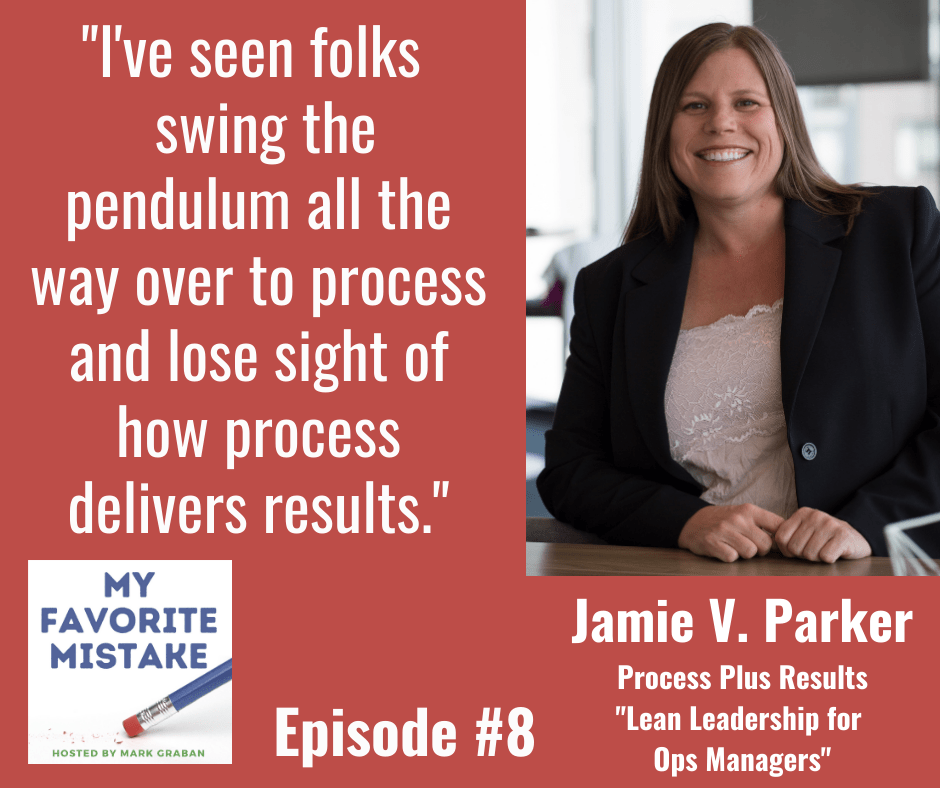
Jamie V. Parker: Yeah, absolutely. Because I think that I've seen folks kind of swing the pendulum all the way over to process and kind of lose sight of how process delivers results. And so, yes, we want to look at our processes because that's what's gonna help us generate consistency and sustainably over time, but we don't do it in a vacuum. We understand that we are here to create value and to enhance, enrich, and create more value. And what are the ways that… what do we need to achieve in order to do that? And then let's be more targeted. So it's, yes, I'm all about, “Hey, let's do some two-second lean or daily improvements or things where team members get to be engaged,” but let's not just do that.
Let's also look and be targeted. What does your organization need right now? And when we go and work on leadership development, we're not going to do it in a vacuum. We're not going to say, “Hey, let's go take the leadership development class off the shelf.” We're going to do it specifically within the context of impacting those results.
Mark Graban: Yeah. Yeah. And so you can find Jamie's website and learn more about her work: processplusresults.com. And that's all spelled out, not a plus sign, but the words processplusresults.com. And then one of those new initiatives you want to make sure podcast listeners learn about: a new podcast. If you can share, Jamie—Lean Leadership for Ops Managers—what the theme is, what the focus is, what makes your podcast unique?
Jamie V. Parker: Yeah, absolutely. So I'm super excited about this podcast. So it's called Lean Leadership for Ops Managers, which means we're talking about lean leadership for ops managers. And really kind of anything from that team lead to supervisor, to manager, to director. The people that are really in it every day. And I'm doing this because I have a special place in my heart for those folks. If we think about the impact that our operations leaders have, they generally are interacting with the most amount of people every day, team members every day, day in and day out. The people who are creating the value through product or service. And oftentimes these folks are the least invested in.
So the executive might have an executive coach. The senior director might be able to go to conferences and workshops. But the team lead, the supervisor, the plant manager, or a value stream manager is often not getting that development. And so this is a way for me to serve. It's super short. Typically an episode is around 15 minutes or so, because I'm looking for one lesson that you can apply, one next step you can apply. And there's a little bit of the technical of lean, but a lot of it is the people side of it. So not so much the technical side of, “You know, your gemba walking, what is your frequency? What is the agenda?” But how do you interact with people? The way that my colleague did to have an aha moment for me—how do you bring that into your gemba walks and your daily startup meetings and your one-on-ones and all of the things that are happening in your work as you lead your teams?
Mark Graban: Yeah, that's great. Well, I hope people will check that out. Again, Lean Leadership for Ops Managers. Our guest has been Jamie V. Parker. If you're watching on YouTube, you see the book over her shoulder on the bookshelf, and I'll hold it up here: this book, Practicing Lean. You can find it on Amazon. You can go also to practicinglean.com. And Jamie, I don't know if you know the latest, but since we've been donating all of the royalties from the book and the audio—you can find it on Audible—last month, we just hit the $5,000 threshold that's been donated to the Louise Batz Patient Safety Foundation. So Jamie, thank you for your contribution to the book and to the effort and to this cause. So thank you again for that. And thank you for being a guest on the podcast.
Jamie V. Parker: Thanks Mark. I really enjoyed it.
LinkedIn Post by Jamie
She really does a great job of summarizing what this podcast series is all about:
This episode examines a command-and-control leadership mistake and how one question transformed a leader’s approach to coaching. It offers practical lessons for lean leaders who want better results through better conversations.