

Another example of asking people to work around the design instead of improving it
I recently spent time in a hospital while a loved one was hospitalized. In situations like that, my attention is obviously focused on the patient and the clinical decisions being made (and what's been some disjointed and uncoordinated care across specialists).
But signs always catch my eye. I'm weird like that.
Especially signs that seem to reveal a recurring problem.
This one was posted directly beneath a fire-extinguisher cabinet:
PLEASE DO NOT
PLUG IN ANY
DEVICES IN FRONT
OF FIRE
EXTINGUISHER
And immediately below the sign was what seemed to be a perfectly usable electrical outlet.
The message appears to be: Please don’t use this conveniently located outlet for the purpose outlets are normally used for.
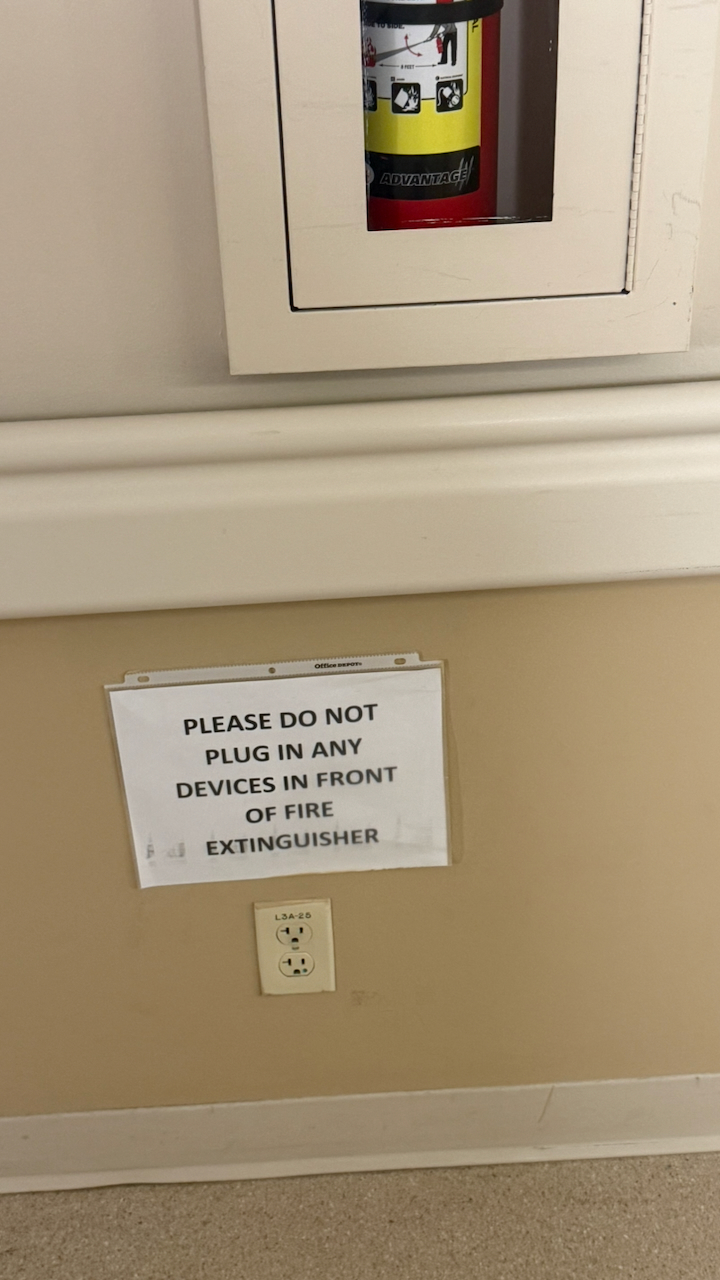
Directly below the sign was an electrical outlet.
My first reaction was: Why place an outlet there and then tell people not to use it?
But looking at the photo again, I think that may be the wrong interpretation.
The Outlet May Not Be the Problem
The real concern is probably not that someone plugs something into the outlet.
The concern is that a device, cart, charger, or other object might be placed on the floor directly in front of the fire extinguisher, obstructing access during an emergency.
That is a legitimate safety issue.
But the sign does not communicate it very clearly.
It says not to “plug in any devices in front of” the extinguisher. That wording leaves several questions:
- Is the outlet itself off-limits?
- Is it acceptable to plug in a device located several feet away?
- Is the problem the cord, the device, or anything occupying the space?
- How much clearance needs to remain?
The sign seems to describe one way the problem might occur rather than stating the actual safety requirement.
Say What Needs to Stay True
A clearer sign might simply say:
DO NOT BLOCK ACCESS TO FIRE EXTINGUISHER
Or:
KEEP THIS AREA CLEAR
That wording focuses on the condition that matters.
It would apply whether the obstruction came from:
- a medical device,
- a cleaning cart,
- a chair,
- a box,
- a power cord,
- or something else entirely.
That is an important distinction in process design.
When we write instructions around one anticipated behavior, people may comply with the literal instruction while still creating the underlying hazard.
Someone could avoid using the outlet and still park a cart in front of the extinguisher.
Someone else could use the outlet without blocking anything.
The better standard is not “don’t plug something in here.”
It is “maintain unobstructed access to the fire extinguisher.”
The Physical Environment Still Matters
A better sign would improve clarity, but it would still be a sign.
The hospital could also make the protected space more visible with floor markings, wall markings, or a clearly defined keep-clear zone.
That would help answer the practical question:
How much space needs to remain open?
A visual boundary is often more useful than a paragraph because it shows the required condition at a glance.
The outlet itself may still be perfectly reasonable. Staff might need it for temporary equipment, maintenance work, or cleaning devices. There may be no reason to remove or cover it.
The better question is whether the environment makes it obvious where equipment can be placed without interfering with emergency access.
Signs Often Reveal the History of a Problem
A sign like this usually exists because something happened.
Perhaps someone placed a device in front of the extinguisher. Perhaps it happened repeatedly. Someone recognized the risk and responded by printing a warning.
That is better than ignoring the problem.
But the wording matters.
Good visual management should make the expected condition easy to understand. It should not require people to infer the real rule from an awkwardly worded instruction.
This sign seems to be saying:
Don’t do the particular thing we saw someone do.
A stronger message would be:
Keep emergency equipment accessible at all times.
The first is a reaction to one incident.
The second defines the condition the system needs to maintain.
That is a more useful distinction than arguing over whether the outlet should be there at all.